
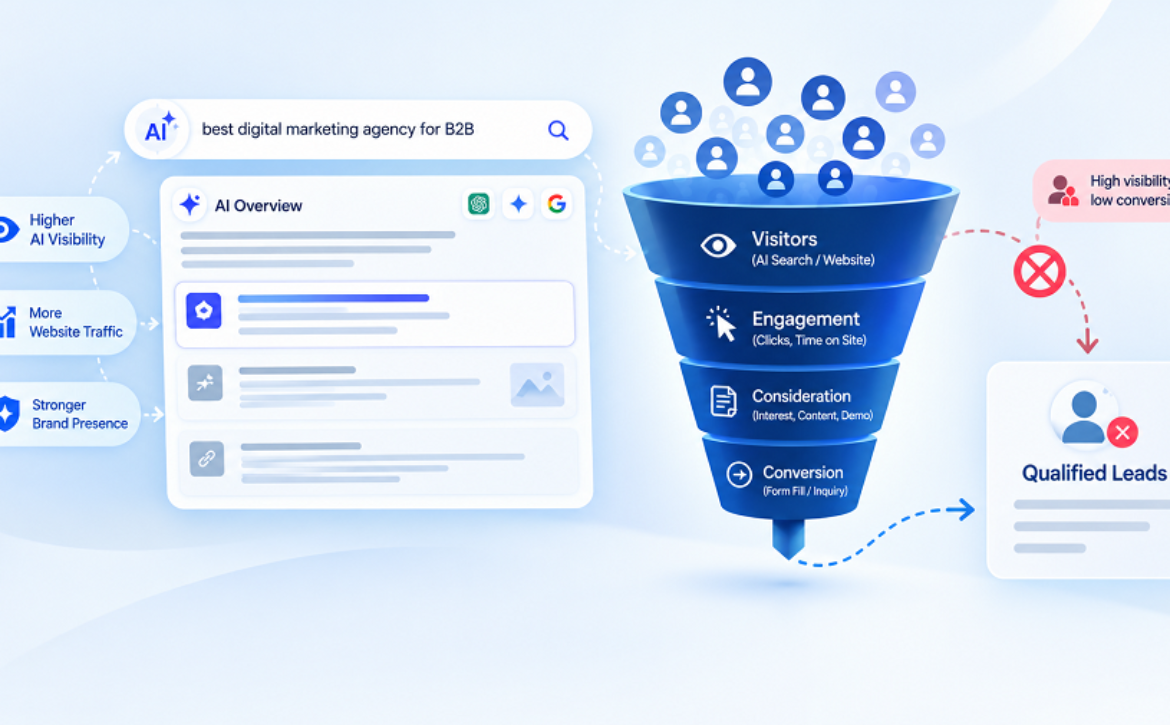
Why AI Search Visibility Isn’t Turning into Qualified Leads

Every digital marketer and business owner seems focused on the exact same target right now: getting featured inside generative search platforms. Whether it’s Perplexity, ChatGPT Search, or Google’s AI Overviews, appearing inside a synthesized answer feels like taking the top spot on traditional search results.

Yet, many brands hit a frustrating wall after earning strong AI search visibility. Their company name gets cited, praised, and recommended across multiple generative platforms. But when they check their CRM, the sales pipeline stays completely quiet. Inquiries don’t come in, contact forms sit empty, and sales teams wait for inbound calls that never materialize.

Why does a surge in generative mentions fail to deliver qualified leads from AI search? Getting recommended by an algorithm is only half of the battle. Converting that citation into actual revenue demands a totally different approach to content, authority, and lead capture.


The AI Search Paradox – Mentions Without Traffic  

———————–

In classic organic SEO, ranking well directly drives website visits. Someone types a question into Google, sees your link, clicks through, and lands on your site. Simple enough.

GEO (Generative Engine Optimization) completely flips that model upside down. Generative engines scrape information across dozens of web pages simultaneously, synthesize the data, and deliver a clean, direct answer right inside the chat window. They don’t act as a signpost pointing to your site. They act as the final destination.

When a user gets a complete answer without ever leaving the search interface, why would they bother clicking an outbound link? That’s the trap. Your overall AI search traffic projections might look solid on paper, but your actual site visits stay at zero. And when brand mentions don’t push people toward your website, your overall AI search performance collapses right at the bottom of the funnel.


5 Clear Reasons Your AI Mentions Are Flapping  

———————–

If your brand keeps showing up in generative answers but your sales pipeline isn’t growing, one of these five friction points is usually to blame-

  1. You’re Answering Everything in the Preview  

Old-school blog posts used teasers to pull people in. AI tools do the exact opposite. They grab your core takeaways, package them into neat little bullets, and hand them to the user. If your article only contains basic advice or surface-level definitions, the AI answers the prompt completely. The user gets what they need, closes the tab, and moves on with their day.

  1. Your Brand Voice Gets Stripped Away  

Generative tools extract raw data points and facts, leaving behind the personality that actually builds trust. Readers absorb the information without remembering who provided it. If your content lacks a bold point of view, original frameworks, or distinct phrasing, your business just becomes another nameless source in an AI summary.

  1. You’re Catching Researchers, Not Buyers  

Generative platforms spend a lot of time answering broad, top-of-funnel questions. If your citations come from high-level educational queries rather than commercial comparison searches, the person reading the answer isn’t in a buying mood anyway. Broad research mentions rarely turn into high-value AI-generated leads.

  1. Your Third-Party Footprint Is Spotty  

AI search engines don’t rely solely on your website. They crawl review boards, industry forums, news outlets, and social channels. If your brand presence outside your main site is thin, inactive, or full of mixed feedback, the AI won’t recommend your product with much buying confidence.

  1. Mismatched Destination Pages  

Let’s say a user actually clicks your source link. What do they see? If they get sent to a generic homepage or a broad service overview that doesn’t immediately match the specific detail cited in the AI answer, they bounce. Mismatched context kills conversion rates on the spot.


How to Align AI Visibility with Real Buyer Intent  

———————–

If you want actual revenue from generative engines, stop chasing vanity impressions. Shift your strategy toward high-intent conversion pathways and targeted commercial queries through deliberate AI search optimization.

Here is how you actually bridge the gap- 

Publish Proprietary Data Nobody Else Has  

Generative engines love citing unique numbers, original survey findings, and proprietary benchmarks. When you publish original research that can’t be found anywhere else on the web, AI answers are forced to link back to you as the primary source. Anyone who wants to see the full methodology or raw data has to click through to your site.

Target Commercial, Decision-Stage Questions  

Stop writing just for basic high-level terms like “marketing strategy”. Focus on hyper-specific evaluation queries – for instance, “What are the best marketing automation platforms for mid-sized SaaS companies integrated with Salesforce?” Optimizing for specific commercial intent boosts your AI search conversion rates significantly.

Create Brand Sentiment Across the Web  

Because generative models search the entire internet for truthfulness, you need to establish your authority far beyond your own blog. Active forum discussions, recent press releases, updated review profiles and guest articles are what these platforms are looking for in the digital paper trail. External sentiment directly influences AI visibility for business.

Provide Interactive Value Additions  

AI summaries give away standard text for free. So, your landing pages need to give something a text summary can’t. Consider interactive calculators, downloadable templates, or free audit tools. A great reason for a visitor to give you their email turns a passive click into a real sales conversation.

Modern Framework for Content Optimization  

Modern growth teams use a multi-tiered framework that balances technical structure, content depth, and conversion mechanics to systematically turn visibility into revenue. Rather than treating content as a simple blog feed, this model aligns four core strategic pillars-

  • First off, building a technical authority is all about schema markup and entity structuring. Adding nested Organization, Product, and HowTo JSON-LD schema throughout your site gives AI engines structured data that increases the accuracy and frequency of your brand mentions.
  • Second, Information Density is built on proprietary insights and original data. Publishing first-party research reports and expert interviews and unique operational frameworks creates unique value for search engines to cite, directly driving high-intent source clicks back to your domain.
  • Third, growing your Digital Ecosystem is all about multi-channel sentiment and review management. Managing your presence on G2, Trustpilot, Reddit and other high-quality niche publications increase recommendation confidence for AI platforms.
  • Finally, opening Conversion Pathways combines intent-matched calls to action with gated tools. Offering specialized templates, ROI calculators, or tailored audits on your landing pages converts passive inbound AI referral traffic directly into active sales pipelines.


A Hands-on Execution Plan to Increase Revenue  

———————–

In terms of turning generative mentions into closed deals, there are a few layers that matter – technology, content strategy, landing page design, etc.

Technical Setup- For a smooth and precise brand credit, deploy nested Organization, Product, and HowTo JSON-LD schema on your site so AI crawlers can parse it easily.

More Depth- Cut generic fluff. Encourage in-depth case studies, original research and unique frameworks that will draw readers to click through to learn more.

Ecosystem Management- Make sure you optimize your profiles on review sites, Reddit, and industry platforms to give positive and stable information for the AI models.

Conversion Paths- An optimized landing page with tools, ROI calculators or templates to generate inbound referral traffic.


Turning Generative Discovery into Closed Deals   

———————–

Unlocking consistent qualified leads from AI search means viewing generative search engines as early touchpoints in a longer customer journey, rather than a single-click sales channel.

Review your existing AI search marketing assets and ask yourself these questions-

  • Is the landing page consistent with the citation? When an AI comment is showing support for your specific framework, make sure the target page prominently displays that specific framework.
  • Are you providing value immediately? Give visitors simple answers as soon as they land, then give them more advanced tools – such as customizable templates or quick audits – to naturally capture their details.
  • Is retargeting enabled for you? Many users will read an AI summary long before they are ready to buy. Running retargeting campaigns on platforms like LinkedIn helps to keep your brand front and center as they consider their options.    


Conclusion

For long-term ai search visibility, align your overall strategy with the demands of GEO and the way people search today. But being mentioned is not the finish line, it is only the starting line.

This is where real business growth happens – technical visibility and deep, value-driven conversion pathways. Publishing original data, keeping your web presence sharp across all channels, and building intent-driven landing pages can turn passive generative mentions into a reliable pipeline for real sales.

Read More
Sanju October 6, 2026 0 Comments

Generative Engine Optimization (GEO): How to Rank in AI-Driven Search Results

Search isn’t just about blue links anymore.

2026 — People are engaging more and more with AI-powered search experiences that produce direct answers, summaries, comparisons, and buying advice. Utilities such as Google’s AI Overviews, conversational assistants, and generative discovery engines have reshaped the way content is surfaced and consumed.

Let me introduce you to Generative Engine Optimization (GEO).

If traditional SEO was about ranking webpages, GEO is about becoming the source AI systems rely on, cite, summarize, and recommend.

This deep-dive guide breaks down what Generative Engine Optimization is, how it plans out with traditional SEO, and the blueprint for how you can organize your content strategy to dominate the AI-driven SERPs in 2026 and beyond.


What Is Generative Engine Optimization?

——————————

Generative Engine Optimization (GEO) is the practice of optimizing digital content so it is:

  1. Referenced in AI-generated answers
  2. Quoted or summarized by AI search systems
  3. Cited as a trusted source
  4. Recommended in conversational search

While traditional SEO tries to rank web pages in SERPs, GEO involves being the source of knowledge behind AI responses.

In AI-powered search, users might not even have to click a link. Instead, they get:

  • A synthesized answer
  • A step-by-step explanation
  • A comparison table
  • A buying recommendation
  • A summarized guide

If the content fuels that response, you win — even if you’re not in position #1 of classic search results.


Why GEO Matters in 2026

——————————

In 2026, search and discover is dramatically different:

  • Zero-click searches are dominant
  • Users expect conversational, contextual answers
  • AI tools pull together knowledge from many domains
  • Trust, credibility, and structure are more important than ever.

Search engines using AI are seasoned to:

  • Detect authoritative sources
  • Extracting structured and semantically enriched content
  • Extract definitions, processes, and data
  • Prioritize clarity and topical depth

If your content is thin, out-of-date, or stuffed with keywords, it won’t be selected for AI results.

GEO rewards:

  • Expertise
  • Topical authority
  • Clear structure
  • Contextual completeness

GEO vs Traditional SEO: What is the Difference?

——————————

Traditional SEO

Generative Engine Optimization

Focus on rankings Focus on AI citations and inclusion
Keyword density Semantic coverage
Backlinks Authority + trust signals
Meta tags Structured, answer-ready content
Click-through rate Answer inclusion & brand visibility

Traditional SEO is still important. But GEO adds another twist: machine interpretation and authority reconciliation.

Indeed, in 2026, the top brands are a mix of:

  • Technical SEO
  • Topical authority building
  • Entity optimization
  • Structured data
  • Expert positioning

How AI-Driven Search Actually Works

——————————

In order to cater to SEO, you might want to know how content is being judged by AI engines.

AI systems:

  • Crawl and index high-quality content
  • Identify entities and relationships
  • Evaluate authority signals
  • Extract structured insights
  • Generate synthesized answers

They look for:

  • Clear definitions
  • Step-by-step frameworks
  • Comparison data
  • FAQs
  • Statistics
  • Expert opinions
  • Contextual depth

The more structured your content is, the more we can use it for AI summarization.


12 Proven Tactics to Rank in AI-Powered Search Results (GEO Framework)

——————————

1. Building Topical Authority, Not Just Articles

AI favors domain-level expertise.

Instead of releasing disparate blog posts, assemble content clusters by topic.

For example:

If you’re a PrestaShop optimization niche writer, don’t just write meta tags. Create clusters around:

  1. Technical SEO
  2. Core Web Vitals
  3. Schema markup
  4. Product optimization
  5. Payment restrictions
  6. Checkout UX

As time goes on, AI recognizes you as an expert in that subject.


2. Write Definition-First Sections

AI frequently extracts definition paragraphs.

Each major section should start with a short, explicit definition.

Example structure:

What Is Generative Engine Optimization?

Short, precise 2–3 sentence explanation.

This means AI is more likely to grab your explanation verbatim.


3. Replace Keyword Stuffing with Semantic Depth

It is already 2026, and keyword density is a thing of the past.

AI evaluates semantic coverage. That means covering:

  1. Related concepts
  2. Synonyms
  3. Contextual subtopics
  4. Entities
  5. Real-world applications

For instance, if working towards the goal of GEO, target-related like:

  1. AI search
  2. Generative search
  3. Zero-click results
  4. Conversational search
  5. AI Overviews
  6. Entity optimization

Depth signals expertise.


4. Structure Content for Machine Extraction

AI prefers:

  • Bullet points
  • Numbered lists
  • Tables
  • Clear headings (H2, H3)
  • FAQ sections

Avoid:

  • Long unstructured paragraphs
  • Fluff
  • Vague statements

Clarity improves extraction.


5. Optimize for Entities

Entity recognition is the power behind AI engines.

An entity can be:

  • A brand
  • A person
  • A product
  • A technology
  • A concept

To improve GEO:

  • Clearly define entities
  • Link related concepts
  • Maintain consistency in terminology
  • Build a strong brand footprint

Put yourself in a recognized group—e.g., an experienced seo expert prestashop — create high-level, technically correct content on a regular basis, and AI systems will attach your name or brand to that expertise bubble.

That association with the entity becomes strong in the generated outputs.


6. Add Expert Signals

AI systems evaluate expertise through:

  • Author bios
  • Experience depth
  • Case studies
  • Real-world examples
  • Data-backed insights

Don’t write generic content.

Write from:

  • Experience
  • Practical implementation
  • Tested frameworks

Include:

  • Results achieved
  • Before-and-after comparisons
  • Performance metrics

Original insight increases inclusion probability.


7. Update Content Frequently

AI systems prioritize:

  • Fresh data
  • Recent examples
  • Updated frameworks

Stale content is hardly found in AI summaries in 2026.

Add:

  • “Updated for 2026” insights
  • Recent industry changes
  • Algorithm evolution
  • New platform features

Freshness equals relevance.


8. Create AI-Friendly FAQs

Sections of FAQ greatly improve AI extraction.

Include:

  • Clear questions
  • Concise answers (50–100 words)
  • Direct explanations

Example:

Is GEO replacing SEO?

No. GEO complements SEO. Of course, established rankings still count, but AI inclusions are offering more visibility outside of SERPs.

Notice that the AIs are very fond of Q&A formatting.


9. Strengthen Brand Authority Signals

AI models prefer recognizable brands.

Strengthen:

  1. Branded searches
  2. Consistent publishing
  3. Industry mentions
  4. Guest contributions
  5. Thought leadership

If you consistently publish advanced PrestaShop SEO frameworks and position yourself as a trusted seo expert prestashop, AI engines will learn to associate your entity with authority in that vertical.

Authority is cumulative.


10. Trust in Focus (E-E-A-T in the AI Era)

EAT gets even bigger in AI search, now!

Build trust by:

  1. Showing credentials
  2. Demonstrating hands-on knowledge
  3. Providing transparent information
  4. Avoiding exaggerated claims
  5. Backing statements with logic

AI is also being trained not to rely on unreliable sources and to be wary of misleading claims.

Trust wins.


11. Create Comparison and Framework Content

AI frequently generates:

  1. Comparisons
  2. Pros and cons
  3. Step-by-step guides
  4. Decision frameworks

Write content in those formats.

For example:

  • Traditional SEO vs GEO
  • Manual Optimization vs AI Optimization
  • PrestaShop vs Shopify (SEO Comparison)

Comparison tables are highly extractable.


12. Optimize for Conversational Intent

In 2026, the users would have questions such as:

  • “How do I rank in AI’s search results?”
  • “Why doesn’t my site show up in AI answers?”
  • “How does GEO work?”

Doesn’t your content respond to whole-conversation questions instead of just short keywords?

Write naturally. Write comprehensively. Write contextually.


The GEO Content Blueprint for 2026

——————————

Here’s a practical workflow:

Step 1: Identify Intent Clusters

Group topics by user problems.

Step 2: Build Pillar + Cluster Model

Create your own full core guides, including contributing sub-articles.

Step 3: Design for AI Robo-Extracting

Use explicit subheads, definitions, lists, and FAQs.

Step 4: Demonstrate Real Expertise

Avoid generic rewriting. Provide implementation-level depth.

Step 5: Build Entity Authority

Consistent branding + expertise positioning.


Common Mistakes in GEO (Avoid These)

  1. Writing generic AI content with no depth
  2. Overusing AI-generated text without human expertise
  3. Ignoring topical authority
  4. Publishing thin content
  5. Hunting keywords, not problems
  6. Not updating outdated posts
  7. No author credibility

By 2026, surface-level content is not visible.


The Future of GEO Beyond 2026

——————————

Generative search is only expanding.

We are moving toward:

  • Fully conversational commerce
  • AI product recommendations
  • Personalized answer engines
  • Context-aware results

Brands that:

  • Build authority
  • Publish structured expertise
  • Demonstrate credibility
  • Optimize for entities

…will dominate the next decade of search.


Final Thoughts

Generative Engine Optimization is not a substitute for SEO; it’s just an improvement over it.

To appear in AI-based search results in 2026:

  • Build topical authority
  • Structure content clearly
  • Demonstrate real expertise
  • Optimize entities
  • Update consistently
  • Focus on trust

Whether you have an eCommerce shop, or are an SaaS writer, or a seo expert prestashop trying to get the word out about your service, GEO will help you potentially gain more sales in AI-powered search and discovery.

Search is NOT just about ranking anymore.

It’s about being the authority that AI selects.

And that calls for depth, clarity, and authority.

These have been featured, too obviously, by Master GEO now, so that you won’t only rank in search engines.

And you yourself will rank within the answers.

Read More
Sanju February 25, 2026 0 Comments