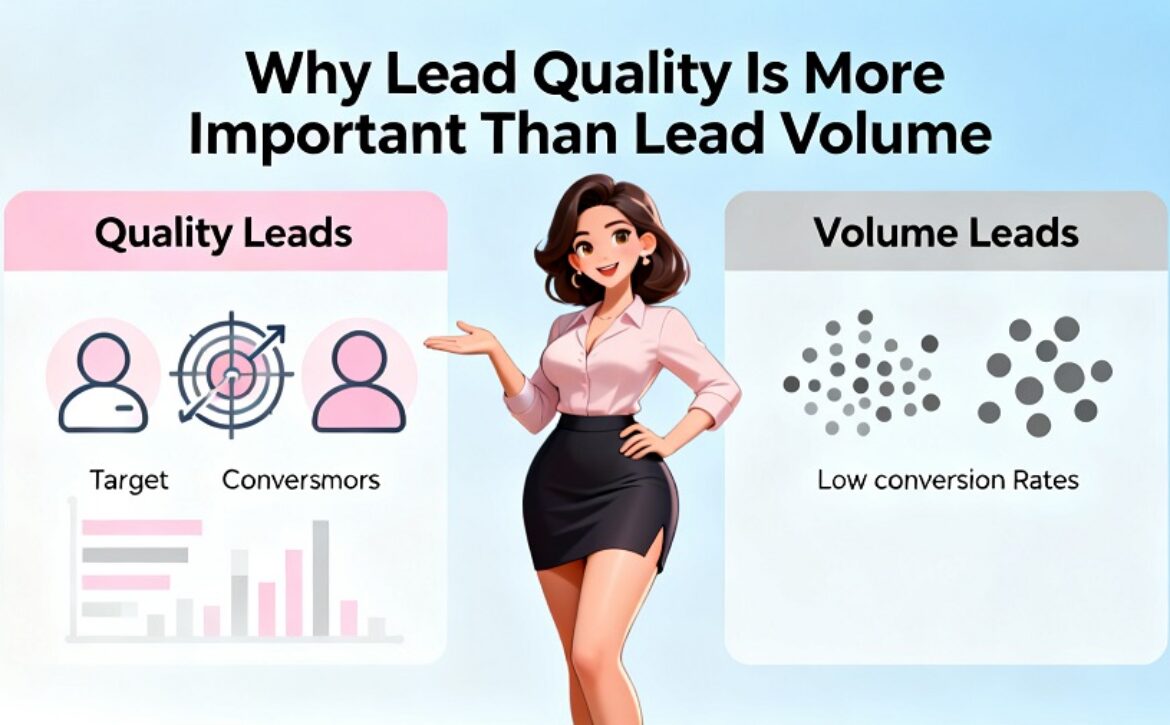
Why Lead Quality Is More Important Than Lead Volume

In the fast-paced world of digital marketing, it’s easy to get caught up in a numbers game. For years companies measured the success of their marketing efforts by the sheer number of names, phone numbers and email addresses pouring into their customer relationship management systems.

But a significant revolution is taking place in the field of growth within corporations. As per the latest figures from the industry, around 61% of marketers feel that lead generation is their biggest problem. It is further noted that a minimum of 50% prospects, in any pipeline, do not qualify for the service offered.

This means organizations are wasting half of their time, energy, and capital chasing dead ends. The modern digital marketplace has made one reality abundantly clear: lead quality outweighs the vanity metric of raw data accumulation.


Shifting Focus: Why Lead Quality Matters for Your Bottom Line

—————————–

When you look at operational efficiency, and you focus on numbers alone, that’s a good recipe for sales burnout. If your marketing team passes on thousands of cold, unverified contacts to your sales development reps, they’ll spend their days dealing with disconnected numbers, wrong addresses, and polite rejections.

This is exactly why Lead Quality Matters more than ever before. When you prioritize the intent, budget, and authority of a prospect over a bloated contact list, your entire business structure changes for the better.

Understanding the True Costs of Bad Data

Chasing a high volume of bad leads drains your corporate resources faster than you realize. It increases your customer acquisition costs while lowering overall team morale.

  • Wasted Sales Hours: Sales reps spend hours calling people who have zero intent to buy.
  • Inflated CRM Expenses: Most software platforms charge you based on the volume of contacts you store.
  • Skewed Data Analytics: Invalid data makes it impossible to accurately forecast your quarterly revenue.
Maximizing Resource Allocation

When you decide that premium data is more Important Than Lead Quantity, you can allocate your marketing budget toward hyper-targeted campaigns that speak directly to decision-makers.


The Strategic Blueprint: Implementing a Quality-First Approach

—————————–

A sustainable pipeline involves your marketing and sales team agreeing on what makes a genuine sales prospect. This can only be achieved by shifting away from generic lead-generation forms to data generation that is specific and targeted.


Setting Strict Qualification Benchmarks

Before launching your next digital campaign, define the exact criteria a prospect must meet before they are sent to your sales pipeline.

Demographics and Firmographics

  • Company Size: Is the target organization large enough to afford your enterprise solutions?
  • Geographic Location: Do they operate within the specific regions where you can legally and logistically deliver services?
  • Industry Vertical: Does their niche align with your case studies and proven success stories?

Behavioral Triggers and Intent Data

  • Content Engagement: Did they download a comprehensive whitepaper, or did they just browse a single blog post?
  • Webinar Attendance: Did they stay for the entire duration of your live demonstration or product Q&A?
  • Pricing Page Visits: Have they repeatedly looked at your subscription tiers within the last 48 hours?

Streamlining the Sales Velocity

A streamlined pipeline means your team closes deals faster. When your sales representatives receive highly vetted, deeply interested prospects, the entire sales cycle shrinks.

Reducing Friction in the Sales Cycle

When you choose to Buy Exclusive Leads, you eliminate the intense competition that usually happens with shared databases. Your team becomes the sole focus of the prospective buyer.

Enhancing Conversion Consistency

A predictable revenue stream relies on predictable close rates. Vetted contacts allow your sales leadership to project quarterly earnings with a much higher level of accuracy.


Partnering with iRadius Group for Scalable Success

—————————–

Navigating this transition from sheer volume to premium data requires the right infrastructure and expertise. This is where specialized data partnerships become invaluable to your organization’s growth.

iRadius Group is the best choice for companies wanting to streamline the process of acquiring customers using quality, intent-based data offerings. Through the blend of comprehensive market intelligence and effective qualifying criteria, iRadius guarantees that your team will only be presented with the best prospects.

With a deep commitment to compliance, accuracy, and operational efficiency, iRadius Group helps you move away from wasteful outreach tactics. Their tailored data delivery systems allow your enterprise to Buy Exclusive Leads that fit your exact buyer personas, turning your sales pipeline into a highly predictable revenue engine.


Overcoming the Vanity Metric Trap in Enterprise Marketing

—————————–

It requires real corporate courage to look at a declining lead count and view it as a victory. Marketing directors are often judged by the size of the lists they generate, which creates a natural conflict of interest with the sales department.

However, the financial reality remains absolute: lead quality outweighs volume when it comes to return on investment. A small, hyper-targeted list of fifty decision-makers will consistently generate more revenue than a list of five thousand random contacts.


The Mathematics of Modern Sales Conversion

Let us look at a simple scenario comparing two different approaches to lead generation. If you invest a fixed budget into acquiring a massive pool of five thousand cheap, unverified contacts, a standard conversion rate of half a percent yields only twenty-five closed deals.

On the other hand, investing that exact same budget into a highly refined pool of five hundred verified leads completely shifts the dynamics. Because these prospects have verified intent and budget, conversion rates frequently jump to fifteen percent, resulting in seventy-five closed deals.

This comparison clearly shows that choosing a methodology that is more Important Than Lead Quantity results in triple the revenue for the exact same initial marketing spend.


Fostering True Marketing and Sales Alignment

When both teams are measured by revenue closed rather than leads generated, cultural friction disappears inside the organization.

  • Shared Definitions: Both departments must agree on the exact definition of a Marketing Qualified Lead.
  • Closed-Loop Feedback: Sales must tell marketing exactly why certain prospects failed to convert.
  • Unified Compensation: Reward marketing teams based on the pipeline value they create, not just the volume of form fills.

The Long-Term Benefits of Premium Lead Acquisition

—————————–

Deciding to invest in valuable data provides a much greater return on investment than you would achieve from focusing solely on your sales for that quarter.

Relevant, useful information delivered at just the right time transforms your company into an industry expert, not a spammer, in the eyes of the public.

Protecting Your Corporate Domain Reputation

Sending mass emails to unverified lists will land your corporate domain on global email blacklists very quickly. Validated data protects your email deliverability scores with major internet providers. Contacting people who actually need your services reduces the likelihood of being marked as spam. High domain health ensures your critical business proposals actually reach the main inbox.

Mitigating Employee Burnout and Attrition

Sales professionals want to close deals, not dial disconnected phone numbers all day. Providing your team with vetted contacts keeps them motivated, reduces employee turnover, and creates a highly competitive, positive sales culture. This proves once again that Lead Quality Matters for your internal company health just as much as it does for external sales.


Tactical Execution: How to Sourcing High-Intent Prospects

—————————–

If you are ready to pivot your corporate strategy, you need practical methods to transition away from low-tier data aggregation tactics.

Optimizing Organic Inbound Channels

Your digital assets should act as a natural filter that weeds out low-budget or lookalike prospects before they ever reach your sales database. Displaying your base pricing upfront stops unqualified buyers from booking calls with your team. Shift from generic blog topics to deep, technical case studies that appeal exclusively to senior leaders. Add specific qualification questions to your contact forms to filter out casual browsers.

Utilizing Specialized Databases

When organic inbound growth is not fast enough to meet your immediate corporate expansion goals, outbound sourcing becomes necessary.

However, you must avoid the temptation to purchase cheap, scraped email packages from unverified internet sources. Instead, you must intentionally Buy Exclusive Leads from reputable data vendors who actively update, verify, and clean their lists.


Final Thoughts: Securing a Competitive Advantage

The future of business growth belongs to organizations that value precision over noise. When your leadership team internalizes the fact that lead quality outweighs raw volume, your operational efficiency sky-rockets while your marketing campaigns become sharper, your sales representatives become more confident, and your overall customer acquisition costs drop.

It is crucial to understand that the procuring qualified data is much more important than Lead Quantity for any company looking to build sustainable business value, therefore choose to be definitive in your approach, understand the importance of intent, and recognize why Lead Quality Matters.

Look at your current pipeline analytics today and find where the dead weight is slowing down your sales cycle and make the structural adjustments needed to focus on premium prospects. To accelerate this transformation without interrupting your day-to-day, choose to Buy Exclusive Leads from trusted, verified sources that link you straight to buy-ready decision-makers.

Read More
Joe Christian June 27, 2026 0 Comments

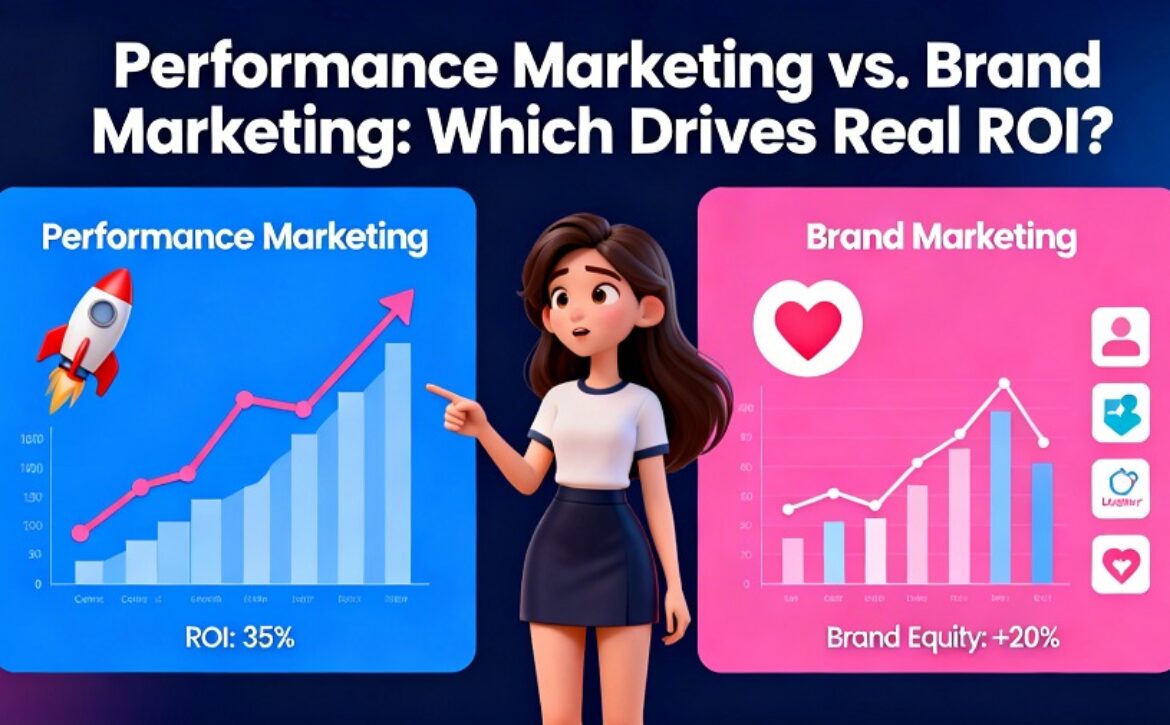
Performance Marketing vs. Brand Marketing: Which Drives Real ROI?

In the modern competitive digital world, companies are always driven to prove the value of their marketing investment. Each campaign is expected to yield results, and each investment is measured in terms of return on investment. This is the reason it is still a debate whether performance marketing or brand marketing is the best. The real issue is not which one is better, but which one is producing real ROI.

Businesses must understand what type of results they are actually seeking, as opposed to which technique is preferable. Performance marketing focuses on immediate outcomes, while brand marketing prioritizes long-term growth through trust and reputation.


What Is Performance Marketing?

—————————-

Performance marketing is a results-based approach in which advertisers only pay when a specific action is executed. This could be a click, lead, purchase, or any other meaningful conversion. The entire strategy is founded on data, tracking, and optimization. Performance marketing provides a clear view of the performance campaign as compared to traditional marketing. Businesses can see in real time the money they have been spending and how much they are getting back.

Performance marketing is implemented in paid platforms such as search engine advertisements, social media ads, affiliate marketing, and retargeting campaigns. Through these channels, businesses are able to reach users in terms of intent, behavior, and demographics.


Key Characteristics of Performance Marketing

The difference between performance marketing and brand marketing is usually based on purpose and effect.

Performance marketing is structured in such a way that it can find users who are willing to convert into leads or sales. Brand marketing is a long-term process that creates awareness, trust, and a good brand presence that shapes future decisions.

One is concerned with the quantifiable outcomes of the present, whereas the other is concerned with the perception of customers in the future.


Advantages and Limitations of Performance Marketing

Performance marketing has the opportunity to provide fast results,, and this is one of its greatest benefits. It is perfect when it comes to product launches, promotions, and growth-based campaigns, as it enables businesses to create leads or sales almost immediately. It gives increased control of the budgets as well as enables constant testing and optimization.

However, performance marketing has its own limitations. Performance marketing has the opportunity to provide fast results, and this is one of its greatest benefits. It is perfect when it comes to product launches, promotions, and growth-based campaigns, as it enables businesses to create leads or sales almost immediately. It gives increased control of the budgets as well as enables constant testing and optimization.


What Is Brand Marketing?

Brand marketing is concerned with creating awareness, confidence, and emotional attachment to the audience in the long run. Instead of forcing people to make instant conversions, it influences the way individuals view a brand and their attitudes towards it.

Brand marketing does not aim at achieving immediate sales, but instead it aims at establishing a strong identity, consistent messaging, and long-lasting impressions that create an impact on future purchase decisions.

Some of the most popular methods of brand marketing include content marketing, organic social media, storytelling, PR, video marketing, and thought leadership. These are the channels that help to convey values, expertise, and personality.


Key Characteristics of Brand Marketing

Brand marketing is an emotionally oriented, long-term approach aimed at creating brand recall and developing trust and recognition that helps businesses remain relevant and promote sustainable growth in the long run.


Strengths and Challenges of Brand Marketing

The biggest strength of brand marketing is trust. When a brand gains credibility, it naturally experiences more engagement, higher conversion rates, and lower customer acquisition costs over time. Customers are more likely to choose brands they recognize and trust, even if cheaper alternatives are available.

However, the effect of brand marketing is difficult to measure. It may be challenging for some organizations to justify the investment because ROI often takes time to yield results.


Performance Marketing vs. Brand Marketing: Key Differences

Performance marketing aims to generate immediate results in terms of conversions and actionable outcomes. On the other hand, brand marketing focuses on building long-term value in the form of trust, recognition, and developing strong relationships with the consumer. Performance marketing will deliver an immediate, quantifiable ROI, and brand marketing will create long-term perception and loyalty. Both strategies are significant in overall business growth.


Which Strategy Drives Real ROI?

—————————-

ROI is influenced by both brand marketing and performance, but in different ways. Performance marketing is perfect for short-term objectives like lead generation, e-commerce sales, or short-term campaigns since it produces immediate results that can be measured. Companies can quickly modify their methods after determining what works.

In contrast, brand marketing generates long-term benefits. It builds trust, increases client loyalty, and establishes a unique identity that produces long-term results. Additionally, performance marketing programs are more successful and efficient when they have a strong brand.


Which Strategy Is Right for Your Business?

—————————-

Performance marketing is the only method that many businesses use to achieve their goals, hoping that paid campaigns will yield instant outcomes. This technique may be effective in the short term, but in many cases, it results in increased expenditure, ad fatigue, and decreased engagement.

Without a strong brand, advertisements sometimes rely on short-term strategies such as discounts or special offers to attract customers. This may increase traffic easily, but it rarely builds trust or long-term loyalty. However, outcomes can be limited if brand marketing is the only strategy used and there are no obvious calls to action for consumers. Although awareness and trust are crucial, income and ROI will stay low if users are unable to convert. Brand marketing is most effective when integrated with performance-based techniques that convert interest into tangible results.

The most successful businesses are those that combine the two approaches. Brand marketing establishes trust and credibility, which in turn generates demand, whereas performance marketing fulfills that demand through targeted campaigns. The combination of a good brand enhances the performance of the ad and reduces the cost of acquisition, and boosts the conversion rate.


Conclusion

Successful marketing requires both performance and brand strategies working together. Performance marketing drives immediate, measurable results, while brand marketing builds long-term value, trust, and credibility. When both are aligned, businesses achieve sustainable growth, foster lasting customer loyalty, and generate real ROI that stands the test of time.

Partner with our trusted and reliable company to integrate performance and brand marketing strategies that deliver results today and build value for tomorrow.

Read More
Sanju February 15, 2026 0 Comments

AI-Powered Performance Marketing: The Future of Conversion Growth

In today’s constantly changing digital economy, marketing success is no longer measured by reach alone, it is defined by precision, predictability, and measurable revenue impact. In this rapidly increasing online environment, marketers are finding that traditional performance marketing methods are no longer enough for sustained success. Although traditional marketing models have proven effective in driving results in the past, they still find it difficult to cope with modern consumer paths, fragmented media, and increasing costs of acquisition. As a result, artificial intelligence is becoming the competitive edge behind high-performing marketing strategies, separating brands that scale profitably from those that struggle with rising acquisition costs.

Artificial intelligence-driven performance marketing represents a fundamental shift in how businesses acquire customers, improve conversion efficiency, and scale growth without linear increases in ad spend. Through the integration of analytics and artificial intelligence, businesses now have the ability to not only react to their optimization processes but also to optimize and grow in an intelligent and sustainable manner. The new age of performance marketing is all about engineering conversions through precision, automation, and intelligent decision-making.


What Is Performance Marketing?

——————————-

Performance marketing represents a data-driven digital marketing strategy in which advertisers compensate only for specific actions, not merely advertising exposure. Such actions may involve clicks, leads, app downloads, purchases, or other predetermined actions. What makes performance marketing stand out is that every dollar spent is tied to a measurable outcome, allowing businesses to control costs, optimize ROI, and scale what actually works.

Unlike the traditional form of brand ads, where the emphasis is on promotion, performance marketing emphasizes actual business outcomes. These ads are constantly optimized using real-time data to improve efficiency and performance. Such a system is common on search engines, social media platforms, display networks, and markets.

Present-day performance marketing solution providers are able to leverage strategy, implementation, analysis, and optimization in an end-to-end approach. With the right technology, data foundation, and strategic guidance, performance marketing becomes a predictable, scalable revenue engine rather than an experimental cost center.


The Limitations of Traditional Performance Marketing 

——————————-

Although measurement and optimization have long been core to performance marketing, legacy approaches are increasingly failing to deliver sustainable ROI in high-competition, multi-channel environments. Manual bid strategies, traditional segmentation, and testing structures are no longer nimble enough to keep up with market changes as they happen.

Important limitations are:

  • Use of historical information instead of analytical foresight
  • Slow optimization cycles
  • Lack of scalability in personalization
  • Cost escalation because of inefficient targeting

These challenges directly impact conversion rates, customer acquisition costs, and long-term profitability to make optimization speed and intelligence business critical. This is where the game-changing role of AI comes into play.


The Rise of AI in Performance Marketing

——————————-

AI improves performance marketing by removing guesswork from decision-making and replacing it with predictive, self-optimizing systems designed to maximize conversions and revenue efficiency. Instead of using predefined decision rules, AI platforms focusing on performance marketing apply big data analytics instantly to identify relationships and trends, which are then utilized to make better decisions.

AI brings value to advertising efforts based on data by:

  • Predicting user intent and the likelihood of a user converting
  • Automating bid and budget allocation
  • Personalizing messages at scale
  • Speeding up experimentation and learning

This allows marketers and growth leaders to focus on strategy and revenue impact, while AI handles execution complexity.


How AI-Powered Performance Marketing Helps You Achieve Higher Conversions

——————————-

As a growth-focused business, your objective is clear: attract high-intent audiences, convert more qualified leads, and scale efficiently without inflating acquisition costs. AI-powered performance marketing helps you do exactly that by using intelligent data, automation, and real-time insights to turn interest into action and clicks into customers

  • Get Personalized Experiences That Actually Convert
    AI allows your brand to deliver personalized messages, offers, and product recommendations tailored to each user’s behavior and intent. When your audience sees content that feels relevant and timely, they are more likely to engage, trust your brand, and convert.
  • Reach High-Intent Leads at the Right Time
    With AI-driven predictive analytics, you can focus on leads who are most likely to take action. By identifying buying signals and intent patterns, AI helps you target the right users at the right moment—improving conversion rates while reducing wasted ad spend.
  • Improve Results Through Continuous Optimization
    AI continuously tests and improves your ads, landing pages, and messaging without manual effort. This means your campaigns are always learning and improving, helping you convert more leads without constantly tweaking strategies.
  • Stay Optimized 24/7 Without Manual Effort
    AI-powered optimization works around the clock, automatically adjusting bids, creatives, and targeting based on real-time behavior. Even when you’re offline, your campaigns continue to perform and convert efficiently.
  • Make Smarter Decisions With Real-Time Insights
    AI gives you instant visibility into what’s working and what isn’t. With clear performance insights, you can act quickly, protect your budget, and focus on strategies that generate real results.
  • Turn Marketing Spend Into Measurable Growth
    By combining personalization, predictive targeting, and automation, AI-powered performance marketing helps you maximize ROI, convert more leads, and scale your business with confidence.

By leveraging AI and machine learning, businesses can transform their performance marketing efforts into scalable, conversion-focused systems that deliver long-term success. The result is not just better campaigns, but consistent, scalable conversion growth aligned with business goals.


AI-Powered Performance Marketing Across the Funnel  

——————————-

AI brings intrinsic value throughout the performance marketing funnel, allowing it to form a seamless, self-optimized process.

1. Awareness: Predictive and Intelligent Reach  

In the awareness stage, the role of AI is to improve audience discovery and targeting. AI algorithms use behavioral, contextual, and demographic information to determine the most likely users for a brand.

For businesses working with a performance-focused paid advertising or digital marketing partner, this translates into reduced budget wastage, sharper targeting, and stronger conversion efficiency. It can be more effective as it can reach consumers just before the point of maximum intention.

2. Consideration: Personalization & Engagement  

In the consideration stage, AI allows highly personalized experiences. The messages, offers, and creative assets are dynamically tailored according to the real-time signal of browsing activity, usage, and interaction.

This is a major AI marketing application where automation and intelligence are combined for relevance throughout the customer journey. This enhances customer interaction and reduces the funnel drop-off.

3. Conversion: Precision Optimization at Scale  

This is where the effect of AI on performance marketing can be most easily measured. The AI-powered bids assess an infinite number of factors in a split second, including intent, competition, device, time, and user behavior.

Advanced Pay-Per-Click Management Services powered by AI are designed to:

  • Focus on value conversions over low-quality clicks
  • Dynamically optimize bids for auctions
  • Enhance quality scores & landing page alignment
4. Retention and Growth: Maximizing Long-Term Value  

AI-driven performance marketing transcends the initial point of conversion. Predictive analytics are used to identify remarketing, cross-selling, and upselling opportunities to optimize customer lifetime value.

However, automation also plays a significant part, allowing brands to re-engage individuals with messages that are both relevant and well-timed. Such a strategy also helps with ROI-driven marketing, where acquisition costs are proportionate to the revenue that can be gained.


Core Capabilities of AI-Powered Performance Marketing

——————————-

AI incorporates numerous cutting-edge features that revolutionize the way in which performance marketing functions.

1. Predictive Analytics and Forecasting  

The AI model can predict demand, conversion probability, and revenue results with a high level of accuracy. This will enable marketers to allocate budgets and plan their marketing activities thoroughly.

2. Automated Audience Segmentation  

Contrary to the predefined segments, AI systems are constantly segmenting consumers on the basis of their behaviors and intentions.

3. Real-Time Bidding and Budget Optimization  

The bids and budgets of AI get adjusted instantly according to changes that occur in competition, user behavior, and performance trends. This is extremely useful when it comes to Google Ads services, which undergo rapid changes in auctions.

4. Dynamic Creative Optimization  

Artificial intelligence enhances creativity automatically, pointing out where the most effective image, title, and call to action are to reach each type of audience.


Traditional vs AI-Powered Performance Marketing

——————————-

This difference between traditional methods and AI-based techniques throws light on the acceleration of adoption.

Aspect Traditional Performance Marketing AI-Powered Performance Marketing
Optimization Speed Periodic and manual Continuous and real-time
Audience Targeting Static segments Dynamic, intent-based
Budget Allocation Rule-driven Predictive and adaptive
Creative Testing Limited A/B tests Automated multivariate testing
Decision Making Historical analysis Predictive intelligence
Scalability Resource-dependent Algorithm-driven

This accounts for why huge brands nowadays often partner with a performance marketing agency in the USA that utilizes an AI-first approach. For organizations focused on growth efficiency, this shift is not optional. AI-powered performance marketing is rapidly becoming the standard for brands that demand accountability, scalability, and measurable ROI from their advertising investments.

Ready to turn your ad spend into predictable conversion growth? Partner with AI-driven performance marketing experts to scale efficiently, reduce acquisition costs, and achieve measurable, ROI-focused results.


The Role of Automation in AI-Driven Performance Marketing

——————————-

Automation represents the “execution layer” that implements AI in performance marketing. Although AI completes the insight and decision-making processes, automation executes them quickly.

In advanced performance marketing services, automation enables:

  • Campaign creation & scaling
  • Bid & budget adjustments
  • Creative testing and rotation
  • Performance tracking and alerts

It makes the process more efficient and helps enhance the quality of the results by increasing accuracy.


Strategic Advantages to the Decision-Makers  

For executives and growth leaders, AI-driven performance marketing means clarity and control. Instead of guessing, decision-makers are providing predictive insights and performance data transparency.

Key benefits are:

  • Increased conversion rates on various channels
  • Lower cost per acquisition
  • Faster experimentation cycles
  • Enhancing revenue projections

When it comes to being led by experienced professionals in a PPC management company or an advertising agency, AI itself becomes a multiplier of expertise rather than a replacement.


Challenges and Responsible AI Adoption  

Though it presents various advantages, AI-driven performance marketing needs to be executed effectively. Data quality, integration, and management are essential aspects. Relying completely on technology, losing human intervention, can also be counterproductive.

Successful implementation combines AI strengths with:

  • Strategic direction
  • Creative judgment
  • Ethical considerations
  • Continuous human review

This allows for sustainable growth with good accountability.


The Future of Performance Marketing in an AI-First World

——————————-

As AI technology advances, the performance marketing industry is going to become more self-driven and predictive. Future models will be able to foresee market changes and make suggestions regarding necessary changes in strategies based on predictions.

For brands that have invested in performance marketing, this revolution means:

  • Improved ability to resist market fluctuations
  • More alignment of spending with revenue growth
  • Increased competitive differentiation

AI is not replacing performance marketing, but it is reshaping what is possible with performance marketing.


Conclusion: Developing Smart & Scalable Growth Engines   

AI-driven performance marketing represents a shift from manual optimization to intelligent growth engineering where conversions, revenue, and efficiency are designed into every campaign. By harnessing the power of predictive analytics, AI marketing, automation, and full-funnel expertise, marketers can establish unparalleled control over conversion outcomes.

By being powered by top-quality performance market management, sophisticated pay-per-click management, and a results-driven digital advertising agency, AI ensures that marketing efforts become scalable and predictable revenue engines. Companies adopting an AI-first performance mindset are not just upgrading campaigns, but building future-ready growth models.

In the current digital environment shaped by competition and rising acquisition costs, AI-powered performance marketing is not just an advantage, it is a requirement for sustainable, conversion-led growth.

Read More
Sanju January 18, 2026 0 Comments