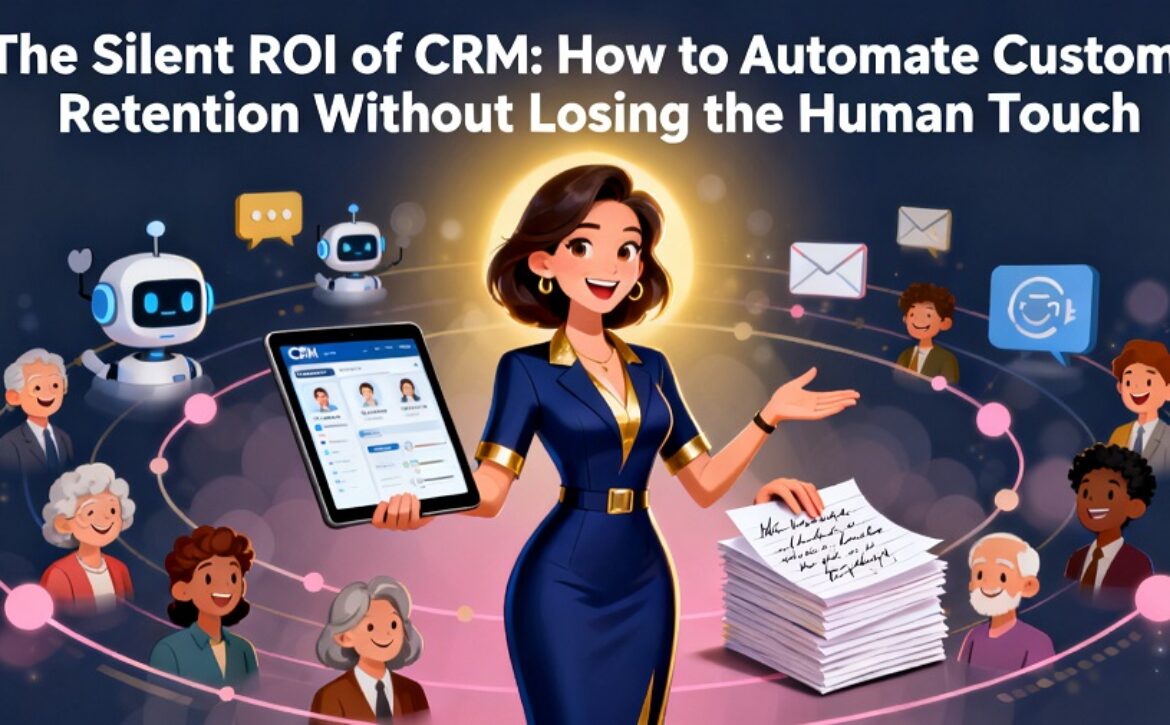
The Silent ROI of CRM: How to Automate Customer Retention Without Losing the Human Touch

Customer retention has quietly become one of the most valuable and sustainable growth drivers for modern businesses, especially in an environment where customer acquisition costs continue to rise significantly. As a result, organizations are increasingly shifting their focus toward CRM-driven retention strategies that are powered by automation and Artificial Intelligence to improve long-term customer engagement.

However, this transition requires maintaining a critical balance: automation must be implemented in a way that enhances, rather than replaces, the human connection that underpins strong customer relationships.

It is within this context that the concept of “silent ROI” emerges referring to measurable returns generated by CRM systems that operate seamlessly in the background, improving efficiency and customer experience without creating visible disruption.


Why CRM Automation Is Reshaping Customer Retention

——————————-

Recent developments in CRM technology highlight a clear shift toward intelligent, automated ecosystems.

According to a 2025 announcement, Done.ai Group introduced an AI-powered CRM as the first module of its Done OS platform, specifically designed to streamline workflows and enhance customer engagement in a growing Nordic market.

The system integrates automation with operational processes, enabling businesses to manage customer relationships more efficiently while reducing manual intervention.

Key Takeaways

1. CRM platforms are evolving into AI-driven ecosystems

Contemporary Customer Relationship Management (CRM) platforms have undergone a significant transformation from traditional data repositories to AI-enabled ecosystems that integrate multiple business functions. This evolution is characterized by the incorporation of Artificial Intelligence to facilitate real-time data analysis, predictive modeling, and automated decision-making.


2. Automation is being embedded directly into business workflows

The integration of automation within CRM systems has progressed from peripheral functionality to a foundational component embedded within core business workflows. This shift is evident in solutions such as AGCRM v2.0, launched in 2025, which consolidates multiple operational processes into a unified platform to streamline service management. By embedding automation into workflows, organizations can standardize routine processes, reduce operational inefficiencies, and enhance consistency in service delivery. This structural integration minimizes reliance on manual intervention and supports scalable operations across diverse business environments.


3. Customer engagement is becoming more proactive than reactive

The paradigm of customer engagement is shifting from reactive response mechanisms to proactive, data-driven strategies. AI-enabled CRM systems facilitate this transition by leveraging historical and real-time data to predict customer needs and trigger pre-emptive actions. This approach allows organizations to initiate interactions such as service reminders, personalized communications, and issue prevention measures before customer dissatisfaction arises. As demonstrated by recent CRM innovations, proactive engagement enhances customer experience by reducing friction and anticipating expectations


What “Silent ROI” Really Means in CRM

——————————-

Silent ROI refers to incremental improvements that occur without visibly altering the customer experience. Rather than producing immediate or noticeable changes, it enhances service delivery in subtle ways that collectively generate long-term value. These gains are often embedded within CRM systems and operate in the background, ensuring efficiency while maintaining a seamless customer journey.

  1. Faster response times
    AI-powered CRM systems enable instant acknowledgment of customer queries and automate initial responses or task routing. This reduces waiting time and ensures that customer requests are addressed promptly. As a result, customers perceive the service as efficient and responsive, even though much of the process is automated.
  2. Improved service consistency
    Automation standardizes workflows and communication processes, ensuring that all customers receive uniform and reliable service. Whether it is follow-ups, updates, or notifications, CRM systems eliminate variability caused by human limitations, thereby strengthening trust and brand reliability.
  3. Reduced churn through timely engagement
    CRM systems equipped with Artificial Intelligence can identify patterns in customer behaviour and trigger timely interactions, such as reminders or personalized messages. These proactive engagements help address potential issues before they escalate, reducing the likelihood of customer disengagement.

For example, AI-powered CRM platforms can automatically initiate follow-ups, send reminders, and provide service updates without requiring manual intervention. These processes occur seamlessly in the background, ensuring that customers receive timely and relevant communication.

This creates value that customers experience as seamless service, not automation.


Automation Without Losing the Human Touch

——————————-

A common misconception is that automation reduces personalization. In reality, modern CRM systems are designed to enhance it.

In 2025, ITK Solutions launched AGCRM v2.0, a unified CRM platform for multi-brand automotive workshops. The platform integrates multiple service operations into a single system, improving coordination and customer communication.

By centralizing data, businesses can:

  1. Understand customer history instantly
    Centralized CRM systems provide immediate access to past interactions, preferences, and service records. This enables faster decision-making and more informed customer engagement.
  2. Provide context-aware responses
    With complete customer data available, responses can be tailored based on previous interactions and specific needs. This ensures communication remains relevant and personalized.
  3. Deliver consistent service across touchpoints
    Unified systems standardize processes across channels such as email, calls, and support platforms. This ensures customers receive the same quality of service regardless of how they interact.


How Human Touch Is Preserved

——————————-

Automation Feature Human Impact
Automated reminders Timely, helpful communication
Unified customer data Personalized interactions
Workflow automation Faster response from real agents


What AI Enables in CRM

——————————-

  1. Predictive engagement based on behaviour
    Artificial Intelligence enables CRM systems to analyse past customer behaviour and predict future actions. This allows businesses to initiate timely and relevant interactions before issues arise, improving retention and customer satisfaction. Additionally, predictive models help identify early signs of disengagement, enabling organizations to intervene proactively with personalized communication and targeted solutions. This not only strengthens customer relationships but also enhances long-term loyalty.
  2. Automated task management
    AI automates routine CRM tasks such as follow-ups, scheduling, and data updates, ensuring consistency and reducing manual effort. This improves efficiency while allowing employees to focus on more complex responsibilities. Furthermore, automation minimizes human error and ensures that critical tasks are executed without delay, thereby maintaining workflow continuity and operational accuracy. As a result, organizations can scale their operations without proportionally increasing resources.
  3. Real-time insights into customer interactions
    AI-driven CRM systems provide immediate insights by continuously analysing customer data. This helps organizations respond quickly to customer needs and adapt strategies in real time. In addition, real-time visibility into customer behaviour enables more informed decision-making and allows businesses to refine engagement strategies dynamically. This ensures that interactions remain relevant, timely, and aligned with customer expectations.


The Ethics of Transparency and the “Authenticity Gap”

——————————-

As automation becomes more sophisticated, businesses face a new challenge: the “Authenticity Gap.” This occurs when a customer feels “tricked” by a bot that is pretending to be human. To maintain a true human touch, organizations must navigate the ethical implementation of their CRM tools with total transparency.

The latest industry standards in 2025-2026 suggest that Transparency is a Trust Multiplier. When implementing automated response systems, the goal should not be to replace the human identity, but to “bridge the gap” until a human can take over.

  1. Identity Clarity: Clearly labeling AI-driven interactions (e.g., “I’m the Done.ai Assistant, let me get a head start on your request while I find a specialist”) actually increases customer satisfaction. It manages expectations regarding response complexity while still providing the “Silent ROI” of speed.
  2. Context Handover: The most critical “Human Touch” moment is the handoff. A unified CRM ensures that when a human agent enters the conversation, they aren’t asking the customer to repeat themselves. They have the full transcript of the automated interaction, the customer’s history, and the predicted solution ready to go.
  3. The Empathy Buffer: Automation should be used to handle “Information Tasks,” while humans are reserved for “Empathy Tasks.” By automating the data retrieval and scheduling aspects of a service call (as seen in the AGCRM v2.0 digital job cards), the human agent is freed from the stress of administrative work. This allows them to bring more patience, creativity, and genuine empathy to the conversation qualities that AI cannot yet replicate.


Balancing Efficiency and Empathy

——————————-

The primary challenge in CRM implementation does not lie in the adoption of automation itself, but in the manner in which it is strategically designed and executed. An effective CRM system must achieve a balance between operational efficiency and human-centric engagement to ensure that technological advancements enhance, rather than diminish, the quality of customer relationships.

A well-structured CRM framework is characterized by its ability to automate repetitive and routine tasks, thereby reducing operational burden and minimizing the likelihood of human error. By handling activities such as follow-ups, notifications, and data updates, the system allows human agents to redirect their focus toward more complex and value-driven interactions that require critical thinking and emotional intelligence. Furthermore, standardized workflows embedded within the CRM ensure consistency in communication and service delivery across multiple customer touchpoints, which is essential for maintaining reliability and trust.


Best Practices

From an implementation perspective, organizations should adopt a structured approach to balancing automation with empathy. Automation should primarily be utilized for routine and predictable communication processes, such as reminders and status updates, where efficiency and timeliness are critical. In contrast, human interaction should be reserved for complex, sensitive, or high-impact situations that require personalized attention and nuanced understanding.

Additionally, maintaining transparency in automated interactions is essential. Customers should be aware when they are engaging with automated systems, as this clarity helps manage expectations and preserves trust in the communication process. Transparent automation also reinforces the perception of authenticity, even within system-driven interactions.


Next Steps: How to Apply This Strategy

——————————-

  1. Start with Unified Data
    Establish a centralized CRM system where all customer interactions are consistently recorded and updated. This unified view enhances data accuracy, improves coordination across teams, and enables more informed, insight-driven decision-making.
  2. Automate Repetitive Tasks
    Implement automation for routine processes such as follow-ups, reminders, and scheduling to ensure timely and consistent execution. This reduces manual workload while improving operational efficiency and service reliability.
  3. Integrate AI Gradually
    Adopt Artificial Intelligence in a phased manner, beginning with basic predictive insights and scaling over time. This approach allows organizations to adapt effectively without disrupting existing workflows or overwhelming teams.
  4. Prioritize Human Interaction
    Leverage automation to support human efforts rather than replace them, particularly in complex or sensitive customer scenarios. Maintaining human involvement strengthens trust, empathy, and long-term relationship quality.
  5. Measure Silent ROI
    Continuously evaluate performance metrics such as response time, customer retention, and service efficiency. Tracking these indicators helps quantify the underlying value generated through CRM automation and guides further optimization.


Final Thoughts

CRM automation is no longer about replacing human effort. It is about enhancing it intelligently.

The latest innovations in 2025 show a clear direction:

  1. AI-powered CRM systems are becoming standard
    Organizations are increasingly adopting AI-enabled CRM solutions to enhance decision-making and streamline customer management. This shift reflects the growing reliance on intelligent systems for scalable and efficient operations.
  2. Unified platforms are improving operational clarity
    Integrated CRM platforms consolidate multiple functions into a single system, reducing data silos and improving coordination. This leads to clearer workflows and more consistent service delivery across teams.
  3. Automation is driving retention quietly but effectively
    Automated processes enable timely engagement and consistent communication without disrupting the customer experience. As a result, businesses improve retention through seamless and proactive interactions.

The businesses that succeed will be those that understand one principle:

Technology should make customer relationships feel more human, not less.

Read More
Sanju May 28, 2026 0 Comments

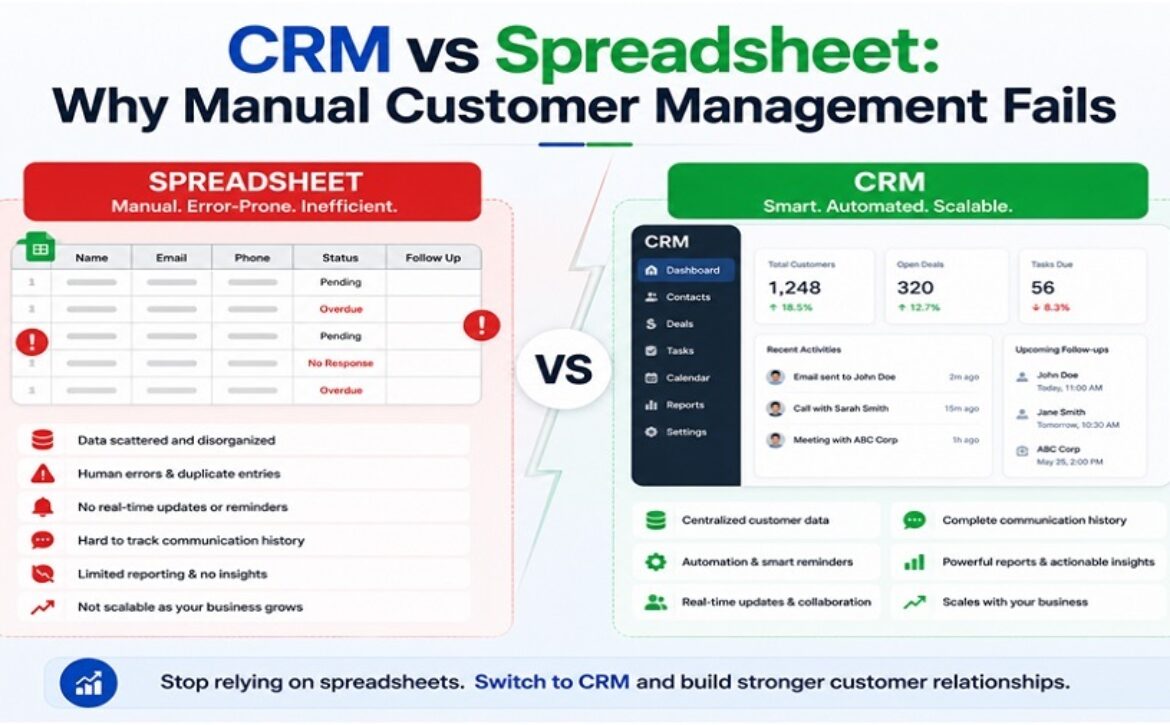
CRM vs Spreadsheet: Why Manual Customer Management Fails

Customer management functions as an essential component that drives business expansion while ensuring its ongoing prosperity. Companies use customer data to handle leads and create better communication methods, develop better customer experiences, and achieve higher sales results. Businesses continue to use spreadsheets as their primary tool for handling customer data, even though their operations have become more complex.

Businesses eventually reach a point where their operations become too large for spreadsheets, which businesses initially consider as a budget-friendly solution. Spreadsheets used for manual customer management create data accuracy issues because they prevent proper communication and teamwork, while businesses miss important revenue chances.

The organization now works with custom crm software development companies based in the USA to develop unified CRM systems that automate their customer management tasks.

Businesses need to establish scalable digital systems, which modern organizations consider essential because they want to achieve sustainable development through customized software development services.


The Limitations of Spreadsheet-Based Customer Management

——————————

Businesses have used spreadsheets for customer data organization and sales monitoring and communication management since their introduction. Small businesses prefer spreadsheets because they are simple to use and need very little time to set up.

The process of managing databases becomes more difficult for businesses when they expand their customer database size.

Common limitations of spreadsheets include:

  • Manual data entry errors
  • Lack of automation
  • Poor collaboration capabilities
  • Limited scalability
  • Data duplication issues
  • Weak security measures
  • Inefficient reporting
  • Difficulty tracking customer interactions

Operational processes and customer experiences both suffer from these constraints.


Why Manual Customer Management Fails

————————

As businesses grow, their customer interactions become more complex and need improved systems that can handle their growing needs.

The manual customer management systems do not work because they cannot handle:

  • Large customer databases
  • Multi-channel communication
  • Sales pipeline tracking
  • Real-time updates
  • Automated follow-ups
  • Team collaboration
  • Customer analytics

Businesses that depend on spreadsheets experience difficulties because they are unable to maintain correct customer data, which leads to slow responses and low customer retention.


Data Errors and Inaccuracies

The most significant obstacle for customers who use spreadsheet systems to manage their relationships is the possibility of human mistakes.

Manual data entry can lead to:

  • Duplicate customer records
  • Incorrect contact details
  • Missing information
  • Data inconsistencies
  • Accidental deletions

Small mistakes in work processes lead to major problems that affect both sales chances and relationships with customers.

CRM systems automate data management processes, which decreases error rates and enhances system performance.


Lack of Centralized Customer Information

Multiple departments use spreadsheets to save customer details, which they keep in different files. The system creates communication problems because teams struggle to find current customer information.

The custom crm software development company in USA created a centralized CRM platform that enables all departments to access real-time customer information through one system. The system enables better teamwork between sales teams, marketing teams, and customer support teams.


Poor Collaboration and Communication

Modern businesses need their different departments to work together without any interruptions.

Spreadsheets fail to deliver suitable collaboration features because multiple users need to edit customer data at the same time.

The situation results in multiple problems, which include:

  • Version control problems
  • Data conflicts
  • Miscommunication
  • Delayed system updates

CRM systems offer three main features, which include role-based access, real-time system updates, and centralized communication monitoring.

Teams can work together effectively because they can share data without creating any problems.


Inefficient Lead and Sales Management

Sales teams face more challenges when they need to track leads through spreadsheets because their sales pipelines keep expanding.

Sales teams often struggle to:

  • Prioritize leads
  • Track follow-ups
  • Monitor conversion stages
  • Analyze sales performance

The CRM system provides automatic lead tracking together with visual sales pipelines, which enhance both productivity and conversion rates.

Businesses that invest in custom software development services can create CRM platforms that match their specific sales workflows.


Limited Reporting and Analytics

Data-driven decision-making is essential for business growth.

Spreadsheets offer restricted reporting functions that need manual data processing for analysis.

CRM systems provide advanced analytics dashboards that show insights about customer behavior, sales performance, marketing effectiveness, and customer retention and revenue trends.

The insights enable businesses to make strategic decisions based on sound evidence.


Weak Security and Data Protection

The reason customer data security has gained higher importance today is that cybersecurity threats have become more frequent, and data privacy regulations have become more stringent.

Spreadsheets provide only basic security features, which make them susceptible to:

  • Unauthorized access
  • Data leaks
  • Accidental sharing
  • File corruption

CRM systems use special security techniques that protect data through:

  • Data encryption
  • Access controls
  • Audit logs
  • Automated backups
  • Multi-factor authentication

These features help businesses protect sensitive customer information.


Lack of Automation

The process of handling customers through manual methods requires businesses to spend their resources and work hours.

Businesses that use spreadsheets as their primary tool depend on manual methods to handle three tasks which include:

  • Sending follow-up emails
  • Updating customer records
  • Tracking appointments
  • Managing sales pipelines

CRM systems enable staff to work on essential business tasks by streamlining their repeated work activities.

Automation technology boosts work efficiency while creating better interactions between businesses and their customers.


Scalability Challenges

The organizational challenges of spreadsheet management increase as businesses expand their operations. The handling of large datasets causes spreadsheets to perform poorly while making it difficult to extract information. CRM systems are designed to scale with business growth.

A custom crm software development company in USA can build scalable CRM platforms that adapt to changing business requirements. The setup will provide both sustained operational efficiency and operational adaptability throughout time.


Benefits of CRM Systems Over Spreadsheets

——————————

Businesses gain multiple benefits when they switch from spreadsheets to customer relationship management systems.

Centralized Customer Management

The platform stores all customer information in a secure database system.

Improved Customer Relationships

The CRM system provides businesses with tools to establish personalized contact methods while delivering quick customer assistance.

Better Sales Performance

The system generates automated lead distribution, which enables sales teams to work more efficiently.

Enhanced Team Collaboration

The system enables departments to communicate better through its capability to deliver instant updates.

Advanced Analytics

The automated reporting system provides businesses with essential insights for their operations.

Increased Productivity

Automation technology eliminates the need for employees to perform manual work and handle administrative responsibilities.


Custom CRM Solutions for Modern Businesses

——————————

Every business has unique operational workflows and customer management requirements.

Generic CRM platforms do not match all business processes because they lack complete alignment with company operations.

Organizations choose to develop custom software solutions for their businesses because they need to create specific CRM systems that meet their needs.

Custom CRM platforms can include:

  • Industry-specific workflows
  • AI-powered automation
  • Customer segmentation tools
  • Integrated communication systems
  • Advanced analytics dashboards
  • Third-party software integrations

Customized CRM solutions bring operational efficiency improvements, which help businesses grow over the long term.


Future of Customer Relationship Management

——————————

The upcoming development of CRM technology will use automated systems together with artificial intelligence, predictive analytics, and personalized solutions. Businesses will increasingly rely on intelligent CRM systems to:

  • Predict customer behavior
  • Automate engagement strategies
  • Improve customer retention
  • Enhance sales forecasting

Businesses can develop customer management solutions that will meet future requirements by partnering with a custom CRM software development company located in the USA. The establishment of a custom software development service infrastructure will provide organizations with the ability to maintain their competitive advantage while adapting to market changes.


Conclusion

Modern businesses need more advanced customer management systems than manual spreadsheet management methods. Spreadsheets create operational problems because they make organizations less efficient, generate incorrect data, fail to establish proper communication channels, and create security vulnerabilities.

Customer relationship management systems offer businesses a complete solution that combines centralized control with automated processes and scalable customer relationship management tools to enhance their operational efficiency. USA businesses that work with custom crm software development companies can create personalized CRM systems that match their specific business needs.

Organizations can develop digital ecosystems that support both expansion and customer interaction through their investment in custom software development service solutions. Businesses today need to adopt CRM systems as their primary operational system because this change will help them achieve better customer satisfaction results.

Read More
Sanju May 18, 2026 0 Comments

Integrating Mobile CRM with Marketing Automation & Analytics Platforms

Technology-driven solutions have been going viral in businesses to keep up with the digital landscape of today and these solutions have become the main tools for businesses to streamline operations, enhance customer engagement and optimize marketing efforts. The most important components of these strategies are Mobile Customer Relationship Management (CRM) systems, marketing automation tools and analytics platforms. They are very powerful when used as a single unit because they give companies the possibility to increase sales, make customers more loyal, and use data for making decisions. The article goes deeper into the benefits that result from combining mobile CRM with marketing automation and analytics platforms, deals with the challenges and best practices accompanied by the latest trends in the mobile CRM market.


Understanding Mobile CRM, Marketing Automation, and Analytics

———————————–

It is necessary to understand what the key components mean before we start the integration process:

  1. Mobile CRM: A mobile CRM system is a software that helps a company keep track of its communication with existing and new customers. It does this by putting all the customer data in one place, recording the interactions and making it easy to manage the relationships through any communication channel. Mobile CRM applications enable companies to use the functions of a CRM wherever they want. This way, they can make decisions faster and provide better customer service.
  2. Marketing Automation: Marketing automation software simplifies the activities and processes which include email marketing, lead generation, social media management and customer segmentation. Such platforms take on the repetitive tasks, make the campaigns more efficient, and provide for the giving of the targeted marketing messages at the right time.
  3. Analytics Platforms: Analytic platforms are designed to get data from many different sources, analyze it and then give the results that can be acted upon. They observe the behavior of customers, evaluate the effectiveness of the campaigns and create the reports that answer the questions of the businesses regarding the preferences and the trends. Such companies become capable of making the right decisions that lead to the expansion of their business.

Benefits of Integrating Mobile CRM with Marketing Automation & Analytics Platforms

———————————–

The connection of mobile CRM through marketing automation and analytics platforms results in several substantial benefits such as increased customer engagement, smoother sales processes and usage of data for making decisions:


1. Improved Customer Insights

Business firms while integrating mobile CRM with analytics platforms become able to see the whole picture of customer interactions. By integrating CRM data like profiles and transaction history with the marketing automation system data like campaign engagement, companies obtain a much deeper insight into their customer base which in turn allows them to develop extremely personalized marketing strategies.


2. Personalized Marketing Campaigns

Using mobile CRM along with marketing automation businesses can develop individualized promotional strategies with the help of precise customer segmentation. The use of data from CRM allows the sending of targeted communication through email, SMS or social media campaigns that are designed according to the behavior and likes of the customers. Thus, it becomes possible to deliver the most appropriate content at the right time which in turn leads to increased interaction with customers and also more sales.


3. Streamlined Sales and Marketing Collaboration

By offering a consolidated view of customer interactions, integration eliminates the divides that existed between marketing and sales. On one hand, marketing is able to employ CRM data for putting together targeted campaigns that are in line with sales objectives, on the other hand sales can monitor the effectiveness of the campaign and prompt the initiation of contact with those who have received the campaign at the most suitable time. The efficiency in the exchanges between the two departments thus achieved results in shorter response times and higher lead conversion rates.


4. Real-Time Reporting and Analytics

One of the main benefits of integration is the ability to obtain data in real-time. When the data is shared or exchanged through mobile CRM, marketing automation and analytics platforms, companies become aware of their performance continuously and thus, can take immediate action in line with their operational adjustment. Besides empowering management by providing it with different data for making informed decisions, it also accelerates flexibility in decision-making.


5. Enhanced Customer Engagement

By integrating a mobile CRM with marketing automation, a business becomes customer-centric in the most effective way. The sales force is informed instantly via their mobile devices about any alterations in the customer’s behavior thus they can accordingly take the next step whether it be calling, answering, visiting or mailing a coupon without any delay. As a result, customer interaction rises along with their delight.


Key Challenges in Integration:

———————————–

Though there are many advantages to syncing mobile CRM with marketing automation and analytics platforms, companies need to address issues first before the integration can proceed smoothly:

1. Data Quality and Consistency

By combining mobile CRM with marketing automation, companies become capable of customer engagement in a very effective way. The sales team gets the information about the change in customer behavior in real-time through their mobile devices and then they can follow-up, respond, meet or promote quickly, thus increasing the level of customer engagement and satisfaction.


2. System Compatibility

CRM, marketing automation and analytics platforms are not necessarily designed to work together out of the box. To link these instruments, a business might have to spend money on middleware or API integrations. There might also be situations where custom integration will be needed thus leading to higher intricacy and expenses.


3. User Adoption and Training

Employees have to be equipped with the necessary skills through training in order to effectively utilize integrated systems. If nobody is trained well, hardly any of the power that comes from the synergy will be exploited. It is necessary that sales and marketing departments know how to get the data, analyze it and then use the insights for their work processes.


4. Cost and Resources

The process of connecting different platforms can be costly in terms of time, resources, and money particularly if custom development or third-party services are involved that is why small or medium-sized enterprises might consider the initial expenses as an obstacle. Still the return on investment in the long run can compensate for the spending.


Best Practices for Seamless Integration:

———————————–

Businesses should utilize these best practices to get the maximum value of integrating mobile CRM, marketing automation and analytics platforms:

1. Choose Compatible Systems

While deciding on CRM and marketing automation even analytics platforms opt for the ones that are compatible and have pre-built integrations or API connections. Moreover, make sure that the systems are elastic to expand with the business.


2. Establish Clear Data Protocols

Make sure that information is correct and uniform as well as standardized when shared between different platforms by creating methods for data input, control and maintenance. These methods should minimize mistakes to nearly zero and provide accurate customer insights and campaign analysis.


3. Regularly Monitor and Optimize Performance

Keep on measuring the system effectiveness with the help of data and main metrics after the integration and use this understanding to find the ways for campaign optimization, workflow productivity and customer engagement enhancement.


4. Invest in Employee Training

To secure the successful integration, it is necessary to train the employees extensively on the new systems and procedures. Continuous training will provide the teams with the necessary skills to their work being supported by the integration tools.


The Growing Role of Mobile CRM in the Market

The increasing demand for instant customer insights and real-time relationship management is the key factor that keeps the mobile CRM market growing gradually. As a result, companies are putting a lot of money into mobile CRM as a tool for their digital transformation. It is estimated that 70% of businesses have implemented mobile CRM systems. The seamless fusion of mobile CRM with marketing automation and analytics is anticipated to be the key factor that will lead to the next stage of the customer relationship management revolution. Due to this connection, companies can now resort to more personalized and data-driven methods of customer engagement, which in turn leads to better customer experience and higher productivity. As a result, there is expected to be a significant expansion in the mobile CRM industry, as companies are increasingly willing to invest in mobile-friendly and flexible solutions to satisfy the needs of their mobile-first and digitally savvy customers.

According to Pristine Market Insights, it’s a must for businesses to integrate mobile CRM with marketing automation and analytics platforms if they want to survive in the digital age. This fusion of systems not only simplifies the internal processes but also delivers valuable customer insights and allows for the creation of personalized, data-driven customer experiences that will become the norm in the future. Situations like ensuring data consistency and system compatibility may challenge you but the benefits are so great that they make these issues almost negligible.

Companies which will pioneer this integration will be more capable to stimulate their business expansion, upgrade customer loyalty, and take wise decisions supported by data. The evolution of the mobile CRM industry is a signal that the demand for integration solutions will keep rising and, if a company has the correct strategy, tools, and training, it will be able to harness the digital era to its fullest.

Read More
Sanju November 19, 2025 0 Comments

9 Powerful CRM Features Most Businesses Don’t Use (But Should)

If your company has a CRM, you are likely using it only as a contact book. Logging contacts, logging interactions, and tracking only a few tasks are the only things companies do with their CRM features.  

Unlike in the past, customer relationship management software is now more advanced and can do much more. These systems can now automate repetitive tasks, offer insights using AI, assist in lead prioritization, automate customer support, and integrate with other tools used by other departments in the company.   

The issue here is that a gap exists in how businesses use such features. Allotting a budget to a CRM and using advanced systems, but only a contact book, is a clear lack of foresight. These businesses miss an opportunity to optimize their operations, increase sales, and enhance customer service. Consider a system that helps not only organize contact details but helps pinpoints assistance in contact tracing, guides smart interactions, automates interactions, and delivers custom experiences in bulk.   

In this blog, you will find the 9 most powerful features of a CRM system that most companies and businesses never use to their own detriment. As always, there are other things that can and will be worked on for the sake of the company. Boosting sales, improving the customer relationships, and most importantly, making the work of the team easier.  


1. Automated Lead Scoring

——————————

A CRM makes sure that a business does not spend money, resources, and time pursuing unopened emails. Each user will receive their own personalized and uniquely curated marketing experience. As a result, they will be more likely to click on their emails as a result. CRMs will indulge in lead scoring on their own and prioritize based on a myriad of factors.  

Why use it? If login analytics, lead unlocking, and prioritizing leads all mean that their chances of closing a deal will be fatter, they will earn a lot. Each deal closed will be an addition off a lead that was predicted to be resistant. 

Example: A lead clicks links and opens emails. The intelligent lead management system in CRM notice that their emails and messages are being assessed at an intelligent level, and rather than being pestered with constant proposals, they will receive more geared and intelligent marketing. As a result, they are more likely to attend webinars and as a result, money will be spent on advertising that will reward them.  


2. Advanced Analytics & Reporting

——————————

Most companies use basic dashboards and reports for sales pipeline tracking. These dashboards and reports do not cut it for more advanced monitoring. With advanced analytics, it becomes possible to monitor customer behavior, evaluate campaign ROI, track sales, and issue forecasts for sales in the future.   

Why it matters: Gaining insight from advanced analytics allows for informed decision making in today’s highly competitive landscape. Failing to advance analyze the information means making decisions blindly.  

Example: Leveraging CRM’s marketing assist tools, it becomes possible to track client data analytics like customer segments that are most engaged and interested in specific product lines, and marketing focus is then rounded to the most impact-driving campaigns. 


3. Workflow Automation

——————————

Prior to business automation, manual encourage and lead assigning tasks was a major issue. These workflows are ensureable to restrictive automation.  

Why it matters: Get the tasks done, and who doesn’t need a sharply defined workflow around getting it done.  

Example: Take, for instance, a lead submits a contact. These workflow automation tools will make sure that the lead will be assigned to the appropriate salesperson, then a personalized welcome email will be sent, and the task for follow-up will be made, all of this done automatically. 


4. AI Chatbots for Customer Support 

——————————

Support functions are not restricted to answering only customer support issues. CRM systems powered by AI come as customer engagement solutions, as they can chat with customers. AI chatbots can provide instant answers to sales funnel queries, lead customers to sales, and log conversations. 

Why it matters: The capability to provide support outside working hours greatly improves customer satisfaction while also allowing your staff to attend to other more complicated tasks. 

Example: Chatbots can help respond to frequently asked questions (FAQs), schedule meetings, and even automatically capture lead information to guarantee all potential clients are attended to. 


5. Email Marketing and Campaign Tricks  

——————————

Although email marketing can be extremely powerful, executing individual email campaigns can be tiresome and filled with considerable mistakes. More recent CRMs can execute automated campaigns triggered by customer behavior, allowing larger scale lead nurturing.  

Why It Matters: Emails that are sent automatically, but tailored to individual clients, drive up customer engagement and add value to the email campaigns. As a result, the investment that was placed into sending out the emails pays off. 

Example: When a lead captures your product guide, a follow-up email sequence specific to their interests is triggered. By the time they intend to purchase, they have already been adequately prepared throughout the different stages thanks to your CRM. 


6. Marketing Campaign Admin 

——————————

No customer can respond the same to custom messages, even those sent to them personally. With segmentation, you can cluster your customers into grouped behaviors, demographics, and purchase histories so that they respond and act the same to the marketed campaigns.  

Why It Matters: Messages that have been specifically designed for and targeted to a particular market usually register better reach, engagement, or interaction, and in other cases, return on investment far better than the all-in messages. 

Example: CRMs can set or mark special loyal customer VIP for special targeted promotions, while at the same time and instantly grant welcoming offers to the new leads, thereby personalizing their interaction to enhance better relations. 


7. Mobile CRM Availability 

——————————

Your staff does not work from a single location. Salespeople, field agents, and remote workers frequently require mobile access to CRM information to optimize their workflows.  

Why it matters: Having up-to-date information helps your team respond to customer requests, record updates promptly, and avoid missed opportunities.  

Example: A client-facing salesperson updates meeting notes and change logs during a meeting. Team visibility allows staff to see and act on updates instantaneously.  


8. Social Networks Integration 

——————————

Customers engage your brand on a variety of platforms, and connecting social media to your CRM allows you to view every single interaction.  

Why it matters: Leveraging social media is advantageous to brand visibility and helps create consolidated customer relationships.  

Example: A lead commenting on your organization’s post on LinkedIn can be recorded by CRM, alert the sales team, and send automated, tailored follow-up messages.  


9. Other Business Tools Integration 

——————————

Using this CRM in conjunction with other business tools such as ERP, accounting, project management, and marketing automation tools increases its efficiency.  

Why it matters: With a single source of truth, consolidated information, lower error rates, reduced redundant work, and a streamlined, holistic overview of business operations is possible. 

For example, linking your CRM to your invoicing software ensures that billing will be automatically processed when a deal is closed, thus avoiding errors and saving time.  


Conclusion  

As systems that facilitate sales, marketing, or customer success functions, CRMs go beyond being just digital rolodexes. Sadly, many organizations only make use of the most basic features. Using AI lead scoring, automated workflows, scheduled emails, mobile capabilities, and integration with other tools can enable sophisticated precision and agility to accelerate growth.  

ROI can be improved by harnessing the most advanced CRM features your customer relationship management software has to offer. Advanced features provided by smart automation and intelligent tools make customer relations effortless. Stop great leads from slipping due to a lack of efficiency, and ensure the CRM does just as much work as your team. 

Read More
Sanju September 5, 2025 0 Comments

7 Ways to Use CRM and Automation Together Like a Pro

In today’s world, which is constantly evolving with technology, holding customer data is no longer sufficient. Businesses are required to take action for this data in a smart and timely manner. Integrating CRM with automation deals with this problem. The combination of these two offers enhanced automation of repetitive tasks, quicker responses, tailor-made interactions, improved accuracy, and greater effectiveness.  

The integration of CRM and automation changes the way teams’ function for the better. From capturing leads and sales pipeline management to real time analytics reporting and team functioning, automation does it all.  

In this article, we will detail the expertise required in combining CRM and automation to get unbelievable benefits for your business. 


Understanding CRM 

—————————-

The CRM systems focus on assisting businesses with managing their interactions with current and prospective customers and business partners. CRMs have centralized databases which contain an individual’s contact information, his communication history, available sales opportunities, and even support cases. This makes it simple for marketing, sales, and customer support teams to have all the information they require about a specific customer at their disposal.  

Today’s CRMs are much more than a mere electronic filing system that stores information. They offer pipeline management tools, performance tracking tools, and even customer engagement tools which help in closing sales and cultivating relationships. CRM automation tools enable proactive steering of business growth, improve customer satisfaction, and make effective multichannel contact possible. 


Automation in CRM

—————————-

Automation in CRM involves utilizing tools to systematically carry out repetitive processes, initiate procedures based on pre-set parameters, and optimize the flow of work. This ranges from sending follow-up emails to changing the status of leads to sending them emails and updating their account to task delegation.  

Automation is applicable in several functions of CRM: 

  • Marketing: Drip campaigns, emails for email marketing, and lead scoring. 
  • Sales: Reminders for tasks, updating stages in deals automatically, and scheduling meetings. 
  • Support: Reassigning tickets, triggering escalated response, and surveys for client satisfaction. 

CRM workflow automation in itself reduces manual work and improves uniformity, which helps teams concentrate on strategic work such as relationships and closing deals.  


Benefits of Integrating CRM Automation 

  • Time Saving: Chatting and emailing reduces effective working hours, automating reminders and account updates enables data entry to become instant. 
  • Improving Accuracy: Automation leads to near zero human error pertaining to leaving leads unmanageable within the system and going unnoticed.  
  • Enhancing Customer Experience: No chance is lost due to Automation features tracking and closing any gaps that exist by providing timely and personalized interactions. 
  • Providing Real-Time Insights: Reporting, tracking, and monitoring the progress allow users to receive up to date information with the push of a button. 
  • Enhancing Scalability: Growth alongside business demand enables businesses to respond to changes easily. 


7 Tips for Using CRM with Automation Like a Pro

—————————- 

1. Automated Lead Capture and Assignment    

Without automation, capturing leads from several sources such as web forms, email, social media, and even live chats can quickly become tedious. In a connected world where businesses operate via multiple channels, leads can now be directly fed into the CRM database along with all pertinent information.    

After capturing the leads, the next step is assignment according to preset rules such as geographic area, interest in specific products, or sales workload for each representative. Not only does this allow quicker reaction times, but it also mitigates the risks of leads getting lost. Representatives can also be prioritized in engagements due to automation of scoring leads through interactions.


2. Streamline Sales Pipelines Using Automated Workflows   

Touchpoints within sales pipelines start from initial contact and dive deep into closing the deal, which, for most businesses, is a multifaceted process that has several steps. With automated sales processes, there are workflows created to take actions that correspond to movements made in the pipeline automatically.    

Take, for example, sending a proposal to a client. Once a proposal has been sent and a negotiation phase is underway, sales reps should be able to follow up, and automating these tasks should free up time within the sales teams. Stuck deals might mean that certain managers get notified. From all ends, ignored or neglected tasks that everyone hates should get tackled, and pipelines should never have unused completions, aiding them to flow smoother than before. 


3. Personalize Customer Communication 

Messages tailored for individual customers always resonate better for businesses and their customers. Automating your CRM lets you send messages based on customer behavior, preferences, and their purchase history. 

Send automated birthday wishes, follow-up messages, or special deals according to previous purchases. If a customer opens a URL within a product email, a follow-up email can be sent automatically through the CRM, or a sales representative can be alerted to make the outreach. 

Customers receive automated engagement messages which makes them feel more appreciated, and in return, attending to their needs makes them more engaged with the services provided. It is proven that personalization with the help of CRM data increases engagement rates and improves customer satisfaction. 


4. Automate Customer Onboarding 

Customer onboarding automation A smooth onboarding experience paves the way to an enduring customer relationship. Sending welcome emails, product guides, and tutorial videos at set times makes onboarding effortless. 

Also, you can automatically allocate internal responsibilities, like scheduling kickoff calls and creating user accounts for the appropriate staff. This allows all customers to receive the same professional and polished onboarding experience from day one while alleviating the work burden on their team. 


5. Using Auto-Ticketing and Routing for Enhanced Customer Support 

Automation allows support staff to convert a customer’s email, chat, or contact form submission into a support ticket instantly. The CRM can prioritize routing to the appropriate team or agent by issue type, urgency, or customer tier. 

With this system, you can also automate notifications to update customers regarding ticket resolution status, satisfaction surveys post-resolution, and escalation of overdue tickets. All these result in significant improvement to resolution speed and customer service experience. 


6. Schedule Reports and Insights Automatically 

Data is essential, but pulling together reports can be a painstakingly tedious manual process. With automation in CRM systems, sales performance, lead sources, or campaign effectiveness can be set to reporting periods daily, weekly, or monthly and compiled automatically. 

With automated dashboards, stakeholders will have access to current insights in real time, while reports will be sent via email, ensuring the workforce operates as a cohesive unit and is making decisions from relevant and freshly dated information. 


7. Drip Campaigns for Lead Automation 

Each customer has a unique shelf life; nurturing them through the right content serves to deepen their interest, moving them closer to a potential ‘purchase’. A drip campaign is one approach that is supported by CRM automation, and entails sending emails at set intervals after an initial action is taken.  

For example, if someone downloads a whitepaper, you can automatically enroll them in a related educational series. Depending on a potential client’s interaction level, the CRM system can either change their engagement status or alert the sales department when they are ready to be converted. 

With this method, your leads begin to trust your brand with their most unwavering belief, as the touchpoints are built. 


Final Thoughts 

CRM and automation each offer value on their own, but together, the efficiency of double dynamo is untamed. Whether it is capturing leads or nurturing relationships, while restreaming the sales funnel and support services, engagement automation aids literally every single step in the consumer journey. Your brand stands to gain a lot in automating customer relationship management; from creating brand loyalty based on consistent personalized services, to time-saving and increased productivity. 

Read More
Sanju July 9, 2025 0 Comments

7 Features That Will Make You Install Your Set of Microsoft Dynamics 365 Services!

As a customer relationship manager, Microsoft Dynamics 365 Services itself is a tool that integrates various data-driven technical solutions, tending to develop the interaction between business holders and their customers. They are an essential part of the customer experience landscape. CRMs are of the utmost necessity for building strong relationships with existing customers and even extending them to new levels.


How?

Let us explain this on the blog here:

With recent years’ evolution in the technology sector, the use and demand of the various CRM sectors have increased. The simple strategy behind choosing the right CRM services for you depends on the kind of priorities you have.

There are numerous new add-ons and features to discuss when diving into Microsoft Dynamics CRM Development Services –


Why should your clients choose to use Dynamics CRM Consulting Services offered by you?

Think about your Microsoft Dynamics CRM Development Services & Solutions this way before you make your customers do so.

Well, to answer your queries, here are the top highlights which you can represent them with:


Intensely integrated with Business 365 –

The new updated Microsoft Dynamics 365 Services seamlessly integrates with business 365, making it an excellent choice for organizations looking to build an entire technology stack. Using all the major tools present in the Microsoft ecosystem, from work manipulation to tracking and communication, you are just capable of taking control of everything right from the start to the very end. The integration of Dynamics 365 and Microsoft Business 365 brings together the best of both worlds, and you can take maximum benefit from it.


Current CRM and ERP cloud solutions are unified into one –

Microsoft Dynamics 365 takes a fresh look at an overall business perception by incorporating cutting-edge technology. current ERP and Microsoft Dynamics CRM development services are unified into one, for making organizations use the specified business-related applications, functions, and automation all on one single platform. The aim of blending in the CRM and ERP services is to prevent multi-application functioning, prevent data leakage of any sensitive information that your CRM might contain, and reduce the chances of intrusion or fraud as well.


Mobile savvy Microsoft Dynamics 365 Services –

With a billion mobile users worldwide, Microsoft Dynamics CRM Development Services & Solutions can be easily operated on their mobile phones through any random web browser. Yes, it’s that easy now! In particular, Dynamics 365 is specially made for the mobile workforce, ensuring their overall corporate necessities are well managed without any major usage of bigger systems than their phone or laptop. Even though Microsoft Dynamics and Business 365 are easily operable on nearly any device of any type. For example, consider the Microsoft dashboard, which displays all current activity as well as future activity logs.


Sales insights –

The most significant benefit of revising the Microsoft Dynamics CRM Development Services is that it provides improved, foresight, and complete customer information based on the current sales situation. intelligent set of information that you get while using Dynamics 365 and the excessive sales insights via Microsoft Business 365 is just perfect for businesses looking to better understand their target audience. Dynamics 365 offers the most recent and exact algorithms, which you can use for setting up your product priorities, as per the customer information you get.


Microsoft Dynamics CRM Development Services & Solutions –

This is to note that Dynamics 365 is a multi-tenant cloud-based service, which will not be available for private clouds or on-premise for usage purposes. Every piece of data entered into Dynamics 365 will be safeguarded in a hyper-scale, enterprise-class data centre on Microsoft Azure. Outside of Microsoft Azure, however, applications such as Office 365 and Business 365 can be used.


SmartSearch Dynamics CRM Consulting Services – 

The smart search feature of the Microsoft Dynamics 365 Services makes it possible for businesses to see through all the existing data from all the pre-stored records and templates. This feature aims to get the most precise and relevant information in the fastest mode. In return, you save lots of time and manipulation to be done for a particular project. As an organization, this is a huge benefit for any business that wants to get hold of all the data at the same time.


Dedicated vertical support –

The Microsoft services for Dynamics 365 or Business 365 can differ depending upon the niche of the industry you’re operating in. So, be it the financial sector you’re active in, be it healthcare, travel, technology, marketing, manufacturing, or even non-profit organizations too. Dynamics 365 will provide you with dedicated vertical support in every aspect to get the right kind of information and all possible audience details. This will, in turn, help your business to know the right key details about the business.


Wrapping words:

Microsoft is the market leader in terms of Dynamics CRM Consulting Services or Microsoft Dynamics 365 Services!

We think that’s it to describe the pros of trusting this technology. Microsoft Dynamics is the perfect choice for any company looking to get actual sales and business insights and who has already invested in the Microsoft ecosystem.

We offer a long list of Microsoft Dynamics CRM Development Services & Solutions for your understanding and requirements to enhance your business. We offer extensive business implementation and rollout services, including business and Dynamics CRM consulting services. So even if you have your own set of CRM product, we add value to your existing tool structure to make it even more user-friendly and updated with recent tech advancements. Our team of software and digital engineers keenly gets involved in every project and marches through all the highs and lows to make it a great success!

Read More
Sanju September 23, 2022 0 Comments

Why All Digital Marketers Should Pay Attention to CRM?

Customer relationship management software can help you to offer customers an exceptional experience. It also helps to build better relationships.

CRM is a term that you may not be familiar with. CRM stands for customer relationship management and is essential for any online marketing strategy. CRM is the foundation of digital marketing. It’s used to promote and sell products or services. Learn more about CRM and why it is so important!

A combination of apps allows customer relationship management to be done. These apps allow users to manage client and customer databases, lead generation, customer satisfaction levels, etc.

CRM software keeps customer records, tracks correlations between sales and marketing volumes, improves follow-up on leads and connects sales staff members with clients or customers.

CRM also keeps the sales team informed about client details and leads. It allows them to exchange information between themselves. CRM monitors user satisfaction and allows users to increase it organically without too much effort. It builds brand reputation and creates happy customers.

All CRM types aim to cover all aspects of the interaction between customers and businesses.

They can help you manage customer data and then tailor your marketing campaigns. It is an important asset, as not all leads will follow the same conversion process. CRM systems store huge amounts of data from buyer trends to demographics that will prove invaluable for any marketing team.

It is important to remember that specialised CRM systems have. Although most CRM systems share the same core functionality, specialised CRM can use to enhance your digital marketing strategies in distinct ways.


How can CRM improve the digital marketing Plan of action?

You might have already seen the benefits of CRM solutions for marketing. CRM is an important part of any digital marketing strategy, regardless of industry. Any customer-based business, from retail to moving companies, can reap the benefits of CRM.


Here are the main reasons CRM is so important for digital marketing campaigns

These are the top uses of CRM for digital marketing.

Collecting User Data

You can use customer relationship management tools to get to know your audience and gather information about them. It includes their first and last names, purchase dates, locations and email addresses.

This information will make your digital marketing more targeted and personal. We will talk more about CRM benefits in the next section. CRM allows you to target ads and personalise interactions with your audience.


Digital Marketing Campaign Personalization

Personalising your marketing campaign can be done after identifying your target audience.

You can advertise your company perfectly by knowing the preferences of your target demographics.

Broad marketing campaigns don’t work and are no longer effective. Personalisation is the key to successful advertising of your business online. CRM will be your best friend when it comes to perfecting this aspect.


– Connecting with Your Target Audience

Knowledge is power. Once you have that power, you must use it. You can interact with your audience one-on-one, using any medium you choose, but it is best to cover all bases.

It refers to whether you will engage with users via email marketing or social media ads on Facebook, Instagram, YouTube, etc.

Although these digital marketing tools are highly effective, if combined, they almost guarantee success. Your company name being visible online greatly increases your chances of products and services becoming popular.

Your sales will increase once you are popular. However, that does not mean your campaign is over. CRM is still useful, but you must keep your audience happy and engaged.


Enhancing User Satisfaction

It can be not easy to build a following. CRM can help by delivering a highly customised and engaging digital marketing campaign. People have short attention spans and care deeply about customer service.

You will lose the lucrative hashtag if your service isn’t good enough or if you reduce the number of emails, blog posts and targeted ads.

CRM can monitor user satisfaction and keep a detailed customer list. You can improve customer service by having a clear view of customer satisfaction.

Customer service improvement includes customer representative training, building and enabling bots that answer customers’ questions automatically and without hassle, and offering coupons and other promotions to your customers.


Improve Your Return on Investment (ROI).

Every business should invest in digital marketing. But, it is not something that business owners like to do. You can use CRM to get better lead analytics and adjust your marketing campaign. It will allow you to spend less on marketing while still making it more efficient.

CRM analytics can be extremely powerful. CRM will save you money and increase your user base using the earlier methods and uses.


Increase User Engagement

It is important to understand how to keep your user’s attention after being given it. Orlando Sentinel has confirmed that modern people have an eight-second attention span. So how do you keep them engaged? You can go back to personalisation, the previous step. We don’t want to be repetitive. However, you will see that CRM has many interconnected benefits, so these tools are so powerful.

Knowing your audience (e.g., millennial moms) will help you determine the best advertising strategies and communicate with them. You can expect them to read more blogs and spend more time on social media than they do reading emails.

Did you know that millennial moms account for 85% of household purchases and have a $2.4 trillion purchasing power? Many other groups are big spenders, so you don’t need to be focused on this. However, knowing your customers and how they use the internet can make your business more profitable. CRM will help you deduct that.


CRM can help you improve your marketing

Don’t waste your time and money on tools that don’t deliver results. The most efficient, central foundation for digital marketing, CRM, is the best.

It will have many benefits at once. CRM will help you get more leads, personalise your messages, increase engagement, improve user satisfaction, and connect with your audience.


Last Words

CRM tools allow marketers to gain a better understanding of customers. It is impossible to assess the true value of something so useful.

Read More
Sanju May 14, 2022 0 Comments

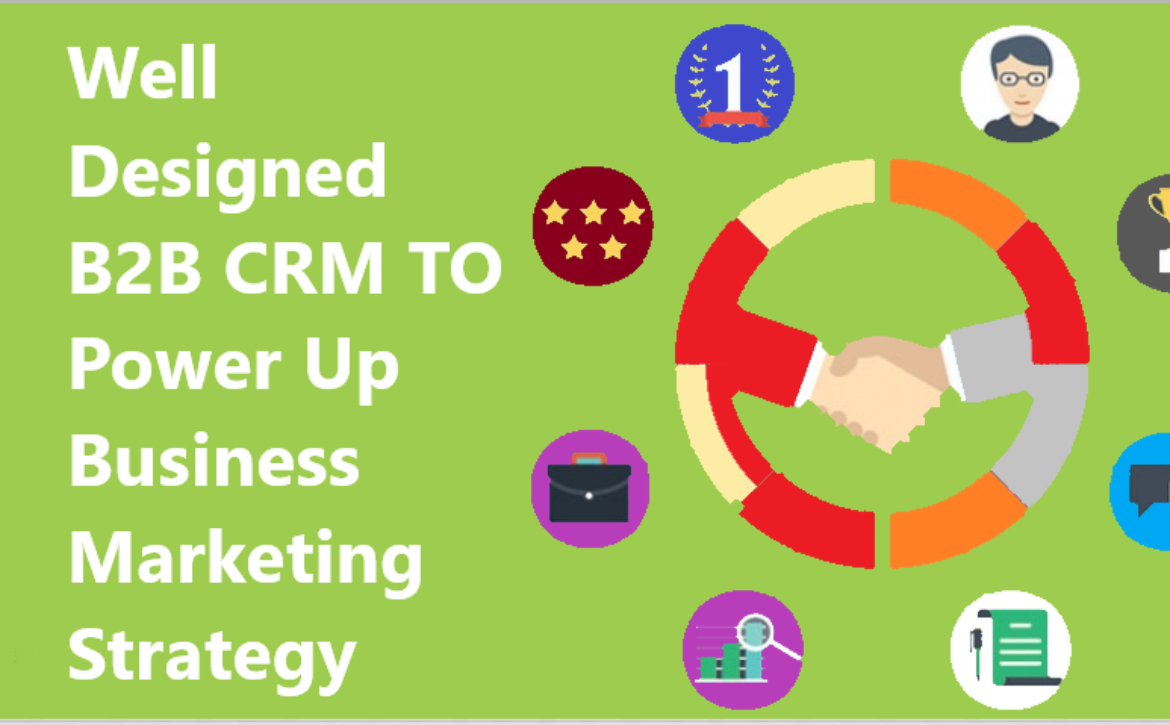
Well Designed B2B CRM TO Power Up Business Marketing Strategy

In general, B2B services relate to a company that sells its goods or services to another company. For example, hospitals require management equipment that is delivered by vendors that make a living by selling this equipment.

In this context, a hospital is a company that buys goods from another company. This is a typical example of business-to-business (B2B) services.


Customers are the most important aspect of every organization, whether it is B2B or B2C. As a result, it is critical for organizations to have an efficient Customer Relationship Management strategy that generates more leads, improves conversion rates, and boosts customer retention rates.


CRM for B2B firms is not the same as CRM for B2C brands. This is due to the fact that businesses are more sophisticated and multidimensional than a single client. Brands have various concerns and requirements at each touchpoint, making it challenging for businesses to determine what they needed and where they require it. This is why B2B organizations need a CRM system and strategy to assist guide and nurture their contacts (other companies) along the sales funnel, as well as automate certain chores.


What is a B2B CRM?

A B2B CRM Software is a cloud platform that handles all aspects of your client connection from a single system. The primary goal of a B2B sales CRM is to manage your sales cycle, from lead capture through discovery calls, follow-ups, customer conversion, and eventually enhancing overall client retention. A great CRM, such as Kapture, contains everything your company requires to manage client connections.

Because the B2B sales cycle is a sophisticated process with various touchpoints, a thorough CRM strategy is required for improved productivity and brand awareness. The B2B CRM strategy is a plan that outlines the procedures that should be applied to boost the company’s sales and profitability. It is a sophisticated tool that identifies flaws in your present B2B sales CRM process and offers innovative solutions to improve business management.

The CRM system, by gathering and sorting the information, enables the marketing and sales team to follow individual prospects in detail and figure out exactly how and when to influence them to go to the next step of the funnel, as well as to automate the various task.

B2B CRMs should be viewed as a strategic approach of analyzing, managing, and meeting the demands of business customers at each stage of the buyer’s journey.


Benefits of B2B CRM

Modern CRM systems are meant to company’s interaction managementwith present and prospective consumers. It aids in data analysis to assess client interest, nurtures leads, and aids in customer retention by providing customized content for them.

CRM is extremely valuable for B2B marketers since it enables them to complete their ultimate objective of Conversion Rate Optimization (CRO) by recognizing and prioritizing their clients’ demands.

CRM not only helps to tailor experiences for potential consumers across many touchpoints, but it also aids in a variety of other activities such as using data from various sources to bridge the gap between marketing and sales teams.

 

Sales management

B2B sales is not a straightforward procedure like B2C sales, where a single sales process may serve the whole lead pool. B2B sales is a complicated process in which organizations must seek an edge from a limited lead pool. As a result, competition is fiercer, and rivals must think outside the box to capture a lead and convert it into a client.

Recognizing that the B2B client is also a corporation, the selling company must exercise extreme caution while developing a sales plan, beginning with the initial discovery call. The sales process entails more study and a deeper understanding of the clients.

The B2B organization may easily manage the whole sales cycle by implementing the best B2B CRM.

The sales process supplied by Kapture is totally configurable and created with innovative features that will undoubtedly make your sales management process easier and more efficient.

Kapture’s sales cycle features specific apps with interconnected workflow to transfer your leads seamlessly through the sales cycle and enhance conversion rate. In addition, the lead generation process assists sales teams in qualifying leads, moving them through the sales funnel, and analyzing the likelihood of the leads becoming loyal clients.


Improved efficiency

Brand exposure is an important issue for B2B enterprises to consider. As previously said, the lead pool is extremely limited, and every second counts. Companies must be persistent and careful while adopting and reviewing their sales strategy. One of the primary benefits of a B2B CRM is that it increases corporate efficiency.

A CRM program features a strong database management system that records all information about leads, opportunities, connections, and customers. Furthermore, it enables teams to record every communication without interfering with the communication process.

Kapture includes specific apps for managing information about customers, contacts, prospects, and leads. This enables sales and marketing teams to easily access prior interactions, ascertain current status, and deliver immediate answers. Another advantage of using a CRM is that it eliminates the need to manage different spreadsheets.

Instead, it connects to various third-party apps and collects all of the data in a single system that is simple to use and quick to manage. Several programs may be used by your company to handle various aspects of your process. Kapture, on the other hand, collects all of the data, develops a correlation, and gives optimum data to boost the efficiency of sales teams that are frequently burdened with unnecessary activities.


Stronger communication

In most B2B services, there are two primary modes of communication. Internal collaboration and outward communication are examples of this. Both are critical components of every business. Communication, whether B2C or B2B, is the cornerstone for improved company management. In reality, both modes of communication are necessary for effective customer service.

When internal communication aids in the avoidance of misunderstanding while providing service, external communication aids in the delivery of timely service to B2B clients. To attain stability and bridge the gaps between these two channels, a powerful CRM system must be incorporated to provide customers with increased services.

The Kapture One package includes specific collaboration tools that assist salespeople in documenting every encounter with a lead, prospect, or client. Kapture’s collaboration capabilities include tasks, notes, call logs, a calendar, documents, and a news feed. These solutions give a consistent platform for sales teams to evaluate prior contacts and respond in a timely manner.


Advanced automation

Automation has evolved into an essential component of a CRM system. Having said that, Kapture boasts cutting-edge automation solutions that alleviate the pressure on sales staff. With B2B customer relationship management software, all of the redundant responsibilities of sales and marketing teams are successfully managed.

Triggers are a popular automation feature from Kapture that do specific operations automatically whenever a condition is met on a record. Similarly, we have additional automation technologies that boost corporate efficiency and allow sales staff to focus more on selling while the system supervises the monotonous chores.


Detailed analysis

In most sectors, data-driven marketing has gained the lead. Companies have abandoned traditional marketing strategies in favor of a greater emphasis on analytics in order to maximize outcomes.

To acquire new leads and maintain existing clients, B2B service companies rely significantly on data-driven marketing. This plan enables companies to categorize their future clients depending on the performance of their current marketing strategy by analyzing their existing customer base based on established KPIs. This also gives information on the essential aspects that a salesperson should consider before certifying leads and moving them through the sales funnel.

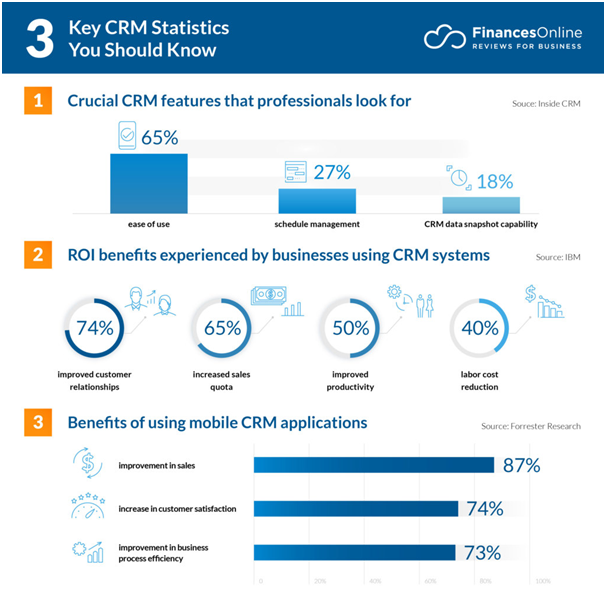
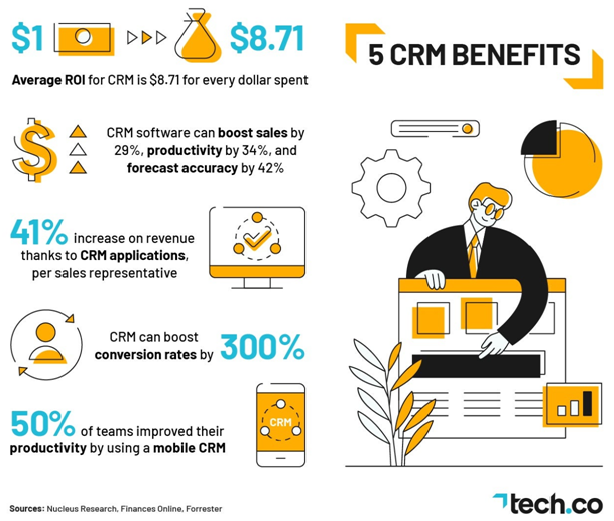
Statistics from Forester have shown that 50% of teams improved their productivity by using a mobile CRM- https://www.forrester.com/bold


Kapture’s sales automation software automates the delivery of daily sales information by email and SMS. You may see total calls planned vs. calls made, client meetings scheduled vs. actual visits, amount of orders placed, real-time sales activity, and so on. These reports may be seen using the desktop API or the mobile dashboard!

Get complete insights into your every sales activity through 1000+ reporting formats and let the data work for you the way you want. Get details in the form you understand and make smart business decisions with the help of Kapture.


Conclusion

CRM solutions are being used by B2B service providers all over the world to manage their company operations. It has become an essential component, with management allocating the most important work to staff and setting the system to handle the redundant duties. This relieves stress on staff, encourages them to focus more on conversion, and eliminates the need for extra resources.

Read More
Sanju January 24, 2022 0 Comments

Which is Best: Cloud CRM or On-premises CRM?

The last decade witnessed a rise in the use and popularity of cloud technology or also known as Software as a Service (SaaS). Many business leaders prefer on-premises CRM solutions for their business because of their needs. But many entrepreneurs might have this question which one is the best cloud CRM or on-premises CRM. No doubt both software solutions have their advantages, but features might differ from one another. In this blog, we will clear a few concepts about customer relationship management software, and you can choose which one is best for you.

Cloud CRM vs on-premises CRM:

The core factor that differentiates between these two CRM software solutions is where they store the software and information. Firstly, the On-premises or traditional or legacy CRM systems store; the database on the local servers. And cloud-based or software as a service solution saves the information on a remote server which your team can access through the internet.

The best advantage of the cloud-based CRM software is that you can leave the hassle of installation and maintenance hassle to the vendor. Many small and medium-sized enterprises prefer cloud solutions; as it does not charge a large amount of upfront cost, or they do not have to invest in a vast IT infrastructure or a team. On-premises solutions work the best for large-sized enterprises because they can invest in an IT infrastructure and a team.

Cost comparison:

The best Cloud-based CRM software is easily scalable as per your business requirement; because you increase or decrease the storage capacity as per your needs. You can speak to your cloud vendor and alter the subscription. Additionally, you do not have to invest in an extra server; to increase the storage capacity.

Implementation of the online CRM system, you can streamline your processes because all the departments are connected on a single platform for a faster result.

The cloud is capable; of centralizing the storage in one place and helps your team; to access real-time information from anywhere.

The cloud CRM vendor is responsible for fixing the bugs and upgrading their information automatically to ensure that your teams are working on the updated bug-free systems all the time. Cloud CRM software will have a cheaper investment cost compared to on-premises because of the above reasons.

What are the benefits of the cloud CRM software for small and medium-sized businesses?

The cloud CRM system is the best available option for small and medium-sized businesses because of:

  • The investment cost is cheaper with more robust features.
  • They do not have to think about IT infrastructure or team, or even hardware.
  • They can access and update the database in real-time from anywhere at any time.
  • All your workforce unifies on a centralized server to perform the task.
  • You do not have to invest in a high-end device; you can access and update the data from a tablet or mobile with an internet connection.

Security:

As CRM software has all your customer databases, it is crucial to secure your data. Many business leaders will prefer on-premises CRM even if the top CRM software is more secure than private data servers.

The best cloud vendor will have lesser outages; because they want to deliver the best services to their clients. Because the downtime of the CRM solution; will cost your company and which is not good.

The on-premises solution might also have downtime, but you have control over your team to resolve the issue with cloud vendors; you have to rely on their team.

The cloud vendors also back up your data at various servers, so if one server crashes you do not lose your data. The vendor also has to comply with data protection policies that is why they have the best cybersecurity in place to keep your data safe. If you choose a shared server to store your data, the server is the same for multiple clients that might put your data at risk.

The on-premises CRM solution is more secure because the servers are local, and a few people have access to it.

Which one to choose between cloud and on-premises CRM?

As many business owners might be hesitant to move to a cloud-based solution so they can go for a hybrid solution. The hybrid solution is a combination of on-premises hardware and software and a private or public cloud.

It is essential to have a pick and mix approach to determine which software works the best for you and its success rate. You can implement on-premises CRM software for an existing and successful business. Moreover, you can implement a cloud CRM for a new business; to minimize the investment risk, on the business. With cloud technology, you can pay as you go or pay per user, which will not drain your finances or add unnecessary expenditures.

Conclusion:

The recent pandemic that affected the world and globalization is expanding; which makes it even more necessary to unite your teams on a single platform. Therefore it is safe to say that cloud CRM software is the best solution because it is a more reliable, scalable, and cost-effective solution for modern businesses. Cloud technology is gaining popularity and has prevalence more than ever and will continue to expand its global market.

Read More
Sanju March 12, 2021 0 Comments

How CRM software can manage a client’s relationship?

The most valuable resource of any company is its customers!!

In today’s economic environment, it is important to minimize the churn of customers and increase their profitability. And, this cannot be achieved without building trust and loyalty.

The foundation of trust is an effective customer management and an individual approach to each of them.

Good customer knowledge allows you to fundamentally change the business model: from an ineffective strategy of finding new customers for the proposed solutions, to moving to develop solutions for existing customers, taking into account their needs. This personalized service is a direct path to building loyalty, which means increasing the value of the customer base and the company’s success.

With technological progress, many Customer Relationship Management (CRM) software came into existence. The main aim of these types of solutions is to streamline the daily chaos of the businesses so that the customers can be prioritized. Saying that- CRM is an effective solution to manage the customer’s relationship is right!!

Table of Contents

What is CRM?
Why is CRM important?
CRM benefits to building customer relationships better
Great customer retention
Better knowledge of customer’s needs
More active communication
More protection of data privacy
Combine all your data into one user-friendly location
Sell more quickly
Update the sales methods
How to choose a CRM?
Concluding Remarks

What is CRM?

Customer Relationship Management (CRM) is translated as “customer relationship management”. Behind these words lies software that is designed to improve business processes in the company and make interaction with customers easier and more convenient for both parties.

In other words, the business gets the opportunity to keep customer data close at hand, thereby increasing the quality of service and the loyalty of its customers. Below are the benefits of CRM for your business:

  • Improves contact management
  • Improves customer retention and satisfaction
  • Improves sales management
  • Improves efficiency and productivity
  • Creates organization and team collaboration
  • Improves the accuracy of reporting and forecasting sales
  • Improves understanding of data for marketing and product development
  • Increases sales figures
  • Promotes business growth

Why is CRM important?

For many companies, their CRM is not just important – it is absolutely essential! To get the most out of your business, you need to build CRM into your business strategy. This will create a structure and organization for your company that will enhance efficiency, productivity and profitability.

Although it was originally designed for sales teams, the benefits of using CRM for an entire organization can be immeasurable. However, it is becoming increasingly important for marketers and customer service teams managing after-sales communications.

The software allows you to better understand how your business is performing by using actual sales data to eliminate guesswork from business decisions. It provides a complete overview of your customers and their activities, allowing you to create a truly customer-centric approach that will guide your customer service strategy.

CRM benefits to building customer relationships better

Great customer retention

Despite being the better asset in knowing and pleasing the new or potential customers, Customer Relationship Management works as the best software for keeping the existing customers satisfied.

The management solution has several customer retention advantages; you can hold your promises by notifying about upcoming appointments and also, send the follow-ups at a suitable time.

However, what makes it the best solution is that it enables you to reach the customers who have not shown interest in a while and even felt ignored. Of course, retaining the existing customers is very much economical than securing the new one. 

For sustaining the customer’s interest, customer relationship management assists you to manage the marketing activities; you can send free trial offers, email campaigns and publish the customer’s surveys on an appropriate time. So, with CRM you can increase customers retention rate easily.

Better knowledge of customer’s needs

Generally, when we know what to expect, we feel more convinced. Same is true when it is about the business. It is simple yet easy to upsell or cross-sell the customer when you know their purchasing needs.

As one of the advantages of CRM software is to assist the salespeople to sell faster and sell more, it is the access to the customer communication history via the entire customer journey that permits the sales reps to know the customer requirements.

When you understand the contact’s purchase history- when they purchase and when what contracts they were provided, what purchasing habits they explained, and how they convert them to the customers, you have to be proactive and have better or new offers at the suitable time.

The CRM system is also essential in offering the best customer service. Access to communication history makes it simple to provide on-time customer service. In just some clicks, you understand if the contact had some problems with the product, how the service requests were managed, and if they were pleased or not. Also, when they have issues of something in the past- it is your chance to restore the reputation and provide better customer experience.

More active communication

Don’t let your customers wait by immediately responding to their requests, which is a symbol of professionalism. Saving you and your customer’s time is the CRM system that provides you ready-to-use email and customizable templates, documents, letters, quotes, proposals, newsletters, etc.

It is being found that there are 90% of the businesses that do not leverage autoresponders for confirming they have got the customer service email.

The other benefit is that Customer Relationship Software also assists you to enlist email or SMS and schedule their dispatch months or weeks in advance. And, when it is about the customer service requests, best speed is a must.

Finding the contact information in just a click, the CRM software permits you to personalize the interaction, send replies and provide quick solutions to recurrent problems, send links to videos and FAQs, etc.

More protection of data privacy

Data privacy cannot be ignored in any case when you are handling a large amount of data. To fulfil the data privacy needs of the new EU regulations, it is more essential to secure the CRM software with the default GDPR (General Data Protection Regulation) related functionality

The major advantage of CRM is that it saves more effort and time as being GDPR compliant is a task in itself. Never forget the repulsive legal consequences when the privacy laws got violated.

The management software assists you to get and draft the contact’s permission to save and use personal information, sending the automatic alerts to every contact notifying that you like to store the data, email communication preferences to manage the customer’s subscription and also, setting up the rules for updating the personal information for several contacts- at one time.

Executing everything manually takes a lot of time and you can also even make several mistakes. However, CRM software for the same assures reliable, quicker and safer data processing. Additionally, it makes all communications GDPR complaints. All these efforts generate trust as you are now managing the customers’ data with total respect.

Combine all your data into one user-friendly location

Customer relationship management software centralizes the customer’s information. It makes all access to the information they require from one platform.

  • Customer’s contact details

Check out the customer’s phone numbers, email addresses, websites, mailing addresses, social media accounts and websites.

  • Over-all interaction history

Tracking of communication history from phone calls, email, customer support tickets and online chats, etc.

  • Customer history

Reference the buying history, length of customer relationships, and how the customers know the business.

●     Sell more quickly

One of the most productivity killers is handling data manually. From CRM software, you can automate the repetitive admin tasks to make the team spend more time selling and less time typing. It, also, assists you create the general sales process that provides the team the proper roadmap for securing deals and assists to lessen the length of the sales cycle. From the sales process, you can:

Update the sales methods

The sales methods offer the data you have to find out the main cause of delayed deals. Follow the steps to solve the issues and assure that the staff focuses on those efforts/activities that offer higher revenue.

  • Correctly analyze the sales

With the more precise sense of the win rate permits the sales manager to examine how many sales are closed by the team from the set realistic revenue goals and given a number of leads.

  • Hire new to speed quickly

The general process assures the training sales reps simple, fast, and almost foolproof, by showing salespeople what they require to do at each stage of the sale. Also, the rookie sellers make an instant impact once they learn the general steps in the sales process.

  • Offer more satisfying customer experience

When sales representatives drove potential customers to the sales stage, they did not expect that this might kill the transaction and destroy the relationship with the buyer. The sales process assures the seller does not promote the sale till the buyer is ready to move ahead.

How to choose a CRM?

When choosing a CRM, be realistic about your IT competency and your needs, as well as how much you want to spend. You need a balance between ease of use and the features included.

Typically, the price is determined by the number of users, the number of customer records, storage requirements, and complexity of features.

Most vendors offer a free trial of CRM so that you can examine how the system will work for you and how customer support is done!

Concluding Remarks

The major priority of businesses is customer relationships. Always remember- the customers are more responsible for generating sales.

 You have more powerful products to provide, however, if you do not consider your customers the best, then, you will not sell!!

Hence, generating better relationships with customers is very much important.  And, this is what the management solution provides. It assists you to manage the best relationship with the customers by treating everyone separately, not ignoring them, and accompanying them when you need them.

All you have to do now is to get the best customer relationship management software as per your business needs.  We hope you will find the best one!!

Hopefully, this article has given you the best of the knowledge. If there are some queries or suggestions then let us know in the comment section below.

Thanks for reading!!

Read More
Sanju January 18, 2021 0 Comments