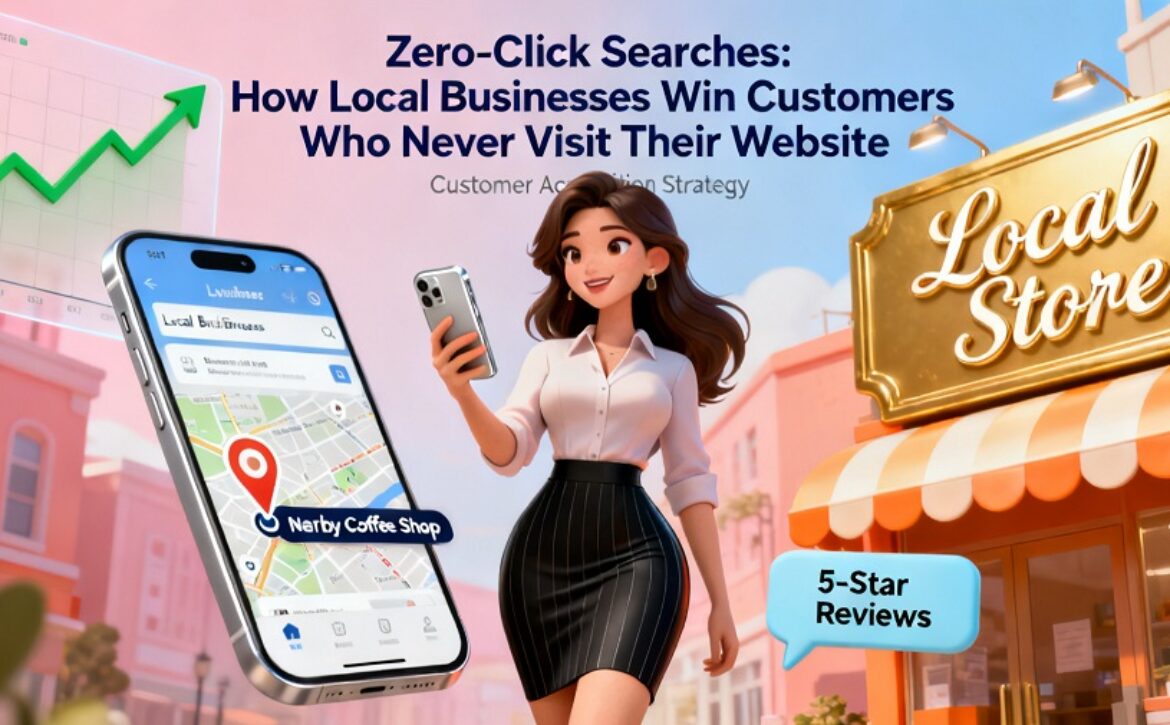
Zero-Click Searches: How Local Businesses Win Customers Who Never Visit Their Website

A majority of Google searches now end without a single click to any website. Unfortunately, most business owners don’t know that. People type a query, get their answer right on the results page, and move on with their day. That means no website visit, no page views, and nothing showing up in your traffic reports.

For local businesses, zero-click searches are now the fastest path from search to sale. The businesses that understand this are pulling ahead of competitors who still obsess over website traffic. This post breaks down what zero-click searches are and how to turn Google’s results page into your best-performing storefront.


What Are Zero-Click Searches?

——————————

A zero-click search is exactly what it sounds like. Someone searches on Google, finds everything they need directly on the results page, and never clicks through to a website. The answer comes from features Google displays right up front: the local map pack, knowledge panels, featured snippets, review stars, and now AI-generated summaries.

A recent SparkToro research (based on Similarweb clickstream data) found that 68% of US Google searches now end without a click. A zero-click search is not a lost visitor; rather, it’s a customer who got what they needed faster. When someone finds your phone number on the results page and calls you immediately, you can skip the website entirely and still win the customer. That is an easy form of conversion.


Why Local Searches Are the Most Zero-Click of All

——————————

Local searches carry urgent, ready-to-buy intent. Google knows this, which is why local queries trigger the most click-free results page on the internet. Searchers see the local three-pack with three businesses on a map, star ratings, review counts, photos, hours, and tap-to-call buttons before any traditional website link appears.

The mobile factor makes this even more dramatic. On a phone screen, the local pack and its map often fill the entire first view. Your website link might sit two or three full scrolls below, in territory most searchers never reach. Nearly half of all Google searches have local intent, so this is not a niche problem. It is the main event for any business serving a physical area.


Your Google Business Profile Is the New Homepage

——————————

For local queries, the Google Business Profile (GBP) has now replaced the homepage as the first impression. Before a potential customer ever views your website, they see your profile with your photos, hours, star rating, services, and reviews. In a zero-click world, that profile is the only impression they get.

Consider your GBP a mini website that lives inside Google itself. It loads instantly, answers the most common questions upfront, and meets customers at the exact moment they are ready to act.

This is why you need a Google Business Profile that is complete, verified, and actively managed, rather than one you set up years ago and forgot about. An abandoned profile with outdated hours and three grainy photos can make searchers think your business might not even be open. On the other hand, a complete one signals a business that is alive, trusted, and ready for their call. Complete means more than filling in your name and address. Here is what a profile that competes in the local pack includes:

  • An accurate primary category that matches your core service, with secondary categories covering everything else you offer.
  • Fresh, high-quality photos of your storefront, team, and work, updated regularly instead of once at setup.
  • A full list of services with descriptions so searchers can confirm you do exactly what they need.
  • Current hours, including holidays, because nothing loses a customer faster than showing up to a closed door.
  • Verified status and correct contact details that match your website and signage exactly.

You do not need to become a full-time profile manager. A little consistent attention beats a one-time setup every single time.


5 Zero-Click Conversion Actions That Matter

——————————

Your profile gives searchers direct ways to become customers without ever touching your website, and these actions deserve a place in your reporting:

  1. Calls placed straight from your listing: A searcher taps the call button and is talking to your team seconds after searching.
  2. Direction requests: Someone asked Google how to physically get to you, which is about as strong as buying intent gets.
  3. Bookings and quote requests: Appointment links and quote buttons on your profile turn searchers into scheduled customers in one step.
  4. Messages: Profile messaging lets people ask quick questions without having to hunt through your site for a contact form.
  5. Service and product views: These show searchers actively comparing what you offer before reaching out.

These actions carry higher intent than a website visit. Google’s research found that 76% of people who search for something nearby visit a business within a day. This is why forward-thinking agencies have changed how they define success for local clients.

Timmermann Group, for example, builds local search strategies around conversions over diversions. Their team measures calls, bookings, and direction requests instead of chasing traffic numbers that look good in a report but never ring the phone.


How Reviews and Photos Help Businesses Close the Deal

——————————

When a searcher looks at three local businesses, they primarily rely on reviews. All three options may offer the same service at similar prices, but the one with 180 recent reviews, 4.8 stars, and high-quality photos will surely stand out.

Reviews and photos are your trust layer in the zero-click moment. Recent reviews also tell Google your business is active and relevant, which can lift your position in the local pack. Trust and visibility grow together here, so treat reviews and photos as an ongoing system with three moving parts.

Build a Steady Review Habit

Ask happy customers for a review right after a great experience, while the goodwill is fresh. Make it effortless by sharing your direct review link in follow-up emails, texts, or receipts. A slow, steady stream of recent reviews beats a big batch from two years ago because searchers check dates.

Respond to Every Review

Reply to the good ones with a quick, genuine thank-you. Reply to the critical ones calmly, own what went wrong, and offer to make it right. A thoughtful response to criticism often impresses future customers more than the five-star reviews around it.

Keep Your Photos Current

Refresh your photos every quarter so your profile reflects the business you run today, not the one you ran three years ago. Show your storefront, team, and actual work rather than stock images. Real photos build trust in a way polished graphics never will.


Your Website Still Matters, Just Differently

——————————

Your profile handles fast, urgent searchers, while your website serves deeper researchers who are comparing options, reading case studies, and looking for detailed pricing before a bigger commitment.

Google uses signals from your site, including your location pages, structured data, and service descriptions, to determine how prominently your profile appears in local search results. A thin or inconsistent website weakens the very profile doing your zero-click heavy lifting.

Local landing pages for each area you serve also give Google more confidence about where you operate. That confidence helps your profile surface for the right searches in the right neighborhoods.

Consistency is the connective tissue here. Your business name, address, phone number, services, and hours should match exactly across your profile and your site.

Professional agencies treat the website and the Business Profile as one connected system rather than two separate projects, and that mindset is worth borrowing. When both assets tell Google the same story, both perform better.


How to Measure Zero-Click Success

——————————

You cannot improve what you do not measure, so start with the performance insights inside your Business Profile dashboard. Then, build a simple monthly routine around these numbers:

  • Profile views and search queries show how many people found you and what they typed to get there.
  • Calls from your listing are your most direct zero-click conversions, and a call tracking number configured correctly for local search tells you exactly which calls came from your profile.
  • Direction requests reveal how many searchers decided to visit you in person.
  • Website and booking link clicks deserve UTM tags so those visits show up clearly in your analytics instead of hiding in generic organic traffic.
  • Month-over-month trends matter more than any single number, so track direction over time.

If calls and direction requests climb while website traffic stays flat, do not panic. Your local presence is working exactly as it should in 2026.


Endnote

Zero-click searches are a shortcut between you and customers who are ready to buy right now, and the results page is where that handoff happens.

The businesses winning this shift treat their Google presence like a primary sales channel, not a box they checked once. Keep your profile complete and up to date, build your review engine, make your website consistent with your listing, and measure actions. None of this requires a big budget or a full marketing team. It simply requires showing up consistently in the place your customers already look first.

All you have to do is search your own business on your phone today and look at your profile the way a stranger would. If what you see would not convince you to call, you know where to start.

Read More
Sanju July 16, 2026 0 Comments

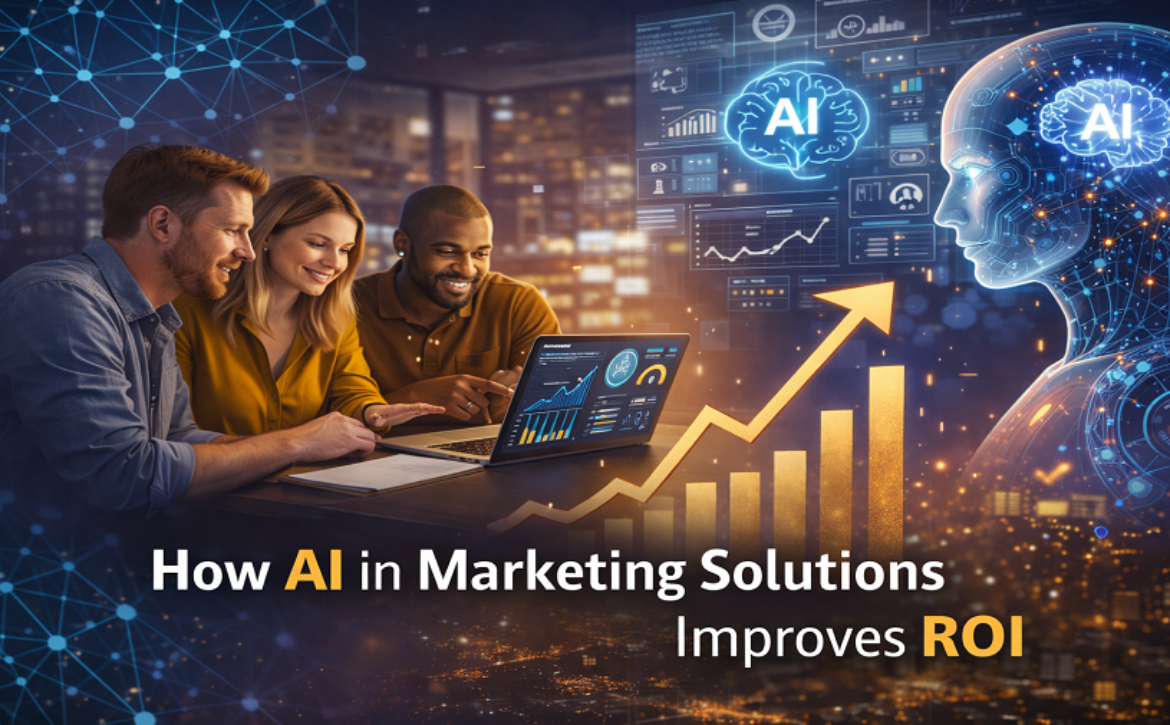
How AI in Marketing Solutions Improves ROI and Marketing Efficiency

The advantage that distinguishes high-performing firms from others is the loss of access to tools and individuals. It is the capacity to make better judgments more quickly and with less ambiguity. Customers allow too little room for mistake, and markets evolve too fast for static tactics. Artificial Intelligence (AI) has enabled marketing systems to learn from every encounter and get better with each result. Prior to allocating resources, they predict what will work rather than responding to performance after it occurs. This move has altered how return on investment is calculated, quantified, and scaled.

In this blog, we’ll talk about how AI in marketing solutions can assist in saving time, cut down on waste, and get a better return on investment throughout the customer’s lifetime.


The Evolution of AI in Marketing Solutions

——————————-

Marketing technology has advanced from basic automation platforms to complex systems that can analyze behavior and make choices on their own within the last ten years.

From Regulation to Intelligence

Static rules governed early marketing automation: send emails at X times, put advertisements in Y channels, and monitor clicks. AI nowadays:

  • Learns from patterns instead of following predefined rules
  • Adjusts actions based on real-time behavior, not historical assumptions
  • Improves over time through continual feedback

Recent Market Shifts Influencing Adoption

Several macro trends have accelerated AI deployment:

Privacy changes
As third-party data recedes, first-party behavioral signals become more valuable. AI systems extract deeper insight from limited data sets.

Digital saturation
Consumers engage across multiple touchpoints. Human teams struggle to coordinate insight at scale. Intelligent systems optimize pathways across channels.

Revenue accountability
Marketing budgets are scrutinized more closely. Decision-makers expect evidence that spending directly adds to measurable value.

In this situation, artificial intelligence serves as the link between data, execution, and results.


Precision Targeting and Personalization

——————————-

AI’s ability to enhance ROI through sophisticated segmentation and customization is among its most significant effects.

Traditional Targeting vs. Predictive Targeting

Historically, audiences were defined by demographics, categories, or industry verticals. These criteria are high-level proxies for intent but weak predictors of purchasing behavior. AI changes this by modeling real-world signals.

AI-Driven Segmentation Uses:
  • Engagement signals (scroll depth, time spent, clicks)
  • Behavioral clusters derived from interaction patterns
  • Contextual signals like buyer readiness and channel affinity

This results in reduced ad waste, higher relevance, and better allocation of resources to high-value prospects.


Dynamic Personalization

Modern systems adapt messaging at scale:

  • Landing page content tailored per visitor
  • Emails customized based on interaction history
  • Offers are adjusted based on the likelihood of purchase

This goes beyond “spray and pray” marketing to intelligent individual engagement.


Automating Execution with Enhanced Performance

——————————-

Efficiency alone does not guarantee ROI growth. The value emerges when automation intersects with performance improvement.

Integrated Automation with Adaptive Learning

AI-driven automation differs from traditional workflow automation:

Decision-level optimization
Instead of adhering to set processes, AI constantly compares the performance of each operation against actual results. It determines which timings, channels, and messages have the biggest effects and automatically ranks those that produce quantifiable lift. It guarantees that resources are constantly directed toward the things that genuinely improve performance.

Feedback loops
Every interaction turns into a learning signal. Instead of depending on out-of-date assumptions, campaign outcomes are fed back into the system, improving future forecasts and enabling tactics to get better with each cycle.

Cross-channel synchronization
A unified experience that adjusts without manual coordination is produced by real-time alignment of activity across online, search, email, and social platforms.


What This Means Practically

  • Budget shifts dynamically toward channels performing above target thresholds.
  • Messaging adjusts automatically to what resonates best with different segments.
  • Lead nurturing adapts based on engagement patterns.

The combined effect? More conversions at lower marginal cost.


Optimization Beyond Surface Metrics

——————————-

ROI is no longer determined by views or clicks alone. Intelligent systems connect marketing activity to value creation in deeper ways.

Modeling Customer Journeys

AI maps multi-stage customer journeys – not as linear funnels, but as evolving graphs of behavior. This allows businesses to:

  • Identify drop-off points that reduce conversion probability.
  • Detect high-potential signals early in the interaction.
  • Forecast which paths drive revenue most efficiently.

Predictive Analytics in Action

Predictive models identify outcomes before they occur:

  • Which leads will become customers?
  • What content accelerates decision-making?
  • When is a prospect most receptive to conversion?

This shifts the strategy from reactive assessment to forward-leaning optimization.

Measuring Impact with Advanced Insights  

——————————-

A common pain point in marketing has been delayed or superficial reporting. AI enables real-time visibility and a deeper understanding.

Through AI in reporting & insights, systems detect correlations and anomalies that humans would never spot across thousands of data points.


Real-Time Performance Intelligence

Rather than static dashboards that report yesterday’s data, intelligent systems provide:

  • Alerts for performance deviations
  • Causal analysis, not just correlation
  • Insight into why outcomes varied

This goes beyond metrics to reveal the drivers behind them.


Cross-Functional Alignment

Intelligent insight bridges operational silos:

  • Marketing performance becomes visible to finance.
  • Customer behavior informs product prioritization.
  • Sales conversations integrate with campaign performance.

This alignment ensures that marketing is accountable not only for input metrics but for revenue outcomes.


Market Trends Driving Adoption and ROI Acceleration

——————————-

Understanding ROI requires context about where the market is heading and how AI reshapes competitive dynamics.

Trend: Privacy-First Intelligence

With restrictions on third-party tracking and cookie deprecation, access to external audience data is diminishing. AI compensates by maximizing value from first-party signals and compensating for data gaps through pattern recognition.

Impact: Improved performance assessment and targeting in a privacy-focused environment.


Trend: Real-Time Adaptive Advertising

Nowadays, real-time optimization is embraced by programmatic media, where bids, creativity, and channel selection adapt to real-time performance indications.

Impact: Higher yield from advertising spend by aligning budgets with active market dynamics.


Trend: Generative AI for Creative Production

Developments in generative models enable the quick production of customized content that takes into account the context and preferences of particular audiences.

Impact: Faster iteration cycles and reduced creative costs without compromising relevance.


What Changes When ROI Becomes Predictable?

——————————-

When AI systems govern marketing performance at scale, several strategic shifts occur:

ROI Moves from Estimation to Measurement

Budgets are no longer justified by replacement cost or benchmark comparisons. They are rationalized based on expected contribution to revenue.

Decision Cycles Accelerate

Manual analysis and planning give way to automated insight loops. Teams spend more time thinking strategically rather than interpreting spreadsheets.

Experimentation Becomes Scalable

Testing is no longer limited by manual constraints. Intelligent models evaluate combinations of messaging, timing, and targeting without exhausting resources.


How to Evaluate AI Investments for ROI?

——————————-

Not all AI systems deliver equal value. To assess the potential impact on ROI, consider:

Data connectivity
Is the system unified with key data sources?

Actionability
Does the solution surface insight that directly informs decisions?

Adaptive learning
Can the platform refine performance automatically over time?

Predictive capability
Does it forecast revenue impacts with measurable accuracy?

Investments should be judged not on features alone but on whether they measurably improve performance outcomes.


Conclusion

To put it briefly, the way value is produced, assessed, and sustained has fundamentally changed as a result of AI’s influence on marketing solutions. Intelligent technologies are transforming ROI from an aspirational number to a measurable, continually optimized outcome. As channels multiply and consumer expectations grow, the ability to anticipate demands, adjust engagement, and respond in real time will differentiate revenue-generating systems from those that generate noise. In this context, marketing intelligence is the primary driver of productivity, expansion, and quantifiable return rather than an add-on.

Ready to make every campaign accountable to results? Connect with our experts to build a marketing framework designed for profitable growth.

Read More
Sanju March 2, 2026 0 Comments

Klaviyo Agencies: Unlocking 2026 Predictive Personalization Secrets

Personalization is no longer about knowing. It’s about predicting.

A customer has not clicked, not browsed, not searched, and yet the system already leans toward what they will want next. That used to feel like magic.

In 2026, it will feel like engineering.

Personalization has moved from reactive to anticipatory. It is probabilistic and real-time. Where teams once stitched segments from past behavior, the next generation will surface offers based on likely intent.

That means anticipating a reorder before the cart fills, surfacing the right cross-sell while a first purchase is still warming, and quieting promotions for a customer on the edge of churn.

Most brands still personalize by looking backward.

The winners in 2026 will be those who look forward.

A Klaviyo marketing agency that masters predictive personalization will stop chasing clicks and start orchestrating choices before the click even happens.

Let’s cut to the chase.


Why traditional personalization is reaching its limits

—————————–

Here are three reasons why traditional personalization can no longer cut the deal.

1. Segments are static in a dynamic world

Rule-based segments were brilliant for their time. They are easy to understand and audit. But they update slowly, rely on fixed criteria, and flatten individual nuance into groups.

In today’s world of multi-session shoppers and shifting intent, a static cohort rarely maps to a moment of purchase readiness.

2. Behavior-based personalization is always late

Most personalization waits for someone to do something, then reacts. After the click. After the browse. After the abandonment.

By the time the rule fires, the buying moment has often passed. Reactive systems can salvage revenue, but they rarely create it.

3. Modern buyers move faster than rules can adapt

Customers jump across devices and channels in a single decision cycle. Micro-moments and short sessions outpace manual updates.

Key point: when personalization reacts, the moment is gone.

Predictive approaches put your message in front of intent before it hardens into action.


What predictive personalization really means in 2026

—————————–

From rules to probabilities

Predictive personalization moves from binary rules to probability estimates: likelihood to purchase, likelihood to churn, likelihood to respond. This changes the unit of work from segments to scores and probabilities that update continuously.

From segments to individuals

No more “high intent group”. Instead, one model per customer, continuously estimating what nudges will move the needle for that person right now. Treat each profile as a moving target, not a bucket.

From automation to decisioning

Automation executes. Decisioning chooses.

Predictive personalization systems decide what to say, when to say it, where to send it, and which incentive will maximize long-term value, all without waiting on manual rules.

Core definition: predictive personalization uses AI to estimate future behavior and act before explicit signals appear.


Why Klaviyo is becoming a predictive personalization platform

—————————–

Here are three primary reasons (features) why Klaviyo is becoming a platform for predictive personalization.

1. Unified customer profiles as the foundation

Klaviyo’s value is its commerce-centric profile: orders, browsing, email and SMS behavior, returns, and support interactions.

When those signals live in one place, models can infer patterns across the whole customer lifecycle.

2. Real-time event streaming

Predictive work needs events as they happen. In-session triggers and micro-moment detection allow a system to update propensity scores mid-session and serve interventions before the customer drifts away.

3. Built-in AI and data science capabilities

Klaviyo has layered predictive models into core flows: churn likelihood, next purchase probability, and engagement scoring.

That makes it feasible for agencies to build lightweight decisioning systems without reinventing the entire stack.

Positioning: Klaviyo is evolving from an automation tool into a practical, commerce-first decisioning engine.


The role of Klaviyo agencies in this shift

—————————–

Why is predictive personalization not plug-and-play?

Prediction requires more than a checkbox. You need data modeling, careful signal selection, governance to avoid harmful interventions, and content architecture that supports many variations. You also need measurement frameworks that validate decision quality, not just open rates.

Agencies as architects, not implementers

Top agencies design prediction frameworks and personalization logic. They build modular creative, map signal flows, and document decision policies. They do not merely set up flows; they design systems that learn.

The new agency value proposition

The agency of 2026 sells intelligence engineering. From campaign execution to revenue orchestration, the deliverable becomes repeatable decision systems that compound value over time.

Now, let’s see what powers personalization in the coming times.


The predictive signals that power 2026 personalization

—————————–

Here are four predictive signals that boost personalization in 2026.

1. Behavioral velocity

Not just actions, but speed and acceleration: a sudden rise in product page views, shortened path times, rapid add-to-cart behavior.

Velocity is an early sign of intent.

2. Intent clustering

Patterns of repeated topic focus and cross-category movement reveal developing interests. Clusters form a probabilistic profile of what a customer is leaning toward next.

3. Micro-friction signals

Hesitation, partial scrolls, returning to the same item across sessions, these micro-friction signals often predict churn or readiness more reliably than a single click.

4. Contextual signals

Time of day, device, session depth, and referral source shape intent. A purchase at midnight on mobile has different implications than a midday desktop session.

Key insight: the loudest actions are not always the most predictive. Subtle patterns matter more than raw volume.


How Klaviyo agencies build predictive personalization systems

—————————–

Here is a 4-step strategy through which Klavioy agencies build predictive personalization systems.

Step:1 Define business outcomes first

Be explicit. Ask yourself: Are we optimizing conversion, retention, expansion, or reactivation? Every model and decision policy should map to a clear business outcome and an evaluation method.

Step 2: Select the right prediction targets

Choose targets that move the business: purchase likelihood, churn probability, product affinity. Focus on a few high-impact predictions before expanding.

Step 3: Design modular personalization blocks

Create interchangeable content modules that can be recombined by decision logic: variable hero blocks, offer modules, product carousels, and CTA variants. Modularity reduces creative overhead and keeps personalization scalable.

Step 4: Orchestrate across channels

Predictive decisions must act across email, SMS, on-site, and paid retargeting. A single decision should pick channel and timing to maximize impact while protecting reputation and frequency caps.

Now, let’s discuss how predictive personalization can be helpful in 2026 for your business.


Use cases defining predictive personalization in 2026

—————————–

Here are some real-life examples where predictive personalization can be a winning move in 2026.

1. Predictive abandonment prevention

A model detects rising abandonment probability mid-session and triggers an anticipatory message or personalized incentive before the cart empties. Intervention timing is chosen by probability, not a fixed timeout.

2. Anticipatory replenishment campaigns

Predict the reorder window and contact customers before they notice depletion. This increases convenience and reduces dependence on promotional nudges.

3. Churn risk suppression

When churn likelihood rises, the system suppresses broad discounts and instead triggers tailored recovery sequences designed to re-engage customers rather than condition them to promotions.

4. Cross-sell before the first purchase ends

Next-best-product logic suggests complementary items during the initial purchase window, improving average order value and creating a better first-order experience.

These systems do not react; they anticipate, nudge, and adapt in real time.

Now, let’s see how you can measure the success of your predictive personalization efforts in 2026.


Measurement in a predictive personalization world

—————————–

From attribution to anticipation

Measure lift versus control, prediction accuracy, and decision quality. The question is less “which email send drove this conversion” and more “did our decision increase the probability of the desired outcome?”

New KPIs that matter
  • Conversion probability lift
  • Time-to-purchase reduction
  • Churn risk delta
    These metrics quantify whether predictions are improving business outcomes, not just clicks.
Why A/B testing evolves

Testing becomes testing of models and policies, not just creative variants. You test which decision strategies produce better long-term revenue, and you iterate on the policies that govern actions.

That was the good part. Now, let’s see what problems you may face.


Common mistakes agencies and brands will make

—————————–

Here are three common mistakes most agencies and brands can make.

1. Treating prediction as a feature instead of a system

Prediction is not a button you toggle. It is an architecture that requires data pipelines, model validation, and ongoing governance.

2. Over-automating without governance

Black-box decisions erode trust. If customers receive seemingly random incentives or messages, you risk brand and legal problems.

3. Ignoring content architecture

Models fail without flexible, modular creativity. Prediction only works when content can be adapted quickly, safely, and at scale.

But then again, the partner you choose plays a vital role in the success of your personalization campaigns. So, let’s see how to find the best fit Klaviyo agency on the first attempt.


How to choose the right Klaviyo agency for 2026

—————————–

Before you partner with a Klaviyo agency, here are a few things you must do without failing.

1. Look beyond certifications

Certifications are table stakes. Ask about data modeling, prediction frameworks, and decision logic.

2. Ask these key questions
  • How do you design predictive journeys?
  • How do you validate models and measure decision quality?
  • How do you govern automated decisions to protect brand and lifetime value?
3.  Find red flags (if any)
  • Overpromising full certainty
  • No measurement framework for prediction quality
  • No explainability or auditability for decisions

Pick partners who treat personalization as engineering, not just marketing.


Wrapping up

That brings us to the business end of this article, where it’s fair to say that the best personalization will happen before the click

Personalization is moving from reactive systems that respond to behavior to predictive systems that anticipate intent.

The shift is not incremental. It changes what it means to engage a customer: fewer messages, fewer guesses, and more precise decisions.

  • From segments to systems.
  • From campaigns to continuous decisioning.
  • From chasing signals to shaping outcomes.

In 2026, personalization will not wait for behavior. It will anticipate it.

And the agencies that win will not send more messages.

They will make fewer, smarter decisions.

Read More
Sanju February 11, 2026 0 Comments

The Future of Marketing: How Customer Segmentation Software is Changing the Game

Marketing stands at a revolutionary juncture with advanced technology reshaping how companies interact with customers. At the core of this transformation is customer segmentation software, a powerful tool that enables businesses to dissect and understand their markets more precisely than ever before. The implications for marketing strategies are profound, offering a level of personalization that was once a mere fantasy. As we dive into this pivotal topic, we will explore the multifaceted dimensions and the potential it holds for businesses looking to thrive in a competitive landscape. Keep reading to uncover the intricacies and advantages of these sophisticated systems.


The Evolution of Customer Segmentation in the Digital Age

————————————

The digital age has transformed customer segmentation from broad demographic targeting into a refined strategy based on behavior, preferences, and predictive data. This shift allows businesses to tailor marketing efforts more personally, improving engagement and loyalty.

Tools like Adestra have led the charge in this evolution. With advanced algorithms and machine learning, the top customer segmentation software now helps businesses adapt in real time to changing customer profiles, boosting retention and overall performance.


Advancements in Customer Segmentation Software Technology

————————————

Modern customer segmentation software leverages advanced data-driven algorithms and real-time analytics to deliver immediate, actionable insights. These tools integrate data from multiple channels—such as social media, email, web activity, and purchase history—to provide a comprehensive view of consumer behavior.

Machine learning enhances this process by allowing the software to continuously learn and improve, resulting in increasingly precise targeting. The user interfaces have become more intuitive, enabling marketers of all skill levels to utilize the technology effectively. This democratization of access empowers broader teams to optimize campaigns using refined segmentation and tailored messaging based on evolving consumer data.


Impact of Artificial Intelligence on Marketing Personalization

————————————

Artificial intelligence (AI) is revolutionizing marketing by enabling deep personalization through behavior analysis, preference learning, and predictive insights. AI-driven platforms surpass traditional segmentation by dynamically adjusting customer groups based on real-time interactions, keeping campaigns relevant and effective.

Formerly overlooked data points are now vital, helping AI uncover trends that guide marketers in delivering timely, targeted messages. This leads to more engaging customer experiences and higher conversion rates. As AI advances, its ability to anticipate consumer needs will sharpen, allowing marketers to tailor campaigns with near-individual precision. This ongoing evolution is redefining how businesses interact with and influence their audiences.


The Role of Big Data in Refining Customer Segmentation Strategies

————————————

Big data has transformed customer segmentation by enabling deeper insights into consumer behavior through vast, fast, and diverse data sources. With advanced analytics, businesses can identify hidden trends and patterns, allowing for highly targeted segmentation strategies. This granularity improves the efficiency of marketing efforts, boosting ROI by focusing on responsive audiences.

Big data also drives innovation by revealing niche markets and specific customer needs, informing both product development and personalized campaigns. Importantly, access to powerful analytics tools is no longer limited to large corporations—small and mid-sized businesses can now leverage these insights, making data-driven segmentation a standard practice across all business sizes.


Predictive Analytics: The New Frontier in Targeted Marketing Campaigns

————————————

Predictive analytics is transforming targeted marketing by enabling businesses to anticipate customer behavior and proactively tailor engagement. Unlike past reactive strategies, marketers now use predictive tools to model scenarios and guide smarter decision-making. This approach helps craft campaigns that align with future trends, boosting effectiveness and competitiveness.

Customer segmentation software with predictive capabilities can identify high-value prospects and churn risks, allowing for personalized outreach that maximizes customer lifetime value. As data becomes more robust and algorithms more sophisticated, marketers will gain deeper insights into behavior, enabling even more refined and impactful segmentation strategies.

Altogether, the integration of customer segmentation software into marketing strategies has introduced a depth of insight that is profoundly impacting how businesses engage with their audiences. The technology described promises to enable even more personalized, efficient, and forward-thinking marketing efforts in the years to come.

Read More
Sanju July 22, 2025 0 Comments

How to Use Video Marketing to Drive More Website Traffic

Have you ever felt that your value-packed content is going unnoticed in the digital world where everyone else is smitten with video marketing? You aren’t the only one! According to a study in the year 2025, around 86% of marketing professionals have seen an increase in their website traffic as a result of video marketing. It’s no longer optional but a major source of driving traffic.

From short how-to explainers to full-on tutorials, they are doing more than just educating, turning scrolls into sign-ups, thus boosting conversions. You don’t have to invest a high amount to deliver a notable performance even with the cheapest Python hosting or cheap domain hosting.

Do you want to bring your blog to life? This blog will explain how to benefit from video marketing strategies in long-term website traffic. Let’s Roll!


Powerful Video Marketing Strategies to Boost Website Traffic

————————————

No matter if you’re developing your own website or handling a client’s project, incorporate a strong video marketing strategy so that you cannot miss out on important engagement opportunities.

Curious to know other reasons that make it worth it?

  • Videos help in improving conversion rates and sales. According to the latest stats, around 82.5% of all the internet traffic is constituted by online video.
  • Studies have shown that videos help in building trust and create a feeling of personal attachment. Around 88% of the shoppers made a decision to buy a product or service after watching the video.
  • Websites that incorporate video content are 30x more apt to rank on the first page of Google.

Strategically Employing Video to Drive More Traffic

————————————

1. Who is Your Ideal Audience?

In this modern era of digitization, videos are the best means not just to reach audiences but to inform them about your brand itself, that is, what’s happening behind the scenes with it. So, before you set about creating video marketing campaigns, think about your audience and the message the videos will convey.

You need to consider your buyers at different stages of their journey and the intent of your video, which will help you determine the style of the video, its content, and the channels of distribution.

At whichever stage of the marketing funnel your buyer sits, an understanding is needed. A storytelling video can work if they are at the awareness stage, whereas the consideration stage requires an explanation video to shove them further down the funnel; testimonial videos can also be incorporated.


2. Top Video Formats You Should Know

Let’s have a look at the top video formats you should know before developing a video:

  • MP4 or MPEG-4
    MP4 is the most prestigious and widely used video file format in the world; although Apple prefers this format, it can be widely played on several other devices. It would work well to post video files on social channels like YouTube, Facebook, Twitter, and Instagram.
  • MOV
    Apple has built it to store high-quality pieces of video, audio, and effect content, but they are generally large in size. MOV-type video is also supported by Facebook and YouTube. It would also suffice for television viewing.
  • WMV [Windows Media Viewer]

    WMV files are thus good in video quality but very large, like MOV files. This video format was developed by Microsoft. It is supported on channels like YouTube. Apple users can view these videos too, provided they have the Windows Media Player downloaded. One drawback of the Windows Media Viewer format is that it does not support aspect ratio selection.

  • AVI [Audio Video Interleave]

    You can play AVI files on nearly every type of web browser on operating systems like Windows, Mac, and Linux. This format was born under Microsoft’s domain. It provides decent video quality but with huge file sizes. The YouTube service supports this format.

  • AVCHD [Advanced Video Coding High Definition]

    AVCHD or Advanced Video Coding High Definition, is primarily designed for high-definition video files. This format was developed for Panasonic and Sony digital camcorders. These files can be compressed for ease of storage without affecting quality and definition.

  • MKV
    If you want your video to be visible on a computer and television using an open-source media player such as VLC or Miro, then MKV is the perfect choice.
  • WEBM or HTML5
    This video format is excellent for videos placed within your business website, homepage, or blog. They are small files that load quickly and stream easily, thereby enhancing user experience.


3.   Where can This be Uploaded?

Here’s a list of places where you can share your video content to drive and retain traffic:

  • Website: If you have an ‘About Us’ video, a promotional video, or any sort of video, it can be best shared on a website. This addition may enhance website SEO and improve audience engagement.
  • Social Media Page: You can reach out to a greater number of people by sharing your brand video or video ads on social media pages such as Facebook, YouTube, Instagram, Twitter, and LinkedIn.
  • Email Marketing: One of the best channels for engaging customers and nurturing leads is email marketing. Use it to share video content to further add value and entice your subscribers to visit your website.

Here’s the Bottom Line

Higher ROI is guaranteed for businesses using video marketing when compared with those that do not. This is because people cannot keep their attention on a static page for a longer time and the short moving images seem to be a content format that can capture attention and engage more audience.

Therefore, if you want to leverage video marketing to drive traffic to your website, you should consider the strategies shared in this post. Implement these tips right away and witness the growth of your business.

Read More
Sanju May 29, 2025 0 Comments

B2B Data-Driven Insights: Approaches towards the Improvement of Market Performance

Digital marketing has revealed immense opportunities for organisations that have no other outlets at the moment. An old-style marketing apparatus observes challenges in addressing the problem of high cost and other maintenance problems.

B2B data-driven marketing helps explain a global access route for marketers using understandable instruments and processes, which are relatively affordable, unfathomed by B2C targeting broader audiences. In digital marketing, most interactions can be initiated without any cost or a very minimal cost spend; which can be escalated as results are being obtained.


B2B Data Driven Marketing – A Quick Flash

——————————-

B2B data-driven marketing means business advertisement and promotion techniques by which a business can promote or advertise its product or service to another business entity electronically. It uses techniques and segment research for particular groups of companies and not for individuals. These procedures often are managed by a data-driven digital agency.


Strategies of Business to Business Data Driven Marketing

——————————-

Before going to the step-by-step explanation of how B2B data-driven marketing works, let’s familiarize ourselves with one of the most essential B2B efficient sales tools, which creates the online profile for good that businesses cannot picture their existence without. Indirect selling is totally pure with this result oriented marketing. It mainly zeroes on the invincible creation of exposure for business to bring it what it takes to support their solutions and products. It is this very thing that is developed to set up the professional ness and the industrial grade for the consumers to judge and differentiate one from the other.

Other forms of content that play a role in capturing clients are; email marketing, simple text, digital ads, visual-copy and blogs/articles that are; compensated and active. These therefore entail their massive engagement that produces crumble-shaped eruptions at creating consumers’ interest that improves industrial skills that, in turn, equals to conversions. That’s why agencies can facilitate all these terms and build cross-channel content using the growth marketing strategy for brands.


Pay Per Click Advertising

Paid advertising with specified use of digital data as the key medium for marketing is what this model refers to. This way it assists the businesses to place ads on search and social media platforms with their contextual copied contents backed by SEO keyword and also enable attractive but beautifully designed and clickable ads and links to be placed on top of search engine result pages [SERPs].

Business organizations will benefit because they can place their ad at the top of the search results if they want, then only pay the search providers when the clicks on the ad are made; else, no payment is required. This trait makes it quite the best for companies to advertise their campaigns and assure themselves of their investments even better. Skilfully implementing PPC marketing agencies helps to address perceived impact on high performing displayed ads to companies.


Email Marketing

The communication technique that is of huge significance to B2B enterprises is email marketing since it guides firms to enter at the doorsteps of the decision makers and executive levels. It contributes towards the realisation of many major leaps in approval tactics.

More so, exclusive to its marketing approach integrated with data technology as well as automation functionality, email marketing contributes to nurturing organizations’ forte in industrial verticals. Therefore, marketing its customers through appropriate and great campaigns and techniques is vital in the growth of a business. While campaigns such as newsletters and promotions assists in shaping healthy loyalty amongst the consumers; and makes the consumer credible to an individual by assisting the latter through offering free utilities.


Social Media Marketing

Explosive penetration and awareness are the two key factors through social media marketing effects that can be best used by the business. PR marketing agencies work on behalf of a company which adds to the credibility of maintaining high awareness visibility on the net.

LinkedIns are also shown to possess a well marketed and busy platform for the B2B businesses and presents innumerable possibilities in terms of ;brand Conscious business networking and relationship also shows that Socials like linkedin have a good marketed and active showcase for

B2B businesses to meet up with their specific customer profile and also to foster the bond of business relationship with them effectively. Social stations can therefore be incorporated into the conversion funnel of the brand and can therefore actively participate in the closure of the sale cycle.


Exploring Business Advantages in the B2B Mode of Marketing

——————————-

Now let’s talk about how digital marketing does its job in generating cross-channel performance and then look at some specific key benefits and features that it has:


Expanded Market Control

B2B data-driven marketing can allow a B2B enterprise to work beyond four walls more than is possible through traditional marketing. Hence, increased reach, better turnout and more opportunities promise more affiliation between such companies and more clients.


Measures Related to Marketing

Digital marketing affords full visibility and openness to marketing firms in regard to the campaigns. It involves the inflow and outflow of cash and measures the effectiveness of campaigns in firms.

Cost-effective: Many may start with no input in marketing and may as well grow it once it gains some certain level. Prospective fixed costs on advertising, unlike other communications methods do not require much to be spent on the initial stage of the business or for long.


To Sum Up

B2B companies stand to benefit a great deal when it comes to the deployment of digital marketing, save for the fact that it greatly increases the circulation of publicity and the growth of the company’s market in terms of sales.

All these strategies do not only help increase business visibility but also offer the opportunity to reach a wider market, gain trust and develop a sustainable business relationship. So through the help of tools such as targeted campaigns, statistics, and marketing, business organizations could achieve the best results and attain sustainable revenues in the highly aggressive technological environments.

Read More
Sanju January 9, 2025 0 Comments

Expert Tips on Internet Marketing for Beginners

Summary: The Internet is a basic need of our daily life. We can’t imagine our life without the internet and technology. The Internet makes our work so easy and saves time. The one feature of the internet which is most convenient for users is internet marketing. Internet marketing for beginners will look easy to you with this article.

Introduction: Online marketing is the best way to buy or purchase any stuff in less time. Internet marketing is full of benefits, but can we only purchase through online marketing? Not at all, this is useful for both buyers and sellers. “Internet marketing” has been spreaded all over the world.

It seems that everywhere we look, companies, brands, even individuals are rising in the field of internet marketing as “internet experts.” Perhaps these companies are great in their work and have completed a degree of expertise as they have been investing in digital marketing for years. What about when you’re just learning the “Basics of Internet Marketing”. Don’t worry we are here to solve your problem.

Everyone has to start sometime, somewhere so this is the right time for you all and here’s our basic guide “Internet Marketing for Beginners” to promote new Digital Marketers.


What is Internet marketing?

Internet marketing, also known as digital marketing or online marketing is the easiest way to reach your customers and sell your products in less time, and can be run on phones, tablets, laptops and other electronic devices which can be displayed through advertisement videos, display ads and mails. These digital marketing is not only limited with social media, emails or web based content, but also text and multimedia content as marketing.


Is online marketing for beginners easy?

Online marketing or we can say Internet marketing for beginners is easy but at the same time it might not be. This is up to you how you will take this statement. Will you take this as a burden that online marketing for beginners is very tough or it is easy as butter on bread.

Take a look on these point and then decide further:

  • There is no barrier to starting online marketing. You can create social media accounts, write blog posts, and even build a basic website for free or at a low cost to promote your site.
  • Many online marketing tools are user-friendly and come with tutorials or helpful resources and are very easy to tackle so that you can easily use them.
  • You can get a huge amount of data regarding digital marketing in the form of articles on search engines.
  • Everyone is using digital platforms so it would be easy in internet marketing for beginners to promote your product or site digitally and get reach.
  • You can start your small, home friendly scale business. You will learn, glow and grow with the time. This allows you to experiment with different strategies without a huge investment and less loss.
  • Your results can be measurable as you can detect almost everything over the internet including your efforts and results.

What internet marketing challenges can be faced by beginners?

  • Uniqueness: Everyone is on the internet and using digital marketing, for being unique in this online crowd your content and creation have to be unique and interesting enough to survive.
  • Updated: Digital marketing trends and algorithms change rapidly and require you to keep learning and adapting your strategies and change with yourself with the upcoming trend.
  • Mastering different channels: There are many different digital marketing channels like SEO, social media marketing, and email marketing, with which internet marketing for beginners can be proven fruitful to analyze their outcome and efforts.

What are the Basics in Internet Marketing?

Relax, no one is going to expect you to solve a physics equation for digital marketing. Digital Marketing is a basic thing, no one is going to ask for accurate ads on display and the expertise content when you are just heading towards the starting in the field of digital marketing. These are some very common digital marketing basics for beginners.

  1. Understanding Your Audience: The very first step of digital marketing is to decide the targeted audience and understand what buyers would love to purchase. Just like any other marketing strategy, the main strategy of internet marketing for beginners is to promote what our targeted audience want. Who are you trying to reach? What are their desires, what they want and their online behavior? By understanding your ideal customer, you can decide your areas and can connect to them also.
  2. Spreading your business through online: In today’s digital world, where every single person is having smart phones and using digital media, a strong online pillar is essential. This could include a website to promote, active social media profiles, or even you can promote through blogs which will focus on your industry. Having an online platform allows you to connect with your audience and showcase your brand.
  3. Content is a must: High-quality, interesting and informative data is crucial for attracting your target audience. Internet marketing for beginners should keep this line “Content is king” in their mind. This content can be, like blog posts, social media updates and trends, or even videos. The purpose is to create valuable content that is relevant with your audience.
  4. Search Engine Optimization: SEO Services helps to generate a variety of services to improve and rank your website over social media. The main purpose of SEO is to attract a large amount of buyers. It analyzes your websites to identify your growth and gives better results.
  5. Social Media Marketing: promoting your brand, products on social media platforms like Facebook, Instagram, Twitter on any other platforms where we can get high reach.
  6. Embrace Email Marketing: Email marketing remains a powerful tool in the starting phase of Internet marketing for beginners to lead digitally and keep your audience informed. Building an email list allows you to send targeted messages, promote special offers, and build stronger customer relationships.
  7. Updated: Digital marketing changes trends constantly and rapidly. New trends and technologies emerge all the time. Staying updated on the latest advancements will ensure your campaigns remain effective and reach your target audience where they are.


What are the common types of Online Marketing Strategies?

There are many different online marketing strategies beginners can adopt and implement in the digital world.

Content Creation: This strategy focuses on creating interesting content to attract more users. This content includes blog posts, articles, videos and podcasts also to engage users.

SEO: This involves the optimizing of your content and online growth to rank higher in search engines for relatable content. When people search for terms which are related to your products or data, this would help you to rank on the top.

Advertising: Targeted ads for promoting on search engines, social media platforms, and other websites. This is the best way to increase reach in internet marketing for beginners.

SMM: This involves using social media platforms like Facebook, Instagram, Twitter, and LinkedIn to connect with your target audience, pomoting of your brand also includes in this to get a higher reach.

Mobile Marketing: With the increasing use of digital media, everyone has smartphones. From children to old age, people of every age group are having smartphones for their use. We can take advantage of this as we can sell our product through smartphones, with the help of things like SMS marketing, mobile app development, and creating a mobile-friendly website.

Influencer Marketing: Partnering with social media influencers who are famous amongst your target audience can be a powerful way to promote a brand in internet marketing for beginners. This will help to get a high reach on social media. Influencers can create content about your products or services, which can help you reach a wider audience and build trust through promotion.

Video Marketing: Videos are a popular and engaging form of content that can be used to promote your products or services, educate your audience, and tell your brand story. You can share videos on your website, social media platforms, and video hosting sites like YouTube for more reach.


Conclusion

Digital marketing is not just a temporary trend which will fade after a time in the world of digital. It will last long so it will be beneficial for users to promote their business online as much as they can for a fruitful growth. We have read how important and easy it is to promote your content through digital media as it is beneficial for both buyers and sellers. Just keep updated with the trend and algorithm, rock the digital world with your unique content.

Read More
Sanju July 8, 2024 0 Comments

IDO Marketing and PR: Everything You Need To Know

Over the 10+ years of the cryptocurrency world’s run, we’ve seen multitudes of ways that projects introduced crowdfunding in the equation, all to gain enough funding and supporters that will back their project until it goes live and grows.

From Initial Coin Offerings (ICOs) where investors are given proprietary tokens in exchange for their money and support, to  Initial Exchange Offerings (IEOs) which are more secure in nature as the funds are kept in a centralized exchange instead of a treasury that the project could just run away with, there’s been a period of trial-and-error in this sector, which lead to loss of assets, distrust, and a general resentment of the public towards crowdfunding methods in the industry.

For a while, the cryptocurrency world persisted without the need for crowdfunding models as projects do the seeding in-house through presales, but this method failed to bring in people that are dedicated to support them through thick and thin.

All changed though, as the industry discovered another form of approach that doesn’t jeopardize the user’s safety, and provides everything a brewing project needs to get funded, develop, get supporters, and more!

Thanks to Initial Decentralized Exchange Offerings (IDOs), crowdfunding is streamlined, secured, and made better with tons of perks that you wouldn’t see from previous crowdfunding mechanisms! The best thing about this is that out of all previous crowdfunding models, the IDO adapts blockchain’s decentralized model the most, so it poses multiple benefits and the ever-necessary scalable feature that lets it stand the tests of time!

So how about we discuss the ins-and-outs of most IDO launchpads, and from there, talk about one of the fastest growing and most trusted IDO platforms in the market today—AdLunam Inc.


IDO Platforms: Crowdfunding Reimagined

—————————————–

In the realm of Initial DEX Offerings, Crowdfunding is just the tip of the feature iceberg. With two massive IDO-exclusive features that offer the best benefits a project would need for its marketing and PR-related issues, the success of a project is significantly increased thanks to Marketing and PR features that are exclusive to IDO launchpads!

Without further ado, let’s glide over the three key features an IDO platform offers to projects that launch in its care!

IDO Crowdfunding

The heart and soul of an Initial DEX Offering (IDO). IDOs introduce a unique way of funding projects they see fit while securing the funds of a cryptocurrency investor to its best abilities. Through safekeeping of a project’s funds in a decentralized exchange instead of a hot wallet or a centralized exchange, funds are preserved until due time, users are able to use their proprietary utility tokens to hold/trade while the project is incubating, and they get massive perks through the IDO platform’s features ranging from staking, to yield farming!

IDO Marketing

In previous crowdfunding iterations, supporters are gathered through hype or through promise. Soon enough investors knew the hard way how these two things fail in delivering what they need the most, which is product.

With IDOs, they do not need to build hype or make waves over the industry by making promises they would fail to keep, they instead focus on creating credibility and authority within the space by creating a community of well-meaning and dedicated supporters behind it!

This bodes well for projects who need strong and well-built communities of people who support the project beyond profit, as it urges investors from across the cryptocurrency space to take the lead and support a project they love in every way they can!

IDO PR

If IDO Marketing focuses on creating a community of well-meaning and dedicated supporters from across the cryptocurrency space, IDO Public Relations lay out a comprehensive plan for IDO-launched projects to retain their desirable public image and spread the word about the project itself!

They do this by simply magnifying the real impact of an IDO-launched project to the public and selling its benefits to potential users. This creates no false promises, and sets the user’s expectations to whatever the project is laying to the table! This also opens massive doors of opportunities for IDOs to gather more members to its community, since we all know an IDO is just as great as the community that is behind it! These three key-features are what sets the IDO-launchpad model apart from the rest of the competition. With these utilities the success of a project is significantly increased with no compromise on the quality of the project, and it sets the stage for enterprises to bring out more from their creations!

It wouldn’t be bizarre to think that IDOs are futuristic and innovative in and of itself, but this launch mechanism can be made even better! Thanks to projects like AdLunam Inc. that streamlines the crowdfunding process, as well as the marketing and the PR sectors to bring the best out of every project within their platform!  


What Does AdLunam Do Differently?

—————————————–
AdLunam Inc. is not your run-of-the-mill IDO launchpad that provides the same benefits as your regular IDO platform. In AdLunam the investor is given the best treatment, while the project gets all the help it needs in order to flourish. Thanks to its Engage-to-Earn Token model, powered by its Proof-of-Attention model, the engagement of an investor/supporter is kept at a maximum, which provides projects their much-needed exposure and community buildup!

But now you might be asking, what does this Engage-to-Earn Token model and Proof-of-Attention model do?

With that in mind, let’s explore what these two amazing features do, and why they are so unique that you wouldn’t see these in any other IDO platform across the cryptocurrency space!

Engage-to-Earn Token Model

Ever wanted to get paid for interacting with your favorite projects? With AdLunam Inc.’s Engage-to-Earn Token Model, you can do that with ease! Incentivising every positive and relevant interaction that a supporter creates with a specific project, this gives every investor the motivation they need to amp up their banner-wagging which helps the project that they love to get all the internet traction it needs to reach wider audiences as it continues to develop!

The Engage-to-Earn Model, while not something unique to projects in the cryptocurrency industry, is certainly a first in the IDO platform space. The inclusion of this feature secures the success of a project by keeping all of its community members paid and interactive, something that most starting projects need to get that initial push!

Proof-of-Attention

The Engage-to-Earn Model will not be possible if not for the Proof-of-Attention protocol that AdLunam implemented within its platform! Thanks to Proof-of-Attention, every user’s interaction within the AdLunam Inc’s platform is recorded and sifted through, meriting every positive and productive interaction that a user makes!

The Proof-of-Attention model, just like Engage-to-Earn, is not a first in the cryptocurrency world, as many projects in the past implemented this within their paradigms but failed miserably to uphold its key principles. This, however, is a first in the IDO platform industry, which is absolutely necessary if an IDO wants to succeed, especially since the space is becoming more and more relentless by the day.

Hands-on Advisory Services

An exclusive feature that AdLunam Inc. provides to projects and enterprises that are under its wings, Hands-on Advisory services enable projects to gain constructive and important insights from the best in the industry, providing indispensable marketing, tokenomics, and technical mentorship to ensure a project’s success just as it is being made!

This interactive approach to helping every project be its best is something that is not particularly seen in IDO platforms besides Adlunam Inc. which makes it stand out among  the rising number of IDO launchpads in the industry!


NFT Profiles

Much like what Binance does with its NFT Profile Pictures, every AdLunam Inc. investor is entitled to an NFT profile that carries all the information that is tied to them, including their disclosed verifiable information, and more.

What’s even greater than this is the fact that unlike Binance Profile Pictures which are technically NFTs but hold no true value, AdLunam Profile NFTs entitle every investor to exclusive perks and benefits that only AdLunam users are able to avail! We’re talking about thousands of dollars in Airdrops, Token Allocation, Community Rewards and Bonuses, as well as insider information on the latest and most anticipated IDO projects to date!


All of this contributes to a well-defined and comprehensive platform that incentivizes the user’s active participation with the project, with no compromise!


Key Takeaways

With the paradigm shift in the crowdfunding world going in the favor of IDO platforms, it would be tempting to try and test this new-age of exposure and funding mechanism. Learn however which platforms suit your project’s visions the most, and what they can do to make it better.

For projects that require much attention from the public and an exposure to major cryptocurrency echo chambers within the industry, AdLunam Inc. remains to be one of the most-suited IDO launchpads for projects to try out and invest in. With the propensity to bring out the best in your project in all the ways that it matters, AdLunam Inc. is your best friend for everything IDO!

Read More
Sanju September 2, 2023 0 Comments

12 Top Trends in Audio Marketing in 2023

The popularity of digital audio content, such as podcasts, music streaming, and audiobooks, has surged in recent years and continues to experience exponential growth in 2023. These platforms have attracted millions of website visits, rivalling primary news sources in online engagement. This trend opens up tremendous opportunities to leverage the expanding listenership base and establish meaningful connections with your listeners.

The potential of digital audio advertising lies in its ability to offer targeted, non-intrusive, and engaging ad experiences. As consumers become more opposed to traditional advertising formats, audio marketing presents a unique opportunity to connect with your market in a less disruptive manner. Creating compelling audio ads that resonate with your listeners can foster positive associations and increase brand awareness and loyalty.

Let’s delve into the top trends reshaping the audio marketing landscape in 2023.

1. Embrace Digital Audio Advertising

—————————————

The rise of digital audio listenership has presented a significant opportunity for audio advertising. Digital audio platforms offer vast and diverse listeners, enabling you to target specific demographics with tailored ad messages. With the global use of smartphones and the availability of streaming services, your listeners can access audio content anywhere and anytime, allowing you to connect with them on the go.


2. Leverage the Power of Podcasts

—————————————

Podcasts have become a dominant force in audio marketing. Their growing listenership, especially among decision-makers, provides an ideal platform for you to reach highly engaged and receptive listeners. The development of professional audio joiner and editing tools has also made creating a podcast easier, leading to an explosion of content and opportunities.


3. Discover the Perks of MP3 Formats

—————————————

As digital audio marketing continues to evolve, the MP3 format has become a valuable tool for audio marketers. MP3 is a universal audio format supported by many devices, from smartphones and computers to music players and smart speakers. Utilising an MP3 converter to transform your audio content ensures listeners can access and enjoy it regardless of their preferred device or platform.


4. Integrate Operational AI

—————————————

AI has emerged as a big changer in audio marketing operations in 2023. By automating monotonous processes, improving ad placements, and evaluating user behaviour, AI technologies like virtual assistants and AI avatar software enable you to focus on strategic initiatives and data-driven decision-making. On the other hand, AI-driven data analysis delivers useful insights into ad effectiveness, listener preferences, and content consumption habits, allowing you to adjust your audio marketing campaigns in real-time for optimum impact and ROI.


5. Prioritize Content Authenticity

—————————————

Content authenticity is essential to combat misinformation and build trust with your listeners. Establishing content authenticity teams becomes crucial to fact-checking and verifying the accuracy of audio marketing materials. Combining AI-driven analysis with human oversight ensures efficiency and accuracy, striking the right balance between technological advancement and reliability.


6. Redeploy Media Budget to Product Placement

—————————————

Consider diversifying your marketing approach as traditional digital ad formats become increasingly saturated. Product placement in audio content offers a non-intrusive and contextual advertising opportunity. You can reach your market authentically and create positive associations with your products by integrating branded products seamlessly into entertainment content.


7. Implement Loyalty Programs

—————————————

In an increasingly competitive audio marketing landscape, loyalty programs play a pivotal role in retaining customers and fostering brand loyalty. Rewarding customers for their engagement and dedication creates a sense of exclusivity and appreciation, building lasting relationships with your listeners and differentiating your brand from competitors.


8. Harness TikTok’s Power in Music Marketing

—————————————

TikTok has revolutionised music marketing since its development in 2016. Its short-form video format and viral potential have propelled artists and songs to unprecedented popularity. Brands leverage TikTok’s vast user base to promote their products and connect with younger viewers.

Adopting TikTok’s community-driven culture and audio trends can generate substantial buzz and exposure for your offerings. Fortunately, tools like a video editor or audio converter can help transform your podcast episodes into Tiktok videos.


9. Focus on Fan Engagement

—————————————

In 2023, audio marketers are moving beyond traditional advertising tactics and focusing on building direct connections with their followers. Engaging fans through personalized direct messaging, fan meetups, limited-edition audio content, and interactive polls foster a dedicated community of supporters who amplify the reach and impact of your audio marketing efforts.


10. Embrace Intimacy in Music Marketing

—————————————

Music marketing goes beyond promoting songs; it involves forming meaningful connections with fans on a personal level. Engage in two-way conversations and incorporate fan-inspired content into your marketing strategy to make your fans feel valued and heard. Prioritising personal connections evokes emotional responses from fans, leading to increased consumer buy-in and a deeper connection to your brand.


11. Focus on Authentic and Organic Music Marketing

—————————————

Authenticity is a driving force in music marketing in 2023. Organic approaches stand out in a sea of influencers and paid promotions. You can develop a brand that connects with your listeners by remaining true to your artistic vision and values.


12. Emphasize Beyond Streaming Numbers

—————————————

While streaming numbers are essential, consider focusing on other engagement metrics like playlist additions and social media interactions to gauge your listener’s reception and overall brand influence. Utilise YouTube Shorts and other innovative tools to showcase your creativity, engage audiences, and drive interest in your music.


In Conclusion

The audio marketing landscape in 2023 offers exciting opportunities for you to connect with your listeners on a deeper level. Embrace the rise of digital audio advertising, tap into the power of podcasts and TikTok, and leverage AI and content authenticity for impactful marketing campaigns. You can navigate the changing audio marketing landscape and achieve long-term success by prioritising fan engagement, intimacy, and authenticity.

Remember, staying agile and adaptive is essential as technology and consumer behaviours continue to evolve. Aligning your strategies with emerging trends, you can create meaningful audio marketing campaigns that resonate with your listeners, elevating your brand to new heights.

Read More
Sanju August 10, 2023 0 Comments

Advantages of Social Media Marketing for The Healthcare Industry

A social media marketing strategy is the best way to gain the target audience’s attention. Especially nowadays, when the entire world revolves around digitization when it comes to healthcare social media marketing- you can carry on with the following tips.


How Social Media Benefit Healthcare Industry

——————————-

It is no secret anymore that social media marketing strategy helps businesses increase brand awareness. Social media is crucial in delivering a business’s vision and message to audiences. In short, make people get to know about your business. One of the most obvious qualities that make a brand “brand” is that many people are known for your products and services.

In the healthcare industry, social media has proven to be a boon. Through the medium of social media, a medical professional or a hospital can spread information on impactful diseases, infections, etc.

During the pandemic, doctors and people were able to share their experiences going through quarantine and fighting COVID-19. Especially during the corona, social media helped millions of people interact, share their country’s healthcare situation, and reach those in need.

Following are some examples of medical professionals sharing their expertise through social media.

The government of different countries uses social media to their maximum capacity. Countries can issue safety guidelines, keep the public view in mind and share essential health advisories.

One of the biggest issues that social media faces are that of laying out misinformation. People can often get scared because of wrong misinformation and myths- this was seen many times during the corona period.


Exercise the Role of Misinformation

When used in the correct manner, social media help out in unfurl accurate information; it can be related to any topic- trending or evergreen. This brilliant feature of social media channels can be used when the information spread is not forged, right, and valuable to millions of people.


Social Media Marketing for Healthcare IndustryIf we dig deep, there are many misconceptions regarding health on social media. But thanks to “no lack of information,” next-gen or millennials are aware of the concept of “fake news,” which came into light mostly during the corona period. Some social media accounts were posting fake news on, mostly on COVID-19.

Some people take fake news seriously; for them, it can prove extremely harmful.


Deliver Information to Educate the Public

The responsibility to provide truthful information to the public falls on the shoulders of the public. Nowadays, people use the internet to learn about a disease by writing down symptoms. Many medical professionals practice this strategy to build a connection with their audiences.


Create a Comfortable Bond with Patients

People are often not excited to see a doctor for a diagnosis.

Something as easy as a check-up can end up with a daunting diagnosis, and the anxiety is greater for people who are in the line for a potential diagnosis.

One needs to be empathetic to ease patients’ concerns; it helps to calm them down. Social media is an excellent platform to show certain measures to make every patient feel at home and heal as they go on with the procedure.


Make Use of Existing Valuable Resources

Medical practitioners learn new information via national or international conferences or by reading credible research papers. You can use social media platforms to deliver all the information known to your audiences.

We’ll take an instance from the days of critical COVID-19; in 2021, the European Society of Intensive Care (ESICM) continued managing their medical conferences digitally- all this sharing of information made people hooked. Many medical institutions turned to social media to form a connection with people (their audiences) through Twitter, YouTube, and Facebook.


Economical Marketing

There is no need for a decided budget with internal healthcare social media marketing. Potential patients can gain a lot from valuable social media marketing, which naturally leads to more profit. Patients, without a doubt, take their health care seriously and want to maintain the same for a long-time.

As we made it clear, a physician’s consistent practice combined with a strong social media presence can significantly change people’s lives. With helpful information, people can prevent the disease by putting their health on top. Often people can share their personal diagnosis experience with other people and assist them with taking care of themselves.


Show Your Achievements through Social Media Network

People want to know their doctors and nurses and the community they serve. As a doctor, sharing information about your daily activities shows that you care about your patient’s well-being- all this builds an untold trust and motivates patients to visit their clinic or institution.

It is best to consider your professional achievements and represent what your organization stands for; this includes doctors who are part of state medical boards and big medical institutions and are connected with the media.

Open communication is necessary for the health industry, and to start with digitally is the call of the era. Social media channels such as Facebook and Twitter are the best options for posting crucial information. Online social media communities are a great platform to hold time-worthy discussions.

In a true sense, social media binds the relationship between patients and their doctors- and permit everyone other to join in. Along with that, potential patients use social media to discover more useful information about any trending or evergreen healthcare topic.


Invest in social media to Heighten Your Practice

Social media is the most important aspect- for sure, it has some drawbacks and advantages. Social media channels are used by people for different reasons- but others deny to take help. Keep in mind that without the use of social media, you can lose out on potential and new patients.


Want to Explore Healthcare SMM Strategy?

——————————-

Every industry needs social media marketing to earn engagement and reach. If you are a beginner and need guidance on how beneficial social media marketing strategy can be-, consult a social media marketing expert.

Read More
Sanju January 9, 2023 0 Comments