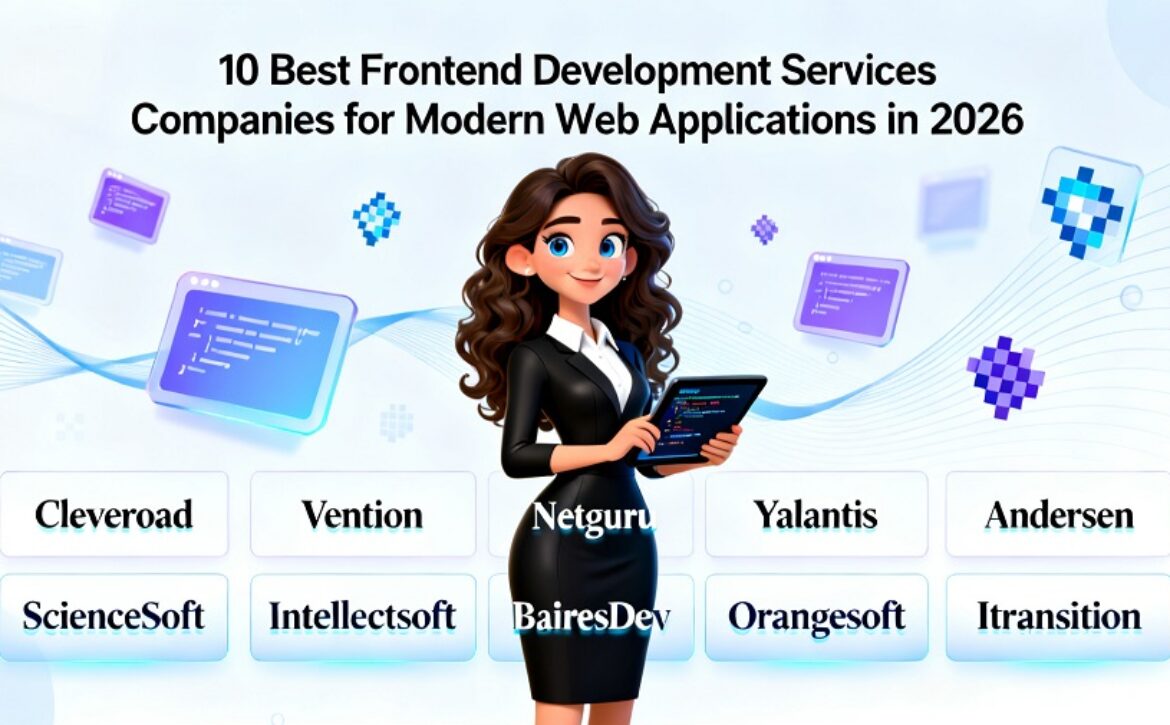
10 Best Frontend Development Services Companies for Modern Web Applications in 2026

Today, Frontends are an increasingly important aspect of every digital product. The user experience is always first-class, as users do not often consider factors like the backend infrastructure, database, or API. When judging which platform to use, users will only judge platforms based on how fast, easy, and responsive that platform is and the overall experience with that platform. An effective frontend will contribute to more engagement, conversions, and overall customer loyalty than a poorly designed frontend will; regardless of whether the backend systems are exceptionally strong, a poorly run frontend typically will lead users away from that company’s website and onto another company’s site.

As companies continue to invest in Building SaaS, customer portals, eCommerce, healthcare applications, and enterprise-based solutions, there is a serious demand for specialized engineering teams that know how to effectively develop modern Frontends.

Today’s Frontend development requires knowledge in a variety of areas including React, Angular, Vue.js, TypeScript, Accessibility standards, Performance Enhancements, Cloud Integration, and Responsive Design.

To assist companies in determining the types of technology partners they can partner with to achieve their digital ambitions, we have evaluated several companies based on their former frontend portfolio, client reviews and their history of success in delivering modern, web-based application development.


Top Frontend Development Services Companies in 2026

—————————-

  1. Cleveroad
  2. Vention
  3. Netguru
  4. Yalantis
  5. Andersen
  6. ScienceSoft
  7. Intellectsoft
  8. BairesDev
  9. Orangesoft
  10.  Itransition

How We Selected the Companies

—————————-

This list is not ranked.

The companies were selected based on their frontend engineering expertise, client feedback, project portfolios, experience with modern JavaScript frameworks, UI/UX capabilities, and ability to deliver scalable web applications for startups and enterprises.

1. Cleveroad

Founded: 2011
Headquarters: Tallinn, Estonia
Reviews: 79 reviews on Clutch, average rating 4.9/5
Website: cleveroad.com

Cleveroad develops custom web and mobile applications for startups, SMBs, and enterprise organizations. The company provides specialized frontend development services that focus on creating responsive, scalable, and high-performance user interfaces.

Its engineering teams work extensively with React, Angular, Vue.js, TypeScript, Next.js, and modern frontend architectures. The company develops SaaS platforms, healthcare applications, logistics systems, fintech solutions, and enterprise portals that prioritize usability and performance.

Cleveroad also holds ISO 9001 and ISO 27001 certifications, making it a strong choice for organizations operating in regulated industries that require both technical quality and security-focused development practices.


2. Vention

Founded: 2002
Headquarters: New York, USA
Reviews: 90+ reviews on Clutch, average rating 4.9/5
Website: ventionteams.com

Vention offers software development assistance to start-up and large companies developing digital products that are complex in design. The business develops front-end software solutions for SaaS applications, cloud-based applications and enterprise software. All of these require high scalibity and up-to-date user experiences.

The development engineers at Vention build on an array of JavaScript and cloud technologies so they are a reliable source for large product development.


3. Netguru

Founded: 2008
Headquarters: Poznań, Poland
Reviews: 80+ reviews on Clutch, average rating 4.8/5
Website: netguru.com

Netguru offers a fusion of development for software as well as design expertise within their product development team. Known for its development of easy to navigate front-end based applications, their clients can be confident in their ability to deliver engaging user interfaces and drive revenue growth for their business.

Their client list ranges from Education, Health Care, Retail, and Financial Services, but they have some of the strongest application capabilities in using modern web technologies in conjunction with User-Centered Design principles.


4. Yalantis

Founded: 2008
Headquarters: Warsaw, Poland
Reviews: 70+ reviews on Clutch, average rating 4.9/5
Website: yalantis.com

Yalantis, a software development company located in Ukraine, focuses on providing digital solutions for the Healthcare, Logistics, Real Estate and Fintech industries. Yalantis has considerable knowledge in developing Front-End Solutions that not only support the execution of complex business processes, but also maintain the highest level of user experiences. Yalantis has earned its reputation of being a trusted Partner for Front-End development through the use of React and TypeScript Expertise.


5. Andersen

Founded: 2007
Headquarters: Warsaw, Poland
Reviews: 70+ reviews on Clutch, average rating 4.9/5
Website: andersenlab.com

Andersen is a provider of software engineering services to both startups and enterprises in many different sectors. The company creates modern web interfaces for applications that support SaaS (Software as a Service), customer portals, and enterprise platforms.

Andersen’s frontend teams concentrate on making products easy to maintain, perform well, and scale easily, which enables organizations to continuously grow their products long-term.


6. ScienceSoft

Founded: 1989
Headquarters: McKinney, Texas, USA
Reviews: 40+ reviews on Clutch, average rating 4.8/5
Website: scnsoft.com

With over 20 years of software engineering expertise, ScienceSoft has extensive experience in developing front-end applications. From mobile-based enterprise application to hospital management systems, from financial services applications to corporate software, we deliver stable and scalable UI solutions.

Due to our established track record, we are a preferred provider for many organizations needing advanced technology solutions.


7. Intellectsoft

Founded: 2007
Headquarters: New York, USA
Reviews: 40+ reviews on Clutch, average rating 4.9/5
Website: intellectsoft.net

The company Intellectsoft specializes in the modernization of programs and enterprise-wide digital transformations. This includes the development of highly efficient front-end systems which are used to support large scale production and also for customer-facing software.

We serve multiple verticals, including: health care services, freight and transportation, construction, and financial service companies.


8. BairesDev

Founded: 2009
Headquarters: San Francisco, USA
Reviews: 60+ reviews on Clutch, average rating 4.9/5
Website: bairesdev.com

For fast growth. BairesDev provides distributed software development to x-Industries requiring scalable development resources. The company’s global delivery network supports all forms of software project development, from front-end systems for SaaS platforms to creating digital products, regardless of complexity or size.


9. Orangesoft

Founded: 2011
Headquarters: Warsaw, Poland
Reviews: 25+ reviews on Clutch, average rating 4.9/5
Website: orangesoft.co

The company develops digital products that are designed to maximize usability & the end-user’s overall experience. Orangesoft also designs frontend applications for startup companies, health systems, schools, and software-as-a-service companies.

The company applies its design-focused approach to deliver an engaging user experience while ensuring that the development processes have been executed at a high standard of technical quality.


10. Itransition

Founded: 1998
Headquarters: Lakewood, Colorado, USA
Reviews: 35+ reviews on Clutch, average rating 4.9/5
Website: itransition.com

Itransition (Itransition) creates custom application software and has developed an enterprise software solution architecture. We create front-end system architectures and can build to support all types of cloud infrastructures.

Itransition has experience developing enterprise technology solutions, thus making Itransition an excellent option for an organization needing large-scale scalable websites.


What Makes a Strong Frontend Development Partner?

—————————-

Picking a company for front-end development is not just about knowing different frameworks. Great vendors also know that the front-end decisions they make will influence how often people use their apps, the percentage of people who convert after using them, and how accessible they are to all users, as well as helping build up the app’s long-term growth.

Make sure that you consider not only technical knowledge but design skills, testing processes, experience optimizing performance, and experience with similar frameworks when looking at potential vendors. Additionally, having experience in a specific sector will help when creating products in different areas like healthcare, fintech, logistics, and education.

A solid front-end partner has both a technological worldview and understands how to accomplish the company’s business goals.


Why Frontend Quality Matters

—————————-

To keep pace with the demands of today’s app users, applications must load very quickly, work on any type of screen, and be easy to use. Studies consistently show that slow application performance and poor user interface design both have negative effects on whether an end user will return to the application or buy from it again.

Today’s frontend engineers have an important role to play in a company’s overall business strategy. Companies who prioritize good user experience typically receive an advantage over their competitors with better engagement relationships and higher customer satisfaction.

As digital applications continue to grow in complexity, the frontend engineering discipline has evolved from a technology-based function to become a strategic business capability.


Final Thoughts

A website’s frontend plays a significant role in how customers view a company. Investment in a solid frontend framework, contemporary technologies, and user-oriented design gives a business an edge over its competitors in today’s saturated marketplace.

The aforementioned organizations are experts in their fields when it comes to engineer frontend for websites and develop responsive websites. Whether you need to develop an MVP for your business, create an Enterprise / SaaS site, or launch a customer-related online product, these companies can provide the technical expertise necessary to deliver high-quality digital solutions by 2026.

Read More
Sanju June 25, 2026 0 Comments

Fintech Web Development: Building Secure, Scalable Financial Platforms

There’s been a sneaky revolution in the financial world. Consumers don’t need to go to branches to check their balances, move money around, or borrow at a bank; it should be done in seconds, regardless of device, without hassle or worry. Under the hood of that promise lies advanced engineering, such as fintech web development services that promise security and user-friendliness at enterprise level.

Creating a financial platform is not the same as creating a regular web application. Stakes are higher, regulations are deeper, and once lost, users’ trust can never be regained. In this post, we’ll dissect what it really means to create a secure and scalable fintech web platform in 2026.


Why There is a Need For a Different Approach in Fintech Web Development?

—————————–

The vast majority of web development projects revolve around how fast they can be delivered and how aesthetically pleasing they are. Fintech development is centered on a more challenging aspect: making sure no one’s money and data gets into trouble.

A single breach in a payment system, or a banking interface can lead to the exposure of millions of user records, fines for the regulatory bodies, and even the destruction of a brand. It influences every decision that is made in architecture, ranging from session token management to database query design, to how APIs get authenticated.

That is exactly why the organisations that seek financial products work with individuals who specialize in fintech web development services, instead of a general development group. The knowledge and understanding of the domain that’s needed for PCI DSS compliance, open banking standards, encryption protocols, fraud detection integration can’t be picked up in a few days.


Security Architecture: The Non-Negotiable Foundation

Security cannot be an afterthought, it is part of the fintech process from inception. A constraint of architecture since the beginning. Fintech giants are established on a number of elements that are interdependent.

All data sent from client to server should be encrypted, TLS 1.3 or higher. Account numbers and transaction histories, identity documents sensitive information at rest demands AES-256 encryption as a minimum.

Financial platforms should use Multi-Factor Authentication (MFA) username and password. A strong MFA system is a standard which no serious fintech product can afford to skip: SMS OTPs, authenticator apps, and more and more, biometric verification.

Zero Trust Architecture is a philosophy that assumes that there is no user and no device or service that is trusted just inside the network perimeter. All access requests are checked on an ongoing basis. On platforms that are processing transactions in real time, this is quickly becoming a must-have, not a want.

Regular Penetration Testing Security is a practice and not a state. Launched activities such as scheduled penetration testing, vulnerability scanning, third-party security audits.

The Payment Card Industry Data Security Standard or PCI DSS is a rule that regulates the storage and processing of cardholder data. Data residency and consent obligations are imposed by GDPR, RBI digital lending guidelines and other jurisdictional frameworks. Compliance should not be an afterthought, it should be built into the Fintech platforms.


Scalability: Engineering for Growth without Downtime

The same seamless performance required by 500 users demands the same for 5M users.If a fintech site performs seamlessly for 500 users, it must perform seamlessly on 5M. The most important thing to remember about scalability is that it’s not about building a system that needs to be scaled up from the ground up, it’s about designing a system that can be scaled horizontally without having to totally rebuild.

Micro Services Architecture Divide and conquer a financial platform into individual, loosely coupled services: authentication, payments, notifications, reporting, and so on — each service can be scaled as needed according to demand. An increase in payment processing does not slow down the analytics dashboard.

Services like AWS, Google Cloud and Azure provide geo-distributed, managed databases, and auto-scaling capabilities that are hard to replicate at scale on-premise. More common tools in production fintech deployments are elastic load balancing and containerisation with Docker and Kubernetes.

Future integrations like third-party banking partners, embedded finance products, mobile applications, etc. can connect to API-First Development Building platform logic without causing instability to the core system, using well-documented, versioned APIs. In several markets, open banking regulations are now also requiring API-first architecture, not just as a technical best practice, but as a regulatory requirement.

Fraud checks, settlement recons, KYC verification are examples of financial operations that should not hold up the user interface. These processes can then be executed asynchronously, maintaining a responsive user experience even when the backend processes are intensive, thanks to the use of message queues or event-driven architectures such as Apache Kafka or RabbitMQ.

Responsive Web Design is a crucial aspect of Fintech.Responsive Web Design plays a significant role in Fintech.

Engineering is the central theme of a fintech platform, with security and scalability being the two primary concerns. However, the surface the user sees/encounters requires the same rigor. In 2026, users will rely on financial services as they use laptops at work, phones on the commute, and tablets at home  frequently using more than one device in the same session.

Responsive web design services aren’t simply about how a site appears acceptable on a little display. In the fintech sphere, responsiveness dictates whether a user is able to finish a loan application, confirm identity and/or view a transaction without having to abandon the process because the user interface failed on their device.


Significant Factor to Consider For Responsive Website for Fintech

—————————–

Tap targets, swipe gestures, and keyboard avoiding input fields; natural interaction design on mobile that is usable on the desktop too.

Complex financial data, such as portfolio breakdowns, mortgage amortisation schedules, multiple currencies statements presented in layers, so users are never overwhelmed, no matter the screen size.

Lazy loading, optimised asset delivery using CDN and code splitting – sub 3-second load times on mobile data connections not just broadband.

Financial platforms with users from a broad spectrum of abilities and those who rely on screen readers or keyboard navigation must comply with WCAG 2.2 standards.WCAG 2.2 standards are an ethical and growing legal minimum for financial websites with a wide range of users.

When responsive web design services are not considered an afterthought but a crucial component of the web design process, online financial platforms realize significantly higher task completion rates, reduced drop-off during user onboarding, and improved retention rates among device types.


Technology Stack Considerations

—————————–

The selection of the right tech stack for fintech platforms involves a careful consideration of developer ecosystems, security experiences, and platform longevity.

React and Next.js are the frontrunners on the frontend, having component-driven architecture, server-side rendering, and robust TypeScript support to build production fintech platforms. Angular continues to be widely adopted in enterprise banking applications where opinionated structure is a way to minimize inconsistencies on large teams.

The most popular options on the backend are Node.js, Python (Django/FastAPI) and Java (Spring Boot), with each having extensive security tooling, a vibrant community, and a solid track record of service in regulated settings.

PostgreSQL and MongoDB meet different storage requirements: The ACID compliant PostgreSQL is the standard choice for transactional financial data, whilst the flexible document storage with MongoDB is suitable for KYC pipelines or audit logs.


Choose the  Right Development Partner

—————————–

Not all development firms possess the expertise to effectively tackle the financial regulation, security architecture and product design that is necessary for defining fintech web development services. The right partner has proven experience in delivering compliant financial products, a clearly defined, security-first development lifecycle, and the ability to take a platform past its launch day.

The fastest and cheapest teams do not make fintech platforms that would be the ones to earn and sustain user trust. They are created by teams that know and understand what is at stake every time a user logs in to manage their money.


Conclusion

To create a secure and scalable financial platform in 2026 requires more than just robust code; it requires the right architecture decisions, a disciplined approach to security, and user-facing design that performs flawlessly in any device and circumstance. However, organisations who invest in tried and tested fintech web development and combine their services with enterprise-class responsive web design services are the ones who will create sustainable, reliable products in the strictest digital world in the world.

Security and scalability are not mutually exclusive in fintech. With the right know-how, they complement each other and that’s what makes a platform users will trust, rather than abandon in secret.

Read More
Sanju June 11, 2026 0 Comments

How to Create an E-Learning Website in 2026: Strategy, Features & Tech Stack

Creating an e-learning website in 2026 requires more than uploading video lessons and adding a registration page. Modern users expect interactive learning experiences, mobile accessibility, personalized content, seamless navigation, and fast platform performance across every device.

The global growth of remote education, corporate training, digital certification programs, and online coaching continues driving demand for scalable educational platforms. Businesses, universities, startups, and training providers increasingly invest in custom learning ecosystems to support long-term digital education strategies.

Many organizations therefore rely on e learning software development services to create scalable platforms tailored to their audience, learning model, and operational goals.

This guide explains how to create an e-learning website in 2026, including business strategy, essential features, technology selection, development stages, and the trends shaping modern educational platforms.


Why E-Learning Platforms Continue Growing in 2026

—————————-

Education through online support has revolutionised the way we develop skills in the workforce. With universities now offering a variety of hybrid and remote learning options, businesses are using digital platforms to employ and train new employees and also develop an internal knowledge base. Individual educators and coaching businesses continue to offer subscriptions to their services. Today’s learners demand flexibility and access to educational content from multiple devices at any given time, regardless of geographical location. The potential for scaling up the size of an organisation through the use of digital educational platforms is being realised by many organisations as they are able to deliver training/education to thousands of employees at the same time (on the same platform) without incurring additional operating costs. The growth rate of the education industry is also being fuelled by advances in artificial intelligence, which is providing organisations with tools to create individualised learning paths, automated assessments and personalised learning experiences.


What Types of E-Learning Websites Exist?

—————————-

Various education models need various kinds of structures and functions to provide an effective learning experience.

Corporate Learning Portals are designed to support employee orientations, compliance training, and corporate certification-related programming.

Typically, Academic Education Systems are set up to accommodate assignments, G.P.A.’s, student/instructor communications and live class sessions.

When you use Subscription-Based Learning Platforms, it typically includes recorded video lessons, downloadables, and self-paced education.

Marketplace-Based Learning Platforms connect instructors with students and generally include payment systems, rating systems/reviews, and multi-instructor management systems.

Coaching and Mentoring Platforms typically include a combination of live communication systems, scheduling systems and personalized workflows for education.

Ultimately, the education business model you select has a direct impact on your platform architecture, monetization strategy, and priority of features.


How to Define an E-Learning Website Strategy

—————————-

Strategic planning is an important part of developing an effective e-learning experience.

Step one; identify the audience – is your user going to be a university student, corporation employee or a technical certification candidate? These types of sites will require a very different set of capabilities to be effective.

Develop a monetization model from the get go, some sites charge annually (or monthly) for access to all of their courses, other sites charge on a per-class basis, and still others are structured with membership tiers for access to specific classes/certifications.

Once you know who your audience is and how you want to develop the monetization model, the next biggest decision to make is about content structure (e.g., live classes, on-demand (self-paced), downloadables, or a combined model).

Lastly, build your platform for scalability from day one; this is where the majority of e-learning platforms fail: they launch without the delivery platform to deliver continued and sustained growth over the long term.

A clearly defined business model will help the educational institution avoid unnecessary feature set and focus on developing the features that deliver the greatest value to users.


What Features Should an E-Learning Website Include?

—————————-

The way you choose to feature your products and create user engagement has a significant impact on the competitiveness of your site.

The primary reasons why users create an account and manage their profile is so that they can build their educational library and access their files from different devices. The ability for learners to easily create an account, manage their progress and access all of the necessary educational material across a number of devices is critical for the success of any educational site.

Another important functionality of any educational site is course management functionality. Most e-learning sites include video lessons, quizzes, assignments, downloadable files, certifications, and progress tracking systems.

Collaboration and retention are two very important aspects of education that are enhanced by communication tools. Communication tools such as discussion forums, live chat, notifications, and messaging capabilities increase user engagement and provide for much greater collaboration between the learner and the instructor.

As the size of educational libraries continues to increase, search functionality will become an increasingly important part of the user experience. Learners should be able to find lessons, instructors and other resources quickly and easily without having to search through multiple menus.

Analytics dashboards allow instructors and administrators to monitor completion rates for their students, assess learner engagement, evaluate assessment performance and monitor operational metrics.

In commercial educational platforms, payment systems play a significant role in helping establish a competitive advantage among educational websites. Payment processing providers such as Stripe and PayPal, as well as subscription billing systems, are often integrated directly into the online learning environment.

Gamification features as well as trophies for completion of each level of the gamification process will enhance learner motivation and retention.


Why UX Design Matters in E-Learning Platforms

—————————-

Learning outcomes and retention statistics can be impacted by educational user experiences (UXs).

More specifically, complex navigation, overloaded interfaces and unclear learning pathways typically reduce course completion rates significantly.

Students want user-friendly experiences so they can concentrate on content during their school train journey rather than having trouble finding the correct path to the content by dealing with the complexity of the educational delivery platform.

Modern educational websites are therefore designed to provide a clean interface, utilise effective use of visual hierarchy, create a responsive design and provide easy to use navigation methods whether on desktop or mobile devices.

Including progress indicators will improve user engagement, in terms of users knowing what they have completed versus what they still need to complete.

Using interactive elements (e.g., quizzes, checkpoints, visual feedback and adaptive learning flows) will increase learner involvement.

In addition to creating engaging learner experiences, educational UXs should also reduce distractions and limit cognitive overload by designing simple and consistent interfaces so they consistently outperform visually overloaded environments.


Why Accessibility Is Essential in Modern Educational Websites

—————————-

Today, Accessibility is a requirement for usability, as well as a priority for compliance.

When providing support for users with visual, hearing, cognitive, or motor disabilities on an educational platform, the entire user group benefits from improvement in usability.

In addition, the vast majority of e-learning websites that are currently in use adhere to WCAG accessibility guidelines when designing their digital learning environments with the goal of providing an inclusive experience for their users.

Some of the many important accessibility practices include developing typography that can be easily read, using sufficient color contrast, implementing keyboard-based navigation, providing compatibility with screen readers, offering alternative text for images, and including captions for video content.

There are several regulatory obligations to create inclusive digital learning environments that education organizations must comply with, especially in the context of the public and academic sectors.

Planning for accessibility should be a component of both the earliest stages of the UX and front-end development phases.


What Technologies Are Used to Build E-Learning Websites?

—————————-

The way in which one selects technology to use ultimately impacts scalability and how well something can perform, maintain, and be integrated into future technologies—platforms will continue to evolve. The majority of Frontend development utilizes React, Angular or Vue.js to create a rich and engaging user interface.

The majority of Backend systems use Node.js, Python, Java or .NET to provide API Management, Authentication, Business Logic, Analyzing data and Integration with other systems.

Database technologies often incorporate both relational database systems such as PostgreSQL or MySQL, and scalable cloud-based storage solutions in order to handle large volumes of multimedia content or user activity.

Cloud-native deployment has become the standard because it accommodates sporadic traffic patterns for educational platforms by offering economically feasible global accessibility.

Amazon Web Services, Microsoft Azure and Google Cloud Platform are the leading Cloud providers for these Educational Systems.

The underlying infrastructure supporting Video Streaming is equally critical. Most Platforms utilize Zoom, Vimeo, Twilio or WebRTC for supporting their Live Classes and bringing Multimedia Learning Materials to their learners.

As more learners continue to gain access to educational resources through smartphones and tablets, Mobile Development will continue to gain in importance.


How AI Changes E-Learning Website Development

—————————-

Online education will continue to evolve through the use of artificial intelligence (AI). Several online education platforms will use AI technology to tailor the learning experience to each student based on their individual needs. The AI technology can track a student’s progress so they can get personalized instructions for the lessons they are taking, help answer their questions, summarize educational materials, and allow for easier communication with support teams.

Some online learning platforms will also be integrating AI-generated quizzes and automated content recommendations to increase retention of learning materials. In addition, predictive analytics will be of great use to educational institutions as they will be able to identify students who are having difficulty learning as early as possible and adjust the educational workflow according to how students have behaved.

Implementing AI technology requires a lot of careful monitoring. Institutions will need to have proper governance in place to ensure that content being taught is accurate, the privacy of individual learners is protected, and ethical guidelines have been followed for the collection and use of data related to students.


What Challenges Arise During E-Learning Website Development?

—————————-

The development of educational platforms has many technical challenges and operational concerns.

One of the main operational problems is scalability. E-learning applications must accommodate substantial numbers of concurrent users, such as live lesson enrolments and during initial enrolment.

In addition, the complexity of managing content becomes increasing as educational ecosystems grow. As a result, a well-built administrative infrastructure is needed to support the management of lessons, instructors, certifications, multimedia elements, and multilingual content.

Another high priority issue is security since educational platforms store personally identifiable data, credit card data, and proprietary and academic information.

The difficulty of engaging users is another ongoing concern. Many educational products suffer from low completion rates due to inadequate UX design or poorly mapped curriculum.

The complication involved in integrating components adds to the difficulty of developing educational platforms. To synchronize with multiple business and marketing applications, vendors typically need to integrate with a company’s existing accounting system, payment processor, analytics provider, and/or communication platform.

A skilled development team will generally employ cloud-native infrastructures, iterative delivery models, continuous testing, and modular architecture planning to successfully address these challenges.


What Trends Will Shape E-Learning Platforms in 2026?

Several trends are continuing to impact how education platforms will be built in 2026.

One of these major trends is Microlearning, which uses shorter-style education modules to help retain information and match how people prefer to learn today.

The second major trend that continues to develop is Community-Based Learning Environments. Online discussion forums as well as mentorship programs and peer collaborative projects all contribute to an increase in overall learner engagement levels.

Gamification is another trend that is becoming standard in many educational products because of the use of rewards to encourage motivation and ongoing participation by learners.

Artificial Intelligence (AI) will also continue to be one of the largest competitive advantages for education providers over the next number of years regarding their ability to develop and deliver personalized content.

Another pivotal trend is utilizing AR and VR technologies to create Immersive Learning Experiences, particularly for the areas of Healthcare, Engineering, and Technical Training.

Mobile-first education is also continuing to dominate the market as users are putting increasing amounts of time into using their smartphone devices for digital learning.


How to Approach E-Learning Development Strategically

Most educational companies will not succeed because they try to create large ecosystems right away instead of validating demand over time.

A focused MVP is typically a low-risk, low-cost means of getting started on the right foot. Core functionality is launched, user feedback is gathered, and the platform can be optimized for educational workflows before being expanded upon.

User research is an important part of continual development. By understanding how learners react to frustration, how they engage with learning, and what their accessibility requirements are, we prevent costly redesigns later.

Strong UX design, scalable infrastructure, mobile optimization, and accessibility compliance should all be first on the list of priorities when developing an educational website or product.

By combining both technical scalability and learner-centered design, educational websites will most often achieve greater long-term growth.


Final Thoughts

Building an e-learning platform today goes beyond just uploading online educational material; modern consumers expect their experiences to be customized based on their individual needs, so they look for sites that offer a seamless user experience (eUX); accessibility; flexible mobile environments; and engaging, interactive places to learn.

Those organizations focusing on the infrastructure to allow for growth and scalability, along with providing a strong eUX and AI-enhanced personalized learning experiences, can typically expect much higher rates of retention and growth than those without these essential features.

The demand for Digital Education in higher education, business/corporate training, industry certifications, or private educational organizations is continuing to grow. Companies making investments in developing scalable educational systems now will be in a better position to succeed over the long term in the ever-evolving world of digital education.

Read More
Sanju June 9, 2026 0 Comments

Best 10 Web Development Companies for eCommerce Projects

The process of selecting a web development partner for an eCommerce project has become more demanding in 2026. Businesses now look for vendors who possess website development skills. They need teams that understand conversion logic, performance under load, integrations with payment systems, and long-term scalability.

To establish list authenticity with complete transparency, we performed structured research across major B2B directories which included Clutch, GoodFirms, DesignRush, and Techreviewer. We examined over 150 eCommerce web development companies which provide web development services.

We evaluated each vendor through directory data assessment together with client feedback examination and delivery pattern analysis and technical positioning review. We used information from eCommerce solution architects and product consultants to determine which project capabilities hold the highest significance.

The research findings enabled us to identify companies that deliver high-quality eCommerce solutions while keeping their clients satisfied. The following companies stand out as successful businesses which provide eCommerce solutions with high customer satisfaction: Cleveroad, Netguru, Future Processing, Brainhub, The Software House, Apadmi, Magora, Imaginary Cloud, STX Next, Digiryte.


Criteria Used for Selection

—————————–

To ensure consistency and trustworthiness, each company was evaluated using a unified set of criteria.

1. Verified client reviews

We focused our selection process on businesses which demonstrated reliable performance feedback across multiple review platforms. The key requirements for our selection process included two specific criteria. The first requirement needed a minimum of 20 verified customer testimonials. The second requirement required businesses to achieve an average rating which reached 4.7 out of 5 or above. Organizations needed to provide complete assessment of their communication skills and delivery methods and operational outcomes.


2. eCommerce technical capabilities

We assessed the capacity of each vendor to construct and expand eCommerce systems through their two testing methods, which included custom web development and platform-based solutions and headless commerce architectures and payment gateway and third-party integrations and high-load performance optimization.


3. Industry experience

We selected companies that have demonstrated their capabilities to work in Retail and D2C and Online marketplaces and Subscription-based eCommerce and Logistics and fulfillment systems.


4. Certifications and recognition

We used certifications and industry recognition as indicators of maturity and reliability through three specific indicators which include ISO certifications and cloud partnerships with AWS and Azure and Clutch Leader awards together with Deloitte rankings.


5. Global delivery experience

We aimed our radar on those masters of the trade who have successfully executed projects for international clients in tandemwith tailored insight into requirements from another market.


Best 10 Web Development Companies for eCommerce Projects

—————————–

  • Cleveroad
  • Netguru
  • Future Processing
  • Brainhub
  • The Software House
  • Apadmi
  • Magora
  • Imaginary Cloud
  • STX Next
  • Digiryte

—————————————————————————————————————————————

1. Cleveroad

Founded in: 2011
Headquarters: Tallinn, Estonia
Hourly Rate: $50–$80
Industry Expertise: eCommerce, Healthcare, FinTech, Logistics, Retail
Reviews: 77 reviews on Clutch, average rating 4.9/5
Website: cleveroad.com

The company provides personalized eCommerce solutions for businesses in order to maintain business processes in an effective manner. Cleveroad helps businesses develop online store and marketplace solutions for both existing and new businesses. Additionally, the company provides custom web application development services.

The company uses advanced technology like React and Node.js for developing high-performance products. Developers at the company include payment processing systems, customer relationship management systems, and logistics in order to develop a unified ecosystem for businesses.

The company has achieved ISO certification under ISO 9001 and ISO 27001 standards. This helps the company maintain quality management and data security in an effective manner. These standards are crucial for developing eCommerce solutions since they require handling customer information and performing transactions.

The company has achieved Clutch Leader recognition for providing quality services. It has achieved 77 reviews and a rating of 4.9/5. The development methodology of the company includes a dedicated discovery phase in order to minimize risks and enhance development processes.

—————————————————————————————————————————————

2. Netguru

Founded in: 2008
Headquarters: Poznań, Poland
Hourly Rate: $50–$100
Industry Expertise: eCommerce, FinTech, Healthcare, SaaS
Reviews: 70+ reviews on Clutch, average rating 4.8/5

Netguru offers digital product development services with a high emphasis on design and user experience. They aid businesses in creating user-friendly interfaces for their respective eCommerce projects, thus promoting customer interactions and subsequently enhancing sales.

The company uses its teams to create systems that connect frontend development work with backend development tasks and AI-powered personalized features. Netguru also provides assistance with mobile commerce solutions which brands need to reach customers who prefer to shop on their mobile devices.

The company has been featured in Deloitte Technology Fast 50 and consistently ranks among top B2B service providers on Clutch.

—————————————————————————————————————————————

3. Future Processing

Founded in: 2000
Headquarters: Gliwice, Poland
Hourly Rate: $50–$90
Industry Expertise: eCommerce, FinTech, Manufacturing, Logistics
Reviews: 30+ reviews on Clutch, average rating 4.9/5

Future Processing develops strong and scalable systems which meet the complex needs of their client companies. In eCommerce businesses need to create platforms which connect their ERP systems with supply chain management tools and extensive data systems.

Their engineers specialize in three areas which include cloud architecture and data processing and enterprise-grade solutions. The company serves businesses which require dependable systems that will grow with their needs instead of needing urgent minimum viable product development.

The company has achieved ISO 9001 certification and Microsoft Solutions Partner status which demonstrates its advanced engineering capabilities.

—————————————————————————————————————————————

4. Brainhub

Founded in: 2015
Headquarters: Gliwice, Poland
Hourly Rate: $50–$99
Industry Expertise: eCommerce, SaaS, FinTech, Media
Reviews: 70+ reviews on Clutch, average rating 4.9/5

Brainhub builds web applications that perform at high levels through their use of modern JavaScript technologies. The eCommerce industry benefits from this delivery system, which provides both rapid storefront performance and backend systems that can handle increased demand.

The teams of the organization concentrate their efforts on three main areas, which include developing clear system designs and creating automated testing systems and implementing DevOps methods. The approach guarantees system reliability because it maintains product performance during growing user demand.

The team at Brainhub develops their expertise through collaboration with SaaS companies and product-based organizations, which demonstrates to them the significance of continuous product development.

—————————————————————————————————————————————

5. The Software House

Founded in: 2012
Headquarters: Gliwice, Poland
Hourly Rate: $50–$100
Industry Expertise: eCommerce, FinTech, IoT, SaaS
Reviews: 40+ reviews on Clutch, average rating 4.8/5

The Software House develops custom web platforms which deliver optimized performance and easy system maintenance. The eCommerce solutions provide businesses with dependable systems which handle increasing visitor numbers and advanced system connections.

Their expertise includes Node.js development, microservices architecture, and cloud infrastructure. The groups work to build capacity for their systems which will enable them to expand their operations in the future.

The company has achieved recognition as a leading Node.js development company which generates positive client reviews across multiple platforms.

—————————————————————————————————————————————

6. Apadmi

Founded in: 2009
Headquarters: Manchester, United Kingdom
Hourly Rate: $75–$150
Industry Expertise: eCommerce, Retail, Finance, Travel
Reviews: 20+ reviews on Clutch, average rating 4.8/5

Apadmi creates digital products through their specific mobile commerce development services. They enable brands to offer consistent shopping experiences through their websites and mobile platforms.

They design systems that integrate the frontend interface with the backend services. This allows businesses to function efficiently while ensuring their users have an uninterrupted experience.

Apadmi has won several awards in the industry and is listed on the Deloitte Fast 50.

—————————————————————————————————————————————

7. Magora

Founded in: 2010
Headquarters: London, United Kingdom
Hourly Rate: $50–$99
Industry Expertise: eCommerce, FinTech, Healthcare, Retail
Reviews: 30+ reviews on Clutch, average rating 4.8/5

Magora offers end-to-end web development services, with an emphasis on building user-friendly websites that work efficiently. The company helps businesses operating in the eCommerce sector to build platforms with operational efficiency as well as user experience.

The teams within the organization offer support for all phases of development, starting from the discovery phase to the final release to ensure that all business needs are met.

Magora has become a trusted development company in the United Kingdom due to its dependable services and customer reviews.

—————————————————————————————————————————————

8. Imaginary Cloud

Founded in: 2010
Headquarters: Lisbon, Portugal
Hourly Rate: $50–$100
Industry Expertise: eCommerce, SaaS, FinTech, Retail
Reviews: 20+ reviews on Clutch, average rating 4.9/5

The digital product development process at Imaginary Cloud develops scalable products which prioritize design elements and user experience. eCommerce platforms need to achieve two goals because they must deliver attractive designs and strong technical performance.

People at this organization develop expertise in creating web applications and designing user experiences and user interface systems and building cloud computing solutions. The company has achieved recognition as a leading B2B service provider which partners with customers from different countries.

—————————————————————————————————————————————

9. STX Next

Founded in: 2005
Headquarters: Poznań, Poland
Hourly Rate: $50–$99
Industry Expertise: eCommerce, FinTech, Data Platforms, SaaS
Reviews: 60+ reviews on Clutch, average rating 4.9/5

STX Next specializes in Python development to create scalable backend systems which support eCommerce platforms. The teams work to improve three main areas of their work which include performance security and data processing capabilities.

The system requires this capability because it needs to handle high transaction throughput. The company is one of the largest Python development firms in Europe.

—————————————————————————————————————————————

10. Digiryte

Founded in: 2016
Headquarters: Manchester, United Kingdom
Hourly Rate: $25–$50
Industry Expertise: eCommerce, Healthcare, FinTech, Retail
Reviews: 20+ reviews on Clutch, average rating 4.8/5

Digiryte provides web development services for startups and growing businesses. The company focuses on delivering cost-effective solutions that maintain their product quality.

Their teams support MVP development and scalable platforms which make them a good choice for early-stage eCommerce projects. Digiryte operates its business through an agile delivery system which supports startup businesses.

The company uses an agile delivery model together with an approach that supports startup businesses.


Final Thoughts

eCommerce platforms require more than basic development. They need strong architecture which allows their system to operate without problems and their system to grow with business expansion.

The companies listed above demonstrate consistent performance in delivering such solutions. Cleveroad stands out to clients because of its ISO certifications and its excellent client ratings and its systematic project management method.

Read More
Sanju April 19, 2026 0 Comments

How UX-Focused Web Development Improves Conversion Rates

Today’s digital business environment requires more than a simple online presence. The new world of web development goes way beyond just beautiful aesthetics and static pages – it’s about creating engaging, interactive, and efficient online experiences that push the user towards a desired action. And as the competitive heat turns up across the board, businesses must do more than bring visitors to their site, they need to turn traffic into leads and into lifelong loyalties.

This is where UX-focused web development can help. By weaving together usability, speed, accessibility, and design with what the user desires, it is possible to increase conversion rates considerably. A tightly woven user experience will increase trust around a site as well as easily direct visitors through complex decision-making points. This article will examine how a user experience-driven web development solution can be applied to conversion rate optimization.


Understanding UX-Focused Web Development

—————————-

“User Experience” essentially refers to how users interact with a website or online product. This includes every aspect of that interaction, right from loading through navigation, content, responsiveness, and right up to satisfaction. Traditional development takes a technology-centric approach, assuming that how people interact is somehow guessable or even predetermined.

As opposed to the traditional methods, which promote through the features, the user-centered method begins with the user intent. This method combines research, usability, performance optimization, and behavioral data into the entire process. The goal is not to create a functional website but an “effortless” user experience.

When the UX is applied to professional web development, the results are more engaging and intuitive to websites.


Why UX Has a Direct Impact on Conversion Rates?

—————————-

Conversion rates are the means by which the effectiveness of a site at persuasion (persuading visitors to perform actions such as buying, submitting a form, subscribing, or making an information request) can be measured. Ineffective UX is associated with confusion, frustration, and abandonment, while effective UX is associated with the elimination of barriers to conversion.

People demand fast, intuitive, and reliable online interactions. When their needs are satisfied, people trust and interact with the brand. If not, they leave, never to be seen again without a second look. User experience-centered development resolves these issues by offering well-designed flows that reduce the number of necessary clicks and efficiently communicate information.

Thus, UX and conversion rate optimization are interwoven processes: improved UX equals making it easier to say “yes.”


First Impressions and Their Influence on User Decisions

—————————-

The initial few seconds of the web page visit are very important. Users form judgments immediately as to whether or not a site is credible, relevant, and useful. Instead, trust is taken right away by visual clutter, non-consistent layouts, slowness of the loading process, or ineffective navigation.

Web development with the UX in mind makes the initial impression positive. Balanced spacing, clean design, readable typography, and constant branding speak of professionalism and trust. These are combined to encourage the user that he is at the correct location, and he can proceed with his journey with certainty. A deep first impression will not only attract attention but also predetermine future interaction and conversion.


Core UX Elements That Drive Higher Conversions

—————————-

Many of the UX elements directly influence user behavior and boost the conversion rate. When properly executed, these components will ensure a stress-free interaction and less friction along the user journey.

1. Website Speed and Performance  

One of the essential elements of UX is the speed of the page. There are increasing demands among users for quick loading of websites, and the slightest delay inconveniences the users.

The UX-oriented web development is aimed at optimizing performance through clean code, optimized images, efficient scripts, and powerful hosting infrastructure. The faster websites retain the interest of the users and make sure that the potential customers do not lose out on the conversion points.


2. Clear Navigation and Information Architecture 

Navigation determines the ease with which users will locate what they seek. Designed to confuse menus or poorly designed content forces one to think, and this makes one abandon as well.

UX-based navigation implies an intuitive way of navigation through clearly organized hierarchies, descriptions, and uniform designs. Easy navigation through pages increases the chances of exploration, use, and conversion among the visitors.


3. Mobile-First and Responsive Design  

Mobile usability is no longer a choice, given that mobile traffic is taking over most industries. This implies that UX based web development will rely on the mobile-first philosophy when coming up with websites that will work well on any screen size.

Adaptable layouts, touch-sensitive buttons, and simple content arrangements remove exasperating usability problems in mobile phones and missed conversion chances. However, a bad mobile experience can severely damage conversion rates.


4. Form Optimization and Ease of Interaction  

The form is usually the very last step before conversion, so it falls under critical UX. Long, complex, or unclear forms tend to drive users away from completing actions.

UX-focused web development includes reducing form fields, making the labels clear, providing helpful feedback for input fields, and limiting form field errors. These little tweaks will dramatically increase form completions.


5. Visual Hierarchy and Call-to-Action Placement  

Visual hierarchy guides the eyes of the users through a page, focusing on the most important elements. UX-driven design employs contrast, spacing, typography, and positioning to make key messages and calls to action.

Clear, well-placed CTAs reduce decision fatigue and guide the user toward conversions without being intrusive or overwhelming.


UX Elements and Their Impact on Conversion Rates

—————————-

The table below highlights how specific UX elements influence user behavior and conversion outcomes:

UX Element User Experience Benefit Impact on Conversion Rates
Page Speed Faster access to content Reduces bounce rates and abandonment
Clear Navigation Easy content discovery Encourages deeper engagement
Mobile Responsiveness Seamless multi-device usage Captures mobile conversions
Optimized Forms Reduced effort and errors Increases form submissions
Visual Hierarchy Focused attention on CTAs Improves action completion


This comparison shows how UX improvements directly support conversion rate optimization by addressing common user pain points.


Establishing Trust with UX Design  

—————————-

Conversion of success requires trust. The users will not give information or buy anything when they are not sure about the credibility of a given site.

The trust in web development is achieved with the UX by being consistent with the brand name, clear communication, secure connections, easy access to the content, and easy interaction. Further building of confidence is through testimonials, clear policies, and professional design.

When users feel secure about a site, they become more open to interacting with the site, making a conversion, and coming back later.


Homepages and UX-Based Conversions  

—————————-

The primary role in conversion-oriented strategies is played by landing pages. The UX is particularly vital since it is meant to direct the user to a single action.

Good landing pages that are UX-driven are concerned with clarity and simplicity. They have a concise value proposition, there are no distractions, and their content is represented through a good visual hierarchy. Each aspect is functional, and it is not overwhelming or confusing to the users.

In cases where the UX principles are disregarded, landing pages can get traffic but cannot convert it.


Eliminating Drop-Off and Abandonment Rates  

—————————-

A high rate of abandonment is an indication of problems with UX. Surprising, non-sequitur, slow, or even unnecessary complexity may demoralize users when they are in need.

Web development that is UX oriented defines and eliminates these barriers. Efficient checkout procedures, status signals, concise messages, and feedback allow users to take actions with ease.

Friction reduction not only increases conversions but also leads to increased user satisfaction.


Dynamically Growing UX and Ongoing Improvement  

—————————-

The successful UX design is not trial and error. Web development that is user-centred is based on information to make decisions and enhancements.

Analytics tools, heatmap, session recording, and user testing give an understanding of the behavior of the users and their points of struggle. Such insights help make design changes to facilitate conversion rate optimization.

The ongoing testing and improvement make sure that the UX is constantly updated according to the evolving user expectations and business objectives.


Access and Accessible UX Design  

—————————-

The crucial element of UX is accessibility. Inclusive design makes websites accessible to people of all abilities, such as those with visual, auditory, or motor disabilities.

Readable fonts, correct contrast, keyboard-navigable features, and compatibility with screen readers are only some of the features that enhance usability not only to users with disabilities. Inclusive UX ensures a wider audience, better interaction, and increased conversion levels.


Business Value in the Long-Term of UX-Centered Web Development  

—————————-

The benefits of investing in UX using the services of professional web development are long-term rather than short-term. Good UX would result in greater customer engagement, better brand perception, lower support costs, and consumer loyalty.

Websites that focus on UX stand out among the competition in the saturated markets and leave unforgettable impressions. These benefits build up over time, leading to sustainable growth and customer relations.


Conclusion  

User-centered web design is a potent force behind the enhanced conversion level and online performance. Prioritizing usability, performance, clarity, and accessibility can enable businesses to create experiences that guide users to act.

Every UX choice contributes to the conversion performance, whether it is the faster load time and easy navigation or the mobile-first design and data-driven optimization. When we take UX as a fundamental component of web development services, websites will be more than a touch point; they will be strategic assets.

Finally, the enhancement of UX is also concerned with the respect of time, needs, and expectations of users. Feeling understood and supported, conversions will be natural, which will form value to both businesses and their audiences.

Read More
Liza Kosh January 10, 2026 0 Comments

Low-Code/No-Code Platforms and AI-Assisted Development: The Future of Fast Innovation

The race to innovate has never been more competitive. Businesses want digital solutions faster, employees expect intuitive tools, and customers demand experiences that evolve in real time. In this environment, Low-Code/No-Code (LCNC) platforms and AI-assisted development have become the backbone of modern digital transformation.

By 2026, Gartner predicts that over 75% of all new enterprise applications will be built using low-code or no-code tools. This isn’t just a trend—it’s a shift in how software is created, deployed, and scaled. And with AI now embedded into nearly every development workflow, the gap between idea and execution has become smaller than ever.

Today, we explore how LCNC platforms and AI-assisted tools are reshaping the development landscape, why businesses (especially small and mid-sized ones) are adopting them quickly, and how these technologies enable teams to innovate cost-effectively. Along the way, we’ll also highlight where complementary systems—like the Prestashop affiliate module for e-commerce brands—fit into this new, democratized digital ecosystem.


What Are Low-Code and No-Code Platforms?

—————————

Low-Code and No-Code platforms are designed to simplify the application development process by reducing or eliminating the need for traditional programming.

Here’s how they differ:

Low-Code Platforms
  • Require minimal coding
  • Provide drag-and-drop interfaces
  • Allow developers to customize advanced features
  • Example users: Developers, IT teams

No-Code Platforms
  • Require zero programming knowledge
  • Are fully visual and template-based
  • Ideal for citizen developers or business teams
  • Example users: Marketers, sales teams, managers

These platforms bridge the gap between business goals and technical execution. Instead of waiting weeks or months for development cycles, teams can turn ideas into functional applications within days—even hours.


The Rise of AI-Assisted Development

—————————

Low-code/no-code platforms alone are powerful—but when combined with AI, they create a new level of development acceleration.

AI-assisted development tools can:

  • Generate code automatically
  • Suggest UI layouts
  • Validate logic errors
  • Improve performance
  • Predict user behavior
  • Automate repetitive workflow steps

Think of AI as a development copilots that not only speeds up building applications but also reduces human error, improves scalability, and enhances the final product’s reliability.

This makes software development more accessible, more creative, and significantly more efficient.


Why Businesses Are Adopting LCNC and AI Development

—————————

1. Speed to Market

Traditional development can take months. LCNC tools reduce timelines by over 70%. This enables companies to launch products faster, test quickly, and adapt to market needs without bottlenecks.

2. Accessibility for Non-Technical Teams

Marketers, HR teams, finance departments, and even sales reps can build lightweight apps on their own. This supports:

  • Quick workflow fixes
  • Department-specific dashboards
  • Internal automation tools

All without waiting for IT.

3. Cost Savings

Hiring full-time developers is expensive. Outsourcing can be inconsistent. LCNC tools eliminate many costs associated with:

  • Full-stack development
  • Extensive QA cycles
  • Changing scope requirements
  • Maintenance and upgrades

This democratizes innovation for SMBs and startups.

4. Improved Collaboration

With visual platforms, stakeholders can collaborate in real time. Everyone—from developers to project managers—can see workflows in a structured, understandable format.

5. Scalability with AI

AI tools ensure:

  • Better optimization
  • Faster debugging
  • Predictive scaling
  • Automated maintenance

This means even beginner-created apps remain stable in the long run.


Real-World Use Cases: Where LCNC + AI Are Making an Impact

—————————

Here are the industries benefiting the most:

1. E-Commerce and Retail

Online stores use LCNC platforms for:

  • Inventory automation
  • Customer segmentation
  • Order tracking dashboards
  • Loyalty program workflows

Pair this with tools like the Prestashop affiliate module, and non-technical store owners can build custom affiliate interfaces, reward systems, and commission workflows without writing a single line of code.

2. Healthcare

Hospitals and clinics use LCNC to develop:

  • Appointment scheduling systems
  • Patient intake applications
  • Telehealth dashboards

AI improves diagnostic workflows and automates repetitive tasks.

3. Financial Services

Banks and fintech companies want:

  • Risk assessment tools
  • Approval workflows
  • Customer onboarding systems

AI ensures accuracy in compliance and fraud detection.

4. Manufacturing

Smart factories use LCNC for:

  • Predictive maintenance alerts
  • IoT data dashboards
  • Workflow automation across teams

AI enhances performance insights and failure predictions.

5. Education

Schools and universities build:

  • Learning management systems
  • Attendance record tools
  • Virtual classrooms

AI personalizes learning paths and student progress tracking.


How AI Makes LCNC Platforms Smarter

—————————

AI doesn’t just speed up development—it enhances decision-making.

Here’s how AI improves LCNC systems:

1. Natural Language to Workflow

Users can simply type:
“Create an onboarding workflow that sends welcome emails and assigns tasks.”

And the platform builds it.

2. Predictive Recommendations

AI suggests:

  • Better UI layouts
  • Optimized automation steps
  • Smarter conditional logic
3. Auto-Fixing Errors

AI highlights and corrects:

  • Data inconsistencies
  • Broken logic chains
  • Missing connectors in workflows
4. Hyper-Personalization

AI recommends features based on:

  • Industry
  • User history
  • Project patterns
5. Real-Time Analytics

AI monitors app performance and suggests improvements automatically.

This transforms traditional development into a “human + machine” collaboration where creativity takes center stage.


Challenges of LCNC and AI Development (and How to Mitigate Them)

—————————

No technology is perfect. While LCNC and AI tools are powerful, businesses must be aware of a few limitations.

1. Vendor Lock-In

Some platforms restrict exporting custom code.
Solution: Choose platforms with open architecture and portability options.

2. Security Concerns

Citizen-developed apps may lack security standards.
Solution: IT teams should review workflows and enable access controls.

3. Scalability Limits

Some no-code tools struggle with high-volume transactions.
Solution: Use low-code platforms for enterprise-grade performance.

4. Customization Boundaries

No-code tools may not support deep customization.
Solution: Combine no-code for front-end with low-code extensions or APIs.

In most cases, hybrid approaches—LCNC + traditional development—provide the best long-term flexibility.


How SMBs and Startups Can Leverage Low-Code, No-Code, and AI

—————————

Even small businesses can leverage these advanced tools, especially if they want to innovate without large budgets.

Here’s how SMBs benefit:

1. Build MVPs Faster

Startups can build prototypes quickly to test ideas before investing heavily.

2. Reduce Dependency on IT

Business teams gain freedom to create apps that improve their own workflow.

3. Improve Customer Experience

LCNC can automate:

  • Customer onboarding
  • Support workflows
  • Order tracking

AI upgrades personalization and response speed.

4. Boost E-Commerce Agility

With platforms like PrestaShop, LCNC tools integrate perfectly.
For example, store owners using the Prestashop affiliate module can create:

  • Custom affiliate registration pages
  • Automated commission workflows
  • Real-time performance dashboards

—all without complex custom coding.

5. Automate Business Operations

Common automations include:

  • CRM updates
  • Lead scoring
  • Purchase approvals
  • Reporting workflows

AI dramatically improves the accuracy and insight levels of these automations.


The Future: AI + LCNC = Autonomous Development

—————————

By 2030, analysts predict that software development will evolve into autonomous workflow building, where AI does 80% of the heavy lifting.

Imagine:

  • You describe your app verbally.
  • AI builds the logic.
  • LCNC provides the interface.
  • You publish with one click.

Developers will become architects rather than coders.
Business teams will become builders instead of requesters.
Companies will innovate faster than ever before.

This revolution will redefine how the world builds digital products.


Conclusion

Low-Code/No-Code platforms and AI-assisted development are not just technological advancements—they are strategic catalysts driving efficiency, creativity, and rapid transformation across industries. As businesses move toward more agile, intelligent, and democratized development ecosystems, LCNC tools combined with AI will become indispensable.

From SMBs to enterprise-level organizations, the need for fast, fail-proof, and scalable digital solutions continues to grow—and LCNC platforms deliver exactly that. Whether you’re simplifying workflows, launching new products, or enhancing e-commerce performance with tools like the Prestashop affiliate module, the future of development is clear:

Build faster. Build smarter. Build with AI and Low-Code/No-Code.

Read More
Sanju December 9, 2025 0 Comments

LearnDash vs LearnPress? Choosing the Right LMS Plugin

Choosing the right LMS plugin for your learning platform and the way it shapes the educator and learner experience is essential to consider.  With many options to choose from, it can be a challenge for you to select.

Both LearnDash and LearnPress are great learning management system (LMS) WordPress plugins to help you create, manage, and make money from online courses. They meet different user needs, so regardless of your experience as an instructor – whether you have a wealth of experience or just starting – the choices you make will impact the way the courses look, function, and grow.

In this guide, we will go through pricing, customization, course-builders, monetization, and support. We want to help you to make an informed choice when you are looking at which to choose as your learning management systems.  Let’s get started so you find the right eLearning platform for your needs and future vision.


1. Price: Free or Paid Options

——————————–

Cost is an important factor in finding an LMS plugin and both LearnDash and LearnPress can accommodate a different budget with different project requirements.

LearnPress is already a step ahead with a free core plugin, so, when it comes to individuals wanting to just start with courses, or try their hand in the world of online course creator, LearnPress is a clear favorite. Numerous limitations apply to the free version of LearnPress and while the free version has some basic features it lacks significantly in advanced features (quizzes, certificates, 3rd party integrations, etc.). All of these advanced features would need to be added back into LearnPress using their premium add-ons which, if you wanted to create an all-in-one learning platform would cost you a lot of money.

LearnDash is available under a premium pricing model, starting from $199 a year. Although that may sound like quite a bit of money upfront, LearnDash is a good value in that it includes a lot of built-in features including quizzes, certificates, drip content and detailed course reporting. LearnDash is best used for individuals looking for an all-in-one solution and who want to avoid several extra plugins.

If you’re starting out and trying to stretch your budget LearnPress is a great place to begin but if you want a scalable, fully integrated LMS that can grow your business LearnDash provides substantially more long term value.


2. Course Reinforcement: Tools for Engagement and Retention

——————————–

Both of these WordPress plugins can provide you full capacity for creating, managing and profiting from online courses.  LearnPress can get simple visual changes done well but achieving a fully branded or custom experience can require additional plugins or custom development. LearnPress is geared toward people with minimal design needs who do not need heavy customization.

In contrast, LearnDash has robust customization tools that let you create that customized, branded experience for courses intensively for structured learning scenarios. LearnPress works well for simple experiences, whereas LearnDash is built for more polished and scalable experiences.

Monetizing your online course is a big part of running a successful eLearning platform. While both LearnDash and LearnPress provide some monetization tools, the variety, flexibility, and ease of use of the monetization tools vary a lot, which makes your decision effective.


3. Customization: Built Your Course to Meet Your Brand    

——————————–

Whether using it with Elementor or Divi, LearnDash exploits fully with popular page builders to give you the flexibility to design course pages that fit your brand look and feel. LearnDash will give your designers everything they need to change layouts, custom styles, and create unique designs. You will be sure to have a professional look while staying consistent throughout the course.  The product has full customization of plugins, features, and functionalities, it’s not just about looks.

For deeper customization, LearnDash custom development  services can tailor your platform’s look and functionality to meet your exact requirements.

LearnPress can do basic design changes and has multiple themes and page builder, but you will have limited custom performance. On the other hand, LearnPress is good for simple visual tweaks but it’s difficult to get a fully branded or personalized experience without adding even more plugins, or custom development. LearnPress is geared toward people with minimal design needs who do not need heavy customization.

In contrast, LearnDash has robust customization tools that let you create that customized, branded experience for courses intensively for structured learning scenarios. LearnPress works well for simple experiences, whereas LearnDash is built for more polished and scalable experiences.


4. Monetization: Exchange Courses for Money

——————————–

Monetizing your online course is a big part of running a successful eLearning platform. While both LearnDash and LearnPress provide some monetization tools, the variety, flexibility, and ease of use of the monetization tools vary a lot, which makes your decision effective.

LearnDash delivers a robust monetization system straight out of the box. You can sell individual courses, bundle multiple offerings, or create tiered membership plans with exclusive content. A key highlight is Course Access Levels, allowing you to control student access depending on their membership or subscription plan. In addition, LearnDash offers a native integration with WooCommerce so you can sell product type alongside your online content, run sales, and track payments all without having to use third-party tools. This is a vast improvement when it comes to your monetization set-up as it allows you to optimize your potential earnings while keeping it all in one place.

On the other hand, LearnPress is much more limited in what it can offer you to monetize learning. It’s true that you can sell your course directly using WooCommerce but monetization via memberships, subscriptions, and multi-pricing options require you to install additional plugins or add-ons, which then leads you to rely on all those 3rd-party tools and it will become a bit messy for someone whom is looking for an all-in-one solution. LearnPress is fine for a basic set-up but it does not offer extensive monetization options.

Given it’s built in monetization tools and integrations, LearnDash proves to be a more powerful tool for maximizing earnings with less effort than LearnPress. It is fair to say that LearnPress works, but is more fitting for standard setups and will require further development to be able to focus on advanced sales opportunities. In the end, it comes down to how advanced you want your monetizing experience to be and what level of flexibility your platform presents.


5. Support and Documentation: Help When You Need It

——————————–

Having dependable support and documentation is an important consideration while building and maintaining an online course. LearnDash and LearnPress both offer their own support options and documentation, but the quality and thoroughness may vary1.

LearnDash is even a step ahead by giving priority support to all paid members so if you have any technical questions, you can be sure there’s going to be a speedy and quality response. The LearnDash support team is responsive and knowledgeable, which makes troubleshooting considerably easier. In addition to their support page, LearnDash also has an extensive knowledge base which outlines everything from set up to their advanced features. They also have a vibrant user community with tutorials, forums, and FAQs that make for convenient learning and help when things need fixing1 .

LearnPress offers community forums and also offers premium support for paid plans. The documentation is decent, but the support experience offered with LearnPress is nowhere near as quick or thorough as what you’ve already come to expect from LearnDash. LearnPress also relies heavily on third party add-ons which is usually more inconvenient and time-consuming to troubleshoot when you have issues – especially if it’s from plugins or add-ons that you have added personally.

LearnDash provides excellent support and detailed guides. In summary, if you’re in need of developing online courses, you will get timely support and a lot of necessary information. Working with a WordPress plugin development company can also assist in customizing your learning platform around your objectives.


Conclusion

When comparing LearnDash to LearnPress, ensure to evaluate your objectives and the level of functionality you require. LearnDash is an all-in-one solution that comes with power features, high levels of customization, and superior support. Obviously suitable for creating and offering professional, appealing courses without the headache.

With that said, LearnPress will be appropriate for those just getting started with eLearning, or those on a limited budget. LearnPress does a great job at the basics but you may need to buy add-ons to access some of the more advanced functionality. They both have their pros and cons, but LearnDash surpasses the others in usability and flexibility and is a perfect choice for building a polished, scalable, money-making eLearning site.

Read More
Sanju September 3, 2025 0 Comments

Top 10 Frameworks for Modern Web App Development

Summary: The top web development frameworks in 2025 include React, Next.js, Vue, FastAPI, and Django. These frameworks offer strong performance, scalability, and ecosystem support. Whether you’re building SPAs, APIs, or fullstack apps, the right choice depends on your project goals, team expertise, and need for long-term maintainability.


Introduction

Modern applications span frontends that must feel instantaneous, backends that serve content in milliseconds, and architectures that can scale, evolve, and integrate across platforms. At the center of this complexity sits a critical decision: choosing the right framework.

In 2025, web frameworks define how teams structure their applications, collaborate on features, handle deployments, and adapt to change. The shift toward edge rendering, hybrid architectures, API-first backends, and increasingly async workloads means developers must weigh more than syntax or speed. They need to consider developer experience, ecosystem maturity, scalability under load, and long-term viability.

This guide highlights the ten frameworks that are setting the pace in modern web development. Whether you’re building internal tools, global-scale SaaS platforms, or data-rich mobile backends, these frameworks reflect the current best practices and the near future of web architecture. Choosing well can reduce friction, improve maintainability, and give your team the leverage to ship quality software, on time and at scale.


Evaluation Criteria for Modern Web Frameworks 

——————————–

Before diving into individual tools, it helps to establish what matters. Picking the right web framework today demands a practical fit. You’re building real applications, often under pressure, and the framework you choose will shape everything from your architecture to your team’s workflow.

  • Developer experience or DX matters more than most people admit. Good DX means clean APIs, helpful error messages, strong defaults, and a mental model that does not fight you. If you’re working in a team, even more so.
  • Whether you’re delivering instant interactions in the browser or handling tens of thousands of concurrent API calls, the framework needs to hold up, both at runtime and at scale. Performance and scalability are important criteria for evaluation.
  • The ecosystem and tooling is a critical criteria. Robust CLI tools, dev servers, testing utilities, and seamless integrations with modern build systems save hours (if not days) over the life of a project.
  • Language alignment must not be ignored either. If your stack leans heavily on TypeScript, Python, or Java, frameworks that natively support these ecosystems tend to give you better safety, better tooling, and fewer surprises.
  • Finally, ensure the framework matches your use case. This is important because every tool may not be built for SPAs or enterprise dashboards. You must choose your framework like your codebase depends on it because it does.

The Top 10 Frameworks to Know in 2025

——————————–

With that in mind, here are ten frameworks worth your attention in 2025. Whether you’re optimizing for velocity, scalability, developer onboarding, or operational maturity, these ten frameworks are shaping how modern applications get built.


Framework Language Type Strengths Ideal For
React JavaScript / TypeScript Frontend Component model, rich ecosystem, declarative UI SPAs, real-time dashboards, highly interactive UIs
Next.js JavaScript / TypeScript Fullstack (React-based) Hybrid rendering (SSR, SSG, ISR), Vercel integration, SEO support eCommerce, SaaS platforms, JAMstack sites
Vue.js JavaScript / TypeScript Frontend Progressive adoption, Single File Components, clean reactivity system Dashboards, internal tools, PWAs
FastAPI Python Backend Async support, Pydantic-based validation, OpenAPI docs High-throughput APIs, ML services, microservices
Angular TypeScript Frontend Built-in CLI, dependency injection, RxJS integration Enterprise apps, large-scale frontend systems
Svelte/SvelteKit JavaScript / TypeScript Frontend / Fullstack Compiled output, minimal runtime, built-in reactivity High-performance UIs, static sites, lean fullstack apps
Remix JavaScript / TypeScript Fullstack (React-based) Server-first architecture, nested routing, form-first development UX-first applications, complex routing needs, progressive enhancement
Django Python Backend Batteries-included, strong admin, security, ORM MVPs, CMSs, dashboards, content-heavy apps
Spring Boot Java Backend Enterprise-grade tooling, DI, modularity, production-ready microservices Secure APIs, financial systems, complex Java applications
Express.js JavaScript Backend Minimalist, flexible, extensive middleware and plugin ecosystem REST APIs, real-time services, custom Node.js backends


1. React

Language: JavaScript / TypeScript

Framework Type: Frontend

If you’ve touched frontend development in the last five years, chances are you’ve run into React, and for good reason. React introduced a way of thinking in components that have reshaped how we build UIs. JSX might seem odd at first glance, but once you’re in the rhythm, it just clicks; it’s intuitive, expressive, and reflects how UI behaves.

What keeps React relevant in 2025 is the ecosystem it brings with it. From routing (React Router) to data fetching (TanStack Query, SWR) to state management (Zustand, Redux if you must), you’re stepping into a mature, battle-tested world. When you pair React with something like Next.js, it becomes a full-stack experience with built-in performance, routing, and rendering flexibility.

React shines when you’re building rich, interactive interfaces, whether that’s a sleek website or a complex SPA with real-time updates.

Ideal for:

  • SPAs and real-time dashboards
  • Projects that benefit from a vast ecosystem
  • Teams that want flexibility without being locked into conventions

Used by: Instagram, Discord, Airbnb, and probably half the tools you use daily.


2. Next.js

Language: JavaScript / TypeScript

Framework Type: Fullstack (React-based)

If React is the engine, Next.js is the fully built-out vehicle. It takes everything great about React and adds structure, performance tooling, and out-of-the-box rendering strategies, so you can ship a production-grade app without stitching 12 libraries together.

Next.js handles the critical areas of web development like routing, bundling, image optimization, internationalization, and SEO seamlessly. It can support hybrid rendering, which means you can use static generation (SSG), server-side rendering (SSR), or even Incremental Static Regeneration (ISR) in the same project. This makes it incredibly versatile for everything from fast-loading landing pages to personalized dashboards.

It’s tightly integrated with Vercel, the platform created by the same team. That means deploying globally distributed apps with edge functions and caching strategies is essentially a push away. Next.js gives you a professional-grade toolset without the boilerplate.

Ideal for:

  • eCommerce sites
  • SaaS products
  • SEO-friendly content platforms
  • Teams that want a React-based full-stack experience

You’ll see it in: Notion, HashiCorp, TikTok web, Twitch.dev


3. Vue.js

Language: JavaScript / TypeScript
Framework Type: Frontend

If React feels too unopinionated and Angular too heavy-handed, Vue.js is the elegant middle ground. It’s approachable without being simplistic, and structured without boxing you in. Designed with progressive adoption in mind, Vue lets you start small, maybe just enhancing a legacy page, and scale up to full-blown SPAs with routing, state management, and server-side rendering.

One of Vue’s standout features is its Single File Components (SFCs) where template, logic, and styling live together in a .vue file. It creates a clear mental model for how your UI is structured, especially in complex applications. And behind the scenes, Vue’s reactivity system is lightweight and intuitive, offering a clean, predictable way to manage state changes without writing a ton of boilerplate.

The modern Vue 3 ecosystem, powered by tools like Vite and Pinia, has matured into a seriously developer-friendly environment. Whether you’re building a slick internal tool, a performance-conscious dashboard, or a polished PWA, Vue can help you get there faster, and keep things maintainable.

Ideal for:

  • Dashboards and admin panels
  • Internal business apps
  • Progressive web apps
  • Teams that want clarity, reactivity, and rapid iteration

You’ll see it in: Alibaba, GitLab, Xiaomi, Behance


4. FastAPI (modern async Python framework)

Language: Python
Framework Type: Backend

If you’re working in Python and need serious performance without sacrificing readability, FastAPI is hard to beat. It’s built on modern Python features like async/await, type hints, and data classes, and it turns them into real productivity tools. You write clean, type-safe code, and FastAPI handles the rest: from request validation to autogenerated OpenAPI docs, right out of the box.

What really sets it apart is its async-first mindset and tight integration with Pydantic. You get robust data validation and serialization without extra glue code. It’s perfect for high-throughput APIs, where you need fast responses and predictable behavior, whether you’re powering a real-time ML inference service, a backend for a data dashboard, or a swarm of microservices.

The developer experience is clean, the performance is near-Go-tier (thanks to Starlette and Uvicorn under the hood), and the documentation is among the best of any framework, Python or otherwise.

Ideal for:

  • High-concurrency APIs and async services
  • ML model deployment and inference layers
  • Lightweight backends for modern web and mobile apps
  • Teams already fluent in Python looking for a modern, typed framework

You’ll see it in: Explosion.ai, Uber Ludwig, Microsoft’s internal ML tools, and many AI-native startups


5. Angular

Language: TypeScript
Framework Type: Frontend

Angular is a popular, full-fledged, and opinionated framework. Backed by Google and used in some of the most demanding enterprise environments, Angular offers a highly structured approach to building large-scale applications. If you value consistency, powerful tooling, and long-term maintainability, Angular brings a lot to the table.

It ships with a built-in CLI, dependency injection system, and RxJS for reactive programming, all tightly integrated. That means less setup, fewer architectural decisions left to chance, and more time writing business logic. Features like two-way binding, component-based architecture, and strong TypeScript support make it a reliable choice for teams that need structure at scale.

While the learning curve is steeper compared to frameworks like Vue or React, Angular rewards you with a battle-tested toolkit. It’s particularly strong for building complex enterprise dashboards, multi-role admin systems, and regulated or high-stakes internal apps where clarity and maintainability matter more than micro-optimizations.

Ideal for:

  • Enterprise web apps with complex state and logic
  • Teams that benefit from strict architecture conventions
  • Long-lived projects needing strong maintainability patterns

You’ll see it in: Google products, PayPal, Upwork, Deutsche Bank, and Fortune 500 internal systems


6. Svelte / SvelteKit

Language: JavaScript / TypeScript
Framework Type: Frontend / Fullstack

Svelte takes a fundamentally different approach to building UI. Instead of shipping a framework to the browser, it compiles your components at build time into lean, vanilla JavaScript. It functions more like native HTML/CSS/JS, but with modern features integrated. There is no virtual DOM or runtime diffing, resulting in fast and minimal output that runs directly in the browser.

Where Svelte is great for UI components and single-page behavior, SvelteKit brings routing, SSR (server-side rendering), file-based structure, and API endpoints, making it a compelling full-stack option. You get tight control over performance without giving up developer experience.

What developers love most is how little ceremony Svelte requires. The syntax is clean, reactive updates are built in (no useState here), and bundling with Vite makes the whole thing snappy. If you care about performance, bundle size, and developer delight, Svelte is worth a serious look.

Ideal for:

  • High-performance UIs and animation-heavy apps
  • Static sites, PWAs, and JAMstack apps
  • Teams looking for simplicity without sacrificing modern capabilities
  • Startups or solo devs who want speed without React’s overhead

You’ll see it in: The Guardian, IKEA’s web experiences


7. Remix

Language: JavaScript / TypeScript
Framework Type: Fullstack (React-based)

Remix rethinks how we build modern web apps by flipping the data-fetching model on its head. Unlike many SPA-first frameworks, Remix is server-first. It leans on standard web APIs and embraces progressive enhancement, making it a strong contender for apps that need to be fast, reliable, and accessible from the first load.

Built on top of React, Remix gives you nested routes that map directly to your component hierarchy, each with its own data requirements and error boundaries. This modular approach improves performance and makes state management feel almost effortless compared to client-heavy models.

One of Remix’s biggest strengths is its form handling. It treats forms as first-class citizens again, just like the web originally intended, while still supporting the needs of modern interactivity and dynamic data. You write less boilerplate, manage fewer client-side states, and get better performance out of the box.

Ideal for:

  • UX-first web apps that prioritize speed, reliability, and accessibility
  • Content-heavy or route-rich applications
  • Teams who want React without needing to over-engineer data management
  • Developers who like web fundamentals and don’t want to reinvent forms and fetch logic

You’ll see it in: Shopify Hydrogen, indie SaaS products


8. Django

Language: Python
Framework Type: Backend

If you’re working in Python and want to move fast without reinventing the wheel, Django is still one of the best backend frameworks out there. It’s built on the philosophy of ‘batteries included’, meaning it comes with everything you need: ORM, authentication, admin panel, security best practices, and templates, all wired up and ready to use.

Django shines when you need to get a fully functional application live with minimal friction. It’s a favorite for startups building MVPs, but it’s equally at home in production systems handling serious scale. The built-in admin interface is a huge productivity boost, especially for internal tools or CMS-driven apps.

Its MTV architecture (Model-Template-View) offers a clean separation of concerns, and its ORM makes working with databases elegant and maintainable. The Python ecosystem is also a major draw, whether you’re integrating with data science pipelines or building a REST API with Django REST Framework.

Ideal for:

  • Rapid prototyping, MVPs, and CRUD-heavy applications
  • CMS platforms, dashboards, and internal portals
  • Teams already invested in the Python ecosystem
  • Projects where security, scalability, and convention over configuration matter

You’ll see it in: Instagram, Pinterest, Mozilla, Disqus


9. Spring Boot 

Language: Java
Framework Type: Backend

If you’re building for scale, security, and long-term maintainability, Spring Boot is still the heavyweight in the room. It’s built on top of the Spring framework, but with much of the boilerplate trimmed away. That means you get enterprise-grade power (dependency injection, robust configuration, and powerful integrations) with a significantly smoother developer experience.

Spring Boot excels in large, modular systems where performance and security are non-negotiable. It’s highly opinionated but flexible, giving teams a strong foundation for building RESTful APIs, microservices, and even event-driven systems.

The ecosystem around Spring is vast. From Spring Security for auth, to Spring Cloud for distributed systems, it’s all built with interoperability in mind. You also get deep tooling support via IntelliJ, Eclipse, and first-class integration with cloud platforms like AWS, GCP, and Azure.

Ideal for:

  • B2B platforms, banking apps, and enterprise software
  • Microservice-heavy architectures
  • Teams that need mature dependency management, observability, and testing support
  • Developers who prioritize maintainability and system architecture

You’ll see it in: Netflix, Alibaba, JPMorgan Chase

10. Express.js

Language: JavaScript
Framework Type: Backend

If you’re building backend APIs in Node.js, Express.js is probably your starting point—and with good reason. It’s small, fast, and unopinionated, giving you just enough to get started without getting in your way. You decide on the architecture, middleware, and tooling. For better or worse, it’s all in your hands.

Express is especially great for developers who want fine-grained control over their stack. It supports all the basics (routing, middleware, templating) and the Node ecosystem fills in the rest. Whether you’re building a REST API, a GraphQL service, or a real-time backend over WebSockets, Express is up for it.

Its minimalism also makes it ideal for microservices, lightweight backend layers, and projects that prioritize speed of development. You can go lean with just a few routes or scale it into a full app using TypeScript, ORMs like Prisma or Sequelize, and testing tools like Supertest or Jest.

Ideal for:

  • REST APIs and backend services
  • Real-time applications (chat, notifications)
  • Teams that prefer flexibility and composition over convention
  • Fast prototyping or lean microservices architecture

You’ll see it in: Uber, Myspace, Accenture


Conclusion

Choosing a web framework is a technical decision with long-term implications. It should be guided by the specific needs of your application, the capabilities of your team, and the long-term maintainability of the solution.

Understanding the fundamentals like how data flows, how systems scale, how teams collaborate, is more valuable than favoring the newest or most popular option. What matters is how well frameworks serve your architecture, your constraints, and your ability to iterate with confidence.

Invest in learning one stack deeply. Build reliable habits around testing, deployment, and performance. As your expertise grows, exploring additional tools will come with greater clarity and less risk.

Sound choices made early reduce rework later. Pick tools that align with your goals. A well-matched framework reduces ramp-up time and future maintenance risk. Thoughtful selection early on helps avoid costly rewrites later.

Read More
Sanju July 25, 2025 0 Comments

Top Reasons to Choose Sitecore Development Services for Your Next Project

When it comes to choosing a CMS, several options come to mind. Among them, Sitecore content management system stands out as one worth discussing in detail.

Sitecore CMS is one of the most-renowned content management systems, widely adopted for its user-friendly features and robust functionality. Many businesses have shifted to Sitecore due to its well-defined capabilities and global availability. While Sitecore is generally user-friendly, a certain level of technical expertise is required to fully leverage the platform.

If you lack in-depth technical knowledge, you can simply outsource your Sitecore development project for your business. They will assist you throughout the process from start to deployment ensuring timely, seamless and effective project delivery.

Before proceeding further let’s understand why Sitecore is a crucial choice for businesses. In the following section we will delve into top reasons why Sitecore development services should be your first choice for your next project. So, in this blog we will discuss the topmost reasons to choose Sitecore content management system in details.


What Makes Sitecore a Leading Choice for Web Development?

———————————

Do you know that Sitecore is not just a web content management system (WCMS); it is a powerful digital experience platform (DXP) that enables large-scale enterprises to deliver smooth, personalized and seamless experiences to their audiences.

Sitecore CMS combines content management, commerce and marketing automation into one cohesive platform ideal for businesses that require advanced digital features and functionalities.

Built on the dot net (.NET) framework and featuring a component-based architecture, Sitecore also offers multilingual capabilities. Such features allow businesses to handle complex websites across multiple markets. Whether it’s a corporate website, product portal, or global marketing platform, Sitecore’s flexibility and extensive functionality provide a reliable foundation.

Interesting, right? Let’s discuss what are the top key factors to choose Sitecore development services for your next project.


Top Reasons to Choose Sitecore Development Services

———————————

I have compiled a list of top features that needs to be consider while choose Sitecore services.

1. Enhanced Your Website’s User Experience Through Personalization

Sitecore is its capacity to provide highly customized experiences for users. Yes, you read it right. It enables enterprises to modify content according to user actions, likes and age group – this substantially enhances interaction.

Moreover, Sitecore, with its integrated in-built tools for mapping customer journeys, empowers marketers to convey the appropriate message to the suitable audience.

Features including segmentation, behavioral profiling and rule-based personalization enable brands to craft dynamic web experiences that adapt instantly. So, those features make the Sitecore is a go to CMS for many businesses.


2. Extended Scalability and Flexibility to Meet Your Business Needs

Second, Sitecore provides outstanding scalability, enabling your digital presence to increase without limitation. Its modular architecture and cloud integration capabilities ensure that organizations can deploy, manage and scale their websites efficiently across geographies. Imagine, how it looks if your digital presence looks unique and different among others.

Whether you operate in a single market or serve customers globally, Sitecore adapts to your infrastructure and operational needs. Moreover, Sitecore facilitates bespoke development, enabling enterprises to construct custom features, integrations and workflows.


3. Robust Security and Compliance with Personalized Sitecore Development

Sitecore provides in-built features that aid in protecting data, controlling user access and managing content governance. This simplifies the process of following regulatory standards such as General Data Protection Regulation (GDPR).

Sitecore offers secure login authentication to role-based access permissions, ensures your digital assets and user data are protected at all levels. So, you do not have to worry at all, businesses can manage sensitive information with confidence, knowing the platform is created with modern security protocols in mind.

Furthermore, Sitecore dedicates itself to upholding compliance in its cloud services and hosting environments. This assistance benefits organizations operating in heavily regulated sectors like finance, healthcare and government.


4. The Role of Expert Support and Maintenance in Successful Project Delivery

The creation of a website powered by Sitecore is merely the start. Continuous support and upkeep are crucial to guarantee that your platform maintains its optimal performance.

The availability of a committed group of Sitecore experts can greatly decrease the period devoted to resolving issues, handling platform upgrades and incorporating new functions. Timely upgrades, proactive monitoring and prompt issue resolution can help maintain peak performance while minimizing downtime.

Expert maintenance also contributes to a more stable and secure environment, keeping your digital platform aligned with evolving user needs and technological standards. This ongoing commitment ensures long-term success and returns on your investment.


5. A Cost-Effective Approach to Balance Quality with Budget Considerations

Sitecore is frequently linked with capabilities of an enterprise level, yet it can also prove to be economical if used cleverly. Its solid dot net framework supports lasting savings by cutting down the requirement for external tools and overlapping systems.

Over time, integrating content management and marketing automation into a single platform minimise operational complexity and maintenance costs.

When combined with proficient development services, enterprises are able to focus on the features they require most. This guarantees that their financial resources are spent wisely while still maintaining high standards in quality and performance.


Conclusion:

These top 5 reasons to choose Sitecore development services guide helps you to take an informed decision to excel your digital presence. Sitecore’s ability to personalize, scale and secure features along with an extensive support system – every essential element for providing profound digital experiences.

Choosing Sitecore for your forthcoming project means investing in a future-proof platform backed by extensive industry knowledge. Whether you’re launching a new digital enterprise or upgrading an existing one, working with a certified Sitecore development specialist will help you tap into all of the platform’s potential and achieve significant results. So, what are you waiting for? Connect now for your any Sitecore development services requirement.

Read More
Sanju June 9, 2025 0 Comments

Next-Level eCommerce Website Development: From AI to Blockchain and Beyond

Online shopping is booming, but with so many websites offering the same products, customers expect more. They look for faster searches, smart suggestions, and quick checkouts – that’s where AI and Blockchain come in. AI is making eCommerce website development smarter, yet only a few businesses are using it right now though 83% say it’s a top priority.

Meanwhile, blockchain is transforming online retail with unmatched security and transparency. In fact, the global blockchain market is expected to increase from $17 billion in 2023 to over $943 billion by 2032. Major firms like Amazon and Alibaba are already leading the way, will you be next?


Ways AI Impacts E-commerce Website Development

—————————–

AI technology is presently being employed for ecommerce website development to:

  • Analyze and observe customer interactions and buying patterns to make informed decisions
  • Tailor online purchasing experiences to engage and impress customers
  • Gen AI automates the creation of unique product descriptions to generate targeted marketing content.
  • Generate tailored services and product recommendations and offer customer services via chatbots
  • Elevate the value of your orders simply by upselling and cross-selling desirable products
  • Enhance conversions, ROI, brand awareness and other vital factors

Here are a few ways artificial intelligence has shown its power in the domain of ecommerce website development.


Identifying Optimal Pricing

Profits increase rapidly the minute you recognize the pricing optimization with accuracy and consistency. AI-driven software and the ability to analyze massive datasets achieving the set target becomes easy. Additionally, AI-enabled dynamic pricing allows you to adjust rates based entirely on supply and demand.


Making site search smarter

The search engine platform delivers optimal relevant results during proactive operations. Artificial intelligent services allow users to search with their voice and by displaying images through their alternative input methods.

This allows search engines to proactively deliver maximum relevant results. Furthermore, Artificial intelligent services facilitate alternative input methods like voice search and visual search, enabling users to find what they’re looking for using spoken words or images.


Winning Customers with Customization

Personalization is crucial for e-commerce success as it establishes brand loyalty and attracts customers, yet its full implementation across all retail channels remains limited.

AI elevates e-commerce customization by processing vast amounts of customer data and providing real-time analytics. This enables web development solutions to offer intelligent recommendations and appealing discounts, creating a more personalized and trustworthy shopping experience.


Making Appropriate Recommendations

E-commerce customization in an online business goes well beyond the customers’ expectations to witness in a physical store. AI algorithms collect relevant insights about shoppers that includes browser and purchase history. It allows accurate prediction of all the products they desire and suggests the related products.


Intuitively cross-selling and upselling

AI upgrades product suggestion technology timely that suggests which things customers are likely to add to their carts while checking out. One uses frequently collected data generated by collaborative filtering to inform generated response.


Increasing conversion rates

Shopping carts left unattended cause a major decline in conversion rates. Acquiring artificial intelligence enables you to increase your conversion rates while decreasing customer churn. Through this technology, businesses can contact doubtful customers after they leave without completing their purchases.

Artificial Intelligence services performs this function by collecting visitor data before contacting them through email about contents left in their online shopping cart.


Reducing Manual Labor

Apart from influencing all that happens at the technological level in an ecommerce store, AI handles repetitive daily activities and reduces personnel headcount.


How Blockchain is Changing Ecommerce Beyond Payments

—————————–

Blockchain is reshaping the key aspects of ecommerce to create better experiences for both businesses and consumers.


Supply chain transparency

Blockchain allows for immediate tracking of different products as they move through the supply chain. This makes managing stock more effective. Customers can check a product’s start point, genuineness and journey which builds trust and simplifies backing ethical sourcing.


Secure Loyalty Programs

Blockchain technology helps in making transactions directly between peers, as it reduces the need for a central authority or intermediaries. This gives more power to buyers and sellers, removes transaction costs, and makes the marketplace more transparent and equitable.


Decentralized marketplaces

Blockchain gives automation and privacy through safely handling personal data, lowering risks in online dealings and financial transactions. This helps to fasten the process of account setup and identity confirmation, enhances checkout procedures, decreases fraud all while ensuring safety for personal information.


Digital identity verification

Blockchain offers automation and privacy by secure management of personal data, reduction in risks of online transactions and financial transactions. This aids to speed up account creation and identity validation, improves checkout processes, and reduces fraud, all while keeping personal data safe.

These innovations support ecommerce companies build stronger customer relationships, streamline operations, and create a more transparent & secure online shopping experience.


Some Upcoming Ecommerce Website Trends in the Coming Years

—————————–

Most businesses are expected to adopt new trends and strategies to shine bright in the digital marketplace. Plan to build or update your online store by understanding the upcoming ecommerce website development trends.


AI and Machine Learning for Personalization

Businesses offer tailored experiences to their customers via AI and machine learning services.  AI assists in understanding customers’ preferences and needs with unmatched precision.  Plus, AI helps create a dynamic user experience that boosts conversions and customer loyalty.


Voice Commerce Will Occupy Center Stage

Devices that include smart speakers and voice assistants are in high demand. It becomes crucial to integrate voice commerce into your ecommerce website development strategy as the majority of consumers adopt voice search for product discovery and shopping.


How to Optimize for Voice Commerce:

  • Employ Natural Language Processing (NLP) for more better search functionality
  • Optimize product descriptions with conversational keywords
  • Emphasize on featured snippets and answer-focused content
  • Make your site mobile-friendly, as most voice searches takes place on smartphones
  • Fusion of Augmented and Virtual Reality (AR and VR)


The adoption of these advanced technologies is estimated to skyrocket in the coming years. They allow customers to visualize products in real-world settings before making a final purchase decision. The combination of these technologies offers an innovative shopping experience. This is true particularly for industries like fashion, home décor, and beauty.  These technologies enhance the customer experience and minimize item returns.


Benefits of AR and VR:

  • Virtual Try-Before-You-Buy affirmative experiences
  • Enhanced product visualization for better decision-making
  • Reduces buyer uncertainty and enhances customer satisfaction
  • Differentiates your brand in a competitive market
  • Enhanced Security with Blockchain


The risk of cyberattacks and data breaches is at peak with the growing ecommerce popularity. A decentralized and secure natured blockchain technology aids in enhancing security across online transactions. In addition to that, integration of blockchain into ecommerce websites offers more secure payment methods and transparent tracking. It will ensure that customers obtain genuine products.


Benefits of Blockchain in eCommerce:

  • Secure transactions and data storage
  • Transparent and immutable records for product authenticity
  • Reduced risk of fraud and chargebacks
  • Enhanced customer confidence in your brand


The Final Words

Success in eCommerce surpasses basic product sales in these swift digitized times. Through AI and blockchain technologies, online stores provide shoppers with enhanced, secure, and personalized shopping experiences.

Better product suggestions together with protected deals and enhanced shopping features will shape the promising future landscape of eCommerce. Your business can become a market leader and establish trust by utilizing advanced technologies in this competitive market environment.

Partnering with a leading eCommerce web development company will help you move several steps forward towards building a future-ready digital storefront that stands out!

Read More
Sanju May 28, 2025 0 Comments