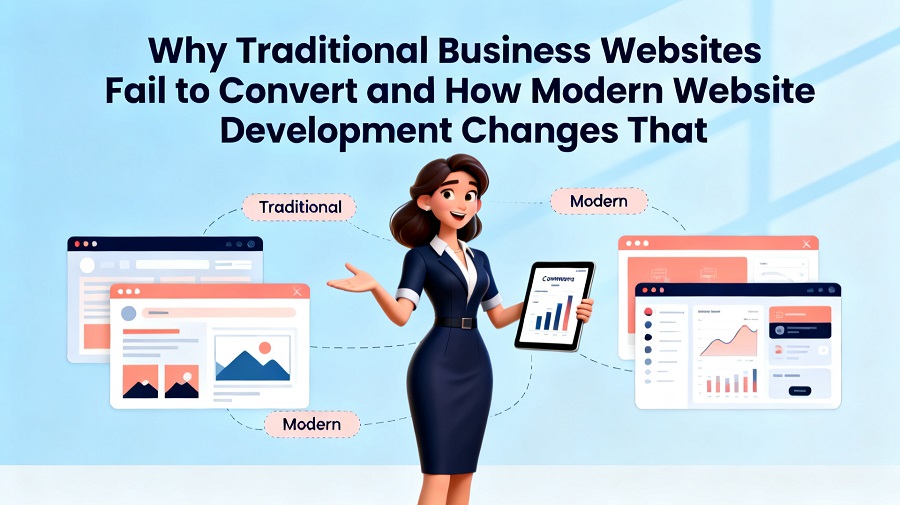
Why Traditional Business Websites Fail to Convert and How Modern Website Development Changes That

A business website should be more than just an online presence. It should be answering questions, establishing credibility, and pointing visitors to meaningful actions. Yet, despite considerable resources spent on design and development, many firms still struggle with low engagement and poor conversion rates.
The problem is not usually traffic, it’s the website itself. Outdated layouts, slow performance, confusing navigation, and generic messaging introduce unnecessary friction that causes potential customers to drop out before taking the next step.
This is why business website development has long since moved beyond just making pages look good. Modern websites are built to meet user intent, to perform, to be accessible, and to deliver measurable business outcomes. They are assets, not digital brochures.
Why Traditional Business Websites Struggle to Convert
———————————
Many older websites were built for a simple reason – to put the company information on the web. That approach might have worked years ago, but today’s visitors want faster experiences, relevant content, and intuitive interactions.
Some of the most frequent problems include-
- Slow page loading speeds
- Navigation that makes information hard to find
- Generic messages that fail to meet customer needs
- Poor calls to action
- Mobile usability issues
- Inconsistent user experience across devices
Even small usability issues can disrupt the customer decision-making process and reduce conversion opportunities.
The Shift Toward Modern Website Development
———————————
Today’s modern website development focuses on experience that works for the user and the business objectives. Instead of going with aesthetic designs blindly, each of these design decisions is made on the basis of data and usability tests.
Modern websites are built to-
- Assist visitors in finding answers quickly
- Reduce the number of navigation steps
- Enhance trust through consistent design
- Promote purposeful participation
- Continue to grow the business over time
Businesses are shifting away from, does the website look good? to does the website help visitors achieve their goals?
That shift in thinking has turned website development into a strategic business investment.
Understanding Why Visitors Leave
———————————
Visitors don’t leave a website for only one reason. Most of the time, a lot of little things add up to an aggravating experience.
| Traditional Website | Modern Conversion-Focused Website |
| Slow page loading | Fast, optimized performance |
| Generic messaging | Content aligned with user intent |
| Complex navigation | Clear information architecture |
| Mobile limitations | Responsive experience across devices |
| Static pages | Interactive, action-oriented journeys |
| Limited analytics | Continuous performance measurement |
By improving these areas, you smooth the path from discovery to conversion much more.
Website Content Is More Important Than Many Businesses Realize
———————————
No matter how attractive an interface is, poor content will still make customers run away.
Questions will be posed by people, and the website should address these questions clearly before seeking any commitments from them. Create trust throughout the purchase process by providing problem-solving, concern-addressing, and expert-level content.
This is when the website content strategy becomes extremely important. Companies should focus on producing high-quality content, which enables users to make decisions, rather than loading their web pages with promotional content.
By blending the best practices of website building with an effective website content strategy for lead generation, one can ensure a cohesive user experience journey from initial contact to actual conversion.
User Experience Directly Influences Conversion Rates
———————————
All interactions play a vital role in how people perceive the company. Loading speed, navigation, typography, form filling, and layout are small but important factors that contribute to creating an experience for the user.
Successful website conversion optimization starts with finding out what is holding back customers from taking certain actions.
Common upgrades include-
- Making navigation menus smoother
- Cutting out unnecessary form fields
- Improved mobile responsiveness
- Calls to action visibility
- Presenting information in a logical sequence
Good websites don’t allow visitors to wander aimlessly. They lead them to the next logical step.
Website Performance Is No Longer Just a Technical Metric
———————————
A website’s speed directly affects the way visitors engage with a business online. Research has shown time and time again that slow-responding pages, especially on mobile, reduce the likelihood of users continuing to browse.
This is why website performance optimization has become an essential part of modern development rather than a post-launch task.
Common performance improvements are-
- Optimized images and media delivery
- Efficient code structure
- Faster server response times
- Browser caching
- Reduced JavaScript execution
- Core Web Vitals optimization
Faster site means better experience for the user, improved visibility on search engines, and increased likelihood of converting the visitor.
What Makes a High-Converting Website Different?
———————————
A high-converting website is purposely built around user behavior instead of assumptions. Each page has a purpose, each section supports decision making, and each interaction reduces friction.
There are a few things that successful websites tend to have in common-
- Clear value propositions above the fold
- Logical page hierarchy for easy navigation
- Strong visual calls to action
- Trust Signals: Testimonials, Certifications, and Client Success Stories
- Mobile-first layouts
- Fast loading on any device
A high-converting landing page for specific marketing campaigns will likely deliver better results than directing traffic to the main homepage of a digitally growing company.
Responsive Development Supports Each Customer Journey
———————————
Business sites are accessed today on smartphones, tablets, laptops, desktops, and even foldables. Ensuring a uniform experience across all screen sizes has become an expected requirement.
Responsive web development means that the layout, navigation, and interactive elements are flexible and flow as needed on whatever device is being used.
There are many advantages to a responsive website-
- Better Usability
- Improved accessibility
- Increased engagement
- Decrease bounce rates
- More exposure on search engines
Designing for multiple devices from the start creates a more uniform experience than retrofitting desktop layouts later.
Data Is Taking the Place of Guesswork
———————————
Modern development decisions increasingly based on what we can measure about users’ behavior, not what we prefer.
Heatmaps, click tracking, session recordings, conversion funnels, and A/B testing help organizations understand how users move through a website and where they encounter roadblocks.
This information supports continuous improvement by assisting teams-
- Simplify user journeys
- Improve content placement
- Optimize calls to action
- Reduce form abandonment
- Increase conversion rates over time
Businesses can continue to improve their systems based on real user interaction rather than one-off redesigns.
A Practical Checklist to Boost Website Conversions
———————————
These priorities can make a measurable difference whether you’re launching a new website or improving an existing on-
- Establish clear goals for each important page.
- Enhance loading speed on desktop and mobile devices.
- Simplify navigation by removing unnecessary clicks.
- Create content to answer customer questions.
- Make your calls to action stronger with clear next steps.
- Test forms often to reduce friction.
- Use analytics on the track and constantly improve pages.
- Prioritize accessible and responsive design.
Little changes done regularly tend to get better results over the long run than doing a big redesign every once in a while.
Conclusion
A professional business website development team doesn’t just build websites – they engineer performance, create seamless experiences, and implement systems that generate revenue. They understand that your website must evolve with your audience, adapt to your industry, and align with your business goals.
And so, in case you feel that there are some performance problems with your website, don’t rely on guessing. Conduct a full audit of your website, improve your lead funnels, and use efficient development tactics. Sometimes the secret to success lies in the little things.