How SaaS Businesses Can Use Conversion Rate Optimization to Drive Growth

Most SaaS teams spend their energy on getting more traffic. More ads, more content, more outreach. It makes sense, because traffic is easy to count and easy to celebrate. But there is a quieter lever that often does more for revenue: getting more value out of the visitors you already have.
That is what conversion rate optimization, or CRO, is about. For a SaaS company, it is not a trick for squeezing out a few extra clicks. It is a steady way of finding out why people don’t sign up, don’t activate or don’t upgrade, and fixing those reasons one at a time.
Why CRO Looks Different for SaaS
—————————
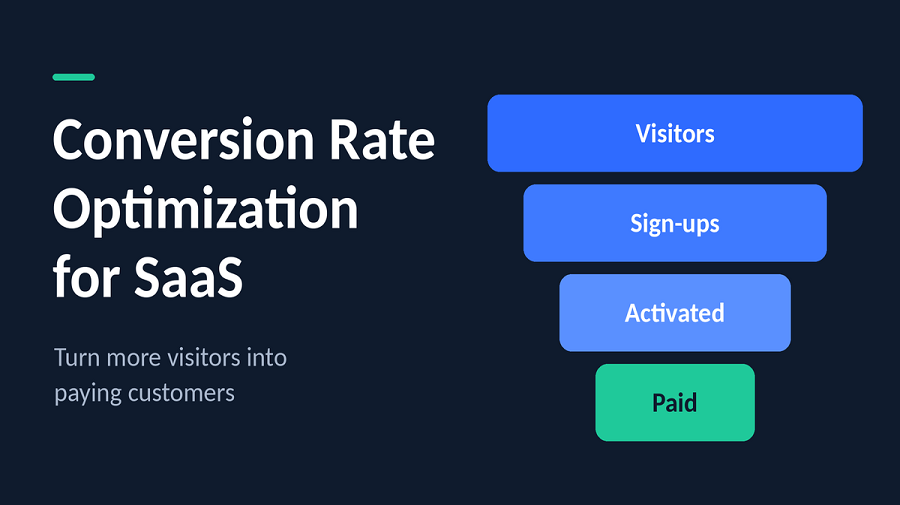
An online store has a fairly short path: see product, add to cart, pay. A SaaS business has a longer and messier one. A visitor reads your homepage, maybe checks pricing, starts a trial, pokes around the product, hits a wall or finds value, invites a teammate, and eventually decides whether to pay. Sometimes that takes three days, sometimes three months.
This means you have several conversion points, not one:
- Visitor to sign-up or demo request
- Sign-up to activation (the first moment the user actually gets value)
- Trial to paid
- Paid to expanded or renewed
A mistake many teams make is working only on the first one. They polish the homepage and the sign-up form, then wonder why revenue barely moves. If half your trial users never complete setup, a better homepage just sends more people into the same leaky bucket.
Start by Mapping Your Funnel
—————————
Before changing anything, write down each step a customer takes and put a number next to it. How many visitors reach the pricing page? How many start a trial? How many finish onboarding? How many pay?
You don’t need fancy software for this. Your analytics tool and your product database are enough. What matters is seeing where the biggest drop sits, because that is where effort pays back fastest. A fifteen percent improvement on a step that loses 70 percent of people is worth far more than the same improvement on a step that loses 10 percent.
Listen Before You Redesign
—————————
Numbers tell you where people leave. They rarely tell you why. For that you need to talk to people and watch them.
A few low-cost ways to do it:
- Session recordings. Watch ten or fifteen sign-up sessions. You will spot confusion that no dashboard shows, like people clicking on things that aren’t links.
- Exit and post-signup surveys. One question is enough: “What almost stopped you from signing up today?” Answers from real users are often blunt and very useful.
- Sales and support calls. Your team hears the same objections every week. Write them down. They are your best list of things the website should answer.
- Churned user interviews. People who left will often tell you exactly which promise the product didn’t keep.
Two hours spent on this usually produces a better list of improvements than a day in a brainstorming meeting.
Fix the Message First
—————————
The most common problem on SaaS websites is not design. It is clarity. Visitors land on the page and can’t tell, within a few seconds, what the product does, who it is for and why they should care.
Test your homepage with a simple exercise. Show it to someone outside your company for five seconds, then ask what the product does. If they hesitate or give a vague answer, you have found your first fix.
Good SaaS messaging tends to share a few traits. It names the customer’s problem in their own words, not in internal jargon. It says what changes after they use the product. And it is specific. “Cut your monthly reporting time from two days to two hours” works better than “Streamline your reporting workflow.”
Make the Pricing Page Do Its Job
—————————
Pricing is where interest turns into a decision, so it deserves real attention. Common problems include too many plans, unclear differences between them, and hidden costs that surface later.
Some practical changes that often help:
- Limit the number of plans so the choice feels manageable, usually three
- Highlight the plan most customers actually pick
- Describe plans by who they are for, not just by feature counts
- Answer the usual questions right on the page: can I cancel, is there a free trial, what happens when I go over my limit
- Put a short customer quote or logo strip close to the buy button
If you sell to larger teams, make it easy to talk to someone. A visible “Talk to sales” option next to self-serve plans lets both kinds of buyers move forward without friction.
Reduce Friction at Sign-Up
—————————
Every field on a sign-up form is a small tax. Ask whether you really need a phone number, a company size and a job title before the person has seen the product. You can often collect that later, once they are invested.
Other things worth checking: Can people sign up with Google or a work email in one click? Is a credit card required for the trial, and if so, is the reason explained? Does the form work properly on a phone? Teams are sometimes surprised to find that a notable share of their sign-up attempts fail because of a small technical issue nobody noticed.
Treat Onboarding as Part of Conversion
—————————
Here is where many SaaS businesses win or lose. A trial user who doesn’t reach their first moment of value within the first session or two is very unlikely to pay later.
Figure out what that moment is for your product. For a project tool it might be creating a first project and inviting one colleague. For an analytics product it could be connecting a data source and seeing the first report. Then design everything around getting people there quickly: a short checklist, sample data so the screen isn’t empty, a well-timed email that points to the next step rather than a generic welcome.
Watch your activation rate as closely as your sign-up rate. It is often the number that best predicts revenue.
Use Social Proof That Feels Real
—————————
Buyers of software are cautious, because switching is a hassle and a bad choice can be embarrassing. Proof that others like them succeeded reduces that fear.
Specific beats generic. A case study with real numbers, a named customer and a short quote carries more weight than a row of logos with no context. Place proof where doubt is highest: near pricing, near the sign-up form and on feature pages that make big claims.
Test, Don’t Assume
—————————
Once you have a list of ideas, resist the urge to roll them all out at once. Run them as experiments so you know what actually helped. Change a headline, compare it
against the original, and let enough visitors pass through before drawing conclusions.
This part is easier than it used to be. Modern AI CRO software can help spot weak points on your pages, suggest what to test and handle the traffic splitting, which saves a small team a lot of manual work. Whichever tool you use, keep the human parts in place: a clear hypothesis, one change at a time, and enough patience to reach a reliable result.
Keep a simple log of every test with what you expected, what happened and what you learned. After six months it becomes one of your most valuable internal documents.
Measure What Matters
—————————
Conversion rate alone can mislead. A page change that boosts sign-ups but brings in poor-fit users will look like a win in week one and a problem in month three. Pair your top-of-funnel numbers with deeper ones:
- Activation rate
- Trial-to-paid rate
- Revenue per visitor
- Retention after 30 and 90 days
If a change improves the early numbers without hurting the later ones, it is a real improvement. If it lifts sign-ups but activation drops, you probably attracted the wrong people.
Common Pitfalls
—————————
A few traps to avoid:
- Copying a famous company’s page. Their audience, brand and traffic are different from yours.
- Calling tests too early based on a few days of data
- Focusing only on the website and ignoring the product experience
- Chasing tiny cosmetic changes while big message and pricing problems stay untouched
- Treating CRO as a one-time project instead of an ongoing habit
Final Thoughts
Growth in SaaS doesn’t always come from louder marketing. Often it comes from removing the small frictions and doubts that stand between a curious visitor and a happy customer. CRO gives you a disciplined way to find those and fix them.
Start small. Map your funnel, find the biggest drop, talk to a few users about why, and run one good test. Then another. Over a few months, those modest improvements compound into something your acquisition budget alone could never buy.