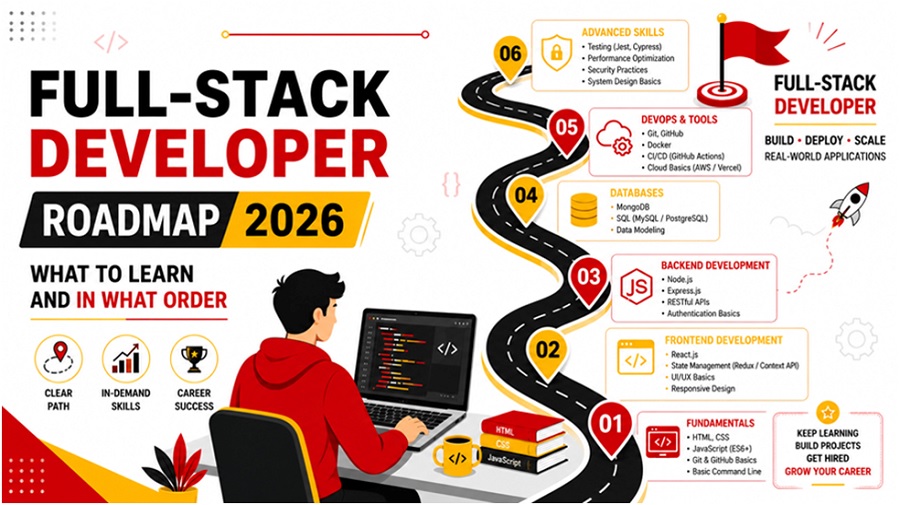
Full Stack Developer Roadmap 2026: What to Learn and in What Order

1. Foundations Before Frameworks
—————————-
1.1 Core Web Fundamentals
Every big building needs a base and full stack development is no different. Before you start with any framework you need to learn the basics of the web: HTML for structure CSS for how things look and JavaScript for how things work. This is not something you do because you have to. Frameworks make it easier to work with these things. They do not replace them. If you do not understand how the web works you will get stuck at some point.
You should pay attention to Semantic HTML. This is because making your website accessible is no longer something that’s nice to have it is something that you have to do. Learning how to write HTML that means something, not how it looks is very important. It helps with search engines, screen readers. Making your website last longer.
CSS has also gotten a lot better. You can do a lot of things with it now like make containers that can change size and use selectors. You should learn how to use CSS without any tools first and then you can use things like Tailwind or Sass.
JavaScript is still the language that web browsers use. You need to learn about things like closures how objects work and how to work with events. These are the building blocks of every framework.
1.2 Version Control and Collaborative Workflows
You need to know how to use Git.. It is not just about memorizing commands. You need to understand how to work with people how to make changes to your code and how to write messages that make sense. Platforms like GitHub and GitLab have made it easy to work with people and you can use them to review code run tests and manage your project.
1.2 Command Line and Operating System Literacy
Some developers do not like to use the command line. They use graphical tools instead.. This is a limitation. You should learn how to use the command line, how to navigate your files and how to use scripts to automate things. You should also know how to use package managers and how to manage your environment variables.
2. Frontend Mastery
—————————-
2.1 Modern JavaScript and TypeScript
By 2026 most companies use TypeScript. It helps you catch mistakes before you run your code. It makes your team work faster. You should learn about things like generics, utility types and discriminated unions. Do not just think of TypeScript as JavaScript with some features.
2.2 Component-Based Frameworks
React is still the popular framework but Vue and Svelte are also good choices. Of learning every framework you should learn one really well. Understand how components work, how they are updated and how to use things like hooks.
2.3 Styling Architecture and Design Systems
You should learn how to use utility- CSS frameworks like Tailwind. This helps you make your website look consistent without having to write a lot of custom CSS. You should also learn how to think about design systems and how to make components.
2.4 State Management and Data Fetching
There are tools for managing state and fetching data. You should learn how to use them and when to use each one. Do not just use one tool for everything.
3. Backend Proficiency
—————————-
3.1 Server-Side Languages and Runtimes
Node.js is still a choice for full stack developers because you can use JavaScript on the backend and frontend.. You should also learn about other languages like Python and Go. Do not try to learn every language pick one and learn it well.
3.2 API Design: REST, GraphQL and RPC
REST is still the most common way to make APIs but GraphQL is also popular. You should learn about the tradeoffs of each and when to use them.
3.3 Authentication and Authorization
You should learn about ways to authenticate users like session-based auth, JWTs and OAuth. You should also learn about authorization and how to make sure that users can only do what they are allowed to do.
3.4 Databases: Relational, Non-Relational and Vector Stores
You should learn about types of databases like relational databases NoSQL databases and vector databases. Understand when to use each one and how they work.
4. DevOps and Infrastructure Awareness
—————————-
4.1 Containerization and Orchestration
You should learn about Docker. How to use it to package your applications. You should also learn about Kubernetes and how to use it to manage your containers.
4.2 CI/CD Pipelines
You should learn about tools like GitHub Actions, GitLab CI and CircleCI. These tools help you automate your tests, builds and deployments.
4.3 Cloud Platforms and Serverless Computing
You should learn about cloud platforms like AWS, Google Cloud and Azure. You should also learn about serverless computing and how to use it to deploy your applications.
5. The AI-Augmented Development Layer
—————————-
5.1 Working with LLM APIs and Agent Frameworks
You should learn about language models and how to use them in your applications. You should also learn about agent frameworks and how to use them to manage your AI workflows.
5.2 Prompt Engineering as a Skill
You should learn how to write effective prompts and how to communicate with AI models. This is a skill that you need to practice. It is not just about tricks or hacks.
5.3 AI-Assisted Coding Tools and Their Limits
You should learn about AI-assisted coding tools and how to use them to help you code. You should also understand the limits of these tools and not rely on them too much.
6. Testing, Security and Performance
—————————-
6.1 Testing Pyramids and Practical Test Coverage
You should learn about types of tests like unit tests, integration tests and end-to-end tests. You should also learn about tools like Vitest, Jest and Playwright.
6.2 Web Security Fundamentals
You should learn about web security and how to protect your applications from threats. You should also learn about the OWASP Top Ten. How to use it to guide your security decisions.
6.3 Performance Optimization and Observability
You should learn about performance optimization and how to make your applications run faster. You should also learn about observability and how to use tools like logging, tracing and metrics to understand how your applications are working.
7. Soft Skills and Career Trajectory
—————————-
7.1 Communication and Documentation
You should learn how to communicate how to write good documentation. This is important for working with developers and for making sure that your code is easy to understand.
7.2 Building a Portfolio That Signals Competence
You should learn how to build a portfolio that shows your skills and how to make it look good. This is important for getting a job and for showing that you are a developer.
7.3 Continuous Learning in a Shifting Landscape
You should learn how to keep learning and how to stay up, to date with technologies. This is important because the landscape of development is always changing and you need to be able to adapt.