Role of Big Data Analytics in Grocery Delivery Applications

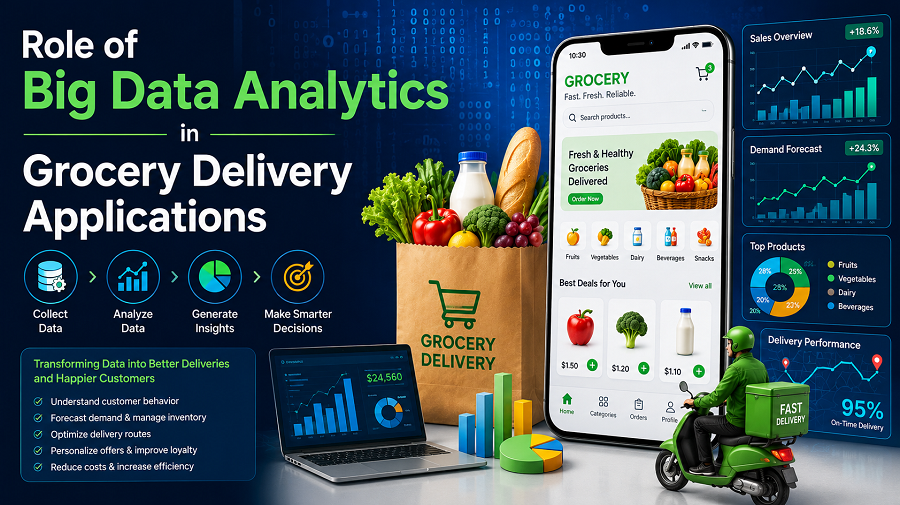
The daily operations of the grocery delivery apps involve processing a huge amount of data, which includes searches, order history, transactions, delivery path, and reviews by users. In the era of ever-growing online grocery delivery platforms, the major issue is not collecting the information anymore, but making sense of this data in real time. This is where the role of big data analytics in the grocery delivery app comes into play.
Data analytics enables grocers to provide quickness, precision, and reliability, three qualities customers expect from their delivery service. Shoppers need to know in advance what products are available at the moment and whether they can buy them at competitive prices and have the delivery on time. Without insights, delivery platforms are forced to make certain assumptions. However, using big data, they can estimate demand, manage inventory levels, customize user experience, and solve the problem of delivery beforehand.
The application of big data analytics within grocery companies allows the decision-making process to be founded on data rather than gut instinct. Thanks to big data, the retailer has an opportunity to forecast demand, cut costs, prevent shortages, optimize the process of delivering goods and tailor customers’ experience. All these advantages affect not only customers’ satisfaction but also the financial results of the company.
In today’s world, successful grocery delivery app development company apply the following innovative technologies in their operations: analytics, artificial intelligence, machine learning and cloud computing in order to analyze millions of data points at once. The application of the above-listed technologies allows companies to see the trends, adapt to changing customers and optimize each step in the grocery delivery process.
For startups and retail companies, the implementation of big data analytics in the grocery delivery application has become a vital solution. Learning about big data and its application in grocery delivery apps will allow you to develop a scalable and data-driven product.
What Is Big Data Analytics in Grocery Delivery?
—————————-
Data analytics is the process of acquiring, arranging, analyzing, and interpreting large volumes of both structured and unstructured data for deriving significant insights that benefit a business. Data analytics in grocery delivery apps is collected from several sources such as customer behavior, inventory databases, payment systems, warehouses, logistic chains, suppliers, and mobile apps.
Analytic processes serve the purpose of converting raw data into insights that will lead to an improvement in business operations. Through the process of Data Analytics in Grocery Delivery App, a business is able to study the behavior of the customers, identify the products that are in demand, forecast future needs, manage inventories, deliver services, and even customize the marketing campaigns.
Data analytics enables grocery stores to make intelligent, timely, and informed decisions for increased efficiency and customer satisfaction.
Types of Data Collected by Grocery Delivery Applications
Every grocery delivery platform generates vast amounts of information throughout the customer journey. Analyzing different types of data allows businesses to optimize services, streamline operations, and improve decision-making.
Customer Behavior Data
Browsing history, search patterns, number of visits, preferred category, wish list, abandoned cart, purchasing behavior, review and application engagement are some examples of data that fall under the category of customer behavior data. This kind of analysis helps organizations create a personalized recommendation, improve customer experience and increase conversion and loyalty through marketing efforts.
Order and Transaction Data
Order and transaction data comprises purchase history, mode of payment, order size, promotions offered, request for refunds, subscription purchase, delivery preference, and checkout process. Such information is used by businesses to forecast demand, pricing strategy, improve payments process, and assess the performance of their marketing efforts.
Inventory and Supply Chain Data
Examples of inventory and supply chain data are inventory levels at the warehouse, supplier performance, replenishment schedules, product availability, product expiration, product damage, procurement cost, and inventory turnover rate. Data analysis can help companies in reducing wastage, maintaining ideal inventory levels, reducing shortages, and improving the efficiency of the entire supply chain process.
Delivery and Logistics Data
Examples of delivery and logistics data include location of the driver, route performance, delivery time, fuel usage, traffic, successful deliveries, failed deliveries, and delivery preferences of customers. By analyzing this data, companies are able to optimize their delivery routes, cut down on their costs of transportation, and improve their punctuality.
Roles of Big Data Analytics in Grocery Delivery App
—————————-
The role of big data analytics extends to all activities in the grocery delivery application. From analyzing purchase patterns to enhancing delivery efficiency, big data analytics allows organizations to take informed decisions that lead to increased profitability and improved customer experience.
1. Personalized Shopping Experience
Big data analytics looks into several aspects of the customer including browsing patterns, previous purchases, favorite brands, purchase patterns, and preferences to recommend personalized items for purchase. The shopping experience through personalization improves customer engagement, their conversion rates, and loyalty towards the organization.
2. Demand Forecasting and Inventory Planning
Future demands for goods can be forecast through the analysis of past sales data, seasonality, local events, changes in weather, and holidays. With proper forecasting, firms can make sure that they have sufficient stocks available to prevent any stock-out and overstock problems, which could lead to wastage of food items.
3. Delivery Route Optimization
Efficient analysis of big data on GPS data, traffic status, delivery timing, customer location, and performance of drivers helps find the best possible route for deliveries. It helps in saving fuel, decreases delivery time, cuts down transportation expenses, increases delivery success rate, and greatly increases customer satisfaction.
4. Dynamic Pricing and Promotional Strategies
A study of the demand of customers, competitor prices, inventory availability, purchasing behavior, and seasonality is helpful in formulating dynamic pricing schemes. It will enable the business to introduce effective promotional schemes and discounts to earn maximum profits.
Big Data Analytics Use Cases in Popular Grocery Delivery Apps
—————————-
Leading grocery delivery app development services leverage big data analytics to enhance customer experiences, streamline operations, and improve profitability. Below are some of the most impactful real-world use cases.
1. Personalized Product Recommendations
Big data analytics evaluates the history of customers’ purchases, browsing, favorite brands, and how often they buy products, offering personalized products. Personalization not only helps in increasing the average order size but also encourages interaction and repeat buying and makes the whole shopping process enjoyable.
2. Smart Inventory Management
By means of analytics, the supermarkets will be able to monitor the inventory level of products in real time at their warehouses and retail outlets. It will be easy to forecast the demand for specific products and avoid overstocking and stock-outs of products among other things.
3. Real-Time Delivery Optimization
Delivery analysis utilizes GPS location, traffic reports, weather forecasts, and driver availability to improve the routing of delivery trucks. This helps companies to reduce delivery time, lower delivery costs, enhance delivery accuracy, boost the efficiency of fleets, and deliver accurate estimated times of delivery of orders to their customers.
4. Targeted Marketing and Customer Retention
Big data analyzes customers’ buying habits, customer preferences, seasonality trends, and dormant accounts. Companies are able to send targeted e-mail marketing messages, reward customers, offer discounts, and send promotional alerts to them.
Challenges of Implementing Big Data Analytics in Grocery Apps
—————————-
Although big data analytics offers significant business advantages, implementing it successfully requires overcoming several technical and operational challenges.
1. Managing Data Privacy and Security
Grocery apps store sensitive personal information such as payment details, home addresses, and purchase history. It is essential that organizations implement certain protective measures such as encryption, cloud security, access control, and regulation in order to protect their customer’s information from cyber-security risks.
2. Integrating Multiple Data Sources
Modern food retail firms rely upon various systems like inventory management system, payment gateway system, CRM, warehouse management systems, and delivery system. Integrating all these systems together into an analytics system can become very difficult.
3. Ensuring High-Quality Data
The accuracy of analysis results is possible only if the quality of data used is correct and consistent. Inconsistent data includes duplicate records, lack of information, old data about inventory, and inaccuracies in customer data that may decrease the effectiveness of analysis and, consequently, negatively affect the decision-making process of a company.
4. Infrastructure and Skilled Resource Requirements
In order to manage data in real time, it is essential for the company to have cloud computing capabilities, analytics software, and individuals like data engineers, artificial intelligence specialists, and business analysts. There may be some challenges small companies can face in terms of having analytical capabilities.
Future of Big Data Analytics in Grocery Delivery Applications
—————————-
Emerging technologies will continue expanding the capabilities of big data analytics, enabling grocery businesses to deliver smarter, faster, and more personalized services.
1. AI-Powered Predictive Shopping
AI will study purchasing history, seasonality, dietary preferences, and shopping habits to predict the customer’s requirements even before placing an order. The applications in the grocery industry will automatically provide shopping lists tailored to individual requirements and facilitate the process of purchases.
2. Hyper-Personalized Customer Experiences
The future of Grocery delivery app development will be driven by advanced analytics tools that leverage behavioral data, health preferences, geographic location, and lifestyle insights to deliver highly personalized shopping experiences. Customers will receive tailored product recommendations, customized promotions, and relevant offers, leading to higher conversions, improved customer satisfaction, and stronger long-term loyalty.
3. Intelligent Supply Chain Automation
Analytics and machine learning, in conjunction with IoT sensors, automated warehouses, and other advanced technologies, will allow for optimizing stock replenishment, controlling product freshness, predicting supplier problems, and enhancing warehouse management. Such smart technologies will result in reducing costs as well as quicker order processing and better stock availability.
4. Sustainable and Data-Driven Grocery Operations
Use of big data analytics helps in minimizing wastage of food products, efficient packaging, delivery process, and decreasing carbon footprints of the organization. Metrics of sustainability and performance will assist grocery retailers in becoming sustainable, minimize cost, and meet the customer’s requirement of environmental deliveries.
Conclusion
Data Analytics in grocery delivery applications is essential for delivering speed, accuracy, and reliability. It helps businesses predict demand, reduce waste, optimize deliveries, and improve customer experience.
For those firms that wish to stay competitive in today’s marketplace, it is recommended that they invest in digital platforms that are both flexible and based on advanced analytics that can change as per the evolving demands of the customers. Using such digital capabilities in Grocery mobile app development will lead to increased efficiency, customer satisfaction, reduced expenses, and opportunities for growth. The use of big data today is vital for building intelligent apps in the future.