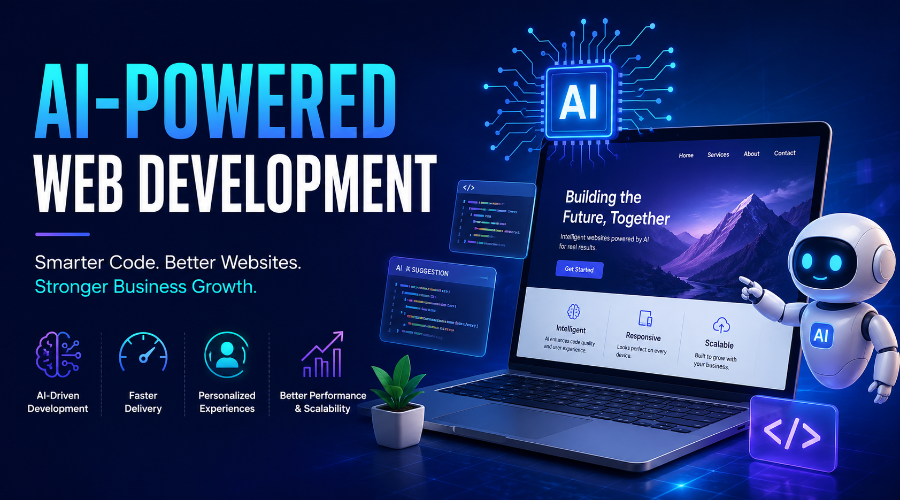
AI-Powered Web Development: Benefits, Challenges, and Future Trends

Business websites have evolved from just becoming an online brochure. Now, it is a salesperson, a channel for customer support, a marketing channel, and a data-gathering tool at the same time.
Companies have to keep up with the ever-changing expectations of their customers and create websites that are quick, smart, and provide individualized experiences without requiring more effort in development. AI-powered web development is playing an important part in bringing this change.
Artificial intelligence is a tool for developers rather than replacing them. Through code generation, test automation, performance enhancement, and even the personalization of the user journey, AI becomes an integral part of the modern web development lifecycle.
Imagine an online store company that is preparing to unveil a new line of products.
Despite all the capabilities of AI, technical knowledge and creativity should not be replaced at all. It takes a team of seasoned web developers to successfully construct a website that is well-suited to the business, the target audience, and the latest technology trends, including accessibility, security, and performance optimization.
This article will be a guide on how AI-Powered Web Development is a change agent in the website development world, the business merits it brings, the potential issues organizations are bound to meet, and the upcoming web development trends that will define the future of the industry.
What Is AI-Powered Web Development?
—————————
Web development with AI involves using different AI technologies to assist in the various phases of website development like design, coding, testing, deployment, and optimization.
Developers can free up their time to focus on more challenging tasks by offloading repetitive tasks to machines powered by artificial intelligence.
Key Benefits of AI-Powered Web Development
Here are some benefits of using AI-powered web development.
Faster Development Without Compromising Quality
Contemporary AI coding tools can not only produce boilerplate code but also suggest ways of enhancing the syntax, point out the programming mistakes common in the area, and finally do the work of documentation.
Web development company can now spend more time writing each line of code anew and more time figuring out the complex business logic and coming up with a superior user interface and user experience.
Smarter Personalization for Every Visitor
More customers are expecting websites to know what they’re looking for and suggest the products they will like.
This is made possible by AI technologies that instantly process user behavior data, browsing history, purchasing habits, and engagement metrics to understand the customers’ needs perfectly and offer them the products they would be really interested in.
Better Customer Support Through Intelligent Automation
One thing customer support agents often grumble about is having to repeat almost identical answers again and again when they are supposed to be solving problems that are unique to different people and their situations. Though it turns out that AI virtual assistants and chatbots can automate responses like these, because of this, it saves customer support reps a lot of time that would be spent on issues where the problem is one that the customer has a hard time understanding.
How Does Artificial Intelligence Revolutionize Every Web Development Phase?
—————————
AI is becoming a vital part of most of the stages of the web development process.
Designing User Experiences That Feel More Personal
Users pay attention to aesthetics for visual appeal. It must guide customers to the information they seek in a natural manner.
Designers can better analyze and decipher the users’ website behavior, like tracking the visitors’ movements on a page, click behaviors, scrolling behaviors, and navigation patterns. This helps them discover where users are not interested anymore or give up looking for what they want.
Supporting Developers with Smarter Coding
Creating clean code is still one of the fundamentals of web development. AI is not replacing developers. Instead, AI is being used as a coding assistant in this context.
AI-driven development tools in today’s software environment can recommend pieces of code, spot syntax errors, explain strange-looking code, and suggest a whole bunch of performance tweaks as developers work on their programs.
For a senior developer, the use of AI may translate into more time and less frustration when it comes to doing the same kind of tasks every day. A novice developer may find it a useful study partner who can provide pointers and emphasize proper techniques.
Improving Testing and Quality Assurance
Website testing is usually one of the most time-demanding development phases.
Each change has to go through different browsers, operating systems, devices, and user scenario checks to make sure everything works properly.
With the help of an AI website builder, this task can be done quite differently and much faster.
AI testing tools can quickly find broken functionality, discover performance problems, or even indicate unexpected changes without human interference.
Strengthening Website Security
Cybersecurity is key for every company regardless of its size. There will always be new types of online dangers that websites will have to defend themselves against. These threats range from automatic bots and attempted phishing to malware distribution and unauthorized system access.
Besides that, AI plays an important role in website security through real-time tracking of users’ online behaviors and detecting any irregularities that might hint at a cyber attack.
Suppose there are a large number of attempted logins coming from a number of different countries within a very short timeframe. In that case, AI-powered security measures can detect the issue and respond accordingly. A common example would involve AI systems issuing additional levels of authentication and/or temporarily suspending such requests.
Challenges of AI-Powered Web Development
—————————
A balanced approach delivers better long-term outcomes.
AI Still Needs Human Oversight
Another widely spread misconception about AI is that it can autonomously build business websites.
Artificial intelligence is able to write codes and get some tasks done automatically, but it doesn’t understand business goals, customer needs, legal issues, branding in and out.
Besides, to provide custom features, a number of AI-based solutions require client’s data.
Data Privacy and Compliance Concerns
There are a number of issues which must be taken into consideration, and which are crucial in terms of ensuring privacy and securing the required consent.
Companies dealing with clients’ personal data should make sure that their artificial intelligence is compatible with the regulation such as GDPR, CCPA, or any other data protection regulation.
Integration with Existing Systems
A large number of companies have adopted mature platforms such as CRMs, ERPs, marketing automation applications, and CMS (content management systems).
It’s not always straightforward to introduce AI in places where such technologies already exist.
Legacy applications might not have the most up-to-date APIs, could be based on old technology, or simply have incorrect/incoherent/incomplete data, which makes the integration much harder than it seems.
Managing AI Bias and Accuracy
Artificial intelligence models, like people, acquire new skills by being taught using example-based data sets or “training data”.
It follows then that if the training data has gaps or is out-of-date, or is prejudiced, the AI will reflect this bias and will not be accurate in its outputs.
Taking the case of a machine intelligence recommendation system, if it has been trained using a restricted customer data set, it may keep recommending only certain types of products without giving customers the full range available, thereby negatively impacting the total user experience.
Future Trends Shaping AI-Powered Web Development
—————————
Here are some trends that are likely to shape the future of AI-powered web development.
AI Agents Will Handle More Complex Tasks
To date, artificial intelligence has mostly been used to facilitate developers, provide service representatives with a chatbot, or create content for marketing campaigns. In the coming years, such AI programs will be able to control complicated and multifunctional procedures with virtually no need for human oversight.
Moreover, an AI component can monitor the functionality of the website, determine the root cause, and present it to the firm in a well-compiled document.
Hyper-Personalization Will Become the Standard
Modern customers require an understanding of what they like without being chased around for long searches.
Soon, the next generation of AI will make sense of the data from surfing, prior contacts, purchase history, and even interaction behavior to build highly individualized web environments.
The homepage would no longer be the same for all, but the web pages would show the products, the content, the ctas and the navigation suited to the needs of each visitor.
Smarter Search Experiences
The use of conventional keywords in searches is being phased out gradually by conversational searches.
People are now shifting from entering keywords to posing questions using natural language.
AI-enhanced search tools will be capable of getting what your context and intent are, and they will provide you with your most relevant matches that would have been hidden otherwise.
This means that with these innovations, users will not only be able to locate information relevant to their queries, but they will save a lot of time that would have been spent going through enormous websites.
Greater Focus on Responsible AI
With AI gradually becoming the dominant part of digital experiences, there will be an expectation for businesses to be responsible in their usage.
Today’s customer not only wants to know when they are dealing with an AI but also how their personal information is being utilized.
On the road to building smart websites through AI, organizations will have to be aware of the fine art of making innovation and accountability coalesce by the establishment of robust structures for governance, the safeguarding of customer data, and providing avenues for human review, in particular when it comes to vital decision-making processes.
Conclusion
AI-driven Web Development is transforming the way companies design and operate online experiences. It’s not only speeding up the development process but also enhancing website functionality; it is also allowing for customized customer journeys and automated repetitive tasks. Because of this, AI is enabling companies to design more intelligent and cost-effective web applications through a combination of creativity and technology.
At the same time, successful implementation without success is not a one-size-fits-all affair.AI tools must be integrated at an enterprise level as well as in the individual departments to achieve a seamless user experience.