Top UI/UX Design Strategies for Building Successful Digital Products

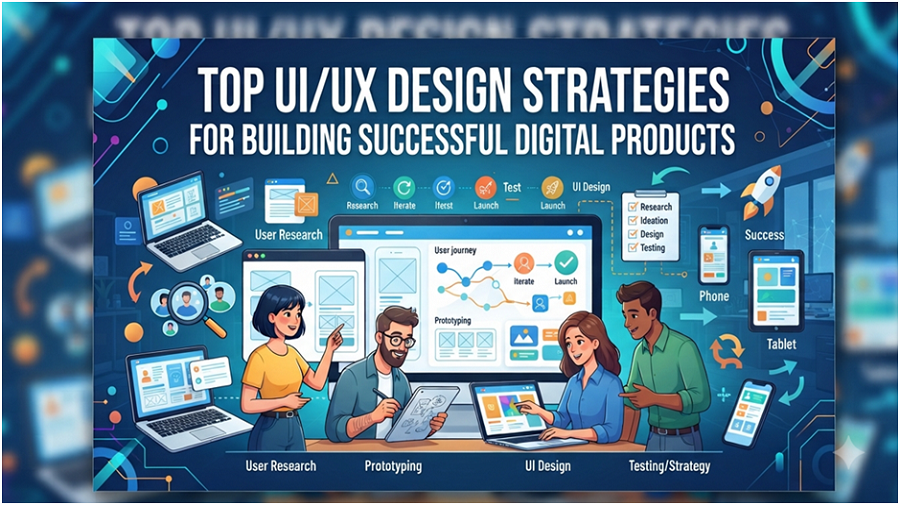
With AI now a common element across digital products, the best user experiences are being defined less by strong AI models and more by human-centered design.
In today’s digital world where trust, transparency, and maintaining control are essential, product development teams have to reconsider the UI and UX conventions of the past.
A great experience with AI involves helping the user understand the nature of the technology, its intentions, and how to use it effectively.
This article features insights from Forbes Technology Council about some of the most important UI and UX principles for AI-powered experiences.
Top Strategies To Look Out For In UI/UX Design
——————————-
Explore the top strategies that leading business around the world use for UI/UX design.
User Value Over Additional Features
With the advent of artificial intelligence in the realm of digital, the emphasis should be placed on user value over additional features.
Organizations are building more agents and features into their offerings with little consideration of how disjointed it’s becoming from the perspective of the user.
More interfaces and connections with more tools make the benefits of the AI invisible under the user complexity.
Incorporating Friction For Human Decision-Making
Incorporating friction has now become an essential part of UX design.
With people inherently trusting technology too much, the idea of seamless experiences might push users into believing the output of the AI without any further questioning.
The design should incorporate the moments which will engage people into thinking and making decisions, depending on the human-AI ratio corresponding to the severity of the application.
Analyze Your Competitors
Take the effort to analyze what your competitors are up to in terms of how they function.
Experience your customer journey in your website or application and experience their customer journey in your competitors’ websites or applications.
Analyze your performance relative to that of your competitors.
Analyze five or six of your competitors and then benchmark yourselves against these competitors on a specific touchpoint along the customer journey like social media.
Should you improve your interface? Should you make changes in the process flow along the customer journey?
Prototype Creation
This stage is crucial in any UX project since here you actually create the rough version of the product/interface and then test it on the users.
Such a version of the product or interface is referred to as the minimum viable product (MVP).
There is nothing wrong if such an MVP isn’t fully developed since the approach during prototyping may be summed up in such a phrase: “fail fast, fail often”.
The main benefit of the prototyping process is that you can actually try your product in the real-world conditions and ‘test the market’ before starting the production in large quantities.
This will allow developing a much better, user-focused product.
In many cases, for creating the prototype, you need to use clickable mock-ups (you can use InVision or Figma, for instance) and not fully functional interfaces.
Then, based on the feedback you got from the research, you will be able to gradually improve your designs till you create a prototype.
While collecting the data about your prototype, keep in mind the following numbers and words:
- Numbers: These are the basic, qualitative information about the prototype that you obtain. You can get this through surveys and feedback forms.
- Words: These are the attitudinal, quantitative information that you can obtain about the prototype. You can obtain this through surveys and forms or interviews and observations.
Fostering Trust via Transparency
Having worked alongside executives implementing AI in workflows and products, one aspect that stands out is that transparency builds trust.
Users must know when the AI has produced, suggested or decided and have sufficient information to assess the output.
Adoption rates are higher when users can challenge, verify or reject AI-driven experiences.
Creating Personalized Experiences without Information Overload
One UX concept that has emerged is relevance-based personalization.
With increased integration of AI in digital products, users expect personalized experiences where only the relevant information is made available.
This helps avoid the problem of information overload, as well as creating an experience that feels conversational to the user.
Identify Risks and Issues that May Arise
Every product strategy needs to have an idea about what kinds of issues and challenges might emerge.
From employee attrition to the ever-changing and unpredictable risks associated with design and testing, any product designer is well aware of the risks and issues involved in digital product design.
Make sure there is a list of potential issues and risks incorporated in your initial product strategy, and update it from time to time. Common risks that one may come across include:
- Risk to budget – when the costs involved in the project may go above the estimated costs. Include some buffer within your budget to handle additional costs, if any.
- Risk of delay – which are bound to occur anyway. Instead of setting a deadline at the end of the project, set deadlines for certain milestones of the project.
- Technical risks – when use of new technology poses challenges. Train your employees with the required skills early enough.
User Testing
User tests play an integral part in the UX program. Strive for getting all possible unbiased data of both qualitative and quantitative nature. Ask your users relevant questions.
Watch them work with your product. Let them describe their first-time experience working with the product.
Be sure that you get feedback and comments from users whom you can trust. Try not to interfere in or prompt them during giving comments.
Just let them freely share their thoughts with you.
As your prototype becomes refined, you may find yourself feeling comfortable enough to start testing it among bigger audiences.
An incremental approach is the right way to do it. There is no sense in having a big number of users testing your prototype that is far from being ready yet.
You should start with less costly small tests, and then go to more costly ones. So, test early, and test often.
By conducting a number of small tests, you should start seeing a picture of your future product becoming clearer and more refined.
Also, most important, it becomes closer to the actual needs of the users.
Now you can begin testing various designs of the product through A/B testing.
This helps you make adjustments on various aspects of the product like color scheme, font type, and button placement.
Analyze The Data
The goal behind prototyping and testing is to obtain as much data as possible prior to releasing the end product.
Quantitative feedback gives you the cold, hard facts, like the statistics regarding the satisfaction levels or dissatisfaction levels.
Yet, qualitative data might provide you with more nuanced feedback.
It should be noted that qualitative feedback isn’t always true to the core since the users might say what you expect to hear from them, thus distorting the truth.
That is the reason why you need to gather both qualitative and quantitative data.
Do what you’ve seen coincide with the qualitative data that you have obtained during the test?
Look into your analytics and find out which parts of your journey are inefficient or broken. Compare the analytics with the feedback provided by the users.
Use Artificial Intelligence
There has been an increase in the use of AI in UX.
AI tools and automation software, such as Kroma, Jasper, and Stable Diffusion, can be used for different tasks associated with UX, such as developing user interfaces.
The tool will be useful when handling routine tasks, for instance, implementing changes on multiple screens.
There are also excellent AI tools that can help develop a website friendly for users.
The AI tool can also help solve the challenges that arise in relation to UX problems, including simplification of user interface and analysis of the huge amount of user data.
However, human intervention will still be necessary to deal with some problems.
UX Mindset Development
It has been discussed earlier that UX is not just a one-time process. It requires development of a UX mindset.
What experience would you like to provide to your customers? And what tools should you use to do that, e.g., a good UI?
Pay attention to your customers and gather data about them. Then use this information to make decisions.
Once the UX consultant has discovered and analyzed the problem, he/she will most probably recommend some short-term actions.
Usually, they become ‘low-hanging fruits’ – the solutions which allow gaining quick success for the company.
There is no one ‘magic bullet’ which allows solving all the UX-related problems of the company.
Most probably, the UX consultant will look deeper and recommend some systemic actions to help the company develop its own UX mindset.
This way, you will avoid the same UX problems in the future.
Implementation of these solutions requires some time and usually means that you will have to build up the relationship with the company.
Conclusion
It’s clear from this digital products journey using the UI/UX design process that smart design decisions have an impact on user engagement and the performance of the businesses. Interface Design to Data-driven Decisions and Cross-platform Compatibility, all these different aspects of design help create an effective experience for the user.
In order to stay ahead of the competition, companies must not only have great products but must also focus on creating a strong UI/UX. It is through the design experience that it becomes apparent which products succeed and which fail. You can simply avoid the failure, all you need to do is hire UI/UX designers.