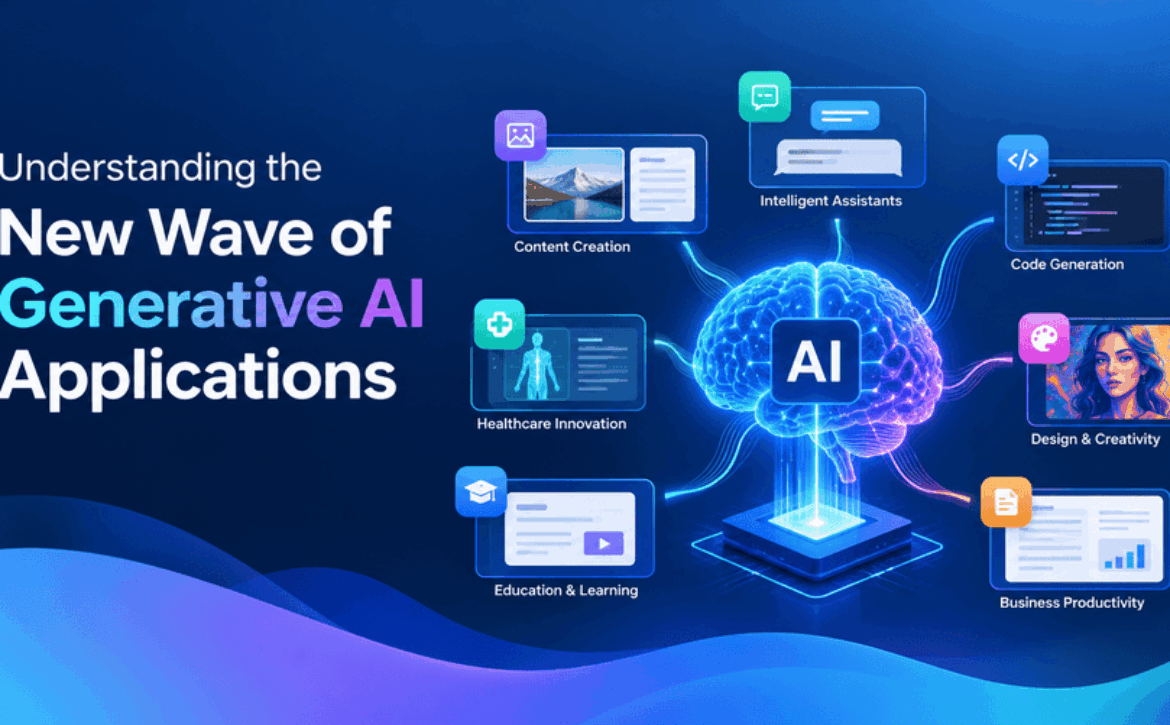
Understanding the New Wave of Generative AI Applications

Most apps used to follow a script. Tap a button, get one fixed result, every time. That is no longer the case. Now, an increasing number of applications can write, design, plan, and do some tasks on their own without requiring an extensive step-by-step input.

People call this shift generative AI. It’s not just a smarter chatbot bolted onto an old app. It collectively changes how developers write code, how applications answer customer questions, and even how design frameworks are built and structured. Examining differences and understanding why they matter will help you form an idea of how applications that you use, and that you build yourself, are structured.


From Rule-Based to Generative: What’s New

—————————-

Older apps ran on scripts. A developer mapped out every path a user might take. Click here, land there. If a user did something outside that map, the app broke or just sat there confused.

Generative apps skip the map. Ask one to summarize a report and it writes a new summary right then, shaped by whatever you gave it. Ask it to draft an email and you’ll get something different each time, not a canned reply pulled from a list. It’s not choosing from pre-written options. It’s making something new.

That changes what a development team actually spends time on. Teams used to burn months scripting every scenario a user could hit. Now a chunk of that time goes into feeding the model good instructions and checking what it produces, instead of hand-writing a path for every click.


Where Generative AI Shows Up in Apps Today

—————————-

Generative AI services have spread into nearly every kind of app. Not just the AI-branded ones.

Writing tools use it to draft blog posts and product copy in seconds. Support apps use it to answer routine questions before a ticket ever reaches a human. Design tools turn a rough sketch or a short prompt into a working mockup, which used to take a designer hours on its own.

Coding tools picked this up fast too. Copilots built into code editors suggest whole functions while a developer types, flag bugs early, and explain code someone else wrote years ago. E-commerce apps lean on it for recommendations that shift in real time based on what a shopper just clicked, not a rulebook someone updates once a month.

Software gives similar examples as above. One app may use one AI model to generate text for its chat support, as well as its onboarding texts and interface. From having distinct buckets, we have entered an AI model-centric future.


Agentic Behavior: Apps That Act, Not Just Respond

—————————-

There’s a step past generating content, and it’s a bigger deal than most of the AI-app hype gives it credit for. It’s called agentic AI.

A basic AI feature answers a question and stops. An agentic one carries out a multi-step task, often without anyone checking in along the way. A travel app that spots a price drop and rebooks the flight itself, that’s agentic. So has an email scheduling feature that allows users to simply send an email. It will then analyze the content to find the availability of these users and send the event as a calendar invite.

Rather than having to navigate through five screens, a user only has to compose one message and the app does everything else. Building that well takes more than a solid model behind it. It takes real guardrails. To be successful, an app needs to know how to pause and prompt a human decision before performing an action with irrevocable consequences.


Multimodal and On-Device Trends

—————————-

Two other things are pushing this wave forward, and they get less attention than they deserve.

First: multimodal input. AI tools used to be mostly text-in, text-out. Now plenty of apps take voice, images, and text together in one go. A healthcare app can read an uploaded lab report, listen to a patient describe symptoms out loud, and pull both into a single summary for a doctor.

Second: on-device AI. Running a model used to mean shipping every request off to a server somewhere and waiting. Smaller models now run right on a phone. That means quicker responses, sure. It also means sensitive data can stay put instead of traveling to a server. For anything touching health records or money, that’s a real difference, not a footnote.


What This Means for Businesses Building Apps

—————————-

There are a few things to consider as you think about incorporating generative AI into apps you build.

One of them is development time. There used to be weeks spent developing supporting scripts and developing UIs, which can now be done in under an hour to develop an initial version. Just developing faster doesn’t improve things if you ship something without humans checking it, though.

Users’ expectations have changed as well. Your audience has daily AI usage that drives app interaction expectations. A static FAQ will feel drastically behind compared to your competition.

Privacy is going to be a major concern as well. Any app that processes or stores personal data through an AI model needs to know what it stores, what it sends, and what can be disabled. An app gets trust erosion, and, by extension, no audience, if you don’t address those.


Getting the Data Right

—————————-

None of this works without decent data behind it. A generative model is only as good as what it’s trained on and what it gets fed at the moment someone uses it. Feed a support bot bad or outdated product info and it’ll answer questions confidently and wrong, which is worse than not answering at all.

This is where a lot of teams trip up early. They plug in a model, get impressed by the first few demo answers, and skip the boring work of checking the model against real edge cases. A return policy that changed last month. A product that got discontinued. Small gaps like that show up fast once real users start typing real questions instead of the ones picked for the demo.


What to Watch For

—————————-

Not every generative AI feature should be used in an app. Some features may get used to keep up with the competition rather than to fulfill a user’s needs.

A good way to test if a feature is needed is to ask if using artificial intelligence to perform this task eliminates a step. There is little time saved using chatbots to answer frequently asked questions. There is, however, a great service provided when chatbots are used to review orders and communicate status resulting in better resolution of delays and suggestions of solutions.

Reliability matters more than novelty here too. Users forgive a plain app that works every time. They’re a lot less forgiving of a flashy AI feature that gets things wrong one time in ten, especially if money or personal data is involved. Better to launch a narrower feature that holds up than a broad one that occasionally embarrasses the business.


Where This Is Headed Next

—————————-

The direction this is moving in isn’t a mystery, even if the timeline is fuzzy. Models keep getting cheaper to run and faster to respond, which means more of the app gets handed over to them, not less. Features that feel experimental now, an app that plans your whole day from one voice note, will likely feel routine within a couple of years.

What’s less certain is how much users will actually want handed over. Plenty of people like an app that suggests and lets them decide. Fewer are comfortable with an app that books, buys, or cancels things without a check-in first. The apps that win probably won’t be the ones with the most autonomous features. They’ll be the ones that got the balance right between doing things for the user and asking first.


Final Take

Generative AI software went from interesting to ingrained and integrated in the architecture of apps very quickly. Now, we not only have automated prompted writing assistants, but we have app designers, content creators, suggestors, and as creative AI advances, automators. AI app development poses an interesting question to companies at what points do we need to keep the Human in the loop? Companies are thinking about what parts of the process can be completely automated. This question is the focus of most generative AI software development now.

Read More
Sanju September 30, 2026 0 Comments

How Generative AI Is Reshaping Smartphone Apps, Personalization, Security, and Mobile User Experiences

Generative artificial intelligence technology is now evolving from mere chatbots to becoming an integral part of the phone operating systems and apps. Latest innovations by companies such as Apple and Google show that generative AI is revolutionizing how people look for information, communicate, generate content, use applications, and perform other ordinary tasks. As the technology becomes built right into smartphones, the revolution is taking place in the design, personalization, security, and overall smartphone industry.


Generative AI Is Changing Smartphone Applications

——————————

Conventional smartphone applications have depended on commands and workflows that were set in advance by the developers. The concept of generative AI is bringing a change in the interaction between the users and the applications because it allows them to speak in natural language without the need for moving from one screen to another. Google has incorporated Gemini into Android smartphones and provided capabilities for users to communicate with information on their screens and accomplish tasks through applications. In 2026, Google added the Gemini Intelligence to selected Android devices and offered multi-step functions, information summarizing, and task assistance features.

This is similar to the process that Apple is following with its foundation models platform, which provides developers access to the foundation model residing in the device that powers the Apple Intelligence platform, allowing them to add AI functionalities to their applications. There are several areas where Apple sees the potential for use of these models, such as personalized quizzes, workout summarization, writing assistants, and many more. With the evolution of these features, the applications will form a part of the interconnected system rather than individual platforms. The AI assistants will be able to gather the necessary information, do work within multiple applications, and respond to users’ actions according to their intent.


Personalization Becomes More Contextual

——————————

Personalization was already included in mobile applications in terms of recommendation systems analyzing the user’s history of actions. Generative AI is increasing the possibilities of personalization due to the analysis of the natural language queries, context, images, documents, and interactions. The user may ask the AI assistant to generate a summary, schedule, paraphrase a message, or find relevant data from the image. Unlike recommendation systems that rely mainly on pre-established categories and the past activities of the user, generative AI will be able to react to the current needs of the user and tailor its output.

The advances in Google’s Android also showcase this trend, as in the case of Gemini that provides assistance that depends on context using data gathered from the screen, camera, file system, and connected apps. In 2026, Google further enhanced Gemini to carry out multiple tasks in different apps. Apple is also moving ahead with the trend in personalization using Apple Intelligence that includes visual intelligence to be able to make sense of the information shown on an iPhone and provide related actions. Other features can detect and organize information, for example, tracking information about orders.


On-Device AI Strengthens Privacy and Responsiveness

——————————

Mobile Generative AI is changing due to the use of on-device processing, which enables phones to do AI-related work locally without necessarily utilizing the services of cloud servers.

Several developments illustrate the growing importance of on-device AI:

  • Google Gemini Nano: The on-device GenAI APIs from Google allow for operations such as summarization, proofreading, rewriting, and image captioning.
  • Local Processing: Input, inference, and output can be done on the device itself for certain operations.
  • Offline Capabilities: Certain operations of the AI system do not require internet connectivity.
  • Apple Intelligence: While many models of Apple Intelligence run locally, more complicated operations can be handled using Private Cloud Compute.
  • Reduced Latency: Local execution may increase the speed of AI applications and features that support this feature.
  • Privacy Considerations: Local execution may limit the amount of private information sent to outside servers, but applications might process large quantities of personal information nonetheless.

Processors within devices are used by Apple Intelligence to reduce latency and prevent data transfer. Even though Private Cloud Compute ensures that the processed data is protected in the cloud environment, applications might handle personally identifiable information.


AI Is Becoming Part of Mobile Security

Generative AI is boosting mobile security by identifying scams, malicious messages, and odd behavior. Android security advances from Google include scam detection on-device, call impersonation prevention, and hardware isolation for secure handling of AI-related information.

Key developments in AI-powered mobile security include:

  • Scam Detection: AI technology can detect abnormal text messaging as well as patterns related to possible scams.
  • On-Device Detection: Some of the scam detection technologies are based on smartphones themselves, rather than cloud-based processes alone.
  • Call Impersonation Protection: Some AI functionalities may aid in detecting suspicious or impersonation calls.
  • Hardware Isolation: The Android security advancements make use of hardware-based techniques to protect AI-sensitive data.
  • System-Level Security: AI protection functions are being increasingly incorporated within operating systems, rather than being just separate security programs.

With the integration of generative AI into smartphones becoming increasingly common, it is inevitable that security operations become integrated parts of the operating system and not standalone programs.


Security Risks Are Evolving Alongside AI

The use of AI is raising new challenges regarding privacy and security because of the processing of sensitive information like messages, photos, documents, voices, and geographic data on smartphone devices. As mentioned by NIST, some of the risks are data misuses, re-identifications, tracking, and surveillance.

  • Controlled Permissions: Proper controls need to be in place for accessing sensitive information about devices.
  • Data Minimization: It is important that developers do not collect any unnecessary personal data.
  • Secure Authentication: Proper authentication measures can stop any unwanted access to AI functionalities.
  • Encryption: It is essential that sensitive data be safeguarded while storing and transmitting.
  • Human Supervision: Human oversight should be maintained for important AI-generated decisions.
  • AI Disclosure: Software applications should disclose AI usage.

This is especially pertinent since smartphones tend to integrate personal communications, financial data, geographical location, pictures, documents, and application usage into one interconnected whole.


The User Experience Is Becoming More Proactive

Generative AI is altering smartphone interactions in such a way that the systems become capable of understanding the intentions of the users and offering suggestions or executing actions accordingly. The Gemini Intelligence project from Google aims to offer proactive assistance and task completion through multiple applications in 2026. Apple has also made advancements through Shortcuts and visual intelligence. This may help users minimize the number of actions needed in certain activities on their smartphones. Nevertheless, over-automation may lead to some problems related to usability and control. Users should be able to understand the actions taken by the AI and also have control over activities like purchasing and communication.


Implications for App Developers and the Smartphone Market

The development of generative AI technology has changed the way applications are developed along with user interfaces. Programmers have to develop applications which can work effectively with AI technology.

Several changes are becoming particularly relevant:

  • Natural-Language Interfaces: People can now interact with software through natural commands rather than navigational actions.
  • Cross-App Functionality: AI-powered agents are now able to integrate information and tasks across multiple applications.
  • On-Device Intelligence: Reduced model sizes enable AI capability on-device and not necessarily in the cloud all the time.
  • Adaptive Experiences: Applications can produce responses and content in context.
  • AI-Assisted Security: There are ways for applications and operating systems to identify scam-like behavior.
  • Greater Governance Requirements: There is a need to take into account the issues of privacy, robustness, transparency, and security in particular to AI.

This is important as generative AI is not just another software function anymore but has started shaping the entire structure and user interaction model of the smartphone industry.


Future Integration of Mobile AI

What is projected to be the next stage for mobile AI would be the integration between the foundation models, operating system, apps, and smartphone hardware. This can be seen with the expansion of foundation models on the device side from Apple and the creation of Gemini Intelligence by Google. Both of these developments will see the implementation of AI not as an application but as an integral part of smartphone usage.

According to Pristine Market Insights, the future effects of generative AI depend on its reliability, privacy protection, user freedom, regulatory standards, and responsible development process. Over time, AI becomes a technology that gradually transforms smartphones into computing platforms rather than simple gadgets. Therefore, the smartphone market is becoming more dependent on the effectiveness of integrating AI in terms of customization, functionality, and security.

Read More
Sanju September 19, 2026 0 Comments

Best Free AI Tools for Content Creation, Coding, and Research in 2026

There’s a strange kind of guilt that comes with paying for software you barely use, and AI tools have become the newest member of that club. Between a writing assistant, a coding copilot, and a research tool, it’s easy to stack up three separate $20-a-month subscriptions before you’ve even figured out which ones you actually need long term. Here’s the good news: you probably don’t have to pay for any of them yet. The free tiers available in 2026 are genuinely capable, not the crippled trial versions free plans used to be. This rounds up the best free options across content creation, coding, and research, what each one is actually good at, and where the free tier starts to show its limits.


Why Free AI Tools Are Finally Worth Using

—————————–

A few years ago, “free AI tool” usually meant a watered-down demo designed to nudge you toward a paid plan within a day or two. That’s changed. Competition between the major labs has pushed free tiers to include genuinely useful capability: real reasoning, real research with citations, real coding assistance, not just a taste of it. The tools below aren’t consolation prizes for people who can’t afford the good stuff. For a huge share of everyday tasks, they’re simply the right tool, full stop.


Best Free Tools for Content Creation

—————————–

ChatGPT: The Reliable Generalist

ChatGPT’s free tier remains the most recognizable starting point for writing help, and it earns that position by being genuinely flexible rather than narrowly specialized. The free plan gives you access to a capable model with real reasoning ability, web browsing for current information, file uploads, and access to the GPT Store for task-specific assistants. It handles brainstorming, first drafts, summaries, and multi-step writing instructions competently.

The tradeoff shows up in usage caps. Heavier, more complex requests get rate-limited faster than lighter ones, and there’s no memory feature carried across sessions on the free tier, so it won’t remember your preferences from one conversation to the next.


Claude: The Writer’s Choice

For anyone whose priority is writing that actually sounds like a person rather than a template, Claude’s free tier is worth prioritizing. It’s known for a warmer, more natural tone and a stronger ability to capture a specific voice on request, whether that’s a brand’s style guide or your own way of writing. It also handles long documents unusually well, which matters if you’re working from research notes, transcripts, or existing drafts rather than starting from a blank page.

The free tier has its own usage limits, as all of these do, but for pure writing quality, output that needs less heavy editing afterward, it tends to punch above its price tag.


Gemini: Research-Assisted Writing

Gemini’s free tier leans into something the others don’t do quite as naturally: pulling real-time information directly into your writing process. It integrates tightly with Google Docs, Sheets, and Search, which makes it a strong secondary tool during the research and ideation phase of content creation, even if you end up drafting the final piece somewhere else. If you’re already living inside Google’s ecosystem, that integration alone can save real time.


Canva Magic Studio and Adobe Express: Visual Content Without a Design Background

Writing isn’t the only content that needs producing. Canva’s Magic Studio combines traditional drag-and-drop design with AI-generated graphics, letting non-designers go from a rough idea to a polished social post or presentation slide in minutes. Adobe Express covers similar ground with a free plan that includes basic editing, templates, and limited generative features, and it’s worth knowing that Adobe’s models are trained specifically on licensed content, which makes the output safer to use commercially without worrying about copyright ambiguity.


Gamma: Turning Ideas Into Presentations

If your content needs occasionally include a pitch deck, report, or structured document rather than a blog post, Gamma takes a rough outline or idea and turns it into a formatted presentation or document automatically. It’s become a quiet favorite for people who need something presentable fast without opening a slide design tool from scratch.


Best Free Tools for Coding

—————————–

Google Antigravity: The Free Coding Standout

Among free coding tools in 2026, Google Antigravity has emerged as a genuinely strong option for logic, debugging, and code generation, often mentioned ahead of longtime favorites for pure free-tier capability. It’s become a smart way to save your ChatGPT or Claude usage allowance for tasks those tools handle better, while routing everyday coding work through a dedicated free option instead.


GitHub Copilot: Built Into Your Workflow

GitHub Copilot remains one of the most practically useful free coding tools simply because of where it lives, directly inside supported development environments rather than a separate browser tab you have to context-switch into. For developers and programming students who want suggestions appearing as they type rather than a back-and-forth chat interface, this integration matters more than raw model quality on a benchmark.


Cursor: The AI-Native Editor

Cursor has built a loyal following by rethinking the code editor itself around AI assistance rather than bolting AI onto an existing tool. Its free tier gives newer developers and hobbyists a genuine taste of AI-native development, understanding an entire codebase’s context rather than just the file currently open, before any paid upgrade becomes necessary.


Ollama and Open-Source Models: For the Privacy-Conscious

Not everyone wants to send code to a cloud server, and that’s where the open-source ecosystem comes in. Tools like Ollama let you run capable open-source models directly on your own machine, completely free and with your code never leaving your computer. The tradeoff is setup complexity and generally lower raw capability compared to the frontier commercial models, but for privacy-sensitive projects, that tradeoff is often worth making.


Best Free Tools for Research

—————————–

Perplexity AI: Research With Receipts

Perplexity has built its entire reputation around one thing: every answer comes with citations. That single feature makes it disproportionately useful for anyone creating content that needs to be accurate, fact-checking claims, finding statistics, or researching competitors without having to independently verify every number afterward. Its free tier includes a limited number of daily queries, but even that limited allowance covers most individual research sessions comfortably.


NotebookLM: Research From Your Own Documents

Google’s NotebookLM, sometimes still referred to by its earlier internal name, takes a different approach entirely. Instead of researching the open web, it lets you upload your own documents, PDFs, notes, research papers, and asks questions grounded specifically in that material rather than the model’s general training. For students, researchers, and anyone working from a stack of source documents, this focused approach avoids the vague, ungrounded answers that come from uploading a PDF directly into a general chatbot.


Google AI Studio: For Technical Research

Developers and technically inclined researchers get real value from Google AI Studio, which offers free access to experiment directly with Gemini’s underlying models, useful for anyone prototyping an AI-powered feature rather than just asking research questions in a chat window.


How to Actually Combine These Tools

—————————–

The mistake a lot of people make with free AI tools is trying to force one single tool to do everything. The smarter approach, and the one that shows up again and again among people getting the most value for zero cost, is matching each tool to what it’s specifically good at and moving between them deliberately.

A practical workflow might look like this: start research in Perplexity to gather fact-checked information with sources attached, move into NotebookLM if you’re working from your own documents rather than the open web, draft the actual content in Claude or ChatGPT depending on whether tone or versatility matters more for that piece, handle any visuals in Canva or Adobe Express, and if the project needs code, keep that work in a dedicated coding tool like Antigravity or Copilot rather than burning your writing assistant’s usage allowance on debugging.

This kind of tool-hopping sounds like more effort than it is in practice. Most of these tools live in a browser tab or a lightweight app, and switching between two or three purpose-built free tools usually produces better results, and hits fewer usage limits, than trying to squeeze every task through a single subscription.


Where Free Tiers Actually Fall Short

—————————–

It’s worth being honest about the limits rather than pretending free means unlimited. Usage caps are real and vary by tool, some limit conversations per hour, others limit daily queries, and heavier or more complex requests tend to get throttled faster than simple ones. Memory features that remember your preferences across sessions are usually reserved for paid tiers. And for businesses handling confidential information, it’s worth reading each platform’s privacy policy carefully before uploading anything sensitive, since free tiers don’t always come with the same data handling guarantees as enterprise plans.

None of that erases the value here. It just means treating free AI tools as genuinely capable members of your toolkit rather than either a full replacement for paid software or a gimmick not worth your time. Somewhere in between is the honest answer, and for most individual creators, students, freelancers, and small business owners, that’s more than enough to get real work done.


The Bottom Line

Free AI tools in 2026 have crossed a real threshold. They’re no longer just enough to test the waters before paying, they’re capable of handling actual production work across writing, coding, and research, provided you’re willing to use more than one tool and play to each one’s specific strength. Small businesses in particular stand to gain the most here, using free tools to draft content, research competitors, and even support day-to-day tasks like local SEO services work without adding another line item to an already tight budget. Start with one or two tools that match what actually eats your time, get comfortable with them, and expand from there. The free tier isn’t a compromise anymore. For a lot of people, it’s simply the right starting point.

Read More
Sanju August 20, 2026 0 Comments

How to Invest in Perplexity AI Pre-IPO

Perplexity AI has become one of the fastest-growing AI startups, drawing attention from developers, investors, and venture funds. While the company remains private, CEO Aravind Srinivas has indicated that an IPO is unlikely before 2028, making secondary marketplaces the primary route for eligible investors seeking pre-IPO exposure.

Unlike public stocks, private shares are typically purchased from employees or early investors through secondary marketplaces. Updated August 2026, this guide reviews popular secondary marketplaces with a focus on Perplexity AI investments.


Forge Global

——————–

Forge Global is a private-market platform serving institutional investors, family offices, and accredited individuals seeking exposure to late-stage private companies.

Pre-IPO Stock / Secondary Market Mechanics: Forge facilitates negotiated secondary transactions and publishes indicative pricing for many venture-backed companies, including Perplexity.

Accredited Investor Eligibility and Verification: Most opportunities require accredited investor status and completion of identity and compliance checks.

Employee Stock Option Liquidity: Employees can monetize vested equity before an IPO, although issuer approval and transfer restrictions may still apply.

Perplexity AI Funding Rounds: Forge’s market data tracks Perplexity’s funding history, Perplexity has raised $1.5 billion from investors so far, with the last funding round being the largest.

Pricing/Fee Structure: Forge Global negotiates pricing between buyers and sellers, with transaction commissions typically ranging from 2% to 4% depending on the size and structure of the deal.

Use Cases: Forge is commonly used by institutional investors, family offices, startup employees, and accredited investors seeking late-stage private-company exposure.

IPO Timeline Speculation and Market Signals: Indicative pricing can help investors monitor market expectations before an IPO, although private-market prices do not guarantee future public-market performance.

Pros

  • Access to a broad private-company market
  • Useful for institutional and accredited investors.

Con

  • Transaction pricing and availability can vary.

Hiive

——————–

Hiive is a secondary marketplace that connects accredited investors with employees and early shareholders selling private-company stock. Perplexity has been one of its more active AI companies since joining the platform in 2025.

Pre-IPO Stock / Secondary Market Mechanics: Hiive facilitates direct secondary transactions between buyers and existing shareholders. By March 2026, the platform reported more than 550 completed Perplexity transactions, reflecting active private-market demand.

Accredited Investor Eligibility and Verification: Most opportunities require accredited investor status. Investors complete identity and eligibility verification before participating in eligible transactions.

Employee Stock Option Liquidity: Employees may sell vested equity through approved secondary transactions, although transfers remain subject to company approval and rights of first refusal (ROFR).

Perplexity AI Key Investors: Perplexity has raised capital from investors including NVIDIA, Jeff Bezos, Accel, and NEA. Its valuation has skyrocketed with a massive 40x leap from early 2024 to late 2025.

Pricing/Fee Structure for Secondary Marketplaces: Pricing is negotiated between buyers and sellers rather than fixed. Transaction costs and minimum investments vary by opportunity.

Use Cases: Hiive may suit accredited investors seeking AI exposure, employees pursuing liquidity, and venture funds rebalancing private-company holdings.

IPO Timeline Speculation and Market Signals: Perplexity remains private till 2028. Secondary marketplaces are therefore expected to remain the primary access route. For additional company analysis, Hiive’s Perplexity AI liquidity thesis provides market commentary and secondary-market insights. Updates are also shared on the official LinkedIn account.

Pros

  • Direct access to private-market transactions.
  • Market activity can improve price discovery.

Cons

  • Shares may remain illiquid and subject to ROFR.

EquityZen

——————–

EquityZen is a private-market platform that connects startup employees with accredited investors seeking exposure to late-stage private companies through structured secondary transactions.

Pre-IPO Stock / Secondary Market Mechanics: EquityZen sources shares from existing shareholders and facilitates secondary investments when inventory is available.

Accredited Investor Eligibility and Verification: Most opportunities require accredited investor status, with identity and financial eligibility verified before investing.

Employee Stock Option Liquidity: Employees can seek liquidity from vested equity before an IPO, although transactions remain subject to transfer restrictions and ROFR provisions.

Perplexity AI Valuation History: Perplexity has raised capital from investors including NVIDIA, Jeff Bezos, NEA, and Accel. Its valuation has experienced explosive growth, skyrocketing from $500 million in early 2024 to $20 billion in September 2025.

Pricing/Fee Structure for Secondary Marketplaces: EquityZen structures each investment individually, so pricing, minimum investment amounts, and transaction costs vary by offering.

Use Cases: The platform may suit startup employees seeking liquidity, accredited investors diversifying into AI companies, and funds building private-market exposure.

IPO Timeline Speculation and Market Signals: If Perplexity remains private until 2028, secondary marketplaces may continue to serve as one of the few investment routes.

Pros

  • Structured access to selected private companies.
  • Can provide liquidity for employee shareholders.

Cons

  • Investment opportunities depend on available share inventory.

Nasdaq Private Market

——————–

Nasdaq Private Market (NPM) operates issuer-sponsored liquidity programs and structured secondary transactions for venture-backed companies.

Pre-IPO Stock / Secondary Market Mechanics: Nasdaq has proposed a series of stricter listing requirements targeting public float minimums. It has increased the minimum Market Value of Public Float to $15 million for companies listing under the net income standard.

Accredited Investor Eligibility and Verification: Participation depends on the transaction, with investors completing compliance and identity verification before investing.

Employee Stock Option Liquidity: NPM is commonly used for company-sponsored tender offers that allow employees and early investors to sell approved shares.

Perplexity AI Valuation: Perplexity’s continued fundraising and rising valuation illustrate why many technology companies remain private while using structured liquidity programs.

Pricing/Fee Structure for Secondary Marketplaces: Pricing is determined through issuer-sponsored transactions. Costs and participation requirements vary by program.

Use Cases: NPM may suit companies managing employee liquidity, institutional investors, and approved shareholders participating in organized transactions.

IPO Timeline Speculation and Market Signals: If Perplexity conducts a future tender offer before an IPO, an issuer-managed liquidity program could provide an additional access route.

Pros

  • Company-sponsored liquidity programs provide greater oversight.
  • Supports structured employee and investor transactions.

Cons

  • Access depends on issuer-approved liquidity events.

Caplight

——————–

Caplight provides pricing intelligence and derivatives linked to private-company valuations rather than operating as a traditional secondary marketplace.

Pre-IPO Stock / Secondary Market Mechanics: Caplight focuses on valuation exposure instead of direct share purchases, helping institutional investors monitor private-market pricing.

Accredited Investor Eligibility and Verification: Its products primarily target institutional and sophisticated investors meeting applicable regulatory standards.

Employee Stock Option Liquidity: Caplight is not primarily designed for employee share sales, although its pricing data may complement broader private-market decisions.

Perplexity AI Funding Rounds and Valuation: Repeated funding rounds and a valuation approaching $20 billion have made Perplexity a closely watched private AI company.

Pricing/Fee Structure for Secondary Marketplaces: Caplight’s pricing differs from traditional marketplaces because it focuses on valuation-linked products rather than direct share transactions.

Use Cases: Caplight may appeal to institutional funds, portfolio managers, and investors tracking private-company valuations before an IPO.

IPO Timeline Speculation and Market Signals: Changes in private-market pricing can signal investor sentiment but cannot predict when a company will complete an IPO.

Pros

  • Provides private-market pricing intelligence.
  • Useful for institutional investors monitoring valuations.

Cons

  • It is less suited to direct employee share purchases.

Summary Snapshot

——————–

Platform


Primary model


Typical users


Employee liquidity


Forge Global


Institutional secondary marketplace


Institutions, accredited investors


Yes


Hiive


Secondary marketplace


Accredited investors


Yes


EquityZen


Curated private investments


Accredited investors


Yes


Nasdaq Private Market


Issuer-sponsored liquidity


Companies and institutions


Yes


Caplight


Valuation data and derivatives


Institutional investors


Limited


Conclusion

The Problem: Buying pre-IPO shares involves limited liquidity, less financial transparency, transfer restrictions, and uncertain valuations compared with investing in public companies.

Key Takeaways: Hiive, Forge Global, EquityZen, Nasdaq Private Market, and Caplight provide different approaches to private-market investing. Investors should compare eligibility requirements, pricing models, liquidity options, and transaction structures before investing.

Next Steps:

  • Verify accredited investor eligibility
  • Review transaction costs
  • Understand transfer restrictions
  • Compare the latest funding valuation with available secondary pricing

Frequently Asked Questions

—————————

Can I invest in Perplexity AI before its IPO?

Potentially, if shares become available through a secondary marketplace and you meet the applicable eligibility requirements.

Do I need to be an accredited investor?

Many private-market opportunities require accredited investor status, although eligibility depends on the transaction.

Can employees sell Perplexity shares before an IPO?

They may be able to sell vested equity through approved secondary transactions or company-sponsored liquidity events, subject to company restrictions.

When is Perplexity expected to go public?

Management has indicated that an IPO is unlikely before 2028, although timelines may change.

Read More
Sanju August 11, 2026 0 Comments

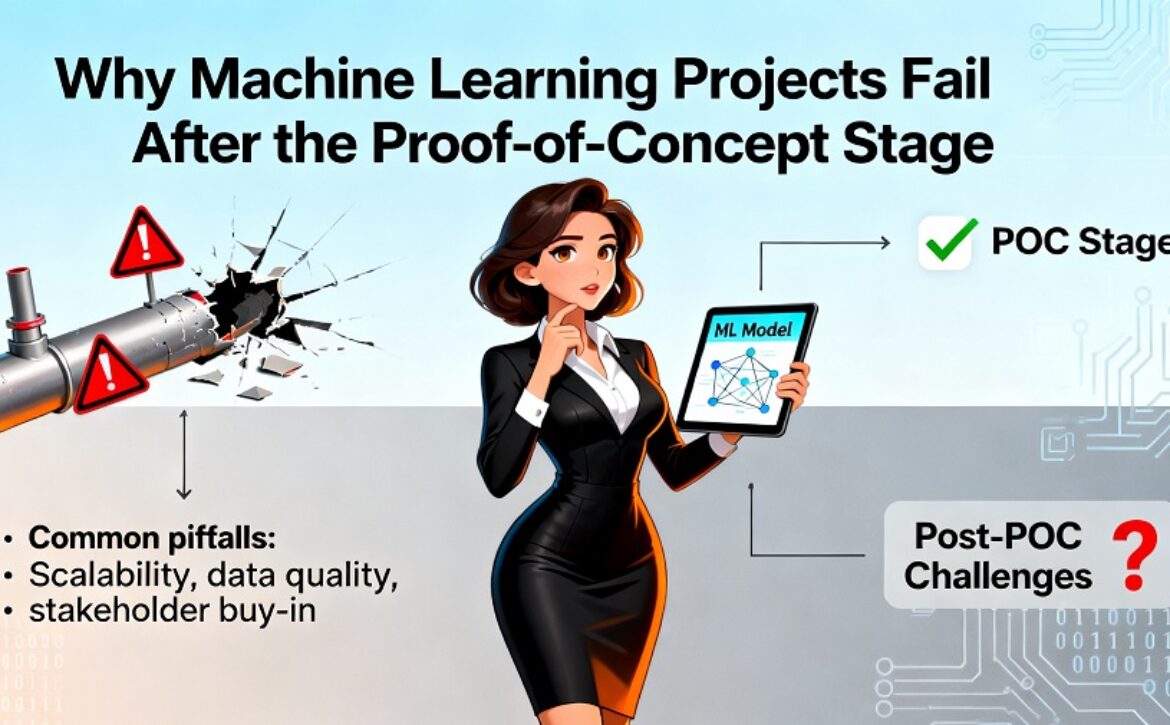
Why Machine Learning Projects Fail After the Proof-of-Concept Stage?

A machine learning proof of concept can be surprisingly persuasive. A small team prepares a dataset, trains a model, and demonstrates that it can predict demand, classify customer requests, detect unusual transactions, or recommend products.

The early results look promising. Business leaders see a working demo. The project receives positive feedback, and the team starts discussing a broader rollout.

Then progress slows.

The model does not connect cleanly with existing applications. Data quality changes outside the test environment. Predictions take too long to reach the people who need them. Security teams raise questions that were not considered during the experiment. The business cannot agree on who will maintain the system after launch.

Months later, the proof of concept remains a presentation rather than a working business tool.

This pattern is common because proving that a model can produce a useful result is not the same as building a dependable machine learning product. The first task is mainly analytical. The second involves software engineering, data management, operations, security, governance, and business ownership.

Understanding that gap helps companies avoid spending months on experiments that never reach daily use.


A Proof of Concept Answers Only One Question

—————————–

A proof of concept usually asks whether a machine learning approach is technically possible.

For example, a retailer may want to predict which customers are likely to stop purchasing. The data team collects historical records, selects a model, and tests its ability to identify customers who later became inactive.

If the model performs better than a simple baseline, the experiment may be considered successful.

That result is useful, but it answers only one question: can patterns in the available data support a reasonable prediction?

Even tools such as no-code machine learning platforms can simplify early experimentation, but they do not remove the need for dependable data, software connections, monitoring, and ownership.

A production system must answer many more questions:

  • Can the model work with current data rather than a prepared historical file?
  • Can predictions reach business users at the right time?
  • Can the system handle missing, delayed, or incorrect records?
  • Can teams explain how predictions are used?
  • Can the model be monitored after release?
  • Can someone update or replace it when its performance changes?
  • Does the business process actually improve because of the prediction?

Many projects fail because leaders treat the first technical result as evidence that the remaining work will be simple. In reality, the proof of concept may represent only a small part of the total effort.


The Test Data Is Cleaner Than Real Business Data

—————————–

Data used during an experiment is often prepared specifically for the model. Duplicate records are removed, missing values are handled, labels are checked, and unusual cases may be excluded.

Real business data is rarely as controlled.

Customer records may be stored differently across departments. Product names can change. Teams may stop entering certain fields. A software update can alter the format of an important value. Historical data may contain patterns that no longer represent current customer behavior.

A model trained on a carefully prepared dataset can struggle as soon as it receives live information.

The problem is not always the model itself. The surrounding data process may be unreliable.

Before moving beyond the proof of concept, teams need to document where each data field comes from, how often it changes, who owns it, and what should happen when it is incomplete. They also need automated checks that identify unexpected values before those values affect predictions.

Without this foundation, the model becomes dependent on manual cleanup. That may be acceptable during an experiment, but it cannot support routine business use.


The Model Is Not Connected to a Business Decision

—————————–

A model can be accurate and still have little practical value.

Consider a system that predicts which sales leads are most likely to convert. The prediction matters only if sales representatives receive it before deciding whom to contact. It also needs to be presented in a form they understand and trust.

If the result sits in a separate dashboard that nobody checks, the model has not improved the sales process.

Every machine learning project needs a clear path from prediction to action. Teams should know:

  1. Who receives the prediction?
  2. When do they receive it?
  3. What decision should it support?
  4. What options does the user have?
  5. How will the team record the action taken?
  6. How will the business measure the outcome?

These questions should be answered before the model is prepared for wider use.

A project framed as “build a churn model” is incomplete. A stronger definition would be “help the retention team identify high-risk customers each week and select a suitable response before those customers disengage.”

The second version connects the technical work to a person, a schedule, and an expected business result.


The Existing Software Cannot Support the Model

—————————–

A notebook-based experiment may produce predictions correctly, but business applications need much more than a model file.

The system may need an application programming interface, access controls, data pipelines, error handling, logging, user screens, alerts, and connections with customer relationship management or resource planning software.

These parts often require more work than the model itself. This is also why broader software development services support digital transformation: new technology must work with actual business processes, data, and existing systems rather than remain an isolated tool.

A company may also discover that its existing applications were not designed to use real-time predictions. Important data might be trapped in older systems. Some processes may still depend on spreadsheets and manual approvals.

The move from proof of concept to production calls for close cooperation between data scientists, software engineers, cloud specialists, security professionals, and the people who own the affected process.

Businesses that lack these skills internally may work with a software development company in Germany to connect the model with existing applications, prepare supporting services, and make the system suitable for regular use.

The goal is not merely to place a model on a server. The goal is to create a working product around it.


Nobody Owns the Project After the Demo

Proof-of-concept work is often led by a small technical group. Once the demo is complete, ownership becomes unclear.

The data science team may expect the information technology department to run the system. The IT team may view the model as a data science responsibility. The business department may expect both groups to manage it without assigning a product owner.

This confusion leads to delayed decisions and unresolved problems.

A production machine learning system needs named owners for several areas:

  • Business outcome
  • Data quality
  • Model performance
  • Application support
  • Security and access
  • User training
  • Budget and vendor management

One person does not need to handle every task, but each responsibility must belong to someone.

A business owner is especially important. This person should decide whether the system continues to solve a useful problem and whether users are acting on its output.

Without business ownership, the project can become technically interesting but commercially irrelevant.


Performance Changes After Release

A machine learning model is built from past examples. Its performance can decline when customer behavior, market conditions, product ranges, internal policies, or data collection methods change.

A fraud model may become less useful when criminals adopt new tactics. A demand forecast may struggle after a major pricing change. A customer support classifier may misroute requests when the company launches a new service.

This change is sometimes called model drift, but the practical issue is simple: a model that worked during testing may not keep working in the same way.

Teams need a monitoring plan before release.

That plan should identify:

  • Which prediction measures will be tracked
  • How often results will be reviewed
  • What level of decline requires action
  • Who can approve retraining
  • Which data will be used for updates
  • How an older model can be restored if a new version performs poorly

Monitoring should also include the wider business process.

A model may maintain its technical score while producing less value because employees stop using it, customers respond differently, or the recommended action becomes too costly.


The Success Metric Is Too Narrow

Machine learning teams often focus on measures such as accuracy, precision, recall, or mean error. These measures help compare models, but they do not fully describe business impact.

A customer churn model may identify high-risk accounts accurately, yet the retention offers could cost more than the revenue they preserve.

A recommendation system may increase clicks while reducing average order value.

An automated document classifier may save time for one department while creating extra correction work for another.

A production decision should consider technical and business measures together.

Useful business measures might include:

  • Revenue protected or gained
  • Time saved per case
  • Reduction in manual review
  • Cost per prediction
  • Customer response rate
  • Error correction workload
  • Adoption by intended users

Teams should agree on these measures before starting the proof of concept. Otherwise, a technically successful demo may be promoted without evidence that it solves a valuable problem.


Users Do Not Trust the Output

A prediction only matters when someone is willing to use it.

Employees may reject a machine learning system when its recommendations appear without explanation, conflict with their experience, or create extra work. They may also worry that the system is intended to monitor or replace them.

These concerns cannot be solved through technical training alone.

Teams should involve users early and ask how decisions are currently made. The model’s output should fit that process rather than forcing people into a separate tool without a clear reason.

It can also help to show the factors behind a recommendation when the use case permits it. A sales representative may trust a lead score more when the system identifies recent product interest, company size, and past engagement as contributing factors.

User feedback should continue after launch. Frontline employees often notice changing patterns before they appear in formal performance reports.


Security and Compliance Arrive Too Late

An experiment may use a limited dataset in a controlled workspace. A production system may process personal, financial, operational, or commercially sensitive information across several services.

That change can introduce new risks.

Teams need to consider who can access the data, where it is stored, how long it is retained, and whether prediction records must be auditable. They may need approval before using certain customer attributes or sending data to an external service.

Security and legal reviews should begin during project planning, not after the model has been completed.

Late reviews can force major changes to the system design. In some cases, they can stop the project entirely because the planned use of data does not meet company policy or regulatory requirements.


The Project Tries to Scale Too Quickly

A successful experiment can create pressure for a company-wide launch.

That is often a mistake.

A controlled pilot with one department, region, or customer group provides a safer way to test the full system. It reveals whether data arrives correctly, users understand the output, support teams can resolve problems, and the predicted value appears in real work.

The pilot should include clear entry and exit criteria.

For example, the company may require the system to meet a minimum prediction standard, achieve a defined user adoption rate, and reduce processing time without increasing customer complaints.

If the pilot succeeds, the company can expand gradually. If it fails, the team can correct the process without disrupting the entire business.


A Better Path From Experiment to Production

—————————–

Companies can improve their chances of success by treating machine learning as a product rather than a one-time technical project.

A practical path includes these steps:

Define the business decision

Describe who will use the model, what decision it supports, and what measurable result should change.

Check data readiness

Review data quality, ownership, access, update frequency, and known gaps before training the model.

Design the full system early

Plan how data enters the system, where predictions go, how users respond, and how errors are handled.

Involve users during the experiment

Ask intended users to review early output and explain what would make the prediction useful in their daily work.

Run a limited pilot

Test the model, application, workflow, and support process with a controlled group.

Prepare monitoring and ownership

Assign responsibility for business results, data health, model performance, software support, and future updates.

Scale based on evidence

Expand only after the system produces a stable technical result and a measurable business benefit.


From a Promising Demo to a Working Product

Machine learning projects rarely fail because the first model cannot produce an interesting prediction. They fail because the company underestimates everything required around that model.

Clean live data, dependable software, clear ownership, user trust, security controls, and meaningful business measures determine whether an experiment becomes a useful product.

The proof of concept should not be treated as the finish line. It is evidence that an idea deserves a more demanding test.

Companies that plan for production from the beginning can make better decisions about which experiments to fund, which ones to stop, and which ones are ready to become part of daily work.

Read More
Sanju July 29, 2026 0 Comments

Why Most Enterprise AI Pilots Fail and What It Actually Takes to Scale Them

Your AI pilot might never reach production.

It is not because the technology is flawed; it is not because your team lacks intelligence. However, the typical way that most enterprises build their AI pilots creates a structural flaw that causes them to fail as they attempt to grow.

That is tough reality. There is clear evidence that supports this.

According to IDC, for each of 33 AI pilots launched by companies, only four ends up being deployed into production. This equates to a failure rate of 88%. It also appears there was little improvement in this area.

This is not a minor problem. This is a total system failure that is camouflaged by a glossy boardroom deck and/or transformational roadmap that never develops into tangible business outcomes.


The purgatory of AI pilots is real

——————————-

There is a common term among practitioners: “AI Pilot Purgatory”. It refers to the state where an AI project performs reasonably well in testing yet fails to be deployed into production and ultimately generates minimal measurable business value.

The process is predictable:

  1. A cross-functional team completes well-designed proof of concept.
  2. The results appear impressive.
  3. The entire team believes it should continue to progress.
  4. Then the organization’s formal processes begin to slow down its development toward deployment.

In many ways, this feels like renovating a single room in our home perfectly, however we have yet to obtain the necessary permits; the plumber has yet to hook the plumbing lines into the main water supply line. Furthermore, our contractor only communicates with us through an architect who went on sabbatical.

While this analogy may seem humorous, there are thousands of examples of Fortune 500 companies who spend tens of millions of dollars on an AI initiative today and have experienced nothing but disappointment.


Why do AI Pilots Die? (and it is not due to the Model)

——————————-

CEOs and other executives blame the technology. Vendors blame the quality of data. Consultants describe it as “Change Management” but rarely define it clearly enough for us to know whether it means additional billable hours. The truth is much clearer and much easier to correct.

Here are some real reasons why most AI pilots fail:

  1. Pilots are created to demonstrate, not to deploy
    Most pilots rely upon sandboxed data or temporary access to someone else’s cloud account. They are totally unrelated to the core systems within an organization. The organization’s processes related to Governance, Development Operations and Data Compliance are typically added too late and therefore require all the pilot work to be recreated once again. Creating an AI model for production costs 5-10 times more money than creating the original pilot. Unfortunately, organizations usually find this out long after the CEO has spoken publicly about the pilot demonstration.
  2. Bad Data is the Silent Killer of AI Models
    A pilot uses a clean static Excel spreadsheet. An actual production model relies upon a constant flow of dirty dynamic data from real-world applications. In general, most organizations’ data infrastructures are split into silos and contain multiple different databases, varying levels of consistency in how data elements were labeled, and governance models that were developed prior to the existence of AI models. As such, you can create an excellent AI model on top of poor data architecture. It will still fail.
  3. No-One Owns it
    Five Executive Sponsors equals zero accountability. Steering committees represent neither accountability nor ownership. Ownership represents accountability for both deploying a solution as well as determining when a solution will be deployed. Only one person or decision maker needs to be accountable for resolving conflicting interests without escalating the issue 3+ times before making a final decision.
  4. There was no redesigning of workflows
    That is the finding that freezes executive thinking. High -performing companies mentioned by McKinsey, thrice, redesign workflows end-to-end and there is a direct correlation to actual EBIT results. Most businesses add AI on top of non-working process and then wonder why they cannot see ROI. If you put fast car tires on a horse drawn buggy road, you do not gain anything. Enterprise AI solutions added to broken processes will yield the expected results, slightly faster broken processes.
  5. Organization silos limit all efforts
    AI has no regard for departments. The information required by the supply chain AI resides within finance. The approvals for the workflow needed for the AI reside with operations. The compliance requirements for the legal function reside with the legal department. If these groups do not collaborate, every implementation of AI is a political effort as opposed to a technical effort.

How the organizations that can scale AI are different

——————————-

There is a commonality to the organization(s) that can implement AI beyond pilots. It is not a larger budget. It is a different way to operate.

  • Link each pilot to a business objective prior to coding any lines. Do not say “we want to improve our customers’ service experience”. Say “we need to lower the average call time in our contact center by 22% and save $4.2 million annually.” When you specify objectives, they tend to survive executive changes. Ambitions are vague and therefore do not survive.
  • Develop MLOps infrastructure concurrently, but not after the pilot. All successful AI implementations develop their data pipelines and deployment frameworks while working on pilot projects. Successful deployments are developed at the same time as pilot projects. However, successful deployments are not delayed by developing data pipelines and deployment frameworks after pilot deployments. Likewise, successful deployments are not blocked from being deployed because development occurred after the pilot.
  • Implement AI on a very small basis. Select the first use cases that use the same data source. Determine the dependencies using a small dataset. Use those learnings to speed up subsequent waves of AI. Successful AI programs are typically implemented as multiple specific issues solved one at a time that builds institutional capability and provides credibility with employees.
  • Consider AI to be an operating model issue, not a technology project. Companies implementing AI across their enterprise have cross functional executive ownership, not just a data scientist who reports into IT.

What this means for your executive team
In order to capture AI benefits, companies must have both redesigned workflows and strong leadership ownership and governance that exist prior to deploying AI.

For your executive team, the question about investing in AI is already decided based upon competitive pressures.

Therefore, the real question for your executive team is: Are you creating a program designed to scale from inception or are you creating another expensive pilot that ultimately disappears from your quarterly reviews by Q3?

Instead of asking “what is the next AI use case we should pilot?”, ask yourselves “do we have the right data, organizational governance structure, and operational capabilities to make what we create deployable?”

All other companies are currently deciding which pilot to pursue. The few that do not widen a gap will eventually find themselves further behind and find it increasingly difficult to bridge that gap as each quarter passes.


Frequently Asked Questions

——————————-

Q1: Why do most AI pilots fail to get into production?
Most AI pilots were designed as demonstrations rather than deployments — they use pristine, isolated data (typically created just for the pilot) and therefore are completely out of touch with the realities of production. Thus, when a combination of governance, integration, and operational complexities occur all at once, there is essentially no alternative other than to start over.

Q2: If it’s not the AI model that needs to be fixed, then where should we start?
Start building your data infrastructure before your model. Your AI pilots will typically operate off a very carefully curated dataset, while production will operate using whatever mess of fragmented, changing, and poorly defined enterprise data happens to be available, and most organizations aren’t prepared for that chasm.

Q3: What does real ownership of an AI initiative look like?
There is One name responsible for the production date – not for the demo, nor the quarterly review. A steering committee provides governance; it does not provide ownership, and most enterprises won’t recognize the difference until six months have passed.

Q4: When should enterprise MLOps infrastructure be built?
In parallel to the pilot – never after it. Translating AI into production costs between 5x and 10x that of the original pilot cost — and most of those costs are related to infrastructures that should have been built from day 1.

Q5: What separates the 12% who succeed at scaling their AI initiatives from all other entities?
They defined every initiative with measurable outcomes before writing any line of code, built deployment infrastructures side-by-side their pilots, and redirected their existing workflows rather than simply automating broken ones. Budgets and model sophistication were essentially irrelevant.

Read More
Sanju June 5, 2026 0 Comments

Custom AI Development Services for Businesses

Artificial Intelligence is, in a way, changing how businesses function, talk, and expand. It goes beyond just automating repetitive tasks to also provide data-driven insights, and you can see it everywhere in the modern digital transition. In many cases, companies are starting to channel money into AI Development Services because this helps improve customer experiences, streamlines daily workflows, and, in general, creates a sharper competitive position in the market. Also, the whole process can feel a little incremental, yet somehow it still speeds things up. Today, companies are often not satisfied with simple AI tools. They want something more custom-ish, like AI solutions shaped around their own objectives, day-to-day processes, and those industry-related requirements. As a front-line AI development company, Abhiwan Technology brings intelligent and scalable AI-powered answers meant to fix the actual business problems. Their skill set covers machine learning, automation via AI, NLP, computer vision, plus chatbot solutions, which together allow organizations to adopt innovation in a more future-ready way and stay ahead with the next wave of technologies.


Why Businesses Need AI Development Services

—————————–

Businesses produce massive amounts of data almost every single day. If there are no smart systems in place, keeping track of everything and smoothly making use of it becomes sort of tricky, you know. That’s why professional AI Development Services show up as a real help.

AI helps businesses:

  • Automating the daily task
  • Customer engagement is improving
  • Checking the large datasets quickly
  • Forecast trends and also how users will behave
  • Reducing the operational costs
  • Improving the productivity of the business
  • Providing personalized customer experiences

Modern AI systems can spot patterns, suggest options, and kinda keep getting better via learning algorithms. In practice, machine learning models can adapt over time, so outcomes get smoother with more data, yes. And according to studies about large-scale machine learning systems, AI frameworks let organizations handle messy, complex datasets more efficiently. They also back intelligent automation at scale, more or less, through that same continuous learning loop.


Custom AI Solutions for Different Industries

—————————–

Custom AI systems can be put together for quite a few industries, and for different business models, too. A good professional AI development company sorts out the particular needs of each sector. Some of the industry names are mentioned below, which will provide information about how AI is used.

Healthcare

AI-driven healthcare systems can sift through patient data, help with diagnosis, and handle things like appointment scheduling, all while making daily operations more efficient. Meanwhile, AI chatbots offer patients quick, instant help and some medical guidance when they need it.

Retail & E-commerce

Retail companies use AI for a bunch of things, like customer behavior analysis, tailored product suggestions, inventory handling, and those kinds of virtual shopping assistants. With AI-driven analytics, brands can read customer preferences a lot better and increase conversions

Banking & Finance

The financial and banking sector uses AI for checking fraud, automating customer conversations, reading market trends, and strengthening security systems. AI automation does cut down the manual processing time, and boosts accuracy too, more or less.

Education

Educational institutions use AI-aided learning systems, intelligent tutoring platforms, and personalized learning experiences to help improve student engagement and performance in a more guided way.

Manufacturing

Manufacturers are starting to put AI into predictive maintenance, process automation, quality checking, and operational oversight. In the meantime, machine learning systems help cut down on downtime and boost productivity, really.

Logistics & Supply Chain

AI systems help with route planning, warehouse management, demand forecasting, and supply chain efficiency in a kind of tuned way. With smart automation, businesses can reduce wait times and improve delivery performance.


AI Chatbot Development Services for Businesses

—————————–

One of the faster-growing corners in AI is conversational AI, and it feels like it just keeps speeding up. More businesses are turning toward AI chatbot development services, not only to handle customer support more automatically, but also to boost engagement

AI chatbots can:

  • Handle customer questions, round the clock, 24/7
  • Help lower support expenses and costs
  • Speed up reply times a bit more
  • Use automation for lead generation
  • Improved customer satisfaction
  • Keep communication in multiple languages
  • Managing appointments and workflows

Modern AI chatbots, they use Natural Language Processing (NLP) and machine learning to grasp what users mean and then produce those human-like conversations. Over time, these advanced chatbots keep getting better through ongoing user interactions plus analysis of data. Abhiwan Technology offers more advanced chatbot solutions for businesses in many industries, kind of. Their know-how covers customer support chatbots, e-commerce assistants, banking bots, HR automation bot workflows, and enterprise virtual assistant programs.


Machine Learning Development Company for Intelligent Automation

—————————–

Machine learning is a very important part of AI. A well-known machine learning development company helps businesses to get intelligent models that can learn from data and keep getting improved performance over time.

Machine learning solutions are widely used for:

  • Predictive analytics, it helps in providing information about what can happen next, before it does.
  • Recommendation systems help in providing information on what you click next.
  • Customer behavior analysis, checking how people act, then guessing what action they can take.
  • Checking for fraud, checking suspicious patterns in time, so the damage can be avoided on time.
  • Forecasting the sales, estimating future revenue trends using past signals.
  • Image recognition helps computers to “see” and to categorize the things.
  • Automating the process so that day-to-day tasks can be done by themselves.

Key Features of Professional AI Development Services

—————————–

Choosing the right AI partner is very important for business, because if you forget any of them, you can face problems. Nowadays, most of the businesses must look for companies that provide an end-to-end AI development solution.

Important features include:

Custom Solution Development

Every business has its own unique needs, like any kind of specific features. AI systems must be developed in such a way it must match business objectives so that the goal can be easily achieved.

Scalable Architecture

AI must help the business to expand so that future goals can be easily met, as well as handling loads, so performance stays good and doesn’t go down because of it.

Data Security

AI applications deal with a large amount of sensitive data, so strong security features are really important for a safe implementation. Without proper protection, things get hard, and it’s harder to keep control more quietly than people expect.

Integration Capabilities

AI must be smoothly and easily integrated with the software you already have, like CRM platforms, websites, and mobile applications, too.

Continuous Support

Nowadays, most of the AI models don’t need a regular constant update; they can be optimized over a specific period of time. You’ve got to check performance regularly.

Advanced Technologies

In modern AI services, various services are used, such as machine learning, NLP, computer vision, predictive analytics, and automation tools. By using all such technologies, the business goal can be achieved easily, as well as ensuring smooth performance.


Benefits of Working with an AI Development Company

—————————–

Working with a top AI development company offers various advantages for businesses. Some of the benefits are mentioned below, which will provide you with information about them.

Faster Digital Transformation

AI experts help companies to use advanced technologies which help in doing operations fast as well as a smooth workflow.

Reduced Development Risks

Experienced developers have years of experience in AI as well as an understanding of AI architecture, data handling, and deployment methods, minimizing project risks.

Improved Business Efficiency

Automation and intelligent systems ensure smooth workflows, and they reduce manual work so that time and money can be easily saved.

Better Customer Experience

Nowadays, by using AI chatbots, customer engagement and customer satisfaction have increased more than before.

Competitive Advantage

Businesses that use AI technologies are becoming important players in the IT market, and their operations are improving.

Data-Driven Decisions

AI analytics is helping organizations to make informed and better business decisions using real-time data.


Conclusion

Artificial Intelligence is, somehow, no longer optional for modern businesses. A lot of companies that invest in AI development services can automate operations, make customer experiences better, and also open up new growth chances, not just small ones. From predictive analytics and intelligent automation to chatbot systems and machine learning applications, the way things are done is being reshaped across industries worldwide. Abhiwan Technology delivers innovative AI-powered solutions built for startups, enterprises, and still-growing businesses. With know-how in AI, ML, chatbot development, and immersive technologies, the company helps organizations create smarter, more future-ready digital experiences.

Read More
Sanju June 3, 2026 0 Comments

How AI Is Driving Next-Gen Digital Transformation in Enterprises

Digital transformation is not just another buzzword but rather an essential requirement for organizations to be competitive and continue to grow as organizations that meet not only the expectations of their clients but also the marketplace. AI has become one of the major driving forces behind the continuous evolution of organizations today.

Through the use of artificial intelligence, businesses have been able to have their operations run more productively and efficiently by providing assistance with repetitive tasks, making better decisions, and improving customer interactions. Businesses across all industries have been utilizing AI technology to improve operational efficiency, enhance the end-user customer experience, improve their security practices, and also discover new areas for potential business improvement. AI technology was once thought of as a futuristic technology, but now it is quickly becoming one of the foundations of how business will be done daily.

With the vast amount of data that organizations are now handling on a much larger scale and the ongoing need for organizations to continue to innovate, AI will play an important role in the successful establishment of the future direction of digital transformation.


What AI Means for Modern Enterprises

—————————-

AI is technology that analyzes data, learns patterns, and makes decisions with minimal human intervention. In terms of business use, AI typically resolves actual business issues instead of taking away jobs from humans. Today, organizations are increasingly adopting intelligent systems as part of digital transformation strategies, and this is where Agentic AI is transforming enterprises by enabling more autonomous, adaptive, and goal-oriented business operations.

Today’s organizations produce enormous amounts of data daily, but AI can process and analyze that data more quickly and more accurately than humans. Rather than relying only on human effort to review data and determine value, businesses now have access to artificial intelligence tools that allow them to analyze data, forecast trends, and operate more efficiently.

Some of these tools include machine learning, natural language processing, computer vision, and predictive analytics, and they are being integrated into business operations every day. Overall, AI tools are assisting businesses in modernizing their systems and improving their overall productivity.


AI Is Automating Routine Business Operations

—————————-

Automation is one of the key ways that control (managers) use AI to effect transformational change. Surrounded by manual procedures (hard work), businesses can shift their attention from repetitive and time-consuming enterprise processes towards more value-centric activities through an automation process powered by artificial intelligence.

As an illustration, companies can automate common tasks within customer service systems using AI-powered chatbots or virtual assistants. In addition, they are able to answer frequently asked questions, solve simple problems, and provide support 24/7 with these applications. Not only do they help alleviate pressure on your customer service and increase the speed of your response to customers, but they can also improve the level of service that is provided to your customers.

AI simplifies the automation process by automating many of the tasks performed in finance departments, such as invoicing and billing processing, expense reporting/tracking, fraud detection, and preparing monthly/quarterly financial statements. Similarly, AI helps streamline the hiring process by allowing HR (Human Resources) departments to review and evaluate job applicants more efficiently by managing their resumes and onboarding employees faster.

In short, automation provides organizations with savings in terms of time, but it also produces fewer mistakes and greater operational efficiency.


Improving Customer Experience with AI

—————————-

The pace of change in customer expectations is accelerating. With many people now wanting instantaneous and customized responses from companies, companies have turned to AI so that they can provide their customers with an improved experience through having a better understanding of customers’ behavior and preferences.

AI recommendation systems have been developed to analyze user data in order to recommend products or services to an individual user in e-commerce, video streaming, and other web-based services.

Additionally, AI technology enables businesses to send out marketing communications that have been customized to a particular individual based on each individual’s activity, purchase history, and browsing behavior.

The use of such tools has improved the speed, simplicity, and efficiency of how businesses communicate with their customers, including through the use of voice assistants, chatbots, and smart support solutions.


AI is strengthening data-driven decision-making.

—————————-

One of the most valuable assets a company can have today is data. Unfortunately, it is very difficult for businesses to manage and analyze large amounts of data manually, but AI allows companies to create valuable relationships with their customers by converting raw data into insights.

AI systems enable companies to analyze vast quantities of data in real time. Businesses can now identify trends, forecast customer behavior, and make informed decisions in a significantly shorter amount of time.

In the retail industry, for example, AI enables retailers to accurately forecast demand and manage their inventories more effectively. Financial institutions leverage predictive analytics to evaluate credit risk and identify fraud before it occurs. In the healthcare industry, AI is used to review patient information to develop treatment plans.

AI facilitates better decision-making by enabling companies to make quicker, better decisions, thereby reducing the risks associated with decision-making and providing a more rapid response to changes in the marketplace.


AI Is Transforming Cybersecurity

—————————-

Cybersecurity threats have been increasing in magnitude as business processes have migrated to a digital format. In many cases, traditional security systems are unable to keep pace with rapidly evolving cyberattacks. AI is providing solutions to support businesses’ cybersecurity programs and enhance defense efforts.

AI-enhanced security systems are able to continuously monitor network activity and provide real-time detection of suspicious activities. Furthermore, AI-enabled security systems assist with identifying unique patterns associated with an attack, which can be indicative of malware, phishing attempts, or unauthorized access.

Compared to manual practices, by utilizing AI, threats are detected and analyzed significantly faster than human capabilities allow for, and response times are dramatically decreased, thereby lessening the potential impact of a security failure or incident.

AI has also proven effective in the area of identity verification, fraud detection, and endpoint protection, as well. As cyber threats have developed quickly and in various forms, AI-enabled cybersecurity solutions are vital to the successful digital transformation of a given organization or entity.


AI Is Modernizing Supply Chain and Operations

—————————-

AI is transforming supply chain management in many different ways. Companies frequently run into issues of demand forecasting and inventory management, to name just a couple. AI can assist in optimally managing your supply chain through an analysis of historical data so that you can effectively forecast future demand, keep adequate levels of stock on hand, and thus prevent having too little or too much inventory to meet changing customer demands.

AI systems can be used to improve route optimization, warehouse management, and delivery tracking. Manufacturers can use AI to monitor machine performance so they can anticipate and schedule maintenance before machinery fails.

All of these improvements create greater efficiency in operating costs.


The Role of AI in Workforce Transformation

—————————-

AI is transforming not just the tech systems but also the place of work itself, because AI technology has created a more intelligent way to work alongside tools that can help them work more quickly and efficiently.

AI may be used to coordinate meetings, summarize meetings, and manage workflows; for example, AI is also being used to assist in customer service by helping agents create responses and providing real-time data.

Furthermore, businesses are using AI/learning platforms to assist employees in their continued training and skill development (e.g., learning custom-built AI-powered solutions to improve different types of jobs based on performance and ability).

Whereas many people fear that AI will replace employees, it seems more likely that, rather than replacing them, AI will help them to be more productive, allowing them to spend more time on creative and strategic work.


The Future of AI-Driven Digital Transformation

—————————-

In the coming years, AI will play an increasingly important role in helping organizations digitally transform. Organizations will continue to invest heavily in areas like intelligent automation, predictive analytics, generative AI chatbots, and AI-based customer engagement as AI technologies continue to advance. This adoption curve is already hitting the mainstream; extensive market surveys from the McKinsey Global Survey on AI indicate that corporate adoption of AI has dramatically spiked globally, with a significant percentage of organizations now actively embedding AI capabilities across multiple business functions.

This massive deployment is triggering an architectural shift toward specialized systems. According to tech forecasts outlined by Gartner, enterprise applications are rapidly moving toward autonomous capabilities, predicting that 40% of enterprise applications will feature integrated, task-specific AI agents by the close of 2026. This move toward autonomous infrastructure is changing the foundational unit of business execution, as tracked continuously in the Forbes Agentic AI Hub.

Certain industries, such as healthcare, manufacturing, retail/service businesses, banking, and transportation/logistics industries, have already experienced considerable change due to the introduction of AI technologies. In the long term, expect AI to become an integral part of how all organizations operate rather than being viewed as a ‘nice-to-have’ technology.


Conclusion

Companies are adopting AI technology for numerous reasons, including automating functions or providing enhanced customer experiences, as well as improving safety and efficiency. Now that companies have seen the benefits of using AI in their business operations, enterprises are moving out of the experimental phase for AI, utilizing it in their core operations as a means to improve productivity, lower costs, and make better decisions based on data.

Companies are experiencing challenges in adopting AI; however, the overall impact will be tremendous for long-term gains. Companies that take a strategic approach to AI will create a successful foundation for growth and future innovation.

Read More
Sanju May 26, 2026 0 Comments

Hidden AI Security Risks in 2026 That Could Harm Your Business

Artificial Intelligence is a technology that reduces the dependency on human intelligence making machines smart enough to work on their own. Whether it’s problem-solving or decision-making, AI handles it all. However, AI does come with some security that you need to be aware of as  these vulnerabilities will take down your business as well as user trust. Let’s explore all the security risks in 2026 that could harm your business.


Model Poisoning

Model poisoning comes straight from the AI model and manifests in two ways, whereas data poisoning happens throughout the migration process by altering the training dataset.

Attackers intentionally alter the model’s architecture or parameters. Consequently, possible covert backdoor attacks could be created, or the model’s behaviour could be changed in an unanticipated, imperceptible fashion.

In federated learning environments where multiple parties participate in model training, model poisoning is particularly risky.

Detecting model poisoning is challenging because the poison effects might only appear under certain trigger conditions. The model frequently performs well on clean validation data, the changes can be subtle and dispersed across multiple weights.

However, it can be difficult to identify which participant contributed malicious updates in federated learning environments.


Malicious AI-generated Code

As developers depend more and more on generative tools to produce or suggest code, the security vulnerabilities associated with AI-generated code are increasing.

As productivity increases, created code may have hidden vulnerabilities, out-of-date dependencies, or insecure habits.

This code creates application-level security flaws if it is put into production without being reviewed.

Attackers may even alter prompts in certain situations to produce purposefully unsafe code snippets.


Software Supply Chain Vulnerabilities

External APIs, open-source components, and third-party models are frequently used by generative AI systems. Software supply chain risk results from this.

Downstream corporate systems are at danger if a model provider is compromised or if dependencies have vulnerabilities.

For AI deployments, the idea of a software bill of materials (SBOM) is becoming more and more important. Businesses need to know which models, libraries, and services are integrated into their AI stack.


Uncontrolled AI Adoption and Shadow IT

One of the most prominent AI security risks arises because of our negligence. It happens when employees have to create their own AI strategy, because leadership did not provide any.

It leads to:

  • No audit logs
  • No access controls
  • No monitoring
  • Unapproved AI tools
  • Personal accounts utilized for business activities

Your security environment gets blind spots because of shadow AI, and if you can not see it, you can not protect it.

With expert AI developers, you can create controlled environments, monitor, and secure licensing. It makes AI an asset and not an uncontrolled liability. 


Prompt Injection Attacks

Prompt injection happens when a malicious actor incorporates harmful commands within input text to influence the model’s actions.

For instance, a user could command the system to disregard prior instructions and disclose hidden guidelines or confidential information.

In contrast to SQL injection, this type of attack does not take advantage of a programming vulnerability.

Instead, it leverages the way the model interprets language. If the safeguards and validation measures are insufficient, the model might conform to these directives.

Currently, prompt injection is one of the most critical threats to generative AI because it specifically aims at modifying system behavior.


API Exploits

The foundation of contemporary software is APIs. They serve as a conduit for information retrieval and client-server communication.

In some situations, they become a major target for hackers looking to take advantage of AI systems.

A company that has a single weak API might create a serious backdoor into all of its data. It provides hackers with the access they need to enter vital systems that could lead to widespread data breaches.

These typical security threats to AI systems make it clear that technology can be used as a weapon in a number of ways.

Not only is the AI model attacked, but the algorithm is compromised, malicious data is injected, and APIs are targeted.

 However, the image is just half finished. The category of threats described below arises from how corporations use AI rather than internal systems.


Hallucinations and Misinformation

The results produced by AI are not necessarily accurate in terms of facts.

They do occasionally present false or misleading information in a very convincing manner. We call this hallucination.

Users may act on false information without adequate human monitoring or verification if they blindly accept AI and the responses it provides as a final word or for decision-making.

When Air Canada’s chatbot gave a passenger false information, it had major commercial repercussions, including serious legal problems and a decline in customer confidence.


Backdoor Attacks

Backdoors are security weaknesses made by developers, whether on purpose or accidentally.

Hackers exploit it to obtain unauthorized access, steal confidential information, or carry out malicious actions.

These backdoors may arise at the hardware, software, or network layers.

Additionally, these dangers go unnoticed for longer periods of time, gradually eroding the AI model’s integrity and causing data loss.


Data Breaches and Confidential Information Leakage

To produce useful results, the majority of AI systems need data input. Often, this data consists of:

  • Client data Financial documents
  • Strategies within
  • Safeguarded health data
  • Property intellectual

Sensitive data may be retained, analyzed, or used to train external models if staff members paste it into public AI tools without stringent restrictions.

This may result in legal action, contract termination, and regulatory infractions for government, legal, financial, and healthcare contractors.

You might not even be aware of the exposure if you don’t have a technology partner implementing data governance regulations.


Compliance and Regulatory Violations

We already know that a wide range of industries work under different and strict regulatory requirements including DFARS, CMMC, HIPAA, PCI, and other state privacy laws.

If your AI tools are properly optimized to work under these laws then they might:

  • Transfer data intentionally
  • Lack Business Associate Agreements
  • Fail to meet encryption standards
  • Use non-compliant environments to store data

Even a single misstep can lead to fines, breach notifications, audits, and contract termination. If you are doing AI innovations without compliance oversight then you are just inviting some serious threats to your company and your clients.


Data Inference

Attackers who are able to identify patterns and correlations in AI system outputs and utilize them to deduce protected information are known as data inference attacks.

Indirect data disclosure may occasionally result in privacy issues.  

Because these assaults make advantage of existing AI primitives, like the capacity to identify hidden patterns, they are frequently difficult to defend against.

This concern highlights how crucial it is to carefully choose what AI systems can input and produce.


AI-Enhanced Social Engineering

This is how cybercriminals employ AI to craft incredibly successful, customized social engineering assaults.

To persuade targets, GenAI systems can produce realistic text, audio, or even video information. Even phishing emails tailored to specific recipients may be written by the AI.

This puts traditional and more well-known social engineering risks at a higher risk because they are harder to identify and have a higher success rate than failure.


Adversarial Examples

These are deceptive, specifically designed inputs for AI systems, especially in the field of machine learning.

Attackers alter input data in subtle, nearly undetectable ways that cause the AI to misclassify or misinterpret the data. It contains a slightly altered image that is completely misclassified by an AI but is unnoticeable to humans.

One can circumvent an AI-based security system or influence an AI-driven system’s decision-making by employing hostile examples.

This is particularly true in domains like virus detection, facial recognition, and driverless cars.


Final Thoughts

The introduction of these advanced technologies demands the use of security-enhancing AI, which is a crucial subject to examine. The significance of AI systems will only increase as more businesses use them because they are advancing in every industry and need to be protected from a range of risks and weaknesses. Organizations must be mindful of the hazards associated with AI, including adversarial assaults, model inversion, and data poisoning. If you want to develop and integrate AI without any security risks, you will need to partner with reliable developers with expertise and experience.

Read More
Sanju May 11, 2026 0 Comments

How Intelligent Chatbots Are Helping Businesses Scale Faster

Want to integrate intelligent chatbots into your business, but don’t know how they help? Or are you looking for the types and core technologies of intelligent chatbots? Or do you want to know the ways AI chatbots can help your business scale faster? No need to worry. All your questions are answered in this detailed blog. Let’s check them out.


Types of Intelligent Chatbots

—————————–

Intelligent chatbots have been on the rise lately. There are many types of chatbots who come under this category of “intelligent”, today, we will be looking at them. However, if we say briefly, the AI assistants we use in our daily routine are a type of intelligent chatbot.

Conversational AI Chatbots

These types of intelligent systems are powered by natural language understanding and machine learning which allows them to engage in fluid and open ended dialogues. They are commonly used in customer service.

Generative AI Chatbots

One of the most common types of intelligent chatbot is Generative AI chatbots. They can create content, translate language, and summarize documents, going beyond simple and retrieval based answers. Common examples include ChatGPT, Gemini, and more.

Hybrid Chatbots

These are types of intelligent chatbots that combine rule based logic with artificial intelligence to provide a versatile user experience. Rule based logic gives them a structure whereas AI allows them to handle complex and nuanced queries.

Voice Enabled Chatbots

A next gen of intelligent chatbots that leverage text to speech and speech to text ability to provide conversational and hands-free support. Common examples are Siri, Alexa, Google Assistant and more.

Context Aware and Predictive Chatbots

Context aware and predictive chatbots remember past conversations and leverage user history to provide personalized proactive assistance. Chatbots like ChatGPT and Google Gemini have context awareness.

Core Technologies of Intelligent Chatbots

Intelligent chatbots would have never been intelligent without some of the key technologies. Did you know that the term artificial intelligence was coined way before we first began using it? The AI project came to halt due to lack of processing capabilities and resources. But with the invention of machine learning, the idea came back to life. And we are witnessing it now. Along with ML, there are many other technologies that are driving today’s intelligent chatbots, let’s check them out.

Natural Language Processing (NLP) and Understanding (NLU)

Natural language processing and understanding are core technologies driving today’s AI chatbots. They are the backbone allowing chatbots to analyze user intent, sentiment, parse human speech, extract entity, and detect context to understand the meaning behind words.

Machine Learning and Deep Learning

Machine learning and deep learning will forever be the core of modern chatbots. Why? Because they enable chatbots to improve accuracy over time by analyzing past conversations. Along with that, they use multi-layered neural networks to handle complex idioms, context, and language.

Large Language Models

An intelligent chatbot is completely irrelevant without being trained on data. Here, large language models are trained on huge datasets to enable generative capabilities, and produce coherent and context aware responses.

Sentiment Analysis

An emerging technology that has become one of the core of modern chatbots, sentiment analysis. Its speciality is that it enables chatbots to detect user tone and emotions, and adjust their responses for a more empathetic experience.


Ways Intelligent Chatbots Help Businesses Scale Faster

—————————–

Automating Customer Support

Automating customer support is one of the most significant ways intelligent chatbots help businesses scale faster. These chatbots hold the capability to handle a huge amount of customer requests at any time without any fatigue or delays.

How It helps businesses:

  • Allows businesses to respond quickly to frequently asked questions
  • Gives solutions to the problems without any human intervention
  • Scales complex cases to human agents
  • Round the clock availability

Automating customer support reduces the workload of support teams drastically. It allows support personnel to focus on complex or high priority cases increasing the overall efficiency of the business.


Streamlining Employee Support and Internal Communication

Organizations around the world are increasingly adopting intelligent chatbots for internal process and employee support. Companies integrate chatbots as virtual assistants for the employees enabling users to access information quickly and effectively.

How it helps businesses:

  • Chatbots helps HR with payroll questions, leave requests, and policies
  • Knowledge based assistants help users to retrieve information quickly
  • IT support chatbots help developers with troubleshooting and ticket generation

Companies that use AI chatbots reduce their dependency from support teams that work manually improving response time and employee effectiveness.


Improving Sales Efficiency and Lead Management

AI chatbots play a crucial role in boosting sales efficiency. They interact with all the website visitors and qualify leads, along with guiding all the potential customers through sales funnel in an automated way.

How it helps businesses:

  • Gives personalized suggestions
  • Schedules appointments and demonstrations
  • Qualify leads and captures them in real-time
  • Helps with questions related to services or products

With AI chatbots, sales teams get qualified leads which reduces the time they spend on ineffective outreach, improving the conversion rates.


Automating Repetitive Business Processes

You must already know that your business has a large number of processes which involve repetitive tasks including data entry, forms submission, status updates, and reporting. When you integrate AI chatbots into your business operations and back-end systems, you streamline all the processes.

How it helps businesses:

  • Tracks and updates order status
  • Books and reschedules appointments
  • Reminds users for payment and generates invoice
  • Collects and validates information

Automating repetitive business processes takes away the dependency from manual work reducing mistakes. Not only that, it also boosts execution, increasing operational efficiency of your business.


Using Real Time Information to Enhance Decision Making

Modern AI chatbots are called intelligent chatbots because they are not limited to just conversations, but they also operate as intelligent data interfaces. By integrating these intelligent chatbots with enterprise level systems and analytical platforms, you can access crucial data in real time.

It helps businesses by:

  • Instantly generating and summarizing reports
  • Providing performance metrics on demand
  • Answering data-driven queries with natural language
  • Informing teams of any threats and anomalies

Real time information enables the managers and decision makers to take actions confidently and faster which increases their productivity on a global scale. 


Enabling Multichannel and Global Operations

If you have a website, mobile apps, or even a social media platform, you can integrate an intelligent chatbot to them for multilingual interaction which makes worldwide operations much easier.

How it helps businesses:

  • Ensures consistent customer engagement across all channels
  • Reduces the need for regional support
  • Enables faster expansion into new markets

With the help of intelligent chatbots, you can centralize communications which enables your business to cut down the complexity of the operations and enhance the ability to scale.


Reducing Operational Costs

It won’t be wrong if we consider it as one of the greatest benefits of intelligent chatbots that businesses can have. These chatbots scale up your business operations without increasing the operating costs. Artificial intelligence powered HR systems can handle thousands of requests and conversations at once. It is impossible for human teams.

How it helps businesses:

  • Reduces the cost of hiring and training staff
  • Lower downs support and services costs
  • Provides better output using fewer resources

With intelligent chatbots businesses can significantly improve their productivity while optimizing operating expenses.


Benefits of Intelligent Bots

—————————–

AI chatbots for businesses offer a lot of advantages. Here we have listed some of the top advantages that your business will experience.

  • Fast Answers to Customer Inquiries
  • Personalized Services and Suggestions
  • Improved Brand Loyalty and Customer Engagement
  • Reduced Operational Costs and Enhanced Efficiency
  • Increased Customer Service Quality
  • Capture Customer Data Directly
  • Maintain Consistent Communication

Final Thoughts

As we said, the blog answered all of your questions. We are in 2026 and the market competition is all time high and will only increase from here. Speed and accuracy are two of the most influential key factors that can scale up or down your business. Apart from that, focus on strategic aspects and core objectives of business is also crucial. With intelligent chatbots, all of these are possible. They will handle repetitive and routine tasks of your business with speed and accuracy, allowing you to focus on the core objectives.

Read More
Sanju April 1, 2026 0 Comments