Understanding the New Wave of Generative AI Applications

Most apps used to follow a script. Tap a button, get one fixed result, every time. That is no longer the case. Now, an increasing number of applications can write, design, plan, and do some tasks on their own without requiring an extensive step-by-step input.
People call this shift generative AI. It’s not just a smarter chatbot bolted onto an old app. It collectively changes how developers write code, how applications answer customer questions, and even how design frameworks are built and structured. Examining differences and understanding why they matter will help you form an idea of how applications that you use, and that you build yourself, are structured.
From Rule-Based to Generative: What’s New
—————————-
Older apps ran on scripts. A developer mapped out every path a user might take. Click here, land there. If a user did something outside that map, the app broke or just sat there confused.
Generative apps skip the map. Ask one to summarize a report and it writes a new summary right then, shaped by whatever you gave it. Ask it to draft an email and you’ll get something different each time, not a canned reply pulled from a list. It’s not choosing from pre-written options. It’s making something new.
That changes what a development team actually spends time on. Teams used to burn months scripting every scenario a user could hit. Now a chunk of that time goes into feeding the model good instructions and checking what it produces, instead of hand-writing a path for every click.
Where Generative AI Shows Up in Apps Today
—————————-
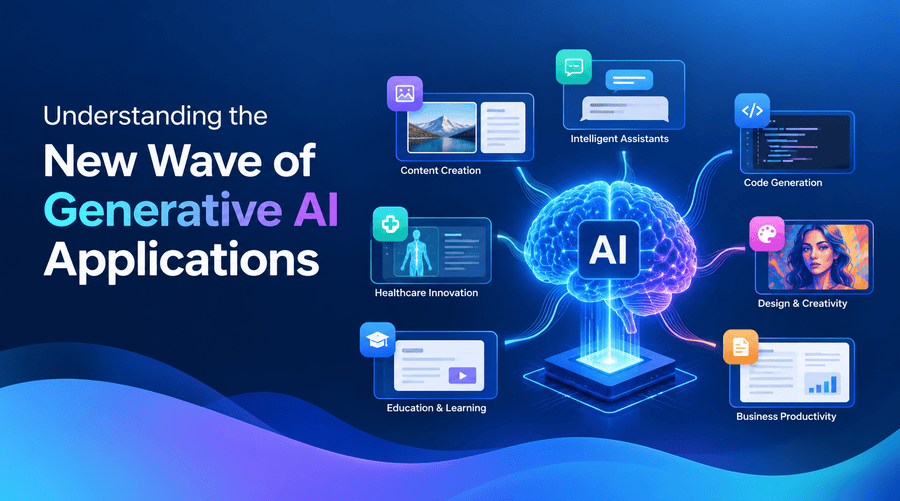
Generative AI services have spread into nearly every kind of app. Not just the AI-branded ones.
Writing tools use it to draft blog posts and product copy in seconds. Support apps use it to answer routine questions before a ticket ever reaches a human. Design tools turn a rough sketch or a short prompt into a working mockup, which used to take a designer hours on its own.
Coding tools picked this up fast too. Copilots built into code editors suggest whole functions while a developer types, flag bugs early, and explain code someone else wrote years ago. E-commerce apps lean on it for recommendations that shift in real time based on what a shopper just clicked, not a rulebook someone updates once a month.
Software gives similar examples as above. One app may use one AI model to generate text for its chat support, as well as its onboarding texts and interface. From having distinct buckets, we have entered an AI model-centric future.
Agentic Behavior: Apps That Act, Not Just Respond
—————————-
There’s a step past generating content, and it’s a bigger deal than most of the AI-app hype gives it credit for. It’s called agentic AI.
A basic AI feature answers a question and stops. An agentic one carries out a multi-step task, often without anyone checking in along the way. A travel app that spots a price drop and rebooks the flight itself, that’s agentic. So has an email scheduling feature that allows users to simply send an email. It will then analyze the content to find the availability of these users and send the event as a calendar invite.
Rather than having to navigate through five screens, a user only has to compose one message and the app does everything else. Building that well takes more than a solid model behind it. It takes real guardrails. To be successful, an app needs to know how to pause and prompt a human decision before performing an action with irrevocable consequences.
Multimodal and On-Device Trends
—————————-
Two other things are pushing this wave forward, and they get less attention than they deserve.
First: multimodal input. AI tools used to be mostly text-in, text-out. Now plenty of apps take voice, images, and text together in one go. A healthcare app can read an uploaded lab report, listen to a patient describe symptoms out loud, and pull both into a single summary for a doctor.
Second: on-device AI. Running a model used to mean shipping every request off to a server somewhere and waiting. Smaller models now run right on a phone. That means quicker responses, sure. It also means sensitive data can stay put instead of traveling to a server. For anything touching health records or money, that’s a real difference, not a footnote.
What This Means for Businesses Building Apps
—————————-
There are a few things to consider as you think about incorporating generative AI into apps you build.
One of them is development time. There used to be weeks spent developing supporting scripts and developing UIs, which can now be done in under an hour to develop an initial version. Just developing faster doesn’t improve things if you ship something without humans checking it, though.
Users’ expectations have changed as well. Your audience has daily AI usage that drives app interaction expectations. A static FAQ will feel drastically behind compared to your competition.
Privacy is going to be a major concern as well. Any app that processes or stores personal data through an AI model needs to know what it stores, what it sends, and what can be disabled. An app gets trust erosion, and, by extension, no audience, if you don’t address those.
Getting the Data Right
—————————-
None of this works without decent data behind it. A generative model is only as good as what it’s trained on and what it gets fed at the moment someone uses it. Feed a support bot bad or outdated product info and it’ll answer questions confidently and wrong, which is worse than not answering at all.
This is where a lot of teams trip up early. They plug in a model, get impressed by the first few demo answers, and skip the boring work of checking the model against real edge cases. A return policy that changed last month. A product that got discontinued. Small gaps like that show up fast once real users start typing real questions instead of the ones picked for the demo.
What to Watch For
—————————-
Not every generative AI feature should be used in an app. Some features may get used to keep up with the competition rather than to fulfill a user’s needs.
A good way to test if a feature is needed is to ask if using artificial intelligence to perform this task eliminates a step. There is little time saved using chatbots to answer frequently asked questions. There is, however, a great service provided when chatbots are used to review orders and communicate status resulting in better resolution of delays and suggestions of solutions.
Reliability matters more than novelty here too. Users forgive a plain app that works every time. They’re a lot less forgiving of a flashy AI feature that gets things wrong one time in ten, especially if money or personal data is involved. Better to launch a narrower feature that holds up than a broad one that occasionally embarrasses the business.
Where This Is Headed Next
—————————-
The direction this is moving in isn’t a mystery, even if the timeline is fuzzy. Models keep getting cheaper to run and faster to respond, which means more of the app gets handed over to them, not less. Features that feel experimental now, an app that plans your whole day from one voice note, will likely feel routine within a couple of years.
What’s less certain is how much users will actually want handed over. Plenty of people like an app that suggests and lets them decide. Fewer are comfortable with an app that books, buys, or cancels things without a check-in first. The apps that win probably won’t be the ones with the most autonomous features. They’ll be the ones that got the balance right between doing things for the user and asking first.
Final Take
Generative AI software went from interesting to ingrained and integrated in the architecture of apps very quickly. Now, we not only have automated prompted writing assistants, but we have app designers, content creators, suggestors, and as creative AI advances, automators. AI app development poses an interesting question to companies at what points do we need to keep the Human in the loop? Companies are thinking about what parts of the process can be completely automated. This question is the focus of most generative AI software development now.