How AI Is Driving Next-Gen Digital Transformation in Enterprises

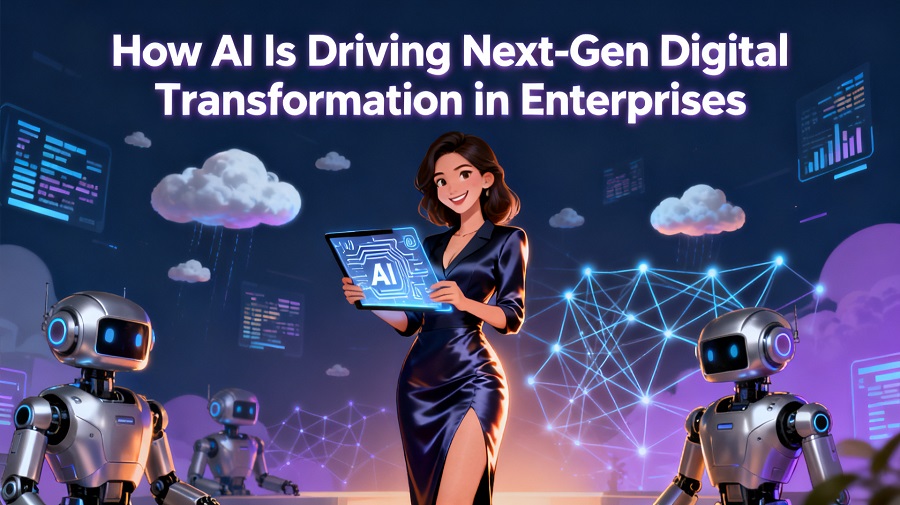
Digital transformation is not just another buzzword but rather an essential requirement for organizations to be competitive and continue to grow as organizations that meet not only the expectations of their clients but also the marketplace. AI has become one of the major driving forces behind the continuous evolution of organizations today.
Through the use of artificial intelligence, businesses have been able to have their operations run more productively and efficiently by providing assistance with repetitive tasks, making better decisions, and improving customer interactions. Businesses across all industries have been utilizing AI technology to improve operational efficiency, enhance the end-user customer experience, improve their security practices, and also discover new areas for potential business improvement. AI technology was once thought of as a futuristic technology, but now it is quickly becoming one of the foundations of how business will be done daily.
With the vast amount of data that organizations are now handling on a much larger scale and the ongoing need for organizations to continue to innovate, AI will play an important role in the successful establishment of the future direction of digital transformation.
What AI Means for Modern Enterprises
—————————-
AI is technology that analyzes data, learns patterns, and makes decisions with minimal human intervention. In terms of business use, AI typically resolves actual business issues instead of taking away jobs from humans. Today, organizations are increasingly adopting intelligent systems as part of digital transformation strategies, and this is where Agentic AI is transforming enterprises by enabling more autonomous, adaptive, and goal-oriented business operations.
Today’s organizations produce enormous amounts of data daily, but AI can process and analyze that data more quickly and more accurately than humans. Rather than relying only on human effort to review data and determine value, businesses now have access to artificial intelligence tools that allow them to analyze data, forecast trends, and operate more efficiently.
Some of these tools include machine learning, natural language processing, computer vision, and predictive analytics, and they are being integrated into business operations every day. Overall, AI tools are assisting businesses in modernizing their systems and improving their overall productivity.
AI Is Automating Routine Business Operations
—————————-
Automation is one of the key ways that control (managers) use AI to effect transformational change. Surrounded by manual procedures (hard work), businesses can shift their attention from repetitive and time-consuming enterprise processes towards more value-centric activities through an automation process powered by artificial intelligence.
As an illustration, companies can automate common tasks within customer service systems using AI-powered chatbots or virtual assistants. In addition, they are able to answer frequently asked questions, solve simple problems, and provide support 24/7 with these applications. Not only do they help alleviate pressure on your customer service and increase the speed of your response to customers, but they can also improve the level of service that is provided to your customers.
AI simplifies the automation process by automating many of the tasks performed in finance departments, such as invoicing and billing processing, expense reporting/tracking, fraud detection, and preparing monthly/quarterly financial statements. Similarly, AI helps streamline the hiring process by allowing HR (Human Resources) departments to review and evaluate job applicants more efficiently by managing their resumes and onboarding employees faster.
In short, automation provides organizations with savings in terms of time, but it also produces fewer mistakes and greater operational efficiency.
Improving Customer Experience with AI
—————————-
The pace of change in customer expectations is accelerating. With many people now wanting instantaneous and customized responses from companies, companies have turned to AI so that they can provide their customers with an improved experience through having a better understanding of customers’ behavior and preferences.
AI recommendation systems have been developed to analyze user data in order to recommend products or services to an individual user in e-commerce, video streaming, and other web-based services.
Additionally, AI technology enables businesses to send out marketing communications that have been customized to a particular individual based on each individual’s activity, purchase history, and browsing behavior.
The use of such tools has improved the speed, simplicity, and efficiency of how businesses communicate with their customers, including through the use of voice assistants, chatbots, and smart support solutions.
AI is strengthening data-driven decision-making.
—————————-
One of the most valuable assets a company can have today is data. Unfortunately, it is very difficult for businesses to manage and analyze large amounts of data manually, but AI allows companies to create valuable relationships with their customers by converting raw data into insights.
AI systems enable companies to analyze vast quantities of data in real time. Businesses can now identify trends, forecast customer behavior, and make informed decisions in a significantly shorter amount of time.
In the retail industry, for example, AI enables retailers to accurately forecast demand and manage their inventories more effectively. Financial institutions leverage predictive analytics to evaluate credit risk and identify fraud before it occurs. In the healthcare industry, AI is used to review patient information to develop treatment plans.
AI facilitates better decision-making by enabling companies to make quicker, better decisions, thereby reducing the risks associated with decision-making and providing a more rapid response to changes in the marketplace.
AI Is Transforming Cybersecurity
—————————-
Cybersecurity threats have been increasing in magnitude as business processes have migrated to a digital format. In many cases, traditional security systems are unable to keep pace with rapidly evolving cyberattacks. AI is providing solutions to support businesses’ cybersecurity programs and enhance defense efforts.
AI-enhanced security systems are able to continuously monitor network activity and provide real-time detection of suspicious activities. Furthermore, AI-enabled security systems assist with identifying unique patterns associated with an attack, which can be indicative of malware, phishing attempts, or unauthorized access.
Compared to manual practices, by utilizing AI, threats are detected and analyzed significantly faster than human capabilities allow for, and response times are dramatically decreased, thereby lessening the potential impact of a security failure or incident.
AI has also proven effective in the area of identity verification, fraud detection, and endpoint protection, as well. As cyber threats have developed quickly and in various forms, AI-enabled cybersecurity solutions are vital to the successful digital transformation of a given organization or entity.
AI Is Modernizing Supply Chain and Operations
—————————-
AI is transforming supply chain management in many different ways. Companies frequently run into issues of demand forecasting and inventory management, to name just a couple. AI can assist in optimally managing your supply chain through an analysis of historical data so that you can effectively forecast future demand, keep adequate levels of stock on hand, and thus prevent having too little or too much inventory to meet changing customer demands.
AI systems can be used to improve route optimization, warehouse management, and delivery tracking. Manufacturers can use AI to monitor machine performance so they can anticipate and schedule maintenance before machinery fails.
All of these improvements create greater efficiency in operating costs.
The Role of AI in Workforce Transformation
—————————-
AI is transforming not just the tech systems but also the place of work itself, because AI technology has created a more intelligent way to work alongside tools that can help them work more quickly and efficiently.
AI may be used to coordinate meetings, summarize meetings, and manage workflows; for example, AI is also being used to assist in customer service by helping agents create responses and providing real-time data.
Furthermore, businesses are using AI/learning platforms to assist employees in their continued training and skill development (e.g., learning custom-built AI-powered solutions to improve different types of jobs based on performance and ability).
Whereas many people fear that AI will replace employees, it seems more likely that, rather than replacing them, AI will help them to be more productive, allowing them to spend more time on creative and strategic work.
The Future of AI-Driven Digital Transformation
—————————-
In the coming years, AI will play an increasingly important role in helping organizations digitally transform. Organizations will continue to invest heavily in areas like intelligent automation, predictive analytics, generative AI chatbots, and AI-based customer engagement as AI technologies continue to advance. This adoption curve is already hitting the mainstream; extensive market surveys from the McKinsey Global Survey on AI indicate that corporate adoption of AI has dramatically spiked globally, with a significant percentage of organizations now actively embedding AI capabilities across multiple business functions.
This massive deployment is triggering an architectural shift toward specialized systems. According to tech forecasts outlined by Gartner, enterprise applications are rapidly moving toward autonomous capabilities, predicting that 40% of enterprise applications will feature integrated, task-specific AI agents by the close of 2026. This move toward autonomous infrastructure is changing the foundational unit of business execution, as tracked continuously in the Forbes Agentic AI Hub.
Certain industries, such as healthcare, manufacturing, retail/service businesses, banking, and transportation/logistics industries, have already experienced considerable change due to the introduction of AI technologies. In the long term, expect AI to become an integral part of how all organizations operate rather than being viewed as a ‘nice-to-have’ technology.
Conclusion
Companies are adopting AI technology for numerous reasons, including automating functions or providing enhanced customer experiences, as well as improving safety and efficiency. Now that companies have seen the benefits of using AI in their business operations, enterprises are moving out of the experimental phase for AI, utilizing it in their core operations as a means to improve productivity, lower costs, and make better decisions based on data.
Companies are experiencing challenges in adopting AI; however, the overall impact will be tremendous for long-term gains. Companies that take a strategic approach to AI will create a successful foundation for growth and future innovation.