How Web Application Development Improves Customer Engagement?

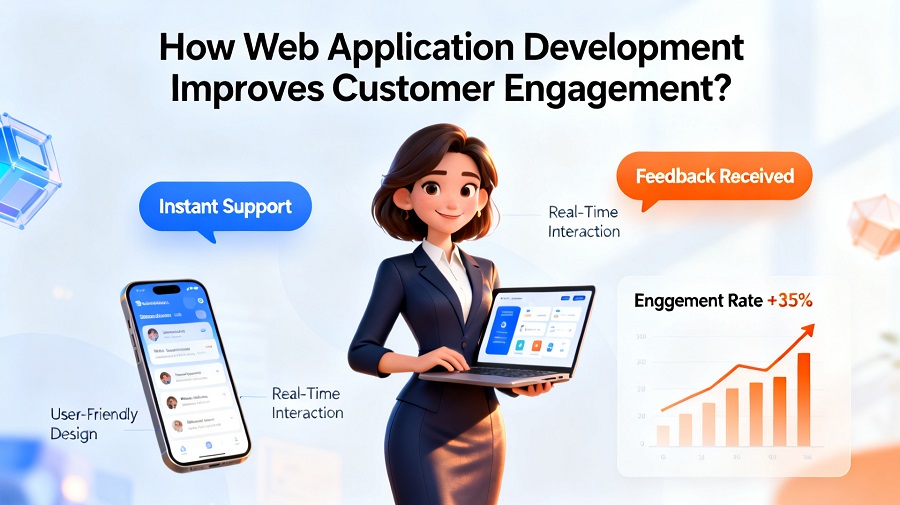
In the highly competitive digital world we live in, customer engagement is no longer a luxury, but the one metric that matters most for long-term business success.
Effective engagement with customers leads to longer customer retention, greater loyalty and increased lifetime value. At its core of this revolution of engagements lies one powerful enabler, web application development.
Modern web applications are more than just static websites. They are dynamic, intelligent and highly personalized, responding to user behaviour in real time. From the first click, the right web application can change the customer’s experience of your brand, whether it’s a self-service portal, a booking engine or a fully integrated e-commerce ecosystem.
By collaborating with the right web application development company, businesses can provide a solid technical base to create such experiences as fast, intuitive, scalable and user-centric.
How Web Applications Create Meaningful Customer Touchpoints?
——————————
Each time a customer engages with your business, it’s called a touch point, and web applications do a lot to increase and enhance these touch points. Web apps are interactive, engaging, and two-way, unlike traditional websites that convey information to customers; this gives them the feeling of being heard, valued and in control.
● Personalized User Experiences That Drive Loyalty
In web applications, the behaviour of users in the application as well as their purchase history and browsing patterns can be analysed and therefore, a uniquely personalised experience can be offered for each user.
It is more personal when customers are met with product suggestions, content and offers tailored to their own interests, as opposed to generic offers. By making this customization, it can encourage the customer’s brand connection and increase the probability of a future visit to make a purchase.
● Real-Time Communication and Instant Support
In-app messaging, push notifications, AI-powered chatbots and live chat are now common in today’s Web Apps to allow interaction with information or with a support agent whenever it is needed.
If there is no friction in the support process, then customers realize their time is precious and there’s no follow-up. Increased customer satisfaction and decreased customer churn are directly connected to real-time communication.
● Seamless Onboarding and Self-Service Portals
On joining the site, they will need to start very quickly and easily, and be able to maintain their own account without having to call the Support team. From the customer’s point of view, this can streamline the onboarding process or allow customers to use a self-service tool to modify their preferences, follow an order or handle their subscription, therefore decreasing the customer service workload and enhancing consumer confidence and self-service.
● Gamification and Interactive Engagement Features
You don’t have any means to do as much as a loyalty point system, progress trackers, reward for referral, badges or interactive quizzes for static websites. These are features that tap into the users’ motivations and create fun interactions. If your site is really interesting to people, they will spend more time on your site and visit it more frequently, and they’ll be much more likely to tell others about it.
● Data-Driven Feedback Loops
With offline, the user doesn’t generate data with each action, with web applications, every action the user takes while using the application generates data. Every one of these events is related to analytics dashboards that provide businesses with information as to where they’re doing right and wrong. This continuous loop facilitates teams to rapidly adapt, address pain points, and continuously improve, while keeping customers engaged.
Mobile-First Web Apps: Engaging Customers Wherever They Are
——————————
Today, more traffic on the web is created by mobile devices than any other device on the planet, and strategies that exclude consideration of the mobile environment are simply wasting tons of potential. Customers want seamless, fast and simple mobile experiences, and businesses that offer this have an advantage.
● Progressive Web Apps (PWAs) for App-Like Experiences
A Progressive Web App combines the best of websites and mobile apps with the features to work offline, get installed on the user’s home screen, and receive push notifications all without having to go through an app store. The effect PWA has on businesses is massive, it has minimised the barriers of connecting with customers on their mobile devices, customers can have the native app experience without downloading, and it’s possible from any device, any time.
● Responsive Design That Adapts to Every Screen
Navigation menus, product grids, forms, checkout processes and all other elements of a web application will fit flawlessly on any screen resolution with responsive design that design for the mobile first.
Research shows that if a customer has had a bad experience with mobile, they’re unlikely to return, and one of the main reasons for user abandonment is poor mobile experiences. This risk is eliminated with responsive design.
● Touch-Optimized Interfaces for Intuitive Navigation
This requires rethinking interface patterns, such as larger targets for tapping, ease of swiping through carousels, navigation bars within easy reach of thumbs, and forms that don’t annoy tiny-screen users.
If navigation is easy and intuitive on a smartphone, customers will navigate through your application with ease and certainty. Customers with ease and certainty convert at far higher rates than customers who are frustrated.
● Faster Load Times Through Mobile Optimization
Time is of the essence on mobile. Other methods of making web applications mobile-friendly, such as lazy loading, compression of images, code splitting and CDN delivery make them run much faster when connected via a cellular network.
Research indicates that a 1-second delay in load time can lead to up to 7% conversion drop. By investing in mobile performance optimization, businesses are directly investing in higher engagement and revenue.
● Push Notifications That Re-Engage Dormant Users
One of the most effective ways of engaging with users that mobile-friendly web apps offer is with push notifications.
Whether it’s informing customers about order status, notifying them of flash sales, personalized offers, or reminding them to complete abandoned carts, push notifications can be deployed to reach out to customers at the right moment.
Unlike email, push notifications are instant and they are visible, that’s why they are one of the highest converting re-engagement channels.
Integrating Advanced Technologies to Elevate Engagement
——————————
The most innovative businesses are not only developing web apps, they’re developing intelligent platforms that seamlessly connect across platforms, with AI and automation in tow. These technologies convert web apps from brochures into effective relationship-building tools.
● AI-Powered Personalization at Scale
AI can do more than segment and provide hyper-personalized experiences for thousands of users at once across web apps.
With the use of behavioural data, machine learning algorithms can be utilized to target every contact with the appropriate content, product or offer, making each visit feel like it was tailored. With the tech-focused custom mobile application development services, businesses can expect measurable improvements in engagement metrics, session time and conversions with AI-powered personalization.
● Omnichannel Integration for a Unified Customer Journey
Today’s customers move from device to device and channel to channel, they may shop on a laptop, add items to their shopping cart on their mobile phone and then purchase on a tablet.
Web applications that work seamlessly with your CRM, email, social media and in-store experiences can guarantee that your customer journey is seamless and there are no gaps. One of the most obvious tell-tale signs of a truly customer-aware brand is omnichannel continuity.
● Custom Mobile Application Development for Extended Reach
Today’s customers move from device to device and channel to channel, they may shop on a laptop, add items to their shopping cart on their mobile phone and then purchase on a tablet.
A web application development company that seamlessly integrates with your CRM, email, social media and in-store experience can ensure that your customer journey is seamless and gapless. One of the most obvious tell-tale signs of a truly customer-aware brand is omnichannel continuity.
● Automation That Removes Friction from the Customer Journey
Whether it involves automated order confirmation emails, appointment reminders, intelligent form autofilling, or dynamic pricing, workflow automation removes the little frustrations that can chip away at customer satisfaction in web apps.
Customers feel a brand is efficient, reliable and easy to do when repetitive and error-prone manual steps are replaced by smooth automated steps.
● Analytics and A/B Testing for Continuous Improvement
It’s always a work in progress, never finished, the best Web apps evolve based on real user data. Integrated analytics dashboards and A/B testing features help product teams test various headlines, layouts, calls-to-action and user flows against one another, and then use the ones that generate the highest engagement.
This is the culture of an ongoing iterative improvement and is what distinguishes market leaders from the ones that build once and leave their platform to stagnate, with the only data gathered being that of their competitors.
Final Thoughts
One of the most direct levers that a business can pull is web application development, which can have a profound impact on the customer engagement.
From custom functions to real-time communication, mobile first design to AI powered intelligence, today’s web apps can do more than a static website in terms of deep, meaningful and long-term relationships with customers leading to commercial benefits.
The businesses that will succeed when it comes to customer engagement in 2026 are the ones that consider their web application as a business asset, and not just a cost center, that are built and evolved consistently, and that are continually optimized for the customer.
It’s a no-brainer that the path forward is the same, no matter if you’re starting from scratch or upgrading the current platform. Invest in the right technology, the right team and build a digital experience your customers don’t want to miss.