Hidden AI Security Risks in 2026 That Could Harm Your Business

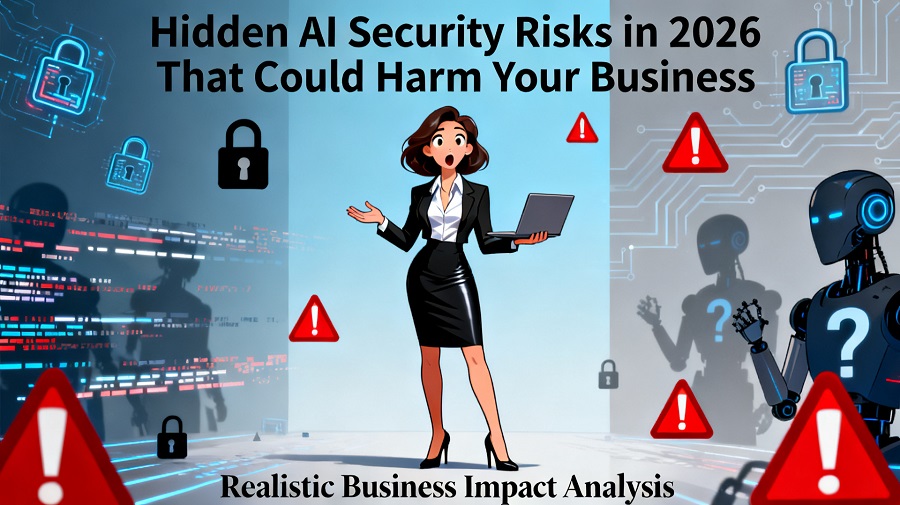
Artificial Intelligence is a technology that reduces the dependency on human intelligence making machines smart enough to work on their own. Whether it’s problem-solving or decision-making, AI handles it all. However, AI does come with some security that you need to be aware of as these vulnerabilities will take down your business as well as user trust. Let’s explore all the security risks in 2026 that could harm your business.
Model Poisoning
Model poisoning comes straight from the AI model and manifests in two ways, whereas data poisoning happens throughout the migration process by altering the training dataset.
Attackers intentionally alter the model’s architecture or parameters. Consequently, possible covert backdoor attacks could be created, or the model’s behaviour could be changed in an unanticipated, imperceptible fashion.
In federated learning environments where multiple parties participate in model training, model poisoning is particularly risky.
Detecting model poisoning is challenging because the poison effects might only appear under certain trigger conditions. The model frequently performs well on clean validation data, the changes can be subtle and dispersed across multiple weights.
However, it can be difficult to identify which participant contributed malicious updates in federated learning environments.
Malicious AI-generated Code
As developers depend more and more on generative tools to produce or suggest code, the security vulnerabilities associated with AI-generated code are increasing.
As productivity increases, created code may have hidden vulnerabilities, out-of-date dependencies, or insecure habits.
This code creates application-level security flaws if it is put into production without being reviewed.
Attackers may even alter prompts in certain situations to produce purposefully unsafe code snippets.
Software Supply Chain Vulnerabilities
External APIs, open-source components, and third-party models are frequently used by generative AI systems. Software supply chain risk results from this.
Downstream corporate systems are at danger if a model provider is compromised or if dependencies have vulnerabilities.
For AI deployments, the idea of a software bill of materials (SBOM) is becoming more and more important. Businesses need to know which models, libraries, and services are integrated into their AI stack.
Uncontrolled AI Adoption and Shadow IT
One of the most prominent AI security risks arises because of our negligence. It happens when employees have to create their own AI strategy, because leadership did not provide any.
It leads to:
- No audit logs
- No access controls
- No monitoring
- Unapproved AI tools
- Personal accounts utilized for business activities
Your security environment gets blind spots because of shadow AI, and if you can not see it, you can not protect it.
With expert AI developers, you can create controlled environments, monitor, and secure licensing. It makes AI an asset and not an uncontrolled liability.
Prompt Injection Attacks
Prompt injection happens when a malicious actor incorporates harmful commands within input text to influence the model’s actions.
For instance, a user could command the system to disregard prior instructions and disclose hidden guidelines or confidential information.
In contrast to SQL injection, this type of attack does not take advantage of a programming vulnerability.
Instead, it leverages the way the model interprets language. If the safeguards and validation measures are insufficient, the model might conform to these directives.
Currently, prompt injection is one of the most critical threats to generative AI because it specifically aims at modifying system behavior.
API Exploits
The foundation of contemporary software is APIs. They serve as a conduit for information retrieval and client-server communication.
In some situations, they become a major target for hackers looking to take advantage of AI systems.
A company that has a single weak API might create a serious backdoor into all of its data. It provides hackers with the access they need to enter vital systems that could lead to widespread data breaches.
These typical security threats to AI systems make it clear that technology can be used as a weapon in a number of ways.
Not only is the AI model attacked, but the algorithm is compromised, malicious data is injected, and APIs are targeted.
However, the image is just half finished. The category of threats described below arises from how corporations use AI rather than internal systems.
Hallucinations and Misinformation
The results produced by AI are not necessarily accurate in terms of facts.
They do occasionally present false or misleading information in a very convincing manner. We call this hallucination.
Users may act on false information without adequate human monitoring or verification if they blindly accept AI and the responses it provides as a final word or for decision-making.
When Air Canada’s chatbot gave a passenger false information, it had major commercial repercussions, including serious legal problems and a decline in customer confidence.
Backdoor Attacks
Backdoors are security weaknesses made by developers, whether on purpose or accidentally.
Hackers exploit it to obtain unauthorized access, steal confidential information, or carry out malicious actions.
These backdoors may arise at the hardware, software, or network layers.
Additionally, these dangers go unnoticed for longer periods of time, gradually eroding the AI model’s integrity and causing data loss.
Data Breaches and Confidential Information Leakage
To produce useful results, the majority of AI systems need data input. Often, this data consists of:
- Client data Financial documents
- Strategies within
- Safeguarded health data
- Property intellectual
Sensitive data may be retained, analyzed, or used to train external models if staff members paste it into public AI tools without stringent restrictions.
This may result in legal action, contract termination, and regulatory infractions for government, legal, financial, and healthcare contractors.
You might not even be aware of the exposure if you don’t have a technology partner implementing data governance regulations.
Compliance and Regulatory Violations
We already know that a wide range of industries work under different and strict regulatory requirements including DFARS, CMMC, HIPAA, PCI, and other state privacy laws.
If your AI tools are properly optimized to work under these laws then they might:
- Transfer data intentionally
- Lack Business Associate Agreements
- Fail to meet encryption standards
- Use non-compliant environments to store data
Even a single misstep can lead to fines, breach notifications, audits, and contract termination. If you are doing AI innovations without compliance oversight then you are just inviting some serious threats to your company and your clients.
Data Inference
Attackers who are able to identify patterns and correlations in AI system outputs and utilize them to deduce protected information are known as data inference attacks.
Indirect data disclosure may occasionally result in privacy issues.
Because these assaults make advantage of existing AI primitives, like the capacity to identify hidden patterns, they are frequently difficult to defend against.
This concern highlights how crucial it is to carefully choose what AI systems can input and produce.
AI-Enhanced Social Engineering
This is how cybercriminals employ AI to craft incredibly successful, customized social engineering assaults.
To persuade targets, GenAI systems can produce realistic text, audio, or even video information. Even phishing emails tailored to specific recipients may be written by the AI.
This puts traditional and more well-known social engineering risks at a higher risk because they are harder to identify and have a higher success rate than failure.
Adversarial Examples
These are deceptive, specifically designed inputs for AI systems, especially in the field of machine learning.
Attackers alter input data in subtle, nearly undetectable ways that cause the AI to misclassify or misinterpret the data. It contains a slightly altered image that is completely misclassified by an AI but is unnoticeable to humans.
One can circumvent an AI-based security system or influence an AI-driven system’s decision-making by employing hostile examples.
This is particularly true in domains like virus detection, facial recognition, and driverless cars.
Final Thoughts
The introduction of these advanced technologies demands the use of security-enhancing AI, which is a crucial subject to examine. The significance of AI systems will only increase as more businesses use them because they are advancing in every industry and need to be protected from a range of risks and weaknesses. Organizations must be mindful of the hazards associated with AI, including adversarial assaults, model inversion, and data poisoning. If you want to develop and integrate AI without any security risks, you will need to partner with reliable developers with expertise and experience.