How Software Development Helps Build Secure and Flexible CMS Platforms

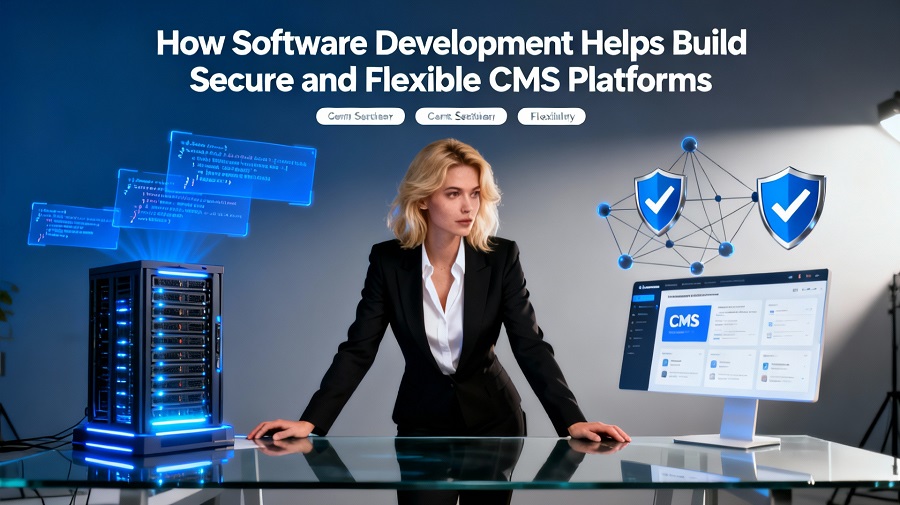
Most people don’t think about CMS platforms until something goes wrong. A page refuses to load. Accessing permission becomes more complicated. A simple update breaks the layout. Or in the worst circumstances, sensitive content becomes visible to the wrong users. When that happens, it’s easy to blame the CMS itself. But in reality, the problem usually starts much earlier. It starts with how the system was built.
This is where software development quietly shapes everything that follows. A CMS is not just a tool that publishes content. In modern environments, it behaves more like a living system. It stores all the structured information, manages user access, connects with other platforms, and evolves over time. When these realities are ignored, security and flexibility always suffer.
A CMS that feels “fine” during the launch can slowly become fragile as real usage begins.
CMS Platforms Have Changed, Even If Perception Hasn’t
——————————–
Earlier CMS platforms were used for blogs and static websites, but as time passes. CMS platforms have often sat at the centre of several digital operations. They support several platforms, including internal documentation, learning portals, financial education platforms, and even systems that display personalized user data.
Once a CMS starts doing more than just publishing text, its responsibilities multiply. Suddenly, questions arise. Who can see what? What happens if data grows tenfold? How are updates handled without breaking the workflows?
At this stage, relying on the default configurations becomes risky. Software development has stopped being a technical choice and has become a structural necessity.
Why Generic CMS Setups Reach Their Limit Quickly
——————————–
Generic CMS platforms are designed to work everywhere. That strength is also their weakness. They assume a level of simplicity that rarely exists in real-world systems.
Some of the common issues that start appearing quietly include:
- Permissions become messy
- Plugins overlap or conflict
- Performance drops without any clear reasons
- Security updates feel unpredictable
But none of these problems is dramatic and appears on day one. They usually show up gradually, especially when multiple users interact with the system in various ways. This is where custom software development services change the whole equation. Instead of just forcing the CMS to fit in every scenario, the system is shaped around the actual usage.
Security Is Often Treated Too Casually
Security failures in CMS platforms rarely come from one catastrophic mistake. More often, they are the result of small compromises that have been made over time. A plugin that doesn’t get updated. A user role that gets more access “just for now.” A quick workaround that becomes permanent.
When security is handled reactively, CMS platforms slowly become unpredictable. Software development allows security to be treated as part of the system’s foundation, but not an emergency response. Authentication, permissions, and data handling are designed intentionally. This major difference matters the most where people often realize.
Architecture Influences Security More Than Tools Do
Many CMS problems are architectural, not technical. When content logic, user management, and system operations are tightly mixed, issues are spread quickly. A small bug in one area affects everything else.
Strong CMS platform architecture and security practices focus more on separation. Content remains as content. Users stay users. System logic remains isolated. This separation makes problems even easier to contain, and systems become more trustworthy. Plugins alone cannot create this clarity. It requires deliberate design choices that are made during development.
Access Control Is Where Problems Hide
One of the most overlooked areas in CMS platforms is access control. Systems often grant users permissions that they actually need. Over time, this leads to confusion and risk.
With custom CMS software development, access rules can reflect the real behaviour. Editors can edit, reviewers can review, administrators can manage, and sensitive areas stay protected without any supervision.
This structure reduces mistakes and improves accountability. It also makes the CMS easier to manage as teams grow.
Flexibility Determines Whether a CMS Survives Change
Security is one of the important things as it is very important for the system to stay protected. Flexibility determines whether it survives tomorrow or not.
Requirements can change instantly. Content formats evolve over time. Integrations become more necessary. Compliance rules shift. CMS platforms that are rigid can accumulate patches and workarounds, and workarounds can eventually weaken the security.
Custom software development allows systems to evolve without breaking. Features can be added cleanly. Old components can be replaced rather than patched. This adaptability is what keeps the CMS platforms useful over time.
Plugin Convenience Comes With Long-Term Costs
Plugins are tempting because they promise quick solutions. But each plugin introduces some uncertainty. Who maintains it? How often is it updated? What happens when it conflicts with another component? With custom CMS software development, features are built specifically for the platform. There are fewer unknowns. Behaviour becomes even more predictable, and maintenance becomes manageable. Over time, this approach reduces surprises and improves stability.
Enterprise CMS Development Solutions Are About Calm Systems
Enterprise-level CMS platforms behave differently from small websites. Large volumes of content, complex workflows, and heavy traffic can change how systems respond under pressure.
Enterprise CMS development solutions focus on stability rather than speed of deployment. Load handling, caching, and performance optimization are planned from the beginning. This prevents reactive, but fix it later. With the help of structured software development services, CMS platforms remain calm even as usage grows.
CMS Platforms in Finance-Related Contexts
CMS platforms can increasingly support the finance-related content. This includes budgeting guides, dashboards, reports, and user-specific resources. These environments demand more accuracy and trust.
Here, CMS platforms must handle:
- Structured information
- Controlled access
- Predictable workflows
- Clear data boundaries
Through custom web software development, these systems can operate securely without exposing users to unnecessary risk.
Integrations Should Strengthen, Not Weaken, Systems
Modern CMS platforms rarely operate alone. They connect with the analytics tools, cloud services, and APIs. Each connection introduces the potential exposure.
Poorly planned integrations often bypass the existing security logic. Custom development ensures integrations follow the same standards as the core system.
This is another reason custom software development services reduce their long-term risk rather than just increasing it.
Performance Problems Are Not Just UX Issues
Slow CMS platforms frustrate users, but they also complicate maintenance. Delayed updates, unstable behaviour, and timeouts create several blind spots. Through thoughtful software development, CMS platforms remain responsive and predictable. Clean code and efficient processes make systems easier to secure and even easier to update.
CMS Platforms Are Long-Term Commitments
A CMS is not a short-term tool. It grows alongside the content, users, and their expectations. Systems built without long-term thinking become difficult to maintain.
Good software development assumes change. It builds systems that can absorb new requirements without chaos. This mindset is what separates stable platforms from constant rebuilds.
Where CMS Development Is Headed
CMS platforms are moving toward headless designs, API-driven workflows, and cloud-based environments. These shifts increase flexibility but also complexity.
As systems become more distributed, CMS platform architecture and security will matter even more. Strong foundations become essential.
Conclusion
CMS platforms today are complex systems, not simple publishing tools. Their reliability depends less on features and more on how they are built. Software Development provides the structure needed to protect data, support growth, and adapt to real-world usage. When CMS platforms are designed with intention, they remain assets instead of liabilities.
Frequently Asked Questions
——————————–
- Why is Software Development important for CMS platforms?
Because it allows systems to be designed around real needs rather than generic assumptions. - How does custom CMS development improve security?
It reduces dependency on third-party plugins and allows tighter access control. - Can CMS platforms securely manage sensitive or finance-related content?
Yes, when built with proper architecture, access control, and data handling. - What makes enterprise CMS solutions different?
They prioritize stability, scalability, and predictable performance. - Why does flexibility matter in CMS platforms?
Because systems that cannot adapt become insecure and difficult to maintain.