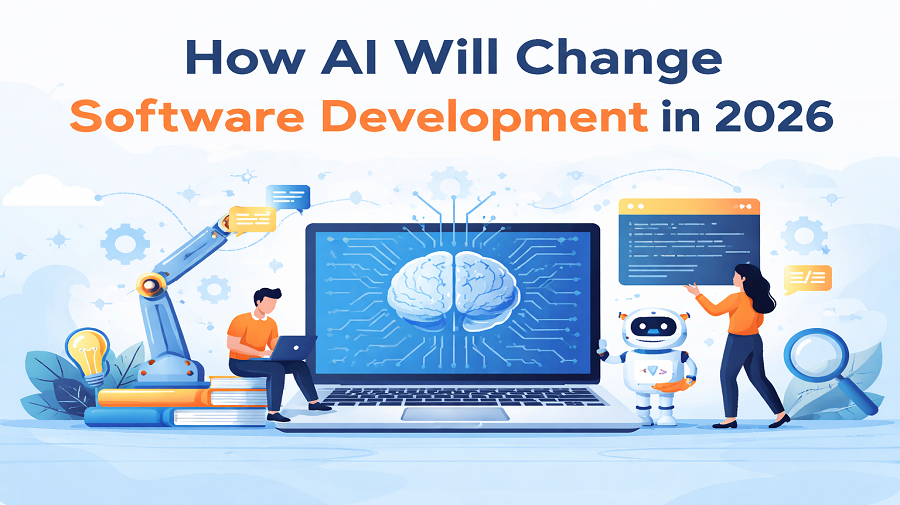
How AI will Change Software Development in 2026

Generative AI is poised to add value somewhere between $2.6 trillion to $4.4 trillion annually and about 75 percent of this value will come from four core areas: Customer operations, marketing and sales, software engineering, and R&D. (McKinsey)
Hence, there is no denying software is at the core of this AI wave. More importantly, with the significant development made recently in the form of AI agents, 2026 is going to pivotal year for software development professional from developer to decision makers.
It is going to be the year when AI will start to show real results affecting business KPIs like EBIT, ROI, productivity, and time-to-market, leading to complete transformation of software engineering as we know it. So much so that we will entering the era of software engineering 3.0 or SE 3.0 in 2026 from SE 1.0, rushing right pass-through SE 2.0.
In this blog, we will cover how AI will change software development. We will cover the topic of SE 2.0 and SE3.0 and how the domain will transition from former to latter. Then we will other impact this transition will have on software development.
From “AI as assistant” in SE2.0 to “AI as co-engineer” of SE3.0
———————————
The year of 2025 witnessed a paradigm shift with AI in software development. We saw software engineering go up a notch from traditional software development i.e. software engineering 1.0, where human engineers explicitly write code and define strict rules.
Driven by artificial intelligence (AI) and machine learning (ML), SE 2.0 arrived and powered software development like nothing before.
AI assisted the coder in driver’s seat by autocompleting code, throwing code suggestions, generative AI software development for small-scale codes. But this is going to change altogether in 2026.
Following closely SE 2.0 on heels in 2026 is the phase of AI Software Engineering 3.0 (SE 3.0), both the terms were popularized by Andrej Karpathy, Ex-Director of AI at Tesla.
This is a phase where AI agent takes the driver’s seat and developers become a “conductor” or “supervisors”. A human software developer describes what they want, and AI understand the context and codebase, breaks the task down, writes code, runs tests, produces deliverables. It even goes on to create documentation as technical writer.
In 2026, this is the most transformative force changing software development itself and across its fronts.
Increased Sophistication in Products and Change in Required Developers Skills
As AI manages much of the clerical work, developers and teams will get sufficient room to attempt more complex projects. This means they can aim for richer features, more and deeper integrations, faster iterations.
Even for large codebases, AI-driven “context-aware” agents will make it feasible to automate tasks considered too risky previously. The AI agent will have the capability to refactor and re-architecting at large scale and to carry out cross-module changes.
At the same time, this will also mean developers will need stronger skills such as
- Designing system architecture,
- Security/compliance Assurance,
- Understanding domain-specific constraints.
- Prompt engineering
- Evaluate AI-generated code,
From an industry perspective, we will see that in 2026 demand for roles like “AI-orchestrator,” “AI-review specialist,” and “AI-workflow engineer,”. All these roles will be responsible to manage and integrate multiple AI agents across SDLC and make software development better and faster.
Enterprise-level Adoption & Workflow Redesign
———————————
In 2026, we will also witness AI integration moving from pilot purgatory i.e. experiments/POCs to full scale enterprise level adoption. Till now, only a subset of organizations has been able to achieve this as per a global survey in 2025.
The succeeding organizations tend to redesign their complete workflows around AI rather than bolt AI on top of existing processes. They redesign their processes, people and product and redefine the critical components therein like validation gates, human-in-the-loop policies, metrics for AI output quality.
This will proliferate in 2026 as we will see more businesses reaping value of AI at scale. Companies will not just rely on tools but also improve organizational readiness for AI such as data infrastructure, governance, new roles, and processes.
Challenges to AI Generation Coding at Scale in 2026
———————————
With the increase AI generated code come certain risks. AI-generated code, especially at scale, lead to security vulnerabilities, bugs, maintainability challenges and interestingly the “AI-style” of coding that may be hard for humans to read/modify.
And as more and more AI-written code accumulates overtime, “technical debt” stemming from AI-generated code becomes an increasingly real concern.
In one of the reports, it was noted that developers increasingly worry about long-term sustainability, quality, and maintainability of AI-led coding at scale. And this is a real concern that a software development company needs to address right from the beginning.
Further down on the systemic level, there are challenges of accountability as who will owns AI-generated code, and the problems emanating from them. There are challenges of compliance such as data privacy, licensing, IP issues, as well as auditability, and governance.
In 2026, these aspects of AI will become more prominent as organizations will become increasingly reliant on AI across SDLCs.
Conclusion: Future of Software Development 2026
To gain edge in software development and even engineering for that matter, decision makers really need to move fast.
The high capability of AI cannot be tapped by just spraying AI on top but in fact re-defining the business altogether covering – people, process and product.
AI promises to add value equivalent to GDP of UK (~$3 trillion), if not more and AI software engineering is one of the core use cases. We hope the trends mentioned are helpful to make the right decision.