Performance Marketing vs. Brand Marketing: Which Drives Real ROI?

In the modern competitive digital world, companies are always driven to prove the value of their marketing investment. Each campaign is expected to yield results, and each investment is measured in terms of return on investment. This is the reason it is still a debate whether performance marketing or brand marketing is the best. The real issue is not which one is better, but which one is producing real ROI.
Businesses must understand what type of results they are actually seeking, as opposed to which technique is preferable. Performance marketing focuses on immediate outcomes, while brand marketing prioritizes long-term growth through trust and reputation.
What Is Performance Marketing?
—————————-
Performance marketing is a results-based approach in which advertisers only pay when a specific action is executed. This could be a click, lead, purchase, or any other meaningful conversion. The entire strategy is founded on data, tracking, and optimization. Performance marketing provides a clear view of the performance campaign as compared to traditional marketing. Businesses can see in real time the money they have been spending and how much they are getting back.
Performance marketing is implemented in paid platforms such as search engine advertisements, social media ads, affiliate marketing, and retargeting campaigns. Through these channels, businesses are able to reach users in terms of intent, behavior, and demographics.
Key Characteristics of Performance Marketing
The difference between performance marketing and brand marketing is usually based on purpose and effect.
Performance marketing is structured in such a way that it can find users who are willing to convert into leads or sales. Brand marketing is a long-term process that creates awareness, trust, and a good brand presence that shapes future decisions.
One is concerned with the quantifiable outcomes of the present, whereas the other is concerned with the perception of customers in the future.
Advantages and Limitations of Performance Marketing
Performance marketing has the opportunity to provide fast results,, and this is one of its greatest benefits. It is perfect when it comes to product launches, promotions, and growth-based campaigns, as it enables businesses to create leads or sales almost immediately. It gives increased control of the budgets as well as enables constant testing and optimization.
However, performance marketing has its own limitations. Performance marketing has the opportunity to provide fast results, and this is one of its greatest benefits. It is perfect when it comes to product launches, promotions, and growth-based campaigns, as it enables businesses to create leads or sales almost immediately. It gives increased control of the budgets as well as enables constant testing and optimization.
What Is Brand Marketing?
Brand marketing is concerned with creating awareness, confidence, and emotional attachment to the audience in the long run. Instead of forcing people to make instant conversions, it influences the way individuals view a brand and their attitudes towards it.
Brand marketing does not aim at achieving immediate sales, but instead it aims at establishing a strong identity, consistent messaging, and long-lasting impressions that create an impact on future purchase decisions.
Some of the most popular methods of brand marketing include content marketing, organic social media, storytelling, PR, video marketing, and thought leadership. These are the channels that help to convey values, expertise, and personality.
Key Characteristics of Brand Marketing
Brand marketing is an emotionally oriented, long-term approach aimed at creating brand recall and developing trust and recognition that helps businesses remain relevant and promote sustainable growth in the long run.
Strengths and Challenges of Brand Marketing
The biggest strength of brand marketing is trust. When a brand gains credibility, it naturally experiences more engagement, higher conversion rates, and lower customer acquisition costs over time. Customers are more likely to choose brands they recognize and trust, even if cheaper alternatives are available.
However, the effect of brand marketing is difficult to measure. It may be challenging for some organizations to justify the investment because ROI often takes time to yield results.
Performance Marketing vs. Brand Marketing: Key Differences
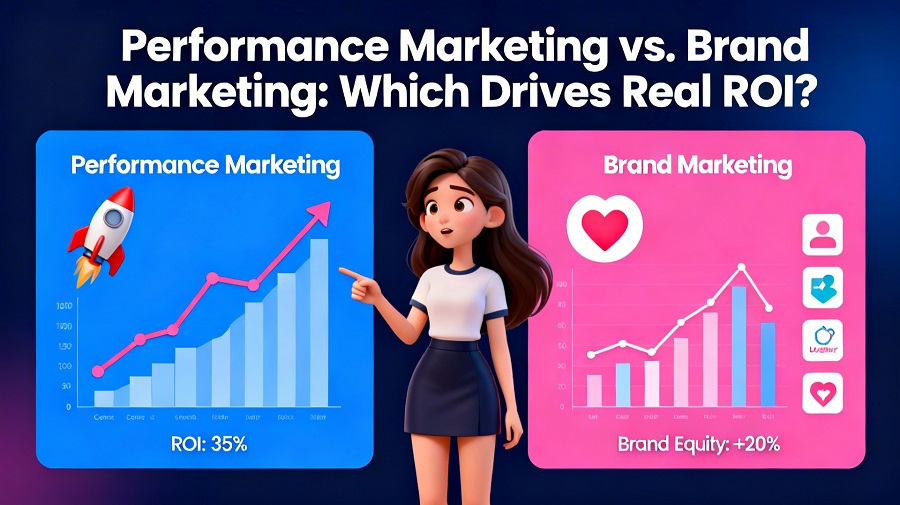
Performance marketing aims to generate immediate results in terms of conversions and actionable outcomes. On the other hand, brand marketing focuses on building long-term value in the form of trust, recognition, and developing strong relationships with the consumer. Performance marketing will deliver an immediate, quantifiable ROI, and brand marketing will create long-term perception and loyalty. Both strategies are significant in overall business growth.
Which Strategy Drives Real ROI?
—————————-
ROI is influenced by both brand marketing and performance, but in different ways. Performance marketing is perfect for short-term objectives like lead generation, e-commerce sales, or short-term campaigns since it produces immediate results that can be measured. Companies can quickly modify their methods after determining what works.
In contrast, brand marketing generates long-term benefits. It builds trust, increases client loyalty, and establishes a unique identity that produces long-term results. Additionally, performance marketing programs are more successful and efficient when they have a strong brand.
Which Strategy Is Right for Your Business?
—————————-
Performance marketing is the only method that many businesses use to achieve their goals, hoping that paid campaigns will yield instant outcomes. This technique may be effective in the short term, but in many cases, it results in increased expenditure, ad fatigue, and decreased engagement.
Without a strong brand, advertisements sometimes rely on short-term strategies such as discounts or special offers to attract customers. This may increase traffic easily, but it rarely builds trust or long-term loyalty. However, outcomes can be limited if brand marketing is the only strategy used and there are no obvious calls to action for consumers. Although awareness and trust are crucial, income and ROI will stay low if users are unable to convert. Brand marketing is most effective when integrated with performance-based techniques that convert interest into tangible results.
The most successful businesses are those that combine the two approaches. Brand marketing establishes trust and credibility, which in turn generates demand, whereas performance marketing fulfills that demand through targeted campaigns. The combination of a good brand enhances the performance of the ad and reduces the cost of acquisition, and boosts the conversion rate.
Conclusion
Successful marketing requires both performance and brand strategies working together. Performance marketing drives immediate, measurable results, while brand marketing builds long-term value, trust, and credibility. When both are aligned, businesses achieve sustainable growth, foster lasting customer loyalty, and generate real ROI that stands the test of time.
Partner with our trusted and reliable company to integrate performance and brand marketing strategies that deliver results today and build value for tomorrow.