From Reactive to Predictive: How AI Maintenance Will Reshape Enterprise Agility by 2026

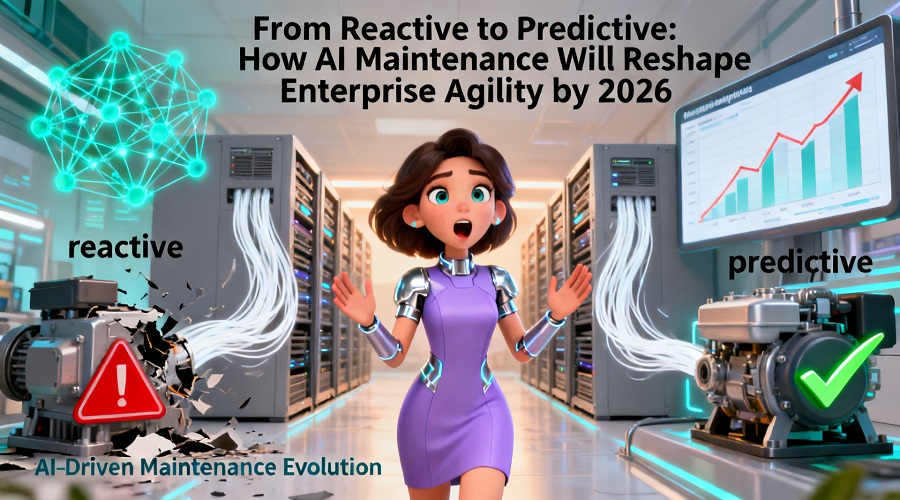
Reactive maintenance is no longer just inefficient. It is a strategic liability. In 2026, relying on “run-to-failure” models is a quick way to cripple operations. Downtime costs now average $125,000 per hour across manufacturing sectors.
But the real cost is the hidden “agility tax.” Constant firefighting forces teams to focus on repairs rather than innovation. It traps the enterprise in a cycle of chaos. Disrupting momentum when you need it most.
The shift to AI-driven predictive maintenance is urgent. It is the only way to move from fast fixes to strategic foresight. AI serves as the enabler. It connects physical assets to digital intelligence to predict failures before they happen.
This article explores that definitive shift. We will uncover the technologies enabling this transition. Plus, the roadmap to implementation. From critical use cases to engineering resilience. Here is how your enterprise moves from reactive to predictive by 2026.
What Is Reactive Maintenance and Why Does It No Longer Scale?
——————————
Let’s understand the overview. Reactive maintenance is the “run-to-failure” model. It means addressing malfunctions only after a breakdown. This approach requires minimal premature planning. But it focuses entirely on post-failure actions, which leads to interruptions and high economic costs.
In contrast, preventive maintenance is proactive. It involves scheduling recurring examinations based on time or usage. While it reduces unexpected breakdowns, it is often based on fixed intervals. It ignores the asset’s actual condition. This results in unnecessary maintenance activities and increased costs.
The Cost of Unplanned Failures
The reliance on reactive models creates a substantial financial burden. Unplanned equipment downtime costs more. In industries like automotive production, the cost of a lost hour can reach $2.3 million.
Beyond direct costs, it hampers decision-making. Operators rely on perceived needs rather than data. This leads to “inexact” interventions. Performing maintenance too late leads to failure. Or too early, resulting in unnecessary costs.
Struggling in Always-On Environments
Reactive models are unsustainable in modern settings. Equipment complexity means a single failure can trigger substantial production losses. With the shift toward 24/7 operations, maintenance windows are severely limited. Making “run-to-failure” scenarios highly disruptive.
This includes Traditional manual inspections yielding an OEE of roughly 50% Disruptions exceeding the speed of human decision-making, and the inability to support Industry 4.0 efficiency standards.
The Hidden Agility Tax
Finally, there is the “firefighting” dynamic. The persistence of reactive maintenance prevents operational agility. It consumes budget and labor on emergency repairs. Diverting funds that could be used for automation or expansion.
A shrinking workforce compounds this resource drain. 40% of the manufacturing workforce is set to retire by 2030. This leads to a loss of “tribal knowledge”. Making manual troubleshooting increasingly difficult. Organizations stuck in these reactive cycles simply cannot keep pace with market volatility.
What Is Predictive Maintenance Powered by AI?
——————————
Predictive maintenance (PdM) is the shift from guessing to knowing. It is a strategy that uses real-time data to detect equipment failures before they occur.
By 2026, this has moved beyond simple alerts. It is now a mature “Industry 4.0” standard that connects your physical assets directly to digital intelligence.
Let’sintegrate IoT sensors into your critical machinery. These sensors continuously monitor the equipment’s physical state. They track specific variables.
- Vibration patterns
- Temperature fluctuations
- Energy consumption
The Role of Machine Learning
Collecting data is not enough. You need to understand it. That is where AI comes in. AI algorithms analyze this massive stream of sensor data. They look for subtle patterns and correlations that human operators would miss.
Deep learning networks create a “health profile” for your machine. When the data drifts away from that profile, the AI flags it. This allows the system to predict a failure weeks in advance.
Predictive vs. Preventive: The Core Difference
Many teams confuse predictive maintenance with preventive maintenance. But they are fundamentally different. Preventive maintenance relies on the calendar.
You service a machine every 3 months or every 500 operating hours. You do this whether the machine needs it or not. This leads to “inexact” intervention.
You are either too late, causing a breakdown, or too early (wasting money on good parts). Predictive maintenance relies on conditions. You only service the machine when the data proves it is degrading.
The Shift to Condition-Based Decisions
This change in strategy has a massive impact on your bottom line. In 2026, the average annual cost of maintaining a heavy equipment unit can be reduced through predictive methods.
Instead of running around putting out fires, your technicians receive specific, actionable alerts. They know exactly what to fix. They know exactly when to fix it. They know exactly which parts they need. This is the power of condition-based maintenance. It eliminates the “run-to-failure” model and replaces it with calculated foresight.
Why Enterprise Agility Depends on Predictive Intelligence
——————————
Agility is the ability to respond. In 2026, agility is the capacity to navigate market changes without losing momentum. It allows enterprises to shift their focus. From “Just-in-Time” efficiency. To “Just-in-Case” resilience. This protects customer trust. It secures service levels.
Even during volatile conditions. True agility empowers organizations to maintain continuity. It adapts to real-time changes without manual intervention.
How unexpected failures slow operations
But unexpected failures kill momentum. Reliance on reactive maintenance creates a “firefighting” dynamic. It consumes production hours. It stalls strategic planning. Because unexpected breakdowns cause ripples. Leading to missed deadlines. Disheveled inventory plans. Inexact interventions based on guesswork.
Predictive insights enable proactive decision-making.
Predictive intelligence shifts the paradigm, moving the operations from fast fixes to foresight. By leveraging AI, teams can identify issues weeks in advance. But it’s not just about prediction. It is about a prescription.
Systems run “what-if” scenarios. This includes:
- Reducing machine speed to extend component life.
- Weaving maintenance into production schedules.
Minimizing impact on throughput. This foresight allows leaders to make confident decisions.
Plus, the use of digital twins allows for a “Simulate-then-Procure” approach. ROI is verified virtually. Performance is tested before capital is deployed. “CapEx guessing” is eliminated.
Maintenance data as a strategic input
Maintenance data is no longer an afterthought. It is a strategic input. It drives enterprise-wide planning. By adopting architectures such as the Unified Namespace (UNS), organizations create a single source of truth. This aggregates maintenance data with IT and OT sources.
It breaks down traditional silos. This integration aligns maintenance with the bigger picture,
- Capital improvement projects.
- Long-term budgeting.
- Margin protection.
It transforms maintenance from a cost center into a lever for operational excellence.
Turning Predictive Insights into Executive Decisions: The Role of Unified AI Dashboards
Predictive maintenance only delivers enterprise agility when insights are visible, contextual, and actionable. This is where intelligent dashboards become the control center for modern operations.
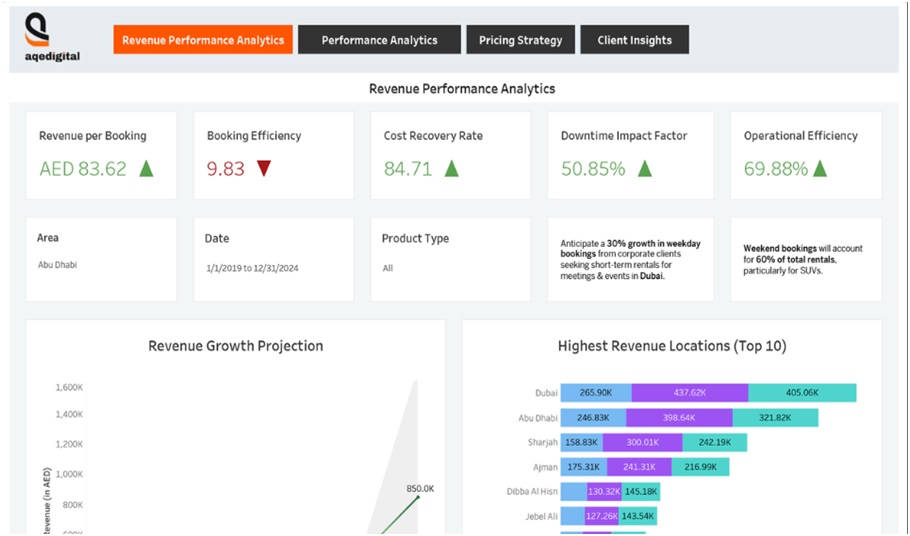 AQe Digital’s AI-powered dashboards unify real-time maintenance, production, and asset health data into a single operational view.
Instead of fragmented alerts across tools, leaders and operators see:
- Asset health scores across plants, lines, or fleets
- Failure probability timelines mapped against production schedules
- Prescriptive recommendations tied to business impact
- Real-time OEE, MTBF, and downtime risk indicators
By aligning maintenance intelligence with operational KPIs, AQe Digital dashboards transform raw sensor data into decision-ready intelligence, enabling teams to act before disruption occurs.
These dashboards are built to support UNS architectures, ensuring seamless integration across IT and OT systems while maintaining a single source of truth.
Key Ways AI Maintenance Improves Enterprise Agility
——————————
AI maintenance isn’t just about fixing machines. It is about speed, resilience, and removing barriers. Here are the specific ways it transforms operations.
1. Reduced unplanned downtime
Unexpected failures cause operational paralysis. AI-driven predictive maintenance practically eliminates this. By using analytics and sensors, you move away from a reactive approach. Instead of catastrophic breakdowns, teams get alerts weeks in advance. This allows for better control over
- Scheduling repairs during planned windows
- Reducing overall maintenance costs
- Extending asset lifespans
2. Faster response to operational risks
Agility relies on speed. Edge AI detects anomalies in milliseconds. This cuts response latency without needing human intervention. But it’s not just about the factory floor. It extends to the entire supply chain, enabling.
- Self-healing supply chains
- Preemptive cybersecurity defense
- Real-time anomaly detection
3. Better capacity and resource planning
Maintenance data becomes a strategic asset. Digital twins allow organizations to test before they buy. This creates a “Simulate-then-Procure” approach. Plus, it optimizes inventory management. Predictive models forecast exactly when parts are needed.
This includes,
- Reducing parts waste significantly
- Minimizing inventory carrying costs
- Aligning schedules with production demands
4. Improved coordination across teams
Data silos hamper agility. Architectures like the Unified Namespace (UNS) bridge the gap. This connects Information Technology (IT) and Operational Technology (OT).
It creates a single source of truth for everyone. From procurement to maintenance, everyone sees the same insights. Because shared data enables collaboration,
- Standardized insights for diverse teams,
- Multi-agent system automation
- Capturing critical tribal knowledge
5. More predictable operations under pressure
High-stakes environments need consistency. Prescriptive maintenance (RxM) goes beyond simple prediction. It runs “what-if” scenarios to recommend specific actions. This helps operations pivot from efficiency to resilience. It ensures continuity even during market volatility.
Use Cases Where Predictive Maintenance Is Gaining Momentum
——————————
Let’s look at the specific industries. Predictive maintenance is not just a theory. It is changing how businesses operate right now, delivering real ROI across the board.
Here is where the impact is happening.
Manufacturing and industrial equipment
Factory floors are transforming. Predictive maintenance (PdM) has become the driver of Industry 4.0, turning standard factories into “smart” environments. But it’s not just about simple prediction. Companies are moving fast to plug these leaks. By integrating AI and IoT, often through a Unified Namespace (UNS), manufacturers streamline data flows to catch issues early.
This includes
- Siemens is detecting pump service life issues,
- Nestlé is enhancing production efficiency
- GE monitoring rotating systems
Energy and utilities infrastructure
The energy sector is rapidly adopting this to manage critical infrastructure. Wind turbine operators, for instance, use IoT monitoring to save roughly $200,000 per turbine annually. They do this by predicting failures before catastrophic damage occurs.
Beyond wind, the grid is getting smarter. From drones monitoring solar farms to AI detecting faults in transmission networks, the goal is safety and sustained power delivery.
This includes
- SenseHawk uses drones for asset health
- Eletrobras detecting grid faults with AI
- Substations evaluating systemic impact
Transportation and fleet operations
Fleet management is being reshaped. The industry is shifting from fixed-interval service to condition-based care. For heavy equipment fleets, the numbers are substantial: transitioning to predictive models reduces annual maintenance costs by 34% and cuts unplanned breakdowns by 62%.
Aviation is seeing similar gains. Airlines are partnering with tech giants to use generative AI, cutting analysis time from hours to minutes.
This includes,
- Air France-KLM is analyzing aircraft data
- Qatar Airways is optimizing flight schedules
- Automotive sensors detecting assembly defects
Facilities and smart buildings
Facilities management is evolving from reactive repairs to intelligent asset stewardship. Digital twins are increasingly used to monitor everything from HVAC systems to elevators, allowing operators to track performance across entire portfolios.
ThyssenKrupp is a prime example. By connecting their elevators to the IoT, they improved service reliability by 50%.
This includes,
- Reducing maintenance costs via digital twins
- Managing distributed smart city infrastructure
- Prioritizing repairs to minimize disruption
IT infrastructure and data centers
Data centers face immense pressure. When 100% uptime is the requirement, predictive maintenance becomes essential. Neural networks are doing the heavy lifting here, achieving a 30% reduction in false alarms regarding equipment anomalies.
“Self-healing” systems are also emerging. If a server node fails, automated systems redistribute the workload while robotic arms physically replace the part.
This includes Robotic arms replacing defective modules
- Automated systems redistributing workloads
- Hybrid cooling cuts power usage
Challenges Enterprises Must Overcome to Go Predictive
——————————
Moving to predictive maintenance isn’t a plug-and-play process. It requires overcoming specific technical and cultural barriers.
Here are the main challenges standing in the way.
Data quality and fragmentation
This is the most significant technical barrier. We often call it “data spaghetti.” Traditional manufacturing relies on point-to-point integrations where systems like ERP and SCADA remain disconnected, trapping valuable insights in silos.
Poor data management hurts productivity. It can reduce it by 20% to 30% because decision-makers lack the full operational context. Plus, inconsistent formats make it hard to create the “single source of truth” needed for AI.
This includes,
- Integrating complex legacy systems
- Standardizing untimely data
- Cleaning up fragmented architectures
Trust in AI recommendations
There is a critical “trust gap.” Operators are often skeptical of “black box” algorithms that appear to diminish the value of their experience. This skepticism is fueled by past technologies that overpromised and underdelivered.
To fix this, organizations are hiring “Trust Engineers.” They ensure systems are explainable and ethical to foster confidence. Because without transparency, operators may ignore valid warnings, negating the system’s benefits.
Skills and change management
The workforce is shifting fast. By 2030, 40% of manufacturing workers will retire, taking decades of “tribal knowledge” with them. There is a pressing need for a bridge between IT and OT (Operational Technology).
But the industry faces a shortage. We lack personnel who can interpret data analytics and manage complex AI systems. Success depends heavily on upskilling existing teams to align them with new, data-driven workflows.
Integration with legacy systems
Many facilities are “brownfield.” They are filled with older machinery that was never designed for digital connectivity. Integrating these assets poses significant compatibility challenges and often requires expensive middleware.
The complexity is high. Connecting disparate protocols like Modbus or BACnet can stall projects.
This includes inflating project costs
- Dealing with incompatible communication protocols
- Retrofitting solutions for older hardware
Moving from pilots to scale
Starting is easy, but scaling is hard. We call this “pilot purgatory.” Currently, only 32% of maintenance teams have fully implemented AI solutions despite widespread ambition.
Moving from a controlled pilot to fleet-wide deployment requires robust governance. You need infrastructure that can handle massive data volumes without performance degradation. Without a roadmap, early wins fail to translate into agility.
How Enterprises Can Start the Shift from Reactive to Predictive?
——————————
Let’s understand the roadmap. You don’t need to change everything at once. It starts with a strategic approach.
Here is how to begin the transition.
1. Identifying critical assets and failure points
Don’t try to boil the ocean. Enterprises should not attempt to monitor every asset immediately. Instead, they must prioritize based on a “criticality assessment” that ranks equipment by safety risks and downtime costs.
Focus on the bottlenecks. For mission-critical assets where a single hour of downtime costs more, investing in high-fidelity sensors yields a massive ROI. This includes identifying true production bottlenecks, investing in high-fidelity prescriptive sensors, and applying basic measures to non-critical tool.s
2. Understanding current maintenance maturity
Be honest about where you are. Before adopting advanced AI, organizations must assess their current maintenance maturity. This involves establishing a clear baseline of activities, such as tracking Mean Time Between Failures (MTBF).
You need to know your status. Are you in a “Perceived Plan” or ready for a “Predictive Plan”? Understanding this prevents the common mistake of deploying complex AI tools on unstable foundational processes.
3. Starting small with focused predictive use cases
Success typically follows a phased approach. A 90-day implementation cycle is a standard model. The first 15 days are dedicated to planning, followed by selecting a pilot group of 3–5 high-value assets.
During this pilot, teams install sensors. They monitor key indicators like vibration and temperature. This targeted approach allows teams to validate the technology and refine alert thresholds before the wider rollout.
4. Building organizational awareness and alignment
You must connect the dots for leadership. To shift from firefighting to strategy, maintenance leaders must connect technical metrics to business outcomes. This involves translating “avoided downtime” into revenue saved.
Win the culture war. Build alignment by demonstrating “quick wins” from pilot programs. Show frontline staff that predictive tools reduce stress and improve safety, rather than just adding complexity.
Wrapping Up
Maintenance is no longer just a support function. It is a strategic core. The goal is to move from simple efficiency to true resilience. By adopting AI, you stop relying on “Just-in-Time” fixes. You build a system designed for “Just-in-Case.”
Reactive approaches destroy agility. You cannot move fast if you are constantly “firefighting.” It drains resources and limits confidence. AI offers a better way. It replaces panic with foresight. Instead of reacting to breakdowns, you neutralize them before they happen.
The choice is simple. The future belongs to those who anticipate. Companies that predict problems will consistently outperform those that react to them. In the end, reliability is not just a safety net. It is your ultimate competitive advantage.