How Digital Marketing Agencies Are Evolving for AI-Powered Search

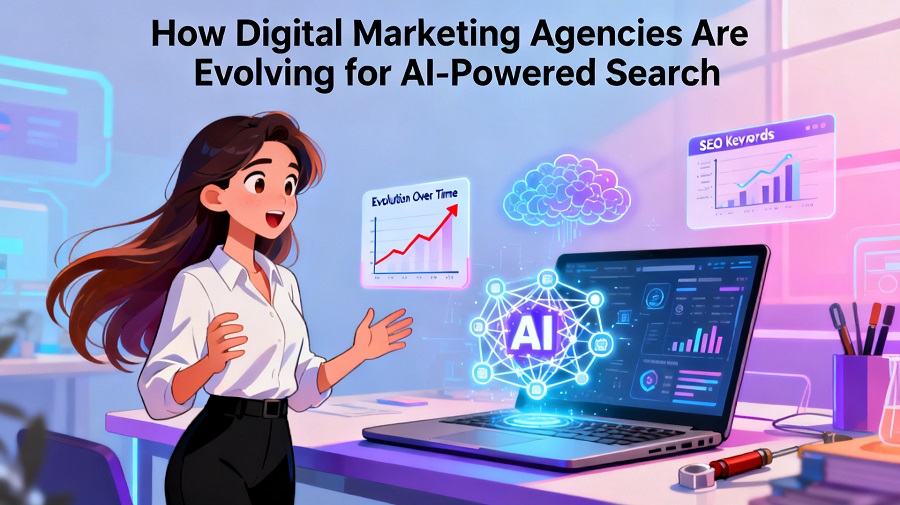
The ground beneath the advertising world isn’t just shifting; it’s being completely rebuilt. The days of simply lining up keywords to grab a top ranking are over. Now, platforms are turning into tools that provide direct answers, looking deep into the context, human emotion, and the underlying “why” behind every search.
For digital marketing agencies, this is the toughest challenge; and the biggest break; since mobile phones changed everything. Survival in this new era means walking away from repetitive tactics and boring, recycled content to focus on building real trust. Recent data suggests that 80% of all searches end without a single click, as AI summaries provide immediate answers
This transition toward AI-Powered Search means that the old “hacks” are dead. You can’t just pepper a page with a specific phrase and expect to rank. The new algorithms look for “information gain”; the idea that your content actually adds something new to the internet rather than just summarizing what’s already there.
Agencies that fail to see this change are essentially shouting into a void. To stay relevant, firms are restructuring their entire creative process to ensure they aren’t just producing noise, but are building a digital footprint that machines can verify, and humans can trust.
Moving from Keywords to Contextual Authority
——————————
For a long time, SEO was a numbers game. How many times did the word appear? How many links pointed back to the site? But as search becomes more intuitive, AI Digital Marketing Agency teams are realizing that “topics” matter more than “terms.” The focus has shifted toward building a comprehensive library of knowledge that proves a brand is a leader in its field.
If a search engine views your site as a definitive source of truth, you win. If you’re just chasing high-volume words, you’ll likely get buried by more helpful, AI-generated summaries.
Why User Intent is the New North Star
Understanding why someone is typing a question into a bar is now more important than the question itself. When a user asks a search engine “how to fix a leaky pipe,” they don’t want a history of plumbing; they want a step-by-step guide with clear visuals.
To optimize content for AI search, agencies are spending more time interviewing real experts and looking at forum discussions to see what actual humans are frustrated by.
By answering the specific, gritty details of a problem, a brand proves to the AI that it understands the user’s real-world needs, which is the ultimate ranking factor in a modern search environment.
Building a Web of Connected Information
Search engines no longer see words in isolation; search engines have stopped looking at words as lonely fragments; instead, they recognize them as entities. They now grasp how a particular brand ties back to a specific industry, a physical location, and a core set of values.
Smart shops are using tech like schema markup to give the algorithm a clear path, showing exactly how different facts link up. It is essentially handing a map to the system so it can piece the story together.
By pinning down exactly what a client does and what they value, firms make sure their clients show up in those prominent knowledge panels and AI-generated snapshots that now sit at the very top of the results page.
Human-Centric Content in an Automated World
——————————
There is a massive irony in the current market: as search becomes more automated, the value of “human” content is skyrocketing. Because AI can churn out generic text in seconds, the internet is being flooded with average content.
To truly optimize content for AI search, agencies are leaning into the “human” elements that machines can’t easily replicate: personal anecdotes, original photography, and controversial, expert-led opinions. This “human-first” approach is becoming the primary way to stand out in a sea of synthesized information.
The Power of Real-World Experience (E-E-A-T)
Google and other platforms have doubled down on a concept called E-E-A-T, which stands for Experience, Expertise, Authoritativeness, and Trustworthiness.
For any AI Digital Marketing Agency, this means the bar for quality has been raised significantly. It’s no longer enough to have a ghostwriter pen an article. You need a verified professional to put their name on it. Agencies are now:
- Interviewing actual specialists to get unique quotes and data that haven’t been published elsewhere.
- Creating original case studies that provide “proof of work” and show real-world results.
- Fixing a company’s online image is now a top priority so that when a system scans a brand, it finds a solid track record of reviews and mentions from sources it actually trusts.
Doubling down on these pillars is the best strategy to optimize content for AI search because it creates a protective barrier around a business that a basic crawler or bot simply can’t get past.
Data: The Fuel for Modern Strategy
——————————
In the past, marketing was often based on “gut feeling” or basic traffic numbers. Now, the sheer volume of data available allows for a much more scientific approach.
The most successful digital marketing agencies are those that treat their data like a gold mine, using it to spot patterns before the competition does.
By looking at how users interact with AI summaries versus traditional links, agencies can pivot their strategies in real time. This level of agility is what separates the legacy firms from the new guard.
Predicting the Next Trend
We are moving into an era of “predictive” marketing. Instead of waiting for a trend to happen, an AI Digital Marketing Agency can use historical data to see what users will likely be searching for in three months.
If you can create the definitive guide for a topic before it even peaks, you secure a “first-mover advantage” that is very hard for competitors to take away. This proactive stance is essential because, in an AI-Driven Services for the UAE, the window of opportunity is much smaller and moves much faster than it used to.
Tools That Enhance Human Creativity
While there is a fear that technology will replace marketers, the reality is that the best tools are being used to remove the “grunt work.” Marketing firms are leaning on software to take care of technical audits, track down broken links, and sort through giant data sets in a heartbeat.
This clears the way for the creative staff to focus on the things only people can do: sharing stories and making a real impact on the audience. By letting tech help optimize content for AI search, the team can stop wasting hours on formatting and instead put their energy into a big picture strategy that actually grows the business.
The Structural Shift of the Modern Agency
——————————
The internal makeup of a marketing firm is changing. The days of hiring an isolated social media manager who ignores SEO, or an SEO person who is clueless about data science, are over.
Those old boundaries are disappearing as shops move toward a setup where every department actually talks to the others. Everyone on the clock has to recognize how their individual output impacts the larger digital ecosystem.
This high-level perspective is non-negotiable now that search platforms are judging a company’s entire web footprint as one single story.
The New Hybrid Marketer
Modern firms are prioritizing the “T-shaped” marketeers: professionals who grasp the big picture across all platforms while maintaining mastery in a specific craft.
In a high-end agency, you’ll see content creators who can actually interpret raw data and analysts who truly get the subtle personality of a brand. Mixing these talents is the only way to build a plan where every piece of the puzzle actually fits together.
When every department is aligned, the content produced is naturally more authoritative, making it much easier to optimize content for AI search across the board.
Transparency and the Death of “Black Box” SEO
For years, some agencies hid behind technical jargon to justify their fees. AI is ending that. Since search results are getting straight to the point, it’s easier for clients to see what’s actually happening, which means firms can’t hide behind confusing talk anymore.
They have to prove exactly how their work improves the bottom line. This move toward being held responsible is great for business owners because it forces digital marketing agencies to prioritize metrics that matter, like real leads and actual revenue. It’s no longer enough to brag about vanity metrics like high traffic numbers if those visitors aren’t actually buying anything.
Looking Toward a Conversational Future
——————————
The way we search is becoming a conversation. With the rise of voice assistants and chat interfaces, the “search result” is often a single spoken sentence.
We are moving toward a reality where companies aren’t fighting for a spot on the first page, but for the single answer provided at the top.
To survive this “all-or-nothing” landscape, a forward-thinking marketing firm has to focus on making a client’s data the most reliable and straightforward option available.
Preparing for Zero-Click Searches
A “zero-click” search is when a user gets the answer they need directly on the search page without ever clicking on a website. While this sounds scary for traffic, it’s a reality of AI-Powered Search.
Agencies are learning to embrace this by making sure their brand is credited as the source of that answer. Earning the “top spot” or a featured answer builds long-term reputation, even if people don’t click on your link right away.
The goal is to be the go-to authority that the system relies on, which requires a serious commitment to doing great work.
This change in how folks search isn’t the end of the road for marketers; it’s a push to do better. By moving away from cheap, robotic filler and focusing on real stories from actual experts, shops can beat the competition.
The winners will be the ones who understand that while the gadgets are new, the job is the same: providing people with the most helpful and honest answers possible.