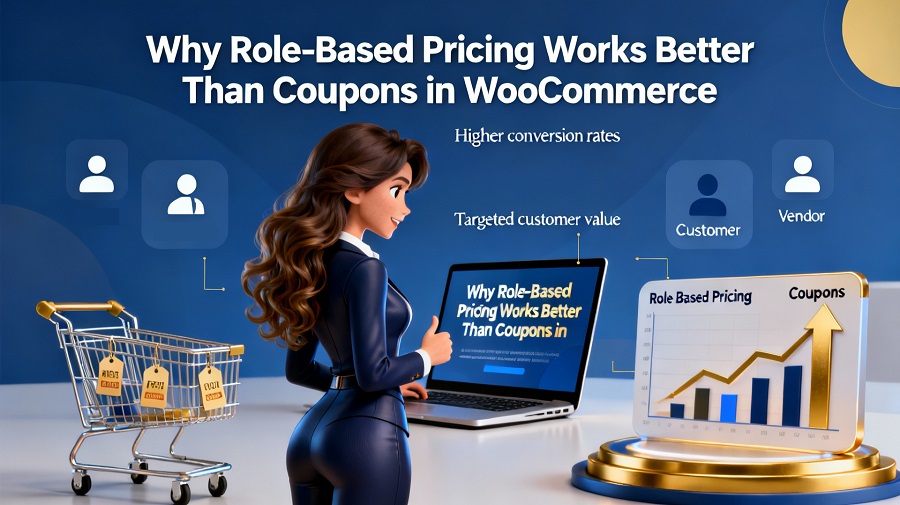
Why Role-Based Pricing Works Better Than Coupons in WooCommerce

Are coupons really the best way to offer discounts in your WooCommerce store, or is there a smarter, more scalable pricing strategy you could be using instead?
That question usually appears late at night. After a long day of orders. After answering the same customer email again. “Why didn’t my coupon work?”
Coupons feel safe. Familiar. Almost comforting. WooCommerce includes them by default, after all. But once a store starts growing more products, more customers, more expectations, those same coupons quietly turn into friction. Small at first. Then loud. Then expensive.
This is where role-based pricing quietly steps in. No flashing banners. No codes to remember. Just the right price, shown to the right customer, every time. Clean. Almost invisible. And that’s the point.
Understanding Coupons in WooCommerce
————————-
Coupons are rules. Conditions stacked on conditions. “If this, then that.” They were designed for promotions. Short bursts of excitement. A nudge. A reminder. Enter the code. Feel the win.
WooCommerce coupons usually work like this: Customer finds a code. The customer enters it at checkout. The system checks rules. Then apply a discount. Simple on paper. Messy in reality.
Hidden Problems with Coupons
————————-
1. Coupons Add Friction to the Buying Process
Every coupon introduces hesitation. Even loyal customers pause.
“Do I have a code?”
“Did I miss a discount?”
Now they leave the cart. They search emails. They open another tab. Sometimes they don’t come back. Tiny interruptions matter—a lot. Role-based pricing removes that moment entirely. No thinking. No guessing. The price is just there.
2. Coupon Abuse Is Hard to Control
Coupons escape. They always do. One customer shares it. Other posts it. Then a coupon site index it forever. Suddenly, a “private” discount becomes public knowledge. You can add restrictions. Limits. Expiry dates. But there’s always leakage. Role-based pricing doesn’t leak. It can’t. There’s nothing to share.
3. Coupons Don’t Scale Well
Five coupons feel manageable. Fifteen starts to feel annoying. Fifty becomes chaos. Rules overlap. Discounts stack when they shouldn’t. Someone forgot to turn off a code. Revenue quietly bleeds. Role-based pricing scales calmly. Add a role. Set prices. Done. No expiration panics. No cleanup later.
What is Role-Based Pricing in WooCommerce?
————————-
Role-based pricing ties price to identity. Who the customer is matters more than what code they typed. A wholesale buyer logs in. They see wholesale prices. A member logs in. Member pricing appears. A guest arrives. Retail pricing only.
This approach, often called WooCommerce custom pricing by user role, changes how customers experience your store. Pricing becomes a feature, not a promotion.
Why Role-Based Pricing Delivers a Better Customer Experience
————————-
1. Transparency Builds Trust
Customers don’t like surprises, especially at checkout. Seeing the final price upfront feels honest. Calm. Professional. There’s no “gotcha” moment. No wondering if they paid too much. Trust grows quietly. And trust converts.
2. Personalisation Without Complexity
Personalization usually sounds complicated. Data. Segments. Automation. But role-based pricing is simple personalization. Almost old-school. You belong to a group. This is your price. It feels intentional. Not gimmicky.
3. Faster Checkout = Higher Conversion Rates
Checkout speed isn’t just about loading time. It’s about decisions. Removing coupon fields removes decisions. One less thing to think about. One less reason to stop. Small win. Big impact.
Role-Based Pricing vs Coupons for Wholesale Stores
————————-
Wholesale buyers hate coupons. They rarely say it. But it shows. They often. In volume. Repeatedly entering codes feels amateur. Like the store wasn’t designed for them.
Wholesale pricing should feel permanent. Expected. Professional. This is why most serious B2B stores rely on WooCommerce user role pricing instead of coupons. It respects the relationship. Not just the transaction.
Better Price Control for Store Owners
1. Centralized Pricing Logic
Coupons scatter logic everywhere. One rule here. Another there. Role-based pricing brings it home. Product-level. Variation-level. Role-level. You know exactly why a price exists.
2. Reduced Risk of Human Error
Most pricing mistakes aren’t strategic. They’re accidental. Wrong checkbox. Forgotten expiry. Stackable discounts nobody noticed. When price equals role, mistakes drop sharply. Fewer switches. Fewer moving parts.
3. Easier Bulk Management
Need to adjust wholesale prices store-wide? With coupons, good luck. With role-based pricing, bulk tools do the heavy lifting. Percentages. Imports. Exports. Done before coffee cools.
Improved Brand Perception
Coupons train customers. Sometimes badly. They wait. They expect discounts. They doubt the full prices. Role-based pricing reframes discounts as privileges. You earn better pricing. You belong to something. That feels premium even if the numbers are similar.
Role-Based Pricing Encourages Account Creation
“Log in to see your price.” That sentence works. Not aggressively. Just enough. Customers register. They log in. They return. Suddenly, your store isn’t anonymous anymore. Coupons don’t build relationships. Roles do.
Cleaner Analytics and Reporting
Coupons muddy data. Was revenue lower because of a campaign? Or pricing strategy? Or stacking errors? Role-based pricing produces cleaner numbers. Each role reflects intentional margins. Analysis becomes clearer. Decisions improve. Quiet benefit. Huge value.
When Coupons Still Make Sense
Coupons aren’t evil. They’re just overused. They shine in short moments. Flash sales. Influencer drops—one-time incentives. The mistake is using them as a permanent pricing structure. That’s not what they were built for.
Technical Advantages of Role-Based Pricing
From a system perspective, role-based pricing behaves better. Prices are calculated early. Fewer conflicts. Less checkout drama. Variable products behave predictably. Coupons act late. And late logic tends to break things.
Role-Based Pricing and Long-Term Growth
Growth adds layers. B2B clients. Members. Loyalty tiers. Special contracts. Coupons buckle under that weight. Role-based pricing welcomes it. Pricing evolves alongside the business, not against it.
Coupons shout—role-based pricing whispers. Coupons demand attention. Role-based pricing works. As stores mature, the difference becomes obvious. Less maintenance. Fewer complaints. Better margins. Not flashy. Just effective.
Conclusion
So why does role-based pricing work better than coupons in WooCommerce? Because it respects the customer. Because it respects your time. Because it scales without noise. Coupons ask customers to remember. To search. To try again.
Role-based pricing rewards them quietly, automatically, every single visit. And in eCommerce, quiet efficiency often wins.