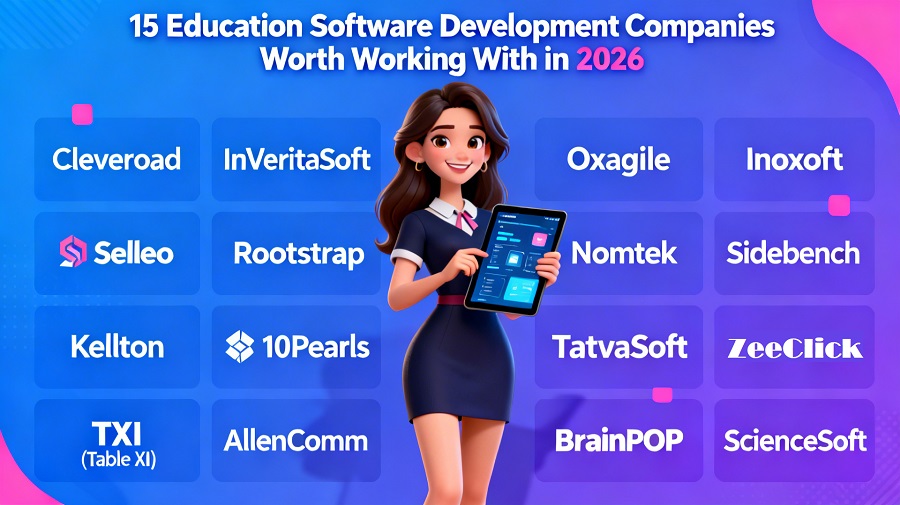
15 Education Software Development Companies Worth Working With in 2026

The educational software development market will already have immense implications for how educational institutions will be able to grow, compete, and maintain a student base. The planning, organizing, delivering, measuring, and reporting of education will be managed on digital platforms that control/enforce aspects of enrollment, curriculum delivery, grading, certification, reporting, measuring analytics, payment and compliance. Schools, universities, and corporate academies will be expecting, among several things, adaptive learning pathways, automated administrative workflow, secure cloud infrastructure, as well as integration with talent management, customer relationship management, enterprise resource planning and identity management systems.
The following represents an expanded overview of 15 education software development companies providing EdTech solutions in 2026 with key company information included for comparison purposes.
1. Cleveroad
—————-
Founded: 2011
Headquarters: Estonia
Offices: USA, Estonia
Team size: 250–999
Engagement model: Dedicated teams, full-cycle development
Core focus: Custom LMS, AI-powered learning platforms, mobile education apps
Best for: Institutions building scalable digital learning ecosystems
Cleveroad is a full-cycle educational app development company delivering tailored solutions for education startups, universities, and corporate academies. The company focuses on custom-built platforms instead of adapting rigid LMS templates.
The included Learning Management Systems, Adaptive Learning Engines, Student Analytics Dashboards, Online Assessment Tools, Administrative Automation Modules, and Mobile Learning Applications represent Cleveroad’s portfolio. Numerous institutions leverage Cleveroad solutions to replace outdated and disparate tools by creating a unified digital campus that provides centralized reporting, automated workflows, and enhanced visibility into data.
Through initial discovery workshops and technical audits, Cleveroad creates architecture decisions with its clients early on in the development process. They utilize an Agile iterative model with UX research, QA testing, DevOps, and ongoing improvements post-launch. This structured approach mitigates risks and supports long-term scalability.
2. InVeritaSoft
—————-
Founded: 2010
Headquarters: USA
Delivery locations: USA, Argentina
Team size: 50–249
Engagement model: Dedicated teams, project-based
Core focus: Custom LMS, education portals, system modernization
Best for: Institutions prioritizing stability and long-term maintenance
InVeritaSoft offers structured Learning Management Systems (LMS) that are designed for maintainability and predictability of release cycles. The system typically has role-based access, dashboards for reporting, and third-party integration options.
They have also built long-term relationships with universities and private educational providers who want the ability to limit the scope of their services and receive incremental upgrades over time.
3. Oxagile
—————-
Founded: 2005
Headquarters: USA
Offices: USA, Europe
Team size: 250–999
Engagement model: Full-cycle development
Core focus: Video streaming platforms, OTT learning systems
Best for: Video-first and hybrid learning environments
Oxagile focuses on multimedia and real-time streaming infrastructure.The company has developed education platforms, including streaming live classes, offering access to prerecorded instruction, offering tools for hosting webinars, etc.
They are a partner to many institutions that require high-quality lectures by live streaming and streaming infrastructure that can scale.
4. Inoxoft
—————-
Founded: 2014
Headquarters: Ukraine
Team size: 50–249
Engagement model: Agile project delivery
Core focus: LMS development, analytics systems, education portals
Best for: Startups digitizing academic workflows
Inoxoft creates LMS (Learning Management Systems) which feature course management, reporting, and integration capabilities into other systems. The company also assists educational institutions in moving from paper-based to online learning environments.
5. Selleo
—————-
Founded: 2005
Headquarters: Poland
Team size: 50–249
Engagement model: SaaS product development
Core focus: Multi-tenant SaaS learning platforms
Best for: Subscription-based EdTech businesses
Selleo builds scalable SaaS education solutions that can be expanded with new features over time. They use a modular approach to structure products, which allows products to evolve over time and be deployed on multiple server locations.
6. Rootstrap
—————-
Founded: 2011
Headquarters: USA, Uruguay
Team size: 50–249
Engagement model: Product discovery and engineering
Core focus: UX-driven education platforms, MVP validation
Best for: Early-stage and growth-phase EdTech startups
The design and engineering team at Rootstrap is responsible for developing product strategy and executing product engineering efficiently. They support customers through feature validation, UX design, and market validation before they build scalable solutions on top of their platforms.
7. Nomtek
—————-
Founded: 2009
Headquarters: Poland
Team size: 50–249
Engagement model: Mobile and immersive development
Core focus: AR/VR learning tools, mobile education apps
Best for: Simulation-based and experiential training
The team at Nomtek specializes in creating immersive learning experiences through mobile apps and augmented/virtual reality solutions for skill-building environments.
8. Sidebench
—————-
Founded: 2010
Headquarters: USA
Team size: 50–249
Engagement model: Design-led development
Core focus: UX-centered learning systems
Best for: Institutions improving learner engagement
Sidebench designs their user interfaces and onboarding processes to be easy to use and intuitive. Their design-first approach results in improved user adoption and retention rates.
9. Kellton
—————-
Founded: 2009
Headquarters: USA, India
Team size: 1,000+
Engagement model: Enterprise delivery
Core focus: Large-scale education platforms, ERP integration
Best for: Institutions modernizing complex IT environments
Kellton specializes in integration based services that include LMS, ERP, HR and Identity Management systems.
10. 10Pearls
—————-
Founded: 2004
Headquarters: USA
Team size: 1,000+
Engagement model: Secure enterprise development
Core focus: Analytics-driven and compliance-ready platforms
Best for: Regulated education environments
10 Pearls provides scalable learning platforms with secure systems and quality assurance.
11. TatvaSoft
—————-
Founded: 1997
Headquarters: USA, India
Team size: 1,000+
Engagement model: Structured project delivery
Core focus: LMS implementation and portal development
Best for: Budget-conscious institutions
Tatvasoft provides predictable development cycles and long-term support for LMS systems.
12. TXI (Table XI)
—————-
Founded: 1999
Headquarters: USA
Team size: 50–249
Engagement model: Consulting + development
Core focus: Strategy-driven digital education initiatives
Best for: Multi-stakeholder digital transformation
TXI integrates technical implementations with institutional strategies and roadmaps.
13. AllenComm
—————-
Founded: 1981
Headquarters: USA
Team size: 250–999
Engagement model: Instructional design + development
Core focus: Corporate training systems
Best for: Workforce education and compliance training
AllenComm integrates instructional design expertise with platform engineering for enterprise learning programs.
14. BrainPOP
—————-
Founded: 1999
Headquarters: USA
Team size: 250–999
Engagement model: Digital curriculum platforms
Core focus: K–12 interactive education tools
Best for: Curriculum-aligned primary and secondary education
BrainPOP delivers multimedia learning resources aligned with standardized curricula.
15. ScienceSoft
—————-
Founded: 1989
Headquarters: USA
Team size: 500–999
Engagement model: IT consulting and custom development
Core focus: LMS platforms, virtual classrooms, modernization
Best for: Institutions planning digital transformation
ScienceSoft supports academic organizations with consulting-led LMS modernization and enterprise system upgrades.
Final Perspective
The growth of education software development in 2026 will result in a major shift toward the need for a scalable architecture, integration of analytics, awareness of compliance, and long-term ownership of the platform. Institutions require technology partners who can operate at an understanding of academic workflows along with the complexities at an enterprise level.
The above-referenced companies have expertise in the development of custom LMSs, SaaS-based education platforms, immersive training tools, enterprise modernization, and AI-enhanced ecosystems. Partner selection that aligns with your roadmap will directly affect adoption, scalability and institutional growth.