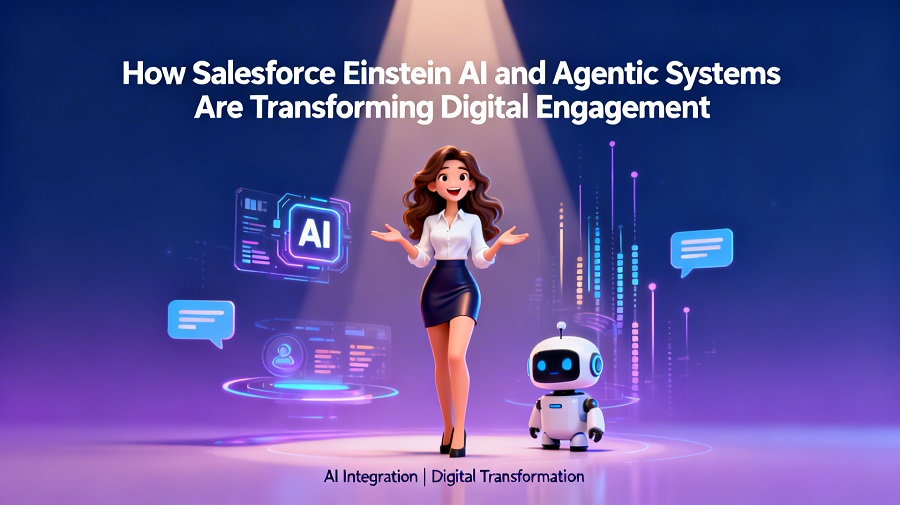
How Salesforce Einstein AI and Agentic Systems Are Transforming Digital Engagement

With personalized and real-time interaction becoming no longer an indulgence but a standard expectation in the age of the individualized consumer, how do businesses, using Salesforce Einstein AI and Agentic Systems, make the most of such power to ensure they beat the competition? The traditional CRM was a record system; nowadays it has been transformed into a system of intelligence.
Salesforce Einstein AI is the first full-fledged CRM AI, which has transcended the automation stage into the status of Agentic Systems. These systems are a paradigm shift of what has been called assistive AI, in which the system waits until a human command is given, to autonomous agents that are able to sense, reason, and act in a layer of trust.
With businesses maneuvering the digital transformation challenges, the combination of predictive nature and the agentic freedom is transforming how customers are dealt with, the future of all digital touchpoints is proactive, highly personalized and intensely efficient.
Conceptualization of Salesforce Einstein AI and Agentic Systems
——————————
To understand the present change, the difference between the original AI and the new agentic layer needs to be identified.
Salesforce Einstein AI:
- This is the composite of AI technologies that incorporates machine learning and natural language processing (NLP) as well as predictive analytics into the Salesforce platform.
- Einstein is a clever platform that runs through Sales, Service, and Marketing Clouds and evaluates billions of data points to reveal recommendations and automate workflows.
Agentic Systems:
- Whereas normal AI is based on an if-this-then-that reasoning, Agentic Systems (commonly known as Agentforce at Salesforce) are meant to make decisions on their own.
- These agents are based on the unique data and metadata of your company. They do not simply propose a response when combined with Einstein AI; they function to carry out the steps needed, like re-scheduling a meeting or processing a refund, without having to be monitored by a human all the time.
The Use of AI in Engaging the Digital Space
——————————
These three pillars describe digital engagement in 2026: Hyper-personalization, Predictive Insights, and Seamless Automation.
Individual Customer Experiences:
- Salesforce Einstein AI provides a business with the opportunity to stop engaging in marketing on a persona-level and start engaging with individuals instead.
- Through real-time behavior, Einstein can know when a customer is going to make a purchase as well as tailor the web interface or email message to a particular intention a customer intends to make.
Real-Time Insights and Predictive Analytics:
- Reactive reporting has been passed. Einstein gives predictions that can be acted on, i.e., Likelihood to Churn or Best Time to Contact.
- This gives the businesses the strength to know what is being anticipated even before the customer raises their voice.
Fluid Automation through Agentic Logic:
- Data entry is done by Einstein. Nonetheless, Agentic Systems go to a higher notch to use wiser decision-making.
- Indicatively, in case a delay in a supply chain is experienced, an agentic system will be in a position to alert the customers who are affected and provide options depending on the levels of current inventory- all in real-time.
Transforming Customer Support with AI and Agentic Systems
——————————
The most obvious beneficiary of this technological development is customer support.
Smarter Chatbots and Virtual Assistants:
- The conventional chatbots have been frustrating for users by having inflexible menus.
- The current virtual assistants are based on Large Language Models (LLM) and operate using the Einstein AI to process nuance and sentiment.
- They offer 24/7 services which are human friendly, and this boosts the First Contact Resolution (FCR) rates to a greater extent.
Automated Case Management:
- Under the umbrella of Agentic Systems, case management is going to be self-resolving. By extracting data across different systems, agents can automatically classify, prioritize, and even solve rather complex cases.
Example: Where a customer requests the agent to update about the installation status of a complex installation, the agent can consult the field service schedule, find out the availability of parts, and give a detailed update without a human agent ever accessing the ticket.
The Implication of Sales and Marketing
——————————
The Einstein and Agentic Systems synergy make sales and marketing to be more of a precision science rather than a game of guesses.
Predictive Sales and Lead Scoring:
- Einstein Lead Scoring is based on machine learning to rank high-potential lead scores based on historical conversion trends.
- This will enable the sales forces to devote their efforts to the best prospects based on the “Propensity to Buy”, which will lead to a drastic win rate.
Optimized Marketing Campaigns:
- Einstein now provides Marketers with the ability to maximize both the Send Time and the Frequency of Engagement.
- Even agentic systems can go further and dynamically redistribute campaign funds by channel, to make sure that the channel that is doing the best in the past hour gets as many funds as it can get, as it means maximizing the ROI on every dollar it spends.
Benefits for Businesses and Customers
——————————
The benefits of the implementation of such systems are two sides, as they will benefit both the enterprise and the end-user.
For Businesses:
- Operational Efficiency: With an automated system that does low value jobs, human beings are free to concentrate on strategic projects.
- Scalability: Agentic systems allow businessmen to handle 10 times more customer inquiries with no 10 times increase in the number of staff.
- Data-Driven Decisions: The data underlies all the decisions made by Einstein; this reduces the chance of human error or biasness.
For Customers:
- Immediate Gratification: 24/7 availability implies that there is no longer a need to wait until the business hours receive an answer.
- Consistency: The customers will experience high-quality and personalized services on both WhatsApp, email, or a web portal.
Significant Implications and lessons learned
——————————
To exploit these tools adequately, the businesses ought to adhere to a strategic implementation framework:
- Information Hygiene is Supreme: AI can only be as good as the input it receives. Make sure that your Salesforce environment is clean, and that your Data Cloud is harmonized.
- Start with “Small Wins”: Start with high-volume, low-complexity tasks, such as password resets or order tracking, and then proceed to complex agentic decision-making.
- Human-in-the-Loop: Although Agentic Systems are self-directed, they ought to always include a human-in-the-loop when making high-stakes decisions. Exploit Einstein to give the “next best action” that a human must approve.
- Aligning Sales and Marketing: Have a single data model such that the insights that Einstein gets in marketing (e.g. what content a lead clicked on) are immediately apparent and actionable to the sales agent when they make contact.
Challenges and considerations
——————————
Although these advantages exist, there are some challenges on the way to the AI maturity:
Privacy and security of data:
- Salesforce Einstein Trust Layer is needed in this case. The company should make sure that any sensitive customer information is concealed when sent to an LLM, and none of the information is utilized in the training of the open-source models of the third-party AI providers.
Complexity of Integration:
- The transition of a legacy system to an AI-based Salesforce environment would need a technical map. Companies have the problem of siloed data that Einstein does not have access to.
Barriers to adoption:
- Special training requirements and the price of the license can be extremely high. In addition, the issue of the internal resistance to AI taking down jobs is to be resolved by explaining the concept of AI as an augmentation tool, but not as a human talent replacement.
Conclusion: Digital Engagement Future
Salesforce Einstein AI and Agentic Systems are not a thing of the future anymore; they can now be considered the driving force of digital engagement. These technologies enable brands to develop stronger relationships with customers, at a scale that would have been considered impossible to achieve without these technologies, by delivering personalized, real-time, and automated experiences to customers.
The shift of the business model trend of reactivity into the one of proactivity, independent working is a process. To manage this, most organizations have realized that the best way forward in this case is to engage in the services of a specialized Salesforce Service Partner. The correct specialist advice can assist you to overcome the obstacles in integration, gain protection of your data layers, and make sure that the AI strategy is fully aligned with your business objectives.
With businesses having their eyes on the future, there is only one question to ask: do you want to be powered by the power of Agentic Systems today or will you be phased out like all other businesses who are not necessarily dealing with speed and personalization, which are now the only true competitive advantages? It is high time to review your digital engagement strategy and drive your digital transformation.
Frequently Asked Questions
——————————
1. What is the difference between Salesforce Einstein and Agentic Systems?
- Salesforce Einstein can be used to get intelligence (predictive insights, NLP, machine learning), and Agentic Systems can be used to get the freedom to act on these insights without human interaction.
2. What are the benefits of Einstein AI in improving the scoring of leads?
- It employs machine learning to analyze the historical data and match patterns of successful conversions to give a numerical score to new leads according to their potential to close.
3. Can my information be stored in Salesforce Einstein AI?
Yes, Salesforce has a so-called Trust Layer, which guarantees data privacy, avoids retaining data by external AI models, and conceals PII (Personally Identifiable Information).