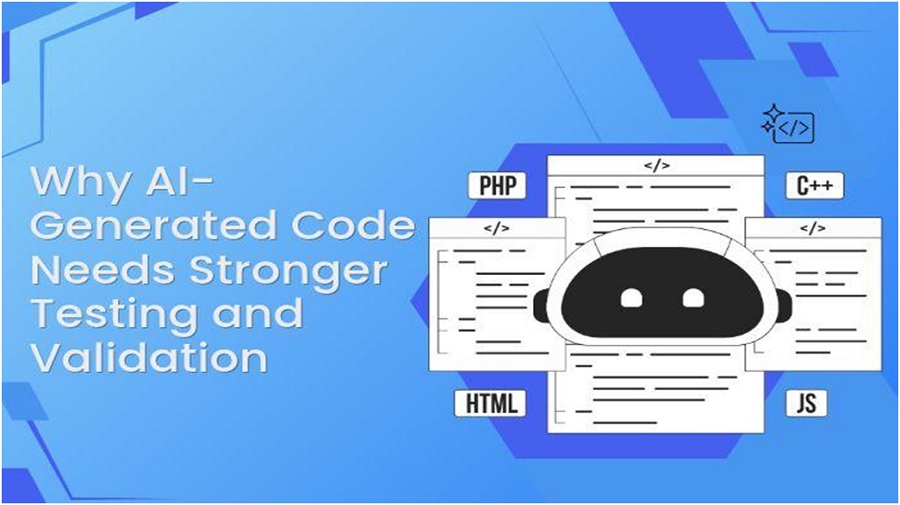
Why AI-Generated Code Needs Stronger Testing and Validation

AI coding assistants have made one part of software development noticeably faster: producing code.
A developer can describe a function, ask for an API integration, generate unit tests, refactor a component, or scaffold an entire feature in minutes. That is useful, particularly when teams are under pressure to ship quickly.
But generating code faster does not make the code easier to trust.
AI-generated code can compile, look clean, follow familiar patterns, and still contain subtle logic errors, weak exception handling, insecure dependencies, or assumptions that do not hold in the actual application. In some cases, the code is convincing enough that those problems survive an initial review.
That is why AI-generated code testing needs to be more deliberate than simply running the existing test suite and checking whether the build passes.
Generated Code Can Carry Hidden Assumptions
————————–
AI tools work from the context they are given.
If that context is incomplete, the generated implementation may fill the gaps with assumptions.
Consider a prompt asking for an endpoint to update a customer profile. The generated code may correctly validate the request body and update the database, but what about role permissions? Audit logging? Concurrent updates? Fields that certain users are not allowed to change?
If none of that appears in the prompt or surrounding context, the generated solution may simply omit it.
That is not necessarily a failure of the model. It is a reminder that software requirements are usually larger than the individual coding task.
Good AI code testing should therefore include scenarios around system behavior, permissions, dependencies, failure states, and business rules that may never have appeared in the generation prompt.
Unit Tests Are Necessary, but They Are Not Enough
————————–
One tempting workflow is to ask AI to generate both the code and its tests.
That can be productive, but it creates an obvious weakness: the same reasoning that produced a faulty implementation may also produce tests that confirm the same faulty assumption.
For example, if an AI-generated calculation incorrectly assumes a particular discount rule, the generated unit tests may encode that assumption as the expected result.
The tests pass. The behavior is still wrong.
Unit tests remain valuable, but teams should avoid treating AI-generated tests as independent evidence of correctness.
Critical logic needs test cases derived from business requirements, known edge cases, production incidents, and human review.
For higher-risk functionality, independent test design matters.
Regression Testing Becomes More Important, Not Less
————————–
AI coding assistants make it easier to change existing code quickly.
That convenience has consequences.
A developer may ask an assistant to refactor a service, simplify a method, replace a library, or optimize an API call. The resulting code may preserve the obvious behavior while subtly changing something elsewhere.
This is where regression testing becomes particularly important.
A change to a customer service may unexpectedly affect billing. A database query optimization may alter ordering assumptions. A refactored authentication helper may behave differently in an edge case used by another application.
Generated code should therefore be tested not only against the feature it was written for but against the parts of the system it can influence.
Teams with mature automated suites have an advantage here. They can move quickly without relying on the generated code author’s understanding of every downstream dependency.
Automated Testing Should Expand Alongside AI Coding
————————–
The answer to faster code generation is not necessarily more manual testing.
It is better automated code testing.
When developers can generate changes more frequently, test feedback also needs to become faster. Unit, API, integration, regression, security, and selected performance checks should run as early as possible in the development pipeline.
The exact mix depends on the application.
A generated UI component may need functional, accessibility, and visual regression testing. A payment-service change needs stronger integration, transaction, and failure-recovery coverage. Infrastructure code may require configuration validation and security checks before deployment.
The important point is that automation should match the risk of the generated change rather than treating all AI-generated code the same.
This broader question, using AI while still independently validating AI-generated output, is also becoming an important area of modern QA. This discussion on testing AI with AI explores how automated and AI-assisted testing can be used without turning validation into a closed loop where one model simply approves another model’s output.
Integration Testing Often Finds What Code Review Misses
————————–
Generated code may be perfectly reasonable in isolation and still fail when connected to the real application.
A model may understand how a generic REST API works but not the unusual retry behavior of a specific third-party service. It may handle a successful response correctly while misunderstanding what a 202 Accepted response means in that particular workflow.
The same issue appears with databases, queues, authentication services, payment gateways, and internal APIs.
That makes integration testing especially important for AI-generated code testing.
Test what happens when dependencies are slow, unavailable, return unexpected data, or succeed only partially.
These scenarios often expose assumptions that are difficult to spot by reading the generated code alone.
Traceability Matters When AI Contributes More Code
————————–
As AI-generated code becomes more common, teams also need to know where changes came from and why they were accepted.
That does not mean creating unnecessary bureaucracy around every generated line.
It does mean maintaining normal engineering discipline: code review, version control, documented requirements, test evidence, security checks, and ownership.
Someone still needs to be responsible for the code after it enters the repository.
“AI generated it” cannot become an explanation for why a decision was made or why a particular implementation behaves the way it does.
For regulated, financial, healthcare, or other high-impact systems, that accountability becomes even more important.
Stronger Testing Does Not Have to Mean Slower Delivery
————————–
There is an understandable concern that adding more validation will cancel out the speed advantage of AI coding.
It should not.
The goal is not to manually inspect every generated line or put every change through the same heavyweight process.
Validation should be risk-based.
A generated internal formatting helper does not require the same scrutiny as authentication code. A UI copy change does not need the same testing as a payment workflow.
Teams can use automated tests, CI/CD gates, static analysis, targeted code review, and risk-based regression selection to keep feedback fast.
The development process becomes quicker only when code generation and validation improve together.
AI Changes Who Writes the Code, Not Who Owns the Quality
————————–
The most important shift is cultural.
AI coding tools can accelerate implementation, but they do not take responsibility for what reaches production.
Developers still own the design. Testers still need to challenge assumptions. Security teams still need to look for exploitability. Engineering leaders still need confidence that the software behaves correctly under real conditions.
That is why AI-generated code testing deserves more attention as adoption grows.
The faster teams can create code, the easier it becomes to create defects at the same speed.
Strong validation keeps that productivity gain from turning into technical debt, security exposure, or unstable releases.
AI can shorten the path from idea to implementation. Testing is what determines whether that implementation is ready to go any further.