AI Agents vs Chatbots: Understanding the Next Generation of Automation

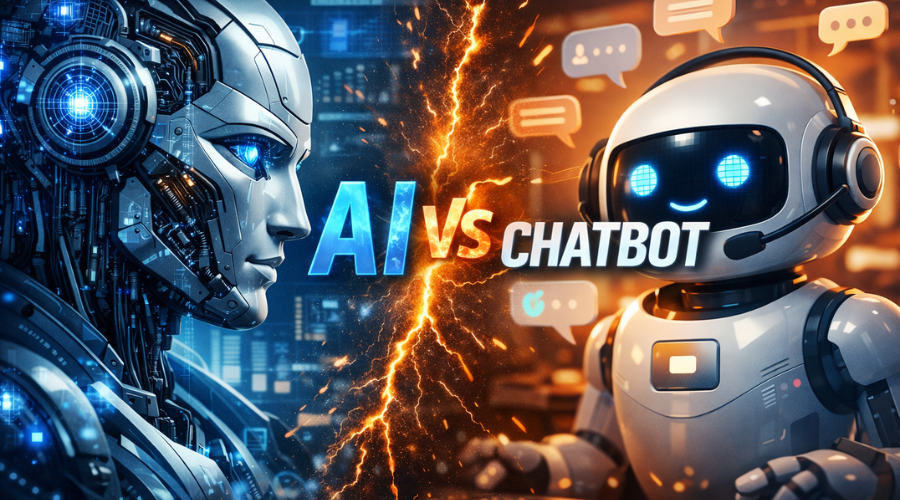
The shift from basic automation to true digital autonomy is happening faster than most boards of directors can track. For years, businesses relied on tools that could talk; now, they are looking for tools that can act. If you have spent any time interacting with standard customer service bots, you know the ceiling for that technology is relatively low.
The conversation is moving away from simple chatbot development and toward the implementation of an AI agent. It is more than just a This isn’t just a rename or a minor update. It denotes a major change in how software interacts with your data, your employees, and your customers.
How Digital Assistant Evolved
—————————–
To grasp where we are going, we have to look at where we have been. Traditional chatbots are essentially sophisticated decision trees. They follow a script. If a user asks “A,” the bot provides “B.” If the user asks something outside of “A,” the system breaks. This linear logic is why so many people find them frustrating.
An AI agent created through agentic AI services, functions differently. These agents do not follow a rigid script. They uses a logic loop to perceive its environment, reason through a goal, and execute tasks. It doesn’t just provide information; it completes workflows.
Defining the Core Differences
| Feature | Standard Chatbot | AI Agent |
| Logic | Pre-defined rules and scripts | Dynamic reasoning and goals |
| Autonomy | Requires constant human prompting | Can take multi-step actions independently |
| Integration | Often siloed or limited to FAQs | Connects to APIs, CRMs, and ERPs |
| Learning | Static until manually updated | Improves through iterative feedback |
Why “Agentic” is the Technology for 2026
—————————–
The term agentic AI services refer to systems that possess agency. In a business context, agency means the ability to make decisions within set parameters to achieve an objective.
Think about a travel request. With a chatbot, you can expect information like flights available, but nothing more. When you make the same request to an AI agent, it checkes your calendar for conflicts, look at your company’s travel policy, and find the best priced flights. Present all the information to you for final approval before booking the tickets and adding it to your schedule.
This moves the technology from being a “search interface” to being a “digital employee.”
Other Relevant Technologies Responsible for Modern Automation
Here are a few more terms to look out for when working towards a transition to modern automation:
- Autonomous Workflows: These systems can run end-to-end processes without any manual intervention.
- Multi-agent Systems: It is part of the agentic AI process where several AI agents talk to each other to solve complex problems.
- Cognitive Architecture: The “brain” structure that allows an agent to remember past interactions and apply them to new ones.
- Task Orchestration: It includes the coordination of various software tools by an AI to reach a goal.
Breaking the Feedback Loop: The Power of Logic Loops
Most older bots operate on a simple feedback loop: Input, leads to Process, completion of which results in Output. If the output is wrong, the user has to fix the input and try again.
Modern agentic AI services utilize a logic loop. This means the agent can evaluate its own work. If it tries to access a database and fails, it doesn’t just stop and give an error message. It analyzes why the failure happened, tries a different path, and continues until the task is done.
For a business owner, this means fewer broken processes and less time spent “babysitting” your automation tools. You set the goal, and the agent handles the execution.
Practical Applications for Business Owners
—————————–
Where does an AI agent actually provide value over traditional chatbot development?
1. Operations and Supply Chain
Instead of just tracking a package, an agent can monitor inventory levels. When it sees that stock is low, it can cross-reference lead times from different suppliers, draft a purchase order, and send it to the operations manager for a one-click sign-off.
2. Personalized Sales at Scale
A chatbot can capture a lead’s email. An AI agent can research that lead’s LinkedIn profile, find recent news about their company, and draft a hyper-personalized outreach message that feels like it was written by a human who did hours of homework.
3. Financial Analysis
Imagine asking a tool, “Why did our overhead increase by 12% last month?” A bot would show you a spreadsheet. An agent would dive into the line items, identify that three recurring subscriptions increased their rates, and suggest which ones to cancel based on usage data.
4. Customer Service & Support
Agentic AI workflows are now becoming the technology behind virtual assistants. They can manage Level 1 and Level 2 support requests. Moreover, in case of a tough situation, continuous sentiment analysis can determine when to escalate and get human customer care executives involved.
Scalability and the Human Element
—————————–
One concern often raised is whether this replaces the need for human staff. In reality, it changes the nature of their work. When you deploy an AI agent, your team stops performing repetitive data entry and starts acting as “agents of the agents.” They become supervisors who set the strategy while the software handles the heavy lifting.
This level of automation allows a small team to produce the output of a much larger organization. It levels the playing field, giving mid-sized firms the same analytical and operational capabilities as global corporations.
Automating Businesses in 2026 – AI Agents Over Chatbots
—————————–
As more people search for “how to automate my business,” the demand for chatbot development is being eclipsed by searches for AI agent capabilities.
To stay ahead, your digital strategy should focus on:
- Interoperability: How well do your AI agents talk to your existing tech stack?
- Data Privacy: How is the agent handling sensitive customer information?
- Reliability: Does the system have safeguards to prevent “hallucinations” or incorrect actions?
Moving Past the Hype
It is easy to get caught up in the excitement of new tech, but for those of us in AI engineering, the focus is always on the ROI. Chatbot development is great for reducing simple support tickets, but it doesn’t move the needle on core business growth.
Agentic AI services move that needle. They reduce the friction between a business decision and its execution. They turn “I should do that” into “That is being handled.”
The transition from chatbots to agents is the difference between having a map and having a driver. Both are useful, but only one actually gets you to your destination while you focus on the bigger picture.
Let’s Build the Future of Your Workflow
The technical bridge between a basic bot and a fully functional AI agent is complex, but the implementation doesn’t have to be. Using the services of experts in agentic AI services, will allow your business to build systems that don’t just talk, but actually produce results.
To determine the right place to use the technology, look at your current data structures. Identify where a logic loop could replace a manual process, saving you hours of work every week.
There was a time when automation meant getting answers, now it is about finishing the work assigned.