Generative AI Integration Services: Turning AI into Real Business Impact

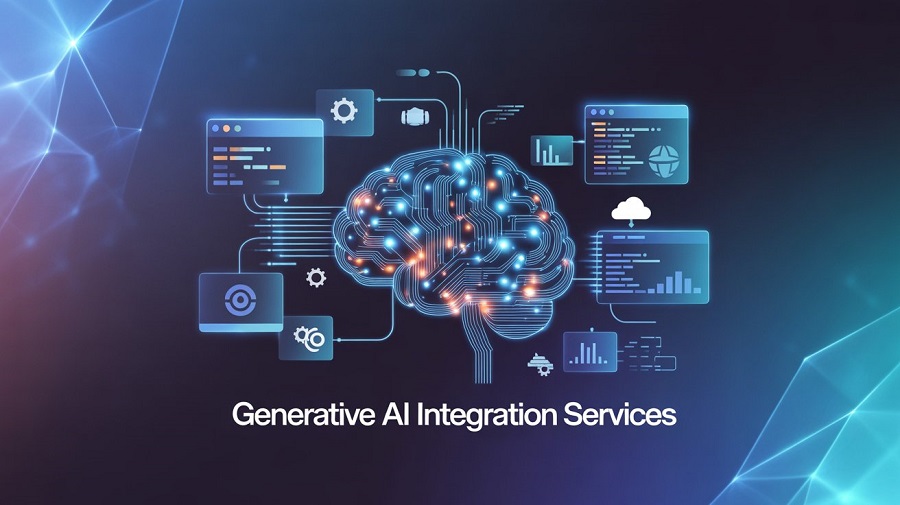
Smart AI integration is taking businesses far beyond imagination. Generative AI integration services are no longer exclusive to tech behemoths. They are now a strategic requirement for companies trying to remain competitive in a changing digital environment.
The truth is that incorporating generative AI into your website involves more than just a chatbot. It involves deeply integrating intelligent AI capabilities into your company’s environment. When implemented properly, AI improves the way your company functions, thinks, and provides value.
Imagine your operations platform anticipating issues before they arise in real time. Let’s explore how generative AI integration works and how companies can use it strategically.
What Are Generative AI Integration Services?
——————————-
Fundamentally, generative AI integration services integrate sophisticated AI models. It can produce text, code, graphics, and insights directly into your current business systems.
Integration guarantees that AI functions within your operations rather than as a stand-alone tool. Consider it as adding an intelligent co-pilot to your software to improve decision-making and productivity.
For instance:
- A CRM that automatically creates customized emails
- A support system that promptly addresses consumer inquiries
- A platform for supply chains that anticipates problems and offers fixes
Working with a Generative AI Development Company guarantees scalability and deployment with business objectives.
Key Components of Generative AI Integration Services
——————————-
Here are the crucial components of Gen AI integration.
1. Strategic Planning
Generative AI integration services that are successful always start with a well-defined plan. However, the business needs to identify the areas in which AI can be the most useful. This involves evaluating the current processes, identifying the inefficiencies, and relating the AI to the issues. Having a strategy in mind is important, as it helps in aligning the AI with the business goals, avoids unnecessary expenses, and helps in achieving quantifiable ROI.
2. Data Preparation
Data is the basis on which the AI systems are built. For the AI systems to be accurate, the data needs to be managed and secured before integration. Inaccurate AI results in poor data quality. Inconsistencies need to be eliminated, and adherence to data privacy regulations needs to be ensured. For the AI systems to be able to access the data in real-time, the data needs to be secured.
3. Model Selection & Fine-Tuning
Selecting the appropriate AI model is essential to getting the desired results. varied models have varied functions; some are better at producing text, while others are better at producing code or analytics. Companies have to decide to employ pre-trained algorithms to refine them. Fine-tuning enables AI to conform to operational demands and industry-specific specifications.
4. Workflow Automation
When AI is incorporated into routine tasks, integration becomes genuinely beneficial. Generative AI integration services with current systems, with CRM, ERP, and project management tools. It enables AI to carry out operations, without initiating actions, updating information, and producing reports. Improved operational consistency, quicker execution, and less manual labor are the outcomes.
Core Capabilities of Generative AI Integration
——————————-
Let’s look at the capabilities Gen AI integrates for businesses.
1. Natural Language Processing (NLP)
The ability to process, interpret, and generate human language is due to NLP. It allows companies to gain important insights from unstructured data. Chatbots, sentiment analysis tools, and content generation tools. NLP allows companies to communicate, serve users, and make decisions based on data with context.
2. Multimodal AI Capabilities
By allowing computers to process and produce several forms of content. Such as text, images, audio, and video, multimodal AI goes beyond integration. It enables companies to produce richer, more captivating experiences. Product teams from ZeeClick can swiftly prototype concepts, while marketing teams can create campaigns. Multimodal capabilities facilitate dynamic consumer interactions, improve innovation, and shorten manufacturing times.
3. Code & Data Generation
Through automated code and data development, generative AI greatly increases productivity. Development time can be decreased by providing developers with usable code snippets and plain descriptions. Generative AI integration services also create artificial datasets for model training. This feature guarantees safe AI implementation across technical settings and encourages experimentation.
Real Business Benefits of Generative AI Integration
——————————-
Let’s see how Generative AI integration services offer multiple advantages.
1. Improved Operational Efficiency
One of the most direct advantages of AI integration is that it can bring efficiency gains to a business. A business can save on physical labor costs by automating time-consuming activities. AI can help manage a workflow, prepare reports, and handle paperwork. It allows human resources to focus on more important activities. This can bring faster workflow, fewer errors, and more departmental productions.
2. Enhanced Customer Experience
Businesses can provide more customized and responsive client experiences. AI may customize interactions and offer product recommendations for immediate assistance by examining consumer data. This customization strengthens bonds, raises client happiness, and boosts retention rates. User engagement is meaningful and productive when AI-driven interactions feel more human.
3. Faster Innovation Cycles
Cutting down on the time needed for development and testing enables businesses to innovate. Teams can test concepts, create prototypes, and make changes as per feedback. Generative AI integration services can react to changes in the market and client expectations. Quicker product introductions and a greater competitive advantage result from faster innovation cycles.
4. Data-Driven Decision Making
The way a business uses data is being revolutionized through Generative AI. It can evaluate huge data sets to bring useful insights into a business, replacing human analysis. Decision-makers use this technology to get updated information to make well-informed decisions. This can bring overall improvement to a business through a culture of data-driven decision-making.
Industry Applications of Generative AI Integration Services
——————————-
Here is how each industry integrates Gen AI services.
Healthcare
AI reduces administrative burden by automating clinical documentation and improving patient engagement.
Impact:
- Reduced physician burnout
- Faster diagnosis support
- Improved operational efficiency
E-commerce & Retail
AI transforms online shopping experiences through personalization.
Use Cases:
- Dynamic product descriptions
- Personalized recommendations
- Automated marketing campaigns
This directly boosts conversion rates and customer retention.
Finance & Insurance
AI enhances risk management and fraud detection.
Applications:
- Real-time fraud detection
- Automated financial reporting
- Personalized investment insights
Financial institutions gain accuracy and efficiency simultaneously.
Strategic Roadmap for AI Integration Success
——————————-
Here is how you can easily integrate Gen AI into your business flow.
Step 1: Identify High-Impact Use Cases
Finding the areas where AI can be most useful is the first step in integrating it. Pain spots like repetitive inefficiencies or gaps in the customer experience should be the focus of businesses. Setting high-impact use cases as a top priority guarantees immediate wins to trust in AI adoption. Before expanding, companies can test efficacy and improve tactics by starting small with pilot initiatives.
Step 2: Prepare Data & Choose the Right Model
Preparing data and choosing the right AI model come next after use cases have been established. Accurate outcomes depend on data that is secure, organized, and clean. Additionally, Generative AI integration services allow the employment of pre-existing models. This necessitates ensuring the selected solution complies with technical specifications and commercial goals.
Step 3: Execute Integration & Manage Change
Implementation entails incorporating AI into current systems to proceed smoothly. This covers creating interfaces, testing performance, and creating APIs. Change management involves educating staff, resolving issues, and promoting adoption. Teams can exploit the advantages of AI integration and adjust to new workflows with clear communication.
The Future of Generative AI in Business
——————————-
The quick development of generative AI points to a long-term change in how companies run.
What to anticipate:
- Increased workflow integration of AI
- An increase in cognitive task automation
- More individualized client interactions
- Making decisions more quickly and intelligently
Early adopters will have a major competitive advantage.
Conclusion
Generative AI integration services are essential to create enterprises that are prepared for the future. AI integration makes it possible for businesses to run more intelligently to improve user experiences. You can contact us to find appropriate use cases to ensure smooth interactions.