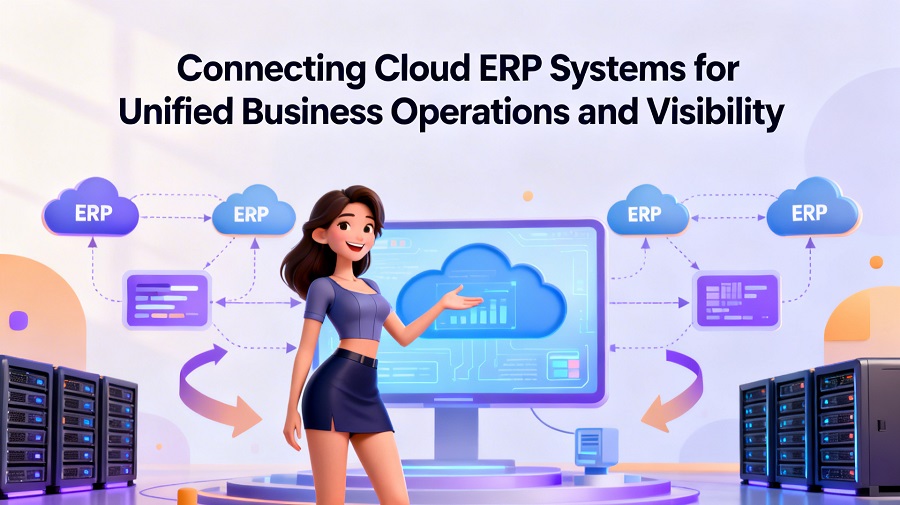
Connecting Cloud ERP Systems for Unified Business Operations and Visibility

Most businesses have more technology than they realise and less visibility than they need.
Finance runs on one platform. Inventory sits in another. The CRM the sales team works from has no reliable connection to the warehouse system fulfilling what they sell. HR data lives somewhere else. When someone finally needs a full picture of how the business is performing, what follows is a half-day exercise in exporting spreadsheets, reconciling figures that never quite agree, and hoping the end result is close enough to trust.
This is not a technology failure. It is a connectivity failure. The tools exist. The data exists. What is missing is the structure that lets both work together at the point decisions actually need to be made.
Connecting cloud ERP systems is how that changes. The goal is not more technology. It is making what is already running work as one joined-up operation rather than several parallel ones that occasionally share information.
Why Disconnected Systems Are More Expensive Than They Look
——————————–
The cost of running disconnected systems rarely lands in one place on a budget. It scatters across the business in ways that feel manageable individually and add up to something significant when looked at together.
The Manual Work Nobody Accounts For
When systems do not share data on their own, people step in to move it. Someone pulls a report from the ERP and pastes it into the analytics tool. Someone else checks the inventory system, cross-checks it against the purchase order log, and manually works out what stock is actually on hand. The finance team spends the first days of every month pulling figures from three different places before the books can close.
This work gets absorbed into the routine. It is rarely tracked as a cost because it has always just been how things get done. The hours involved are real though. So are the mistakes that manual handling produces. Decisions made on information that is a few days old, or slightly off because a figure was entered twice or not at all, carry consequences that are hard to trace back to the source but are there nonetheless.
Delayed Decisions Are Costly Decisions
The other cost is how long it takes to know what is happening. In a business running on disconnected systems, pulling together an accurate operational picture is a project in itself. By the time the data is assembled, cleaned up and in front of the right people, the situation it describes has usually moved on.
A supplier shipment is running late and nobody sees the production scheduling impact until someone checks three systems manually. Businesses running a NetSuite solution provider supported environment often find this is where the gap becomes most visible; the ERP holds one version of events while the warehouse and procurement tools hold another. A cash flow forecast ends up presented on figures four days old because that is how long it took to build it.
Each of these is a contained problem. Across a full year of operations, they represent a consistent drag on performance that is easy to underestimate right up until someone adds it up.
What Unified Cloud ERP Connectivity Actually Looks Like
——————————–
Connecting cloud ERP systems is not a case of ripping out existing tools and replacing them with one platform. For most businesses that would be unnecessary and the disruption would outweigh the benefit. The point is to build the connections that allow different systems to share data as it is created, so the business is working from one version of the truth at all times rather than several that require manual reconciliation to bring into line.
A Single Data Environment Across Functions
When finance, supply chain, procurement, sales and HR are connected through the ERP, information entered in one part of the business becomes immediately usable in others. A confirmed sales order triggers an inventory check and kicks off the fulfilment workflow without anyone moving data manually. A supplier invoice arriving through procurement updates the finance cash position without a separate entry. Payroll costs feed into management reporting without a consolidation run at month end.
Work that used to move in sequence starts happening at the same time. Processes that needed human coordination between systems run on their own. Fewer hands touching the data at transition points means fewer places for errors to enter.
Real-Time Visibility That Is Actually Real Time
The phrase gets used freely and often means something fairly approximate in practice. In a genuinely connected ERP environment it means the numbers a finance director opens on Tuesday morning reflect what happened Tuesday morning. Not last Thursday when someone last ran a sync.
Stock positions update as movements happen in the warehouse. Revenue builds as orders fulfil and invoice. Cost variances show up when they occur rather than when someone gets around to running the month-end report. Decisions stop being made on what the situation probably is and start being made on what it actually is.
That gap between approximation and accuracy, sitting quietly inside the everyday running of the business, produces better outcomes than most finance and operations leaders give it credit for.
The Integration Points That Deliver the Most Value
Some connections between systems pay back quickly and form the foundation everything else is built on. Others are valuable further down the line. Knowing which is which is what separates an integration program that shows results within months from one that is still in progress two years later and struggling to justify itself.
Finance and Operations
Connecting financial data to operational data is where most businesses find the fastest and most concrete return. When the ERP feeds reporting directly without someone manually pulling and formatting the data, close cycles get shorter. When procurement and inventory costs flow automatically into the P&L, the margin picture becomes something the business can look at any day of the month rather than assembling once at the end of it.
There is a secondary benefit worth naming. In most organisations there is a standing tension between what the finance team reports and what operations believes is happening. It surfaces in almost every performance review. A single connected data source does not resolve that tension through better communication or clearer processes. It removes the underlying cause because there is only one set of numbers anyone is working from.
Supply Chain and Inventory
Procurement, inventory and fulfilment running in separate systems means the full supply chain picture has to be assembled manually each time someone needs it. It often does not exist in real time at all. When those systems connect through the ERP, supplier lead times feed production planning automatically. Warehouse movements update the inventory figures purchasing decisions are based on. Fulfilment status is visible to sales and customer service without them needing to chase someone in the warehouse for an update.
The cash impact is direct. Businesses with accurate real-time supply chain data carry less safety stock. They order more precisely because actual demand from sales reaches purchasing without a manual step translating it. Less capital sitting in stock. Fewer emergency orders at short notice. Both show up in the numbers.
HR and Financial Planning
Most organisations run workforce planning and financial planning as separate exercises that then get reconciled, often imperfectly and late in the cycle. Connecting HR data into the ERP means headcount costs, compensation changes and contractor spend feed into the financial model as they occur rather than being consolidated separately.
When the business is in a period of change, whether that is growing fast, restructuring, or working through cost pressures, having workforce and financial data in the same environment means scenario modelling can happen quickly and on current figures. That capability is most valuable precisely when conditions are moving fastest.
Common Integration Mistakes Worth Avoiding
——————————–
Modern cloud platforms are built with connectivity in mind and the tools available for integration work are considerably better than they were five years ago. Most of the failures that happen in integration projects do not come from technical complexity. They come from decisions made in the planning stage that the technical work then faithfully executes.
Connecting Systems Without Cleaning the Data First
Linking two systems that both contain inconsistent or inaccurate data does not produce clean integrated data. It produces the same inaccurate data appearing in two places simultaneously, and now harder to fix because neither system can be corrected on its own.
Data quality work has to happen before integration work begins. It is the least visible part of the project and the first thing that gets pushed back when timelines get tight. It also causes more problems after go-live than almost any other single factor, so the pressure to defer it should be resisted.
Building Integrations Around Current Processes Rather Than Better Ones
When a business sets out to connect its systems, the instinct is usually to automate what already exists. The problem is that a lot of what already exists was designed around systems not being connected. Manual steps, workarounds, hand-offs between teams that exist only because information could not move automatically. Automating these does not eliminate them. It just makes them faster.
Reviewing what the process should look like once connectivity exists, before the integration is designed rather than after, is the step that most often gets skipped and most often creates regret later.
Underestimating the Ongoing Maintenance Requirement
An integration built between two cloud platforms is not finished when it goes live. Vendors release platform updates. Data structures shift. Business processes change in ways that affect what the integration is supposed to do. Without active monitoring and periodic review, integrations drift quietly out of alignment with the systems they connect and the problems that result are often subtle enough to go unnoticed for longer than they should.
A maintenance plan is not an optional extra on top of the integration project. It is part of what the project actually produces.
What Genuine Operational Visibility Enables
——————————–
Connecting cloud ERP systems delivers something beyond cleaner data and faster month-end closes. It gives the business the ability to operate on what is actually happening right now rather than on a reconstruction of what was happening a few days ago.
When leadership has current operational data, the decisions made from it are different. Problems get identified and addressed before they escalate into something that requires a more expensive response. Market changes become visible earlier. Resource allocation reflects where the business actually is rather than where it was when the last report was compiled.
Finance teams freed from reconciliation work at the start of every month spend that time on analysis. The value of that shift is not just efficiency. Analysis-driven finance functions influence commercial decisions in ways that administrative ones cannot.
Operations teams with a connected view across supply chain, inventory and fulfillment catch disruptions earlier. What would have become a production delay or a missed customer commitment gets picked up while there is still time to do something about it.
This is the practical return on ERP connectivity. Not a technology achievement. An operational one.
Conclusion
ERP integration gets classified as an IT project and managed accordingly. Technical execution is an IT responsibility. The decision behind it is not.
Choosing to connect the systems that run the business is choosing what kind of organisation it becomes. One that assembles a picture of its own performance after the fact and acts on information that is already out of date. Or one that knows what is happening as it happens and can respond while the response still matters.
The tools to do this are available and more straightforward to deploy than they have ever been. What gets in the way is rarely capability. It is prioritisation, and the discipline to do the foundational work properly rather than taking shortcuts that create problems further down the line.