CRM vs Spreadsheet: Why Manual Customer Management Fails

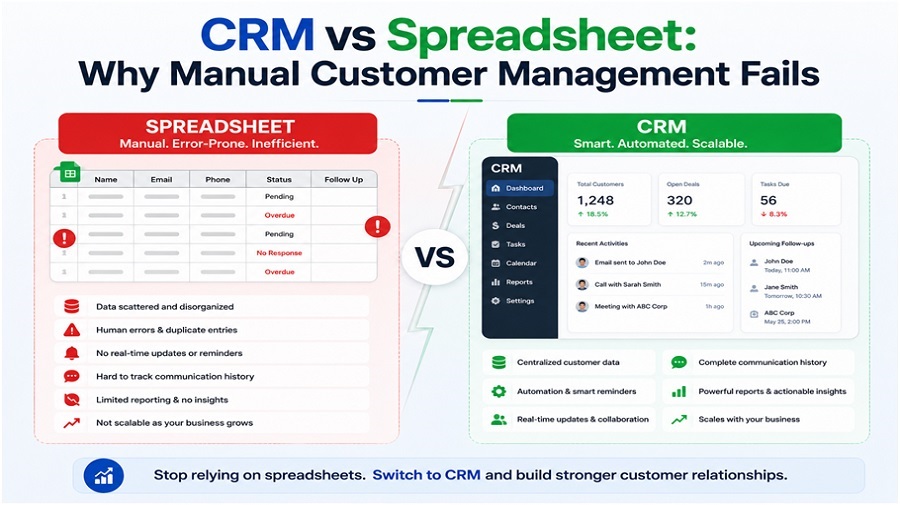
Customer management functions as an essential component that drives business expansion while ensuring its ongoing prosperity. Companies use customer data to handle leads and create better communication methods, develop better customer experiences, and achieve higher sales results. Businesses continue to use spreadsheets as their primary tool for handling customer data, even though their operations have become more complex.
Businesses eventually reach a point where their operations become too large for spreadsheets, which businesses initially consider as a budget-friendly solution. Spreadsheets used for manual customer management create data accuracy issues because they prevent proper communication and teamwork, while businesses miss important revenue chances.
The organization now works with custom crm software development companies based in the USA to develop unified CRM systems that automate their customer management tasks.
Businesses need to establish scalable digital systems, which modern organizations consider essential because they want to achieve sustainable development through customized software development services.
The Limitations of Spreadsheet-Based Customer Management
——————————
Businesses have used spreadsheets for customer data organization and sales monitoring and communication management since their introduction. Small businesses prefer spreadsheets because they are simple to use and need very little time to set up.
The process of managing databases becomes more difficult for businesses when they expand their customer database size.
Common limitations of spreadsheets include:
- Manual data entry errors
- Lack of automation
- Poor collaboration capabilities
- Limited scalability
- Data duplication issues
- Weak security measures
- Inefficient reporting
- Difficulty tracking customer interactions
Operational processes and customer experiences both suffer from these constraints.
Why Manual Customer Management Fails
————————
As businesses grow, their customer interactions become more complex and need improved systems that can handle their growing needs.
The manual customer management systems do not work because they cannot handle:
- Large customer databases
- Multi-channel communication
- Sales pipeline tracking
- Real-time updates
- Automated follow-ups
- Team collaboration
- Customer analytics
Businesses that depend on spreadsheets experience difficulties because they are unable to maintain correct customer data, which leads to slow responses and low customer retention.
Data Errors and Inaccuracies
The most significant obstacle for customers who use spreadsheet systems to manage their relationships is the possibility of human mistakes.
Manual data entry can lead to:
- Duplicate customer records
- Incorrect contact details
- Missing information
- Data inconsistencies
- Accidental deletions
Small mistakes in work processes lead to major problems that affect both sales chances and relationships with customers.
CRM systems automate data management processes, which decreases error rates and enhances system performance.
Lack of Centralized Customer Information
Multiple departments use spreadsheets to save customer details, which they keep in different files. The system creates communication problems because teams struggle to find current customer information.
The custom crm software development company in USA created a centralized CRM platform that enables all departments to access real-time customer information through one system. The system enables better teamwork between sales teams, marketing teams, and customer support teams.
Poor Collaboration and Communication
Modern businesses need their different departments to work together without any interruptions.
Spreadsheets fail to deliver suitable collaboration features because multiple users need to edit customer data at the same time.
The situation results in multiple problems, which include:
- Version control problems
- Data conflicts
- Miscommunication
- Delayed system updates
CRM systems offer three main features, which include role-based access, real-time system updates, and centralized communication monitoring.
Teams can work together effectively because they can share data without creating any problems.
Inefficient Lead and Sales Management
Sales teams face more challenges when they need to track leads through spreadsheets because their sales pipelines keep expanding.
Sales teams often struggle to:
- Prioritize leads
- Track follow-ups
- Monitor conversion stages
- Analyze sales performance
The CRM system provides automatic lead tracking together with visual sales pipelines, which enhance both productivity and conversion rates.
Businesses that invest in custom software development services can create CRM platforms that match their specific sales workflows.
Limited Reporting and Analytics
Data-driven decision-making is essential for business growth.
Spreadsheets offer restricted reporting functions that need manual data processing for analysis.
CRM systems provide advanced analytics dashboards that show insights about customer behavior, sales performance, marketing effectiveness, and customer retention and revenue trends.
The insights enable businesses to make strategic decisions based on sound evidence.
Weak Security and Data Protection
The reason customer data security has gained higher importance today is that cybersecurity threats have become more frequent, and data privacy regulations have become more stringent.
Spreadsheets provide only basic security features, which make them susceptible to:
- Unauthorized access
- Data leaks
- Accidental sharing
- File corruption
CRM systems use special security techniques that protect data through:
- Data encryption
- Access controls
- Audit logs
- Automated backups
- Multi-factor authentication
These features help businesses protect sensitive customer information.
Lack of Automation
The process of handling customers through manual methods requires businesses to spend their resources and work hours.
Businesses that use spreadsheets as their primary tool depend on manual methods to handle three tasks which include:
- Sending follow-up emails
- Updating customer records
- Tracking appointments
- Managing sales pipelines
CRM systems enable staff to work on essential business tasks by streamlining their repeated work activities.
Automation technology boosts work efficiency while creating better interactions between businesses and their customers.
Scalability Challenges
The organizational challenges of spreadsheet management increase as businesses expand their operations. The handling of large datasets causes spreadsheets to perform poorly while making it difficult to extract information. CRM systems are designed to scale with business growth.
A custom crm software development company in USA can build scalable CRM platforms that adapt to changing business requirements. The setup will provide both sustained operational efficiency and operational adaptability throughout time.
Benefits of CRM Systems Over Spreadsheets
——————————
Businesses gain multiple benefits when they switch from spreadsheets to customer relationship management systems.
Centralized Customer Management
The platform stores all customer information in a secure database system.
Improved Customer Relationships
The CRM system provides businesses with tools to establish personalized contact methods while delivering quick customer assistance.
Better Sales Performance
The system generates automated lead distribution, which enables sales teams to work more efficiently.
Enhanced Team Collaboration
The system enables departments to communicate better through its capability to deliver instant updates.
Advanced Analytics
The automated reporting system provides businesses with essential insights for their operations.
Increased Productivity
Automation technology eliminates the need for employees to perform manual work and handle administrative responsibilities.
Custom CRM Solutions for Modern Businesses
——————————
Every business has unique operational workflows and customer management requirements.
Generic CRM platforms do not match all business processes because they lack complete alignment with company operations.
Organizations choose to develop custom software solutions for their businesses because they need to create specific CRM systems that meet their needs.
Custom CRM platforms can include:
- Industry-specific workflows
- AI-powered automation
- Customer segmentation tools
- Integrated communication systems
- Advanced analytics dashboards
- Third-party software integrations
Customized CRM solutions bring operational efficiency improvements, which help businesses grow over the long term.
Future of Customer Relationship Management
——————————
The upcoming development of CRM technology will use automated systems together with artificial intelligence, predictive analytics, and personalized solutions. Businesses will increasingly rely on intelligent CRM systems to:
- Predict customer behavior
- Automate engagement strategies
- Improve customer retention
- Enhance sales forecasting
Businesses can develop customer management solutions that will meet future requirements by partnering with a custom CRM software development company located in the USA. The establishment of a custom software development service infrastructure will provide organizations with the ability to maintain their competitive advantage while adapting to market changes.
Conclusion
Modern businesses need more advanced customer management systems than manual spreadsheet management methods. Spreadsheets create operational problems because they make organizations less efficient, generate incorrect data, fail to establish proper communication channels, and create security vulnerabilities.
Customer relationship management systems offer businesses a complete solution that combines centralized control with automated processes and scalable customer relationship management tools to enhance their operational efficiency. USA businesses that work with custom crm software development companies can create personalized CRM systems that match their specific business needs.
Organizations can develop digital ecosystems that support both expansion and customer interaction through their investment in custom software development service solutions. Businesses today need to adopt CRM systems as their primary operational system because this change will help them achieve better customer satisfaction results.