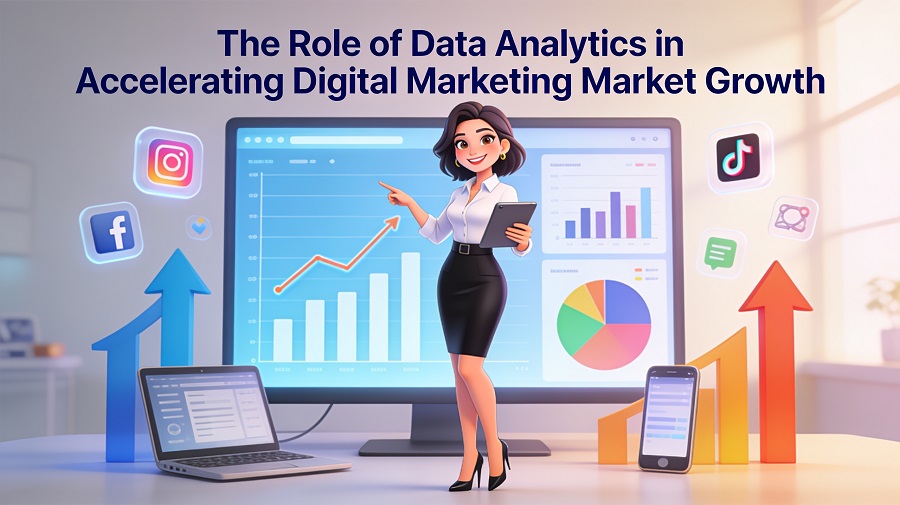
The Role of Data Analytics in Accelerating Digital Marketing Market Growth

Technology is changing the way businesses communicate with customers on a day-to-day basis, how businesses measure performance, and how they make their long-term plans. In the past two years alone, billions of pieces of data have been collected by businesses through the countless contacts that they have with their own customers through websites, apps, social media, search engines, and Internet retail operations. Because of all of this data being produced at such a rapid rate and accumulating over a longer period of time, the direction of analytics has shifted from being primarily used to support other functions to being an area of primary focus in moving forward with decision-making through the use of data in all industries.
To gain perspective on the continuous evolution of the Global Market Place of Digital Marketing [Mercado Mundial De Marketing Digital] from this point forward, one must also recognise that the role of analytics will continue to grow and play an increasingly important part in how businesses develop their digital strategies and create connections with their customers. Access to more and more detailed information on individual audience behaviour, as well as recognising changes in different market segments, will allow companies to make a much more informed decision and create an overall enhanced digital presence, while adapting to the constantly evolving demands created by consumers due to ever-changing trends. Increasingly, analytics is becoming one of several forms of the core components that are helping boost the Global Digital Marketing Marketplace.
Understanding Data Analytics in the Digital Environment
——————————
The term “data analytics” includes gathering, organising, analysing and interpreting large amounts of data gathered from numerous different sources like websites, mobile apps, social media, online purchases, customer feedback, and search activity to find patterns and insight.
The goal of data analytics is not just to collect data, but also to turn raw data into intelligence, or insight that can help an organisation make better decisions. Organisations use analytical tools and methods to help them understand how people behave, find common threads, measure how well something worked, and increase the efficiency with which they operate.
As the digital world becomes more complex, being able to analyse large volumes of information is essential for understanding how people use digital channels and services.
The Growing Importance of Data in Digital Ecosystems
——————————
An unprecedented amount of data is being generated by the digital economy. Every online interaction creates more behavioural, transactional, and engagement data, which in turn helps to build an understanding of how consumers behave in the digital world (i.e., what they look at when they are browsing through different websites or apps and how they are influenced by these experiences – and so on).
The growing availability of data has changed the way organisations plan and evaluate their operations. Rather than just depending on history and experience, decision-makers are now able to use evidence-based insights to understand current conditions and predict future events.
The shift to data-driven decision-making has improved transparency and increased accountability while also enhancing the ability (or components) to measure results across all digital activities.
Analytics Help You Understand Your Audience
Data analytics is helping us to gain more knowledge on how our target audience acts and behaves online. By generating and collecting information from a variety of places (such as social media networks, websites, etc.), it’s possible for organisations to systematically analyse and extract data from different sources, allowing them to find patterns of how users interact with their products, content and services.
Data from analytics can tell you what content users enjoy the most, how long users stay engaged with that content, what device they used, and where in the user journey they are blocked. Being able to do this enables organisations to have a richer understanding of the preferences and behaviours of their target audience.
As consumers continue to change, being able to analyse data will become more important than ever. Analytics provide organisations with the tools to adjust to changes in their audience and deliver theh the right digital experiences.
Utilising Evidence to Improve Decision Making Within an Organisation
The use of data analytics is a key component for an organisation to enhance its ability to effectively make decisions. Traditionally, organisations used a significant amount of intuition, assumption and/or very narrowly defined data to make their decisions. While such experience will always be important, we live in a digital age that requires greater levels of precision, objectivity and measurable processes for those organisations.
When organisations utilise data sources and data analysis, they can better assess their level of performance compared to their original objectives and identify opportunities to improve performance within their organisation. In addition, decision makers can compare results across multiple dimensions, look for trends and identify which actions contribute most to achieving their overall objective.
An organisation can reduce its level of uncertainty and be able to make more informed decisions when using a data-driven approach. Additionally, based on the improved understanding of its organisation via data analysis, the allocation of resources can be done more effectively. Organisations will also be able to modify their strategic priorities as conditions change based on data and analysis.
The Role of Real-Time Data Analysis
——————————
In recent times, there has been a lot of progress in real-time analytics. With all of the advancements made in both computing power and cloud-based technology, organisations can now process and analyse information virtually instantaneously.
Real-time analytics allow for much quicker responses to changes in circumstances, as organisations are able to monitor events as they happen and change their actions if needed without having to wait weeks or days for reports. With the rapid pace of change taking place within the digital environment, this rapid response time is very helpful to organisations in understanding changing consumer behaviour.
Organisations have immediate access to information that will help them identify emerging trends, identify problems sooner, and better meet the needs of users. When organisations use real-time data instead of historical data, they can improve their performance and adaptability in ways they could not without real-time data.
Planning for the Future with Predictive Analytics
Traditional analytics are used to understand present and past events. Predictive Analytics uses data analysis to predict what might happen in the future based on patterns in historical data. Predictive models allow us to estimate how people will act in the future and identify possible future trends.
Predictive analytics is increasingly important as businesses face more complex, rapidly changing digital environments. Predictive analytics helps decision makers to evaluate potential opportunities and risks before they emerge.
Although predictive analytics does not guarantee anything, the insights gained from predictive analytics give businesses valuable information to help them with planning and managing risk. If we can be more proactive in our responses to change, we will be able to improve our level of preparedness and make better strategic decisions within our environment.
Artificial Intelligence and Advanced Analytics
The use of artificial intelligence has greatly increased the ability of data analytics to function as an analytical tool. This ability is due in part to machine learning algorithms able to run through large amounts of data and identify patterns and gain insights from that data at a pace and volume that a human analyst would find overwhelming to do alone.
AI is also used to support many different types of analytical processes, such as pattern identification, trend identification, forecasting and detection of anomalies and so on. These types of analytic processes are used to gain more insight into extremely complex datasets in order to provide organisations with greater value.
Artificial intelligence technology continues to evolve, and with this, the use of artificial intelligence within analytics will continue to grow. The continued evolution of advanced analytics systems will increase the opportunity for organisations that could use this type of technology to receive the benefits of advanced analytical processes.
Using Insights from Data for Personalisation
Data analytics can easily be seen in how digital media is personalised. Digital platforms now collect behavioural information on users to personalise the type of content, recommendations, and overall user experience.
The process of personalising an experience relies upon analysing user behaviour to determine interests, behaviours, and any patterns they might have. By determining these things, we can provide experiences that are as meaningful and interesting to the individual as possible.
The increased demand for personalised digital experiences has created a growing need for analytics. Companies that can analyse data to understand users will be able to provide more engagement and allow for greater interactions within the digital realm.
Improving Performance Measurement
Using analytics lets businesses accurately track how well they are meeting their goals. Most digital solutions track user engagement, conversion rates, site visits, content consumption, and customer journey.
Businesses can now objectively evaluate the results and determine what factors are impacting performance. With detailed metrics for basic measurements and their impact, rather than building broad assumptions about performance, business leaders will be able to measure more specifically.
Real-time measurement enables companies to continuously improve by allowing them to identify strengths or weaknesses in their processes and plan for future improvements. As more and more business competition moves to digital platforms, the ability to measure performance accurately will become increasingly critical.
Analytics and the Customer Experience
The customer experience has emerged as a core focus within many of today’s digital industries. Analytics helps organisations to understand how their customers behave when using digital platforms and how to make improvements to said platforms.
Through analysis of behavioural data, organisations are able to uncover friction points and usability problems, as well as identify barriers to a positive user experience. Insights gained from this analysis provide critical input to improve a provider’s website design, navigation, content structure and overall customer experience.
The better organisations are able to understand how their customers experience digital environments, the better the organisation can create more intuitive and accessible environments for their customers, which ultimately leads to higher levels of engagement and customer satisfaction.
Challenges Associated with Data Analytics
Data analytics presents a significant challenge, even with its numerous advantages. One big issue surrounding data analytics is related to privacy and data security. The amount of information collected by businesses is growing at a fast pace, so it has become extremely important to ensure that the data collected is handled responsibly.
Since regulations surrounding privacy and protection of personal data keep changing, it is critical that businesses can continue to balance their desire for deeper insights into their customers with their obligation to protect those customers’ personal information and maintain their customers’ trust.
Another potential difficulty for businesses is the accuracy of their data. The quality of data used to conduct an analysis greatly impacts the quality of the analysis produced. Therefore, finding inaccurate or inconsistent data can negatively impact the analyses created from it.
Many businesses also have difficulty finding professionals with the skills necessary to maintain complex analytical applications. Therefore, it is very critical for the majority of industries to continue working to create the skill sets in Data Science, Analytics, and Artificial Intelligence necessary to be successful.
Emerging Trends Shaping the Future of Analytics
The concept of data analytics will be shaped by a number of emerging trends. Artificial intelligence advancements will allow for continued automation and improved accuracy of analyses, enabling organisations to take advantage of increasingly complex datasets.
The emergence of cloud-based solutions will allow for increased scalability and access to resources, thus helping organisations analyse their data more efficiently. Improvements in visualisation tools will also make information easier to read and communicate.
Additionally, privacy-enhancing technologies are becoming increasingly prevalent. With the arrival of new laws and growing public perception of these technologies, many organisations are looking for new ways to manage both the analytical capabilities of their data and the protection of privacy.
Overall, analytics is likely to remain a key component of the ongoing digital transformation that will occur throughout many sectors and areas of business.
Future Outlook
Data analytics is projected to grow in significance as digital ecosystems grow increasingly complicated,d with many connections between them. Organisations will keep depending on data-driven insights to comprehend their target audiences, assess the success of their current ventures, and adjust response strategies based on changes in the marketplace.
Increased capabilities for data analytics will be obtained through advances in artificial intelligence, machine learning, and cloud technology. These advancements will provide quicker, more precise processes for making well-informed decisions. The amount of available data is going to continue to expand, nd which will open up various opportunities for innovation as well as put pressure on organisations to have sound governance and ethical practices relating to data use.
As the digital environment continues to advance, organisations that successfully extract and leverage data insights will hold the best positions to successfully adapt to changes and deal with growing complexities in the modern marketplace.
Conclusion
Digital data analytics continues to be a significant contributor to the growth of the global economy. It is possible to use analytics to analyse significant amounts of data to gain valuable insights that can assist businesses in analysing their audiences, making better decisions, enhancing customer service, and measuring performance.
With the continued development of digital technology creating ever-greater amounts of data, the use of analytical capabilities will become increasingly critical. While challenges related to privacy, data quality, and skills development are still present today, the continual advancement of artificial intelligence and cloud computing has opened up the possibilities for modern analytical techniques.
As digital ecosystems continue to become increasingly data-focused, the use of analytics will be a critical component of making informed decisions in the long-term development of digital technologies. The ability of analytics to help businesses identify patterns and opportunities and then justify their strategic decisions will have a considerable impact on the future of digital transformation in the world.