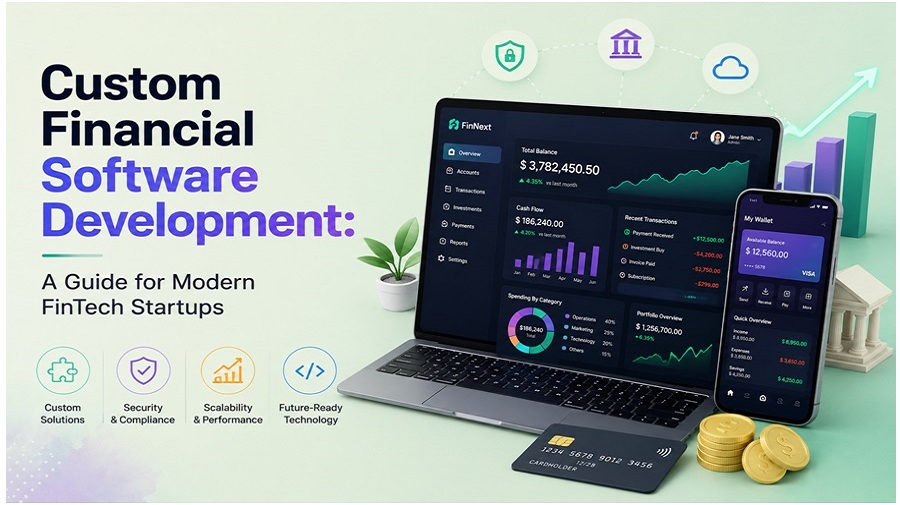
Custom Financial Software Development: A Guide for Modern FinTech Startups

The purpose or core intention of the FinTech industry has matured beyond simply “digitizing” brick-and-mortar bank branches. Moving forward in 2026, it is more about rewriting the rules of money itself. All decisions on how it moves, who controls it, how fast it can get, and where it should go are the questions you should be asking when planning to build a custom fintech software development project in 2026.
According to the latest reports, the global FinTech market is projected to surpass USD 1,760.18 billion by the end of 2034, driven by accelerating digital payments, embedded finance, and open banking ecosystems. The startups that capture this opportunity are not the ones using off-the-shelf tools. They are the ones building precisely engineered platforms tailored to their users, their compliance requirements, and their growth ambitions.
Why Off-The-Shelf Software Approach Falls Short For FinTech
—————————-
Generic SaaS tools are built for the average use case. FinTech, by nature, is never average.
Different regions and countries have different banking regulations, and these regulations even differ by product type. Risk models differ between lending platforms, neobanks, and investment apps. A payment processing startup in Southeast Asia has entirely different infrastructure needs than a B2B invoicing platform targeting European SMEs. Similarly, Brazil’s Nubank ditched generic CRM tools early, building a custom 100% digital bank serving 80M+ customers with tailored fraud detection for local Pix payments.
When you force a financial product into pre-packaged software, you end up fighting the tool instead of building the business. Custom FinTech software development solves this by giving your engineering team full ownership over every workflow, integration, and compliance rule embedded in the codebase.
What are the 5 Core Components of a Custom FinTech Platform?
—————————-
1. Secure authentication and identity verification
KYC (Know Your Customer) and AML (Anti-Money Laundering) compliance is mandatory for almost any fintech software platform/project. Custom development enables you to integrate third-party identity verification APIs while retaining control over user data handling and storage.
2. Payment processing and gateway integration
Whether you are handling card transactions, ACH payments, or international crypto payments, your system design must support real-time processing with fault tolerance. Generic platforms are not well designed to handle edge cases.
3. Data encryption and security architecture
Financial data is among the most sensitive there is. Security features in fintech platforms should include end-to-end encryption, role-based access control (RBAC), and tokenization, which are foundational. Teams working with platforms built on financial web development often find that early security architecture decisions save enormous remediation costs down the line.
4. Reporting and analytics dashboards
Real-time financial reporting software can also help detect fraud, monitor liquidity, and ensure regulatory compliance. A customized dashboard based on your key performance indicators can prove infinitely more valuable than any other financial reporting software.
5. API-first architecture
Financial systems are no longer islands; they are ecosystems. An API-first strategy facilitates smooth integration with banking partners, data providers, and fintech middleware layers, all of which are important to the growth of fintech startups in the connected world.
Real-World Case Studies in Custom FinTech Development
—————————-
1. Nubank: AI-Native Banking at Scale
The Challenge: As Brazil’s leading neobank, Nubank needed to move beyond traditional, slow-moving credit models to serve over 100 million customers.
The Solution: Nubank built a custom AI-First production platform that abandoned standard “tabular” data processing. Instead, they engineered a system using large-scale transformer architectures (similar to those powering LLMs) to analyze entire sequences of customer behavior in real-time.
The Result: This custom architecture provided a 1.2% lift in predictive accuracy (AUC) for credit decisions, a massive margin in banking that allows them to lend more safely and profitably than competitors using off-the-shelf risk tools.
2. Revolut: The “Sherlock” Fraud Detection Engine
The Challenge: With 40+ million users, Revolut faced sophisticated fraud that generic, rule-based security systems couldn’t detect without blocking legitimate transactions.
The Solution: Revolut developed Sherlock, a proprietary machine-learning-based fraud-prevention system. Unlike standard tools, Sherlock was built on a custom high-speed architecture (using Couchbase) to evaluate transactions in under 50 milliseconds.
The Result: Sherlock catches 96% of fraudulent transactions and saved the company over $3M in its first year of production by outperforming industry-standard fraud tools.
3. Wise (Formerly TransferWise): Building Custom Payment Rails
The Challenge: Traditional international transfers rely on the slow, expensive SWIFT network. Wise wanted to make transfers instant and low-cost.
The Solution: Instead of just building a “skin” on top of existing banking APIs, Wise built its own global payment network. They engineered custom integrations directly into local, domestic “instant payment” rails (like PIX in Brazil or UPI in India) across 100+ jurisdictions.
The Result: By bypassing traditional intermediaries through custom-built infrastructure, Wise can offer significantly lower fees and faster settlement times than traditional banks.
4. Eddbee Shares: Algorithmic Trading Platform
The Challenge: The Eddbee Group, a Swedish FinTech, needed an enterprise-grade platform capable of handling high-frequency algorithmic trading and complex “copy-trading” across 60+ global stock exchanges without the latency issues common in standard web apps.
The Solution: Instead of relying on third-party middleware that might not perform optimally, CMARIX developed a proprietary engine for the trading ecosystem. The engine utilizes Laravel in combination with a very optimized MySQL solution. The company also developed a custom UX that has been A/B tested to ensure that novice traders can easily use the complex features of the trading ecosystem. The features include “Autopilot” for portfolio management.
The Result: By building a tailored infrastructure rather than using a generic trading white-label, the platform successfully scales across international markets (including the ASX). It now supports 13 competitive trading games and provides enterprise-grade security for multi-currency transactions with one-click execution.
Designing Financial Systems with Built-In Regulatory Compliance
—————————-
One of the biggest areas that is not given enough attention in custom FinTech software development is compliance architecture. Many FinTech firms have been known to overlook this, and then when they go for their audit, they find that their system architecture makes their reporting process a pain.
Smart compliance engineering means:
- Audit logs are immutable and timestamped at the database layer.
- PCI-DSS, GDPR, or SOC 2 requirements are reflected in your data models, not just your documentation
- Role-based access (RBAC) guarantees that only authorized personnel can view sensitive records.
This is one of the first discussions any serious fintech company ought to have with its development partner, as “retrofitting” compliance into an existing code base is significantly more costly than “designing in” compliance from day one.
How to Build Your Custom FinTech Software Technology Stack in 2026
—————————-
- Backend: Bothjs and Python are popular choices among major financial firms because they have well-developed ecosystems that support asynchronous programming (Node.js) and large-scale data processing (both Node.js and Python). Go is also gaining traction in high-frequency trading systems.
- Database: PostgreSQL remains a dominant choice for transactional data. Teams handling real-time analytics often layer a time-series database such as TimescaleDB or ClickHouse.
- Cloud infrastructure: AWS, GCP, and Azure all offer solutions that have received specific compliance certifications for financial services. The ability to deploy across multiple regions has become increasingly important to international companies that provide their products and services through global platforms.
- Microservices vs. monolith: Startups tend to start with a well-structured monolith and move to microservices as usage increases. There is operational overhead to microservices before product-market fit is achieved.
What does the build vs. buy decision actually look like?
—————————-
The honest truth: most serious FinTech startups end up doing both. You buy commodity infrastructure (cloud, authentication, payment systems, etc.) and build your differentiated core, logic, UX, risk models, etc.
The build-or-buy matrix should be driven by one question: Does this component create competitive advantage? If the answer is yes, build it. If not, integrate a best-in-class provider and spend your engineering effort where it counts.
Financial technology innovation happens fastest when development teams are not distracted by reinventing solved problems.
When is the right time to invest in Custom Fintech Software Development?
—————————-
There’s no need to wait until Series B to start building properly. In fact, teams that build during the seed stage, with a strong foundation, scale much faster and with fewer costly rewrites. This inflection point tends to be when:
- Your product requirements diverge from what generic tools can handle
- Compliance obligations require architecture changes that a SaaS vendor cannot support
- You need data portability and cannot afford platform lock-in.
Choosing the Right Fintech Software Development Partner
—————————-
Next-generation financial platforms are not built by feature factories. They require partners who understand financial regulation, security architecture, and the realities of scaling a transactional system under production load.
The right development partner does not just write code. They help you avoid the architectural mistakes that slow companies down two years after launch, and they bring experience from having navigated similar compliance and scalability challenges before.
Final Thoughts
Custom financial software development is where product vision meets technical reality. Fintech industry trends are moving towards personalization, open finance, and real-time everything. The fintech startups that succeed are those developing platforms that can adapt as trends continue to change and that get the security and compliance basics right from the start.
If your team is evaluating a custom build, the best time to get the architecture right is before you write the first line of production code.