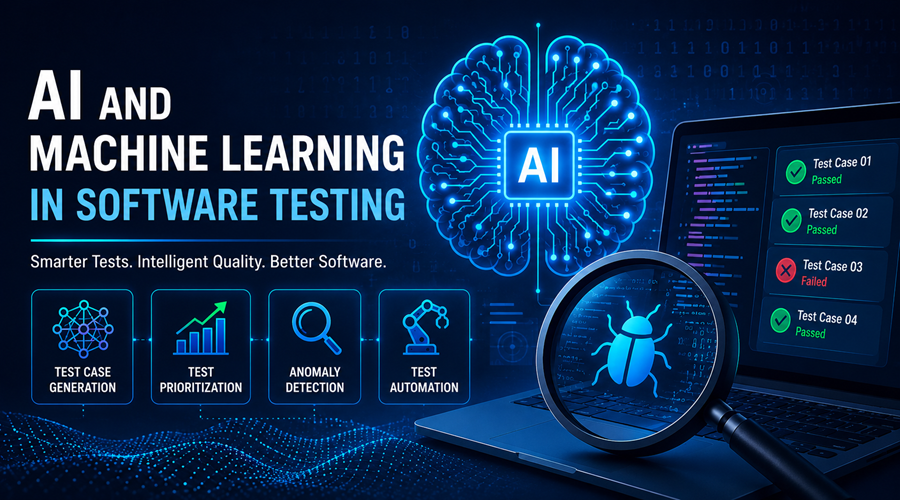
AI and Machine Learning in Software Testing: Benefits, Challenges, and Best Practices

Software testing has always had a slightly uncomfortable relationship with speed.
Every business wants faster releases. Product teams want shorter sprints. Developers want quick feedback. Leadership wants fewer delays. But QA teams are usually the ones expected to make sure nothing breaks while everyone else keeps pushing for speed.
For a long, it has been assumed that automation is the solution to the problem. Indeed it is true because automated testing suites have provided faster regression testing, minimized repetitive manual tasks, and increased confidence before release. Nonetheless, one who understands automation also understands the other part of the story.
Scripts break. Test data gets messy. Environments fail. A small UI change can trigger ten false failures. Large regression suites take hours to run. And after a point, teams are not just maintaining the product; they are maintaining the testing system around the product.
This is where AI and machine learning in software testing starts to make sense. Not as a magic replacement for QA teams, and definitely not as a “set it and forget it” solution. Its real value is much more practical. AI helps testing teams work through large amounts of information, spot patterns, reduce repetitive effort, and make better decisions about what needs attention first.
That distinction matters. AI is not making testing effortless. It is making certain parts of testing less wasteful.
Where AI Actually Helps in Testing
——————————–
In the simplest way possible, this is how one would describe the difference between standard automation and AI-driven testing: Standard automation obeys, but AI-driven testing learns.
Standard automation follows a defined path. Click on this button. Type in this information. Submit the form. Verify the output. In case something has changed along this path, the test can get interrupted even if everything is working fine in the application.
But AI-driven testing can consider wider contexts. These include prior tests, defect history, code changes, user behavior, logging, and application behavior. This is why the use of AI software testing has become popular so fast. Apart from speed, people also need better prioritization.
Let’s take an example. Suppose a team is working on a payment flow where there is the checkout page, tax computation, promotions engine, and the payment gateway. All of these are interconnected and even a minor backend change can impact the application’s user experience unexpectedly. This is where AI can provide certain connections based on failures, recent code activity, and test outcomes.
It does not remove the tester from the process. It gives the tester a better starting point.
The Biggest Benefit: Smarter Prioritization
One of the most useful applications of AI in testing is test prioritization.
In many teams, regression testing becomes bloated over time. Every major defect leads to more test cases. Every new feature adds more coverage. Eventually, the suite becomes too large to run efficiently after every change.
The result is a familiar trade-off. Either the team runs everything and slows down the release, or it runs a smaller set and accepts more risk.
Machine learning could take some of the randomness out of this decision process. By analyzing code changes, previous bugs, failures during build time, and test history, machine learning could indicate which tests are most pertinent to a particular release.
This might not be thrilling in the way of excitement, but it sure is practical. What a QA Lead needs is not yet another dashboard with vanity metrics; what they need is to understand the risk before their customers do.
Applied wisely, AI can help teams avoid running redundant test cases, shrink feedback loops, and allocate their manual testing efforts effectively.
Defect Prediction Is Helpful, Though Not Flawless
Another good use case is defect prediction.
Software defects are rarely distributed evenly across an application. Some modules are stable for months. Others keep breaking because they are complex, frequently changed, poorly documented, or dependent on too many integrations.
Machine learning algorithms can detect such patterns. Modules with a history of many issues, a lot of commits, more than one contributor, and failed tests might be worth examining before releasing.
Such knowledge may be helpful, especially in large products where no one individual has an understanding of everything in the whole product.
However, this is where it becomes crucial to approach this topic wisely. While AI can indicate probabilities, it cannot guarantee anything. Low-risk modules can fail, while high-risk modules may pass all tests without any problems. It is still important to consider business contexts.
For example, while some features may have technical low risks, they are vital because they are required by some customers or campaigns or compliance requirements. This aspect will not be clear for a machine learning model without additional explanation from the team.
Defect prediction should inform testing decisions.
AI Can Reduce Some Automation Maintenance Pain
Automated testing maintenance is not an exciting activity, but it eats up a lot of people’s time.
A locator gets modified. A button is moved around. A label is changed. The test fails. An individual investigates the issue, discovers that the functionality is fine, makes a change in the test script, and runs it once more.
This process goes on and on for hundreds of tests and several versions.
AI-driven self-healing tests are meant to address this challenge.
Instead of using just a locator for recognizing an element, self-healing tests apply different criteria for determining the button or field. The test will continue to recognize it even if one of the attributes changes due to text, position, structure, or behavior.
The approach could make test execution more reliable and reduce false negatives.
Nevertheless, it should not be overhyped. Self-healing tests do not imply that maintenance is not needed anymore. They imply only that developers spend less time fixing bugs that did not exist in the first place.
Visual Testing Is Another Practical Area
Functional tests can tell you whether something works. They do not always tell you whether something looks broken.
A form may submit correctly while the submit button is half-hidden on mobile. A page may load while text overlaps with an image. A checkout screen may work technically but look untrustworthy to a user.
AI-based visual testing tools can compare screens across browsers, devices, and resolutions. They can detect layout shifts, missing elements, overlapping content, and unexpected visual differences.
This is especially useful for products where the interface changes often. eCommerce platforms, SaaS dashboards, banking apps, healthcare portals, and travel websites cannot afford poor visual experiences. Users may not care whether the backend logic is correct if the screen looks broken.
Again, human review is still needed. But AI helps catch visual issues at a scale that manual checking cannot easily match.
The Challenges Are Mostly Operational
The difficult part of using AI in testing is not always the technology. Often, it is the condition of the QA process around it.
AI needs data. If test results are inconsistent, defect reports are vague, environments are unstable, and test cases are poorly maintained, the output will be weak.
A machine learning model trained on messy data will give messy recommendations. That is not a tool problem. That is a process problem.
This is why companies exploring AI and ML services for testing should start by looking at their current QA maturity. Without that foundation, AI may add another layer of complexity instead of solving the problem.
The skills gap is another issue. Testers need not become data scientists, but testers need to be able to make sense of recommendations produced by AI. Testers need to recognize when they can trust the recommendation engine, and when it makes sense to doubt its conclusions.
Final Thoughts
AI in software testing does not involve doing away with testers. It involves cutting down on the noise around software testing.
The best use cases for AI in testing are very practical: improved test prioritization, early risk detection, decreased maintenance costs, enhanced visual testing capabilities, and more intelligent usage of QA resources.
The companies that will succeed will not be those treating AI as a passing fad but will rather be those applying it intelligently to actual testing problems, using good quality data, and involving their experienced testers in decision making.
Testing has always been more than just writing more test cases. Testing has always been about predicting what could go wrong and what kind of experience the end-users will have when the product is eventually released.
And AI can help with this. Just as long as the companies apply it with discipline and understanding of its possibilities and limitations.