
Secure Software Development with Rust: Key Benefits, Features, and Real-World Use Cases

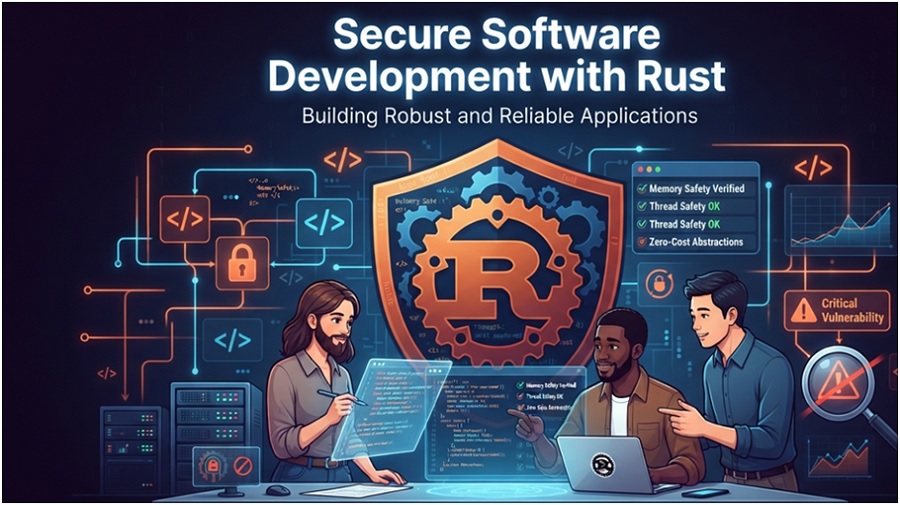
Looking for the benefits or features of software developing with Rust? Or do you want to know the real-world use cases of these software solutions powered by Rust? If yes, then our detailed blog is all you need. Let’s explore.
Key Benefits
——————–
Software development with Rust has been rising recently thanks to its enhanced security. Here we have listed some of the top benefits that make it favorable over others.
Increased Memory Security
Rust provides enhanced memory security.
High Speed of Work
The majority of Rust’s security tools do not affect its performance because the security is based on the compile-time checks.
Programs in Rust run fast enough and can compete with C and C++ in terms of speed.
Concurrent Programming
Rust has fully integrated support of concurrent programming and multithreading.
These capabilities allow developers to increase the performance of Rust by making their programs able to accomplish several tasks simultaneously.
Efficiency
In addition to increased security, the advanced memory management of Rust allows it to write programs that execute faster and consume much less electricity than programs created in any other popular language.
Large Community
Users of Rust have the advantage of a large and active community.
There are many resources available for learning Rust, including manuals, documents and community support.
Secure Programming Features in Rust
——————–
Let’s check out the top programming features of Rust.
Memory Safety
The memory safety feature in Rust secure programming guarantees strict memory rules are enforced during the process of compilation. These memory rules are essential because Rust is able to protect itself against:
- Buffer overflows
- Use-after-free
- Dangling pointers
Concurrency Without Data Races
In Rust, there are no data races, which makes it possible to create multi-threaded applications. This means that concurrency issues can be avoided in Rust secure programming.
Strong Type System
The type system in Rust guarantees that errors are detected during the compilation process.
There Are No Null Pointers and Buffer Overflows in Rust
Rust does not have null pointer dereferencing and safe array indexing like C/C++. This is why Rust is safe even for system-level programming.
Real World Use Cases of Rust in Software Development
——————–
Rust is no longer a niche language. It has proven to be a versatile and reliable tool that is used in various areas of software development.
This includes both low-level system programming and writing cloud-service applications that require top-notch performance.
Let’s take a closer look at the spheres that benefit from using Rust.
System Programming
Using Rust for system programming gives engineering teams the balance between memory safety, performance, and control that they need when writing low-level code.
It helps developers avoid common pitfalls that occur when working with low-level data structures and languages.
With Rust, you can build reliable and high-performance software at the machine level.
Memory safety without overhead. You can get rid of such common causes of bugs as dangling pointers and use-after-free vulnerabilities.
At the same time, you can write code that has predictable memory behavior without garbage collection.
Close-to-metal performance. You can reach C/C++ level performance thanks to zero-cost abstractions.
Fine-grained control. Rust provides you with low-level memory and concurrency management, so you can develop complex system software.
These benefits make it possible to create reliable system software with Rust. Because of memory safety, systems built with Rust do not have common vulnerabilities.
Therefore, Rust is great for building drivers, embedded software, and system-level applications.
It also can be used for writing safety-critical components, such as aircraft or medical devices controllers.
Rust is a good fit for kernel development because you can write highly efficient code while keeping control of what happens in the code.
However, there are some caveats that you should consider before you start developing your kernel in Rust.
Embedded & IoT Development
Rust makes an excellent fit for the domain of embedded and IoT computing, where you have to work under the constraints of limited resources, deterministic time, and high safety needs.
It features a no-runtime approach with predictable memory usage, making it possible to compile your program into a microcontroller, bare metal device, and constrained platform.
How can Rust be used for embedded systems then? Let’s take a look at it:
No Runtime and Deterministic
Rust does not require a garbage collector; therefore, you can be sure that Rust provides accurate time and predictable memory usage patterns.
Safe Concurrency for Real-Time Processes
Thanks to its ownership model, Rust can provide safe concurrency even on devices with limited execution threads.
Support for Microcontrollers without std
Developers can create firmware for ARM Cortex-M, RISC-V, and other MCUs without using an OS, keeping binaries light and having complete control over memory and runtime.
Low Memory Consumption
Zero-cost abstractions make it possible to use Rust in systems with small amounts of RAM and flash memory.
Therefore, is it possible to use Rust in embedded systems? Definitely! Rust performs great when it comes to writing firmware and real-time systems.
The Rust language is employed to create a minimalist OS for Raspberry Pi 3.
The embedding of the kernel into an embedded system basically boils down to ensuring that it meets certain hardware requirements.
This is achieved through efficient memory usage, trimming unnecessary parts and optimizing booting procedures.
Secure-By-Design Applications and Cybersecurity Tools
Rust has proven to be the perfect choice for developing high-assurance security tools and programs which should be reliable, memory-safe, and predictable.
Rust’s strong guarantees also make the language a good fit for crypto-related code, isolation, secure agents, and sandboxing.
Some of the major benefits of using Rust for cybersecurity purposes are:
Absence of memory corruption vulnerabilities. Rust forbids buffer overflows, dangling pointers, and other such unsafe operations at the compilation stage, greatly reducing the vulnerability footprint.
Type guarantees. Rust ensures the compiler-enforced type correctness, which makes introducing logical mistakes and unsafe state transitions more difficult.
Safer cryptographic implementations. Rust boasts an extensive cryptography ecosystem (such as RustCrypto), which makes implementing modern cryptographic solutions much easier and does not require starting from scratch.
Support of isolation and sandboxing out of the box. The ownership and borrowing concept of Rust natively supports isolation and privilege separation.
You may use Rust when security is one of the requirements of your system or tool.
Rust is quite well suited for use in security surveillance because of memory safety and data pipelines.
However, in reality, it is important not only to have efficient ways of capturing data but also to ensure its integrity and prevent leaks.
The ownership paradigm in Rust mitigates some memory related risks that may affect the quality of telemetry.
Cloud Native and Serverless Deployment
Rust is now becoming more popular in cloud-native development communities because it provides a combination of performance, reliability, and efficiency required by modern distributed systems.
The lightweight runtime and compile-time guarantees of Rust will be useful for building scalable cloud services without any overhead.
The following are the advantages of using Rust in cloud-native and serverless development:
Ability to process more requests with less usage of compute and memory. Thus, Rust services will cost less to deploy in the cloud and will be easier to scale up.
Low-latency asynchronous execution of services. With modern async runtimes, it becomes possible to perform highly concurrent operations without additional overhead of multi-threaded programming.
Predictable performance in terms of scalability. As there is no garbage collector in Rust, you won’t experience any unpredictable latency bumps when scaling your cloud services. It makes it easier to meet requirements for SLA and autoscaling.
Containerization efficiency and fast cold starts. Efficient containerization and cold starts are possible due to small binary size and fast start-up time.
Integration with cloud services and architectures. The small size and performance guarantees of the language make it easy to use Rust within Kubernetes, Wasm runtimes, and polyglot microservices.
There is good synergy between Rust and cloud native, high-performance scenarios where trade-offs between these factors cannot be made.
Blockchain and Decentralized Systems
Given its emphasis on safety, correctness, and performance, Rust is highly applicable in the blockchain ecosystem.
The compile-time guarantees enable the prevention of errors in logic and memory management which may affect consensus mechanisms and the security of the network.
Rust is also suitable for writing code for components running in a state of constant load.
Why is Rust a good fit for developing blockchain and decentralized systems?
Strong safety guarantees. Rust’s ownership and borrowing provide safety from catastrophic failures and vulnerabilities in consensus-relevant code.
Reliable cryptographic operations. Determinism and safety ensure no side-channel attack vectors and no undefined states when executing cryptography.
Performance good for decentralized networks. Good performance of concurrency enables processing large transaction loads with low latency.
Predictable consumption of resources. No garbage collection means consistent block times and performance under high load.
Integration with existing ecosystems. Rust is the backbone of Substrate and integrates properly with multi-language blockchain stacks.
Since Rust emphasizes trust and precision, you can write efficient and reliable decentralized systems with it.
High Performance APIs and Back-End Development
The language has already shown its worth and can serve as a viable option when building backends that should provide reliable performance in high-load conditions.
Besides being fast, the language also ensures that the team can avoid many pitfalls associated with the development of backend services such as unpredictable garbage collection, memory expansion, and concurrency bugs.
These aspects make Rust a great solution for APIs and other services where it is necessary to have reliable performance in order not to impact the user experience negatively.
This is how teams begin to regard Rust as an alternative to high-performance solutions.
Advantages of using Rust in backend development and API design:
Highly efficient request processing in terms of latency. The language supports asynchronous runtimes, thus allowing handling highly concurrent loads without the need for heavyweight threading.
Efficient management of concurrency and reliable parallelism. The ownership principle eliminates data races and makes debugging much easier in systems that process requests in parallel.
Consistent performance in case of load. Memory determinism ensures that there will be no unexpected pauses.
Established ecosystem for production services. Tools such as Actix Web, Axum, and Tonic offer developers robust options when working with gRPC, REST, and streaming back ends.
Thanks to all these features, Rust provides you with an excellent platform for building highly performant back ends.
WebAssembly for Edge Computing and Browser
Rust is currently one of the most trusted languages to compile to WebAssembly (Wasm), which ensures fast and safe execution without depending on big runtimes.
Furthermore, its compiling process results in minimal binaries that show predictable behavior.
Rust will assist in your team developing a Wasm product through:
Performance predictability in the browser and edge environment. Rust-to-Wasm compilations ensure near-native execution without stopping for garbage collection.
Efficient and small binaries. Rust has an efficient compilation process to Wasm, reducing load times and resource consumption.
Memory safety guarantees. The ownership system avoids vulnerabilities that could compromise sandbox isolation.
Tooling for Wasm. Tools such as wasm-pack, wasm-bindgen, and wit-bindgen simplify bindings, packaging, and cross-language interoperability.
Rust becomes a great choice for workloads that should run safely in restrictive or sandboxed environments, including browsers and edge environments.
Rust is chosen efficiently to replace the old C components while taking the system-level code to the browser using WebAssembly.
It was noted that the approach minimized memory-related issues and made maintenance easier in the long term.
Rust helped the customer provide secure and low-latency remote connectivity directly within the browser without any runtime.
The trade-offs you should know before you commit to Rust
——————–
The highest costs of using Rust are the steeper learning curve, slow compile time, and smaller talent pool compared to C++, Java, and Python.
None of these is a showstopper, but expect and be ready for them all. The steep learning curve is a fact. Denying it won’t do any good.
The learning curve. The Rust borrow checker that keeps the language safe is what makes people struggle in the first month working in the language.
Most C++ engineers get up and running after a few weeks only.
Compile times. Rust compiles slowly, and not just a bit, but especially for larger projects. However, tooling that helps with this problem exists. Also, it is a valid cost in the development process.
The talent pool. There are fewer people who are fluent in Rust, which is why jobs that require knowledge of this language have a pay premium. Make sure to account for this.
Ecosystem gaps. There are some special cases where Rust’s library coverage is smaller compared to C++ or Python. Check if it is true for your use case.
Integration with existing code. It is rare for you to build an application from scratch. Because of Rust’s ability to call existing C and C++ libraries through its foreign function interface, this is not a problem either.
The best way to mitigate risk for all these challenges is identical: Start small and measure.
Conduct a piloted test under production conditions, establish benefits on one module, and then decide to do a full re-write.
Conclusion
Rust has become a leading choice for secure software development by combining memory safety, high performance, and reliable concurrency without sacrificing efficiency. From system programming and embedded devices to cloud-native applications, cybersecurity tools, and blockchain platforms, Rust enables developers to build scalable, secure, and future-ready solutions. While it has a learning curve, its long-term reliability and performance benefits make it a worthwhile investment for modern software projects.