How Enterprises Are Integrating AI Technologies Within Cybersecurity

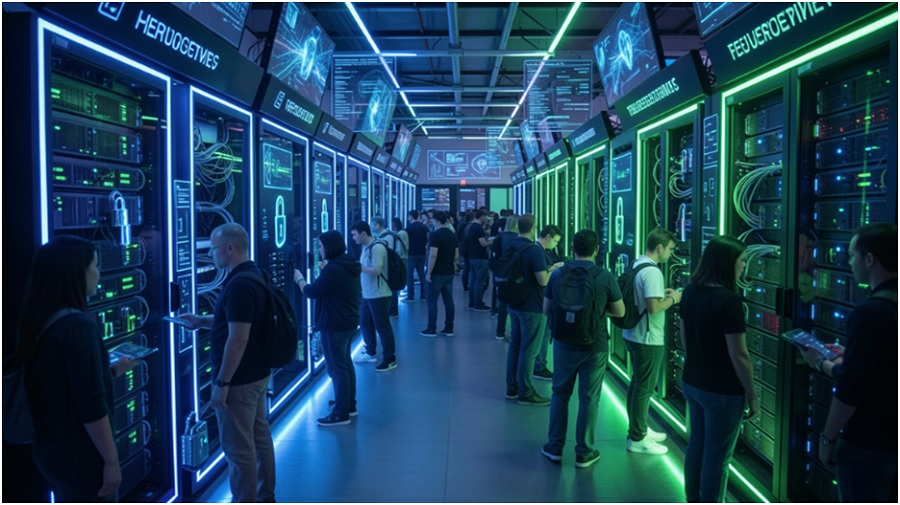
As enterprises increase the adoption of cloud, remote, connected software applications, and third-party solutions within their operating business processes, it requires a layered approach to security that creates a complex management process. Security teams are having to sift through vast amounts of activity and try to understand quickly emerging and adapting threats to defend against them. An AI model could be valuable in helping to evaluate masses of information, identify anomalies, and support decisions.
The rise of AI, along with other technologies such as cloud computing and digital technologies in the modern enterprise, has meant that AI and Cybersecurity markets will both grow together. Enterprises look towards AI in threat detection, security monitoring, vulnerability management, and incident response while also worrying about the privacy and potential dangers surrounding manipulated data, fragile models, and automated bias in automated judgments when applied.
Why AI Is Becoming Important in Enterprise Security
—————————–
Today, an organization’s security intelligence can involve an onslaught of security-relevant data. From access logs, endpoint activity, network traffic, cloud events, to application logs and authentication logs, all of them can have records of malicious activity. However, this data quantity far exceeds the capacity of your security team to analyze by hand, and much of the data ends up being noise.
An AI approach could assist with this: it can identify patterns and anomalous activity by detecting deviations from baseline behavior.
A machine learning system, for example, could learn patterns of an expected user’s activity over a period of time in an environment and, if behavior deviates from what’s expected, signal that. For example, an employee that typically accesses only a handful of internally focused applications at a certain hour and suddenly starts logging from a novel remote IP, accessing sensitive data and attempting to download large amounts of data, might raise the attention of an AI-powered security system. Just because that’s an anomalous activity does not mean the account is definitely compromised, but it helps the analyst focus on an account worth paying closer attention to.
Improving Threat Detection
—————————–
Identifying threats is one of the most mature applications of AI within the cybersecurity sphere. The legacy security tools most organisations have rely on signatures, indicators of compromise, and the specification of explicit rules. Whilst this is very useful for detecting clearly identified malware and known attacks, new versions can change, and attackers adapt the relevant infrastructure as well as the behaviour that makes those attacks identifiable.
Machine Learning adds a new layer: as well as looking for already recognised indicators of compromise, it also looks at behaviour. The AI might monitor network connections, running processes, user logons, file activity, and resource usage. The more signals that align to suggest something out of the ordinary is occurring, the heavier weight an incident receives, elevating the severity of an alert, and drawing it to the attention of a human analyst. This can be really effective in spotting brand new or less-well-known attack methods.
There’s a catch: not all anomalies are bad. An employee travelling, a new app performing a new function on a network, or an administrator performing a task during an emergency – none of these would be deemed to be malicious despite them being entirely out of the ordinary from a normal operations perspective. Too many false alarms lead to information overload for the security team. The goal then for any effective AI deployment is not to generate ever more alerts, but rather help those analysts through the noise, understanding why they have been flagged for attention.
Supporting Security Operations Centres
—————————–
SOCs monitor an organization’s technological infrastructure and analyze suspicious security-related events and anomalies.
It has become an increasingly difficult task, given today’s enterprise infrastructure; one may receive and need to examine huge streams of security-related event data, sourced from a variety of systems and devices (endpoints, cloud environments, identity management systems, firewalls, applications, etc.).
AI can assist by analyzing these events and performing correlations: A failed login can appear innocuous by itself, but when paired with multiple further failed logins, granted elevated privilege, and an unexpectedly large file transfer over the network, it indicates a malicious action rather than failed employee effort.
AI-powered solutions may perform such connections on behalf of human analysts to present a comprehensive view of security operations. New generative AI techniques are assisting in SOCs through less direct measures by summarizing reports, translating technical information into a human-understandable format, finding information from internal sources, and generating reports about past events.
Security operators do not plan on automating SOC entirely, but rather by reducing repetitive analytical tasks, enabling human analysts to focus more attention on actively investigating more advanced incidents.
Faster and More Controlled Incident Response
—————————–
Once a threat is uncovered, the organisation will want to find out how it happened, and reduce any ongoing risks.
This includes understanding what has occurred in terms of events, identifying relevant related activity and establishing the sequence of events. That is where AI can help, as it is able to make sense of such activity and support security teams in doing so.
In some environments, automated actions can also be deployed on discovering and flagging an activity. This may include, for example, isolating an endpoint, blocking a connection with adverse characteristics, or asking for some further authentication details from users in relation to it.
The automation will still have its limitations, however, as the ability to react quickly is useful, but so is making the right call. If, for instance, someone accidentally identifies a production machine running essential operational workload as anomalous, and it’s a false positive, taking such a machine out of service could represent an operational challenge even though no exploit or breach was made. Therefore, different automation levels are usually deployed depending on the level of risk attached to a particular action – more predictable responses with lower risk can be automated, whereas critical systems may need a human in the loop.
Using AI to Prioritise Vulnerabilities
—————————–
Enterprise security teams regularly deal with thousands of vulnerabilities across servers, applications, endpoints and cloud resources. But simply knowing a vulnerability exists does not always help a company understand the immediate need to prioritize fixing it. AI can take vulnerability information and analyze it with other factors – such as the asset value, exploitability, internet exposure, and the sensitivity of any associated data – and this provides a more context-based approach to vulnerability prioritization.
For instance, a vulnerability on a stand-alone development machine might not be as high a priority as on an internet-connected server that stores sensitive data.
AI-powered security platforms can allow security teams to use prioritization as a way to take their scarce resources and effectively use them on those vulnerabilities that pose the highest actual risks – an approach which falls in step with general cybersecurity practices where technical vulnerabilities, as well as business considerations and priorities, are integrated into risk management.
Protecting Cloud and Hybrid Infrastructure
—————————–
The move to the cloud has transformed the landscape of enterprise cybersecurity. Where previously organisations relied on a set of physical premises as a hard boundary of the organisation’s digital assets, the move to cloud infrastructure means now public cloud services, private clouds, on-premises IT and SaaS applications can all be in scope and accessible to employees in and outside the office as well as from devices like smartphones and tablets. This blurred line has effectively blurred physical security boundaries and made it extremely difficult to define and maintain a clear security perimeter.
AI can observe activity in and across these various environments and learn patterns that flag up such anomalous activity as potentially breached accounts, access attempts outside what would be considered normal, or configuration errors.
So, a sudden change in cloud permission privileges or abnormal behaviour around an application’s API could signal an attack beginning against that account or application. Moreover, cloud environments can change at extreme speeds; with new cloud infrastructure and service offerings available from numerous vendors at breakneck speed, static monitoring parameters simply will not keep pace. Again, the AI could offer an increased capacity to maintain effective security and keep pace with the pace of cloud changes, assuming it has the relevant inputs, configurations,s and security best practices underpinning its learning.
Strengthening Identity and Behavioural Security
—————————–
Identity has risen to the forefront of enterprise cybersecurity. Attackers exploit credentials because compromising an account may offer immediate access without generating malware detection alarms. But AI can also be used to detect abnormal activity by noting logging times, hardware used, locations accessed, resources consumed, nd access behavior.
For example, an employee whose work typically requires access to a few applications, all at once, logs into two or more, which involve very highly classified data; AI may detect the risk of that activity and add an extra layer of protection.
This analysis can provide another security feature to identity. But then comes the problem of surveillance-monitoring employees’ actions necessitates creating appropriate guidelines to limit where in an organization human activity monitoring begins and terminates, ensuring only risk-related data is recorded within legal and other constraints.
The Expanding Role of AI in Cybersecurity Research
—————————–
Rapid AI development trends are forcing businesses to develop an understanding of technology along with industry-wide trends. Research organizations, such as Expert Market Research, are investigating the new technology trends and the impacts each could have throughout industry sectors. Understanding these broader industry impacts from the view of cybersecurity can be valuable, as the uptake of AI doesn’t exist in its own bubble.
An evolution of cloud technology, the nature of enterprise data infrastructure, automation, and the nature of enterprise software can impact a business’s security environment.
Having the context of how this technology relates to each other can prevent organizations from thinking about AI solely as a standalone technology and from not having a clear grasp of it as an element of large-scale enterprise transformation.
AI Can Introduce New Cybersecurity Risks
—————————–
The use of AI in defence does not remove security risks. In some cases, it brings further risks in their stead. Attackers can seek to poison data inputs required by AI models, or otherwise intervene with how models make decisions from data.
Other risks include carefully crafted inputs to trick AI systems, or efforts to steal secret data stored within AI systems.
There is further risk posed by Generative AI-security assistance provided can turn out to be incorrect (a misleading explanation or poor guidance on an action)-and models can project confidence even when outputting flawed responses, so sensitive data must always be fact-checked before use, or action taken as a result. This has been encapsulated by NIST in its AI security and cyber defence work, focusing on securing AI systems themselves, but also on leveraging the technology to make Cyber Defence “Smarter” and anticipating cyberattacks that target AI systems. This implies that companies must prepare for security and risks from both directions for their use of AI.
Why Data Quality Matters
—————————–
In essence, an AI system is only as effective as the information it’s given. For enterprise security, there are myriad data feeds which may adopt a diversity of formats, definitions and levels of accuracy to one another. An AI system drawing information from such disparate and potentially inconsistent sources will provide an error-prone output.
Data preparation therefore emerges as a crucial aspect of AI implementation: teams need to have knowledge of data provenance, update cadence, and the comprehensiveness with which given sources represent the current environment.
Similarly, historical data sets need careful examination, as models trained on obsolete patterns of activity may flag real, current, and benign activities as suspicious, or alternatively, be unable to detect contemporary threats. This requires that AI be considered as part of a larger data-management framework, not simply a standalone security device.
Keeping Humans in the Decision-Making Process
An AI will be able to analyze data at a speed that the human team would be unlikely to match. However, speed removes the need for judgement: Security analysts are aware of the operational circumstances surrounding the event. They may be aware that the particular administrator in question is performing scheduled maintenance, or that a seemingly anomalous log-in relates to a legitimate business trip.
An AI may not be aware of this circumstance. It is for this reason that human consideration becomes especially necessary when AI is providing the outcome for a potentially consequential recommendation. It is important to be able to see what led up to that recommendation, challenge it, or do the opposite if necessary; this becomes much easier with intelligent workflows. Our aspiration is not for AI to eliminate the human expertise required to tackle cybersecurity but rather to eliminate some of the grunt work to allow practitioners to do what should matter: investigation and complex decision-making.
Governance and Accountability
—————————–
Since AIs are expected to have closer and more profound integration within security operations, governance becomes more important than ever. Enterprises must establish policies about what kind of AI systems are permissible to use, what sort of data it can access, and what activities it is permitted to perform. At the same time, an authoritative responsible body must be set up by the organization.
It may be found that if an AI-guided operation has made any erroneous detection, either to create an unwanted disturbance or give misleading suggestions to operators, it is possible for the enterprise to explain and evaluate what led to the decision.
Information like that will support researchers’ development toward a closer AI and information security alliance, which has been carried out by various researchers’ organizations (Informes De Expertos investigates developing technological trends and their implications on enterprises). With an overview study of such trends, enterprises would be enabled to incorporate AI adoption in a larger picture of technology and risk management framework.
Measuring the Real Impact of AI
—————————–
AI doesn’t magically make your security environment safer. Organisations need to consider whether the tech offers real and tangible benefits. Perhaps how quickly security teams identify a real attack, how much chaff is generated, the length of time to rank vulnerabilities, or whether analyst workloads can be increased without necessarily adding more heads to the pot. These measures provide a more useful assessment than simply counting the number of AI-enabled tools an organisation has deployed.
If the AI is sending a high volume of alerts but doesn’t improve either detection or investigation, its deployment could put further strain on security teams.
It is thus by results and not adoption that the most appropriate evaluation can occur.
Taking a Practical Approach to AI Integration
—————————–
No company has to try and install AI in all layers of its security operations at once. Enterprises are best off trying to identify an issue within the infrastructure and find a position where AI could be significantly helpful, like in alert triage, vulnerability assessment, behavior monitoring, and incident documentation- all positions where great amounts of data are already being manipulated,d and basic analysis is automated. Before taking an AI system on, the company needs to have concrete goals.
An organization then needs to consider what type of data an AI would require and needs to test for bugs, unexpected results, and integration incompatibilities within an offline environment before being connected to production infrastructure.
While evaluating, companies need to be very honest about how closely the AI should be monitored, and this is influenced by how large a “mistake” it can make. It might take more control to modify access privileges than a purely analytical recommendation system. This way, a business only learns how much AI can reasonably accomplish without taking too many business risks.
The Future of AI-Enabled Cybersecurity
—————————–
AI and Cybersecurity’s intertwining future: Experts predict. “The future relationship between AI and cybersecurity” is the hot topic. AI would play an increased role assisting security teams in parsing enormous volumes of data, discovering irregular patterns of behavior, as well as countering cyberattacks.
With attackers also likely to use artificial intelligence to speed up and enhance the sophistication of attack capabilities.
That is likely to spur another endless loop, as defenses strive to keep up with these advancing threats. Businesses would, in addition, need to protect their developing array of AI software applications performing a wide range of ordinary business functions. Security professionals would assume the mantle of defending these AI models and databases, user interfaces, automated workflows, and their infrastructure as well. This is not a case of ai wiAI supplant existing cybersecurity models.
But a blend ofAI-supported defensess alongside existing frameworks, skilled security professionals, and also the governance & risk management structures.
Conclusion
The use of AI in cybersecurity is driven by the modern environment-more data and complexity than security professionals can address via manual analysis alone. There are many areas- detecting anomalies, correlating security events, prioritizing the response to vulnerabilities, aiding in security incident response, and reducing time spent on repetitive analyses- where AI will likely make major gains.
Conversely, its shortcomings are no less significant. AI produces false positives, can be prone to faulty analysis caused by poor data quality, and adds yet more vulnerabilities itself. Its outputs need human interpretation,n and the resultant recommendations may prove infeasible.
The appropriate and responsible method to adopt AI is as a piece of the cybersecurity process in general. Robust security controls, quality data and governance, along with proficient human resources, will not disappear.
As adoption of AI continues, cybersecurity departments have a dual and related set of challenges: continuing to protect organization assets against increasingly advanced attackers while guaranteeing that the new enterprise AI systems themselves are secure, reliable, and auditable.