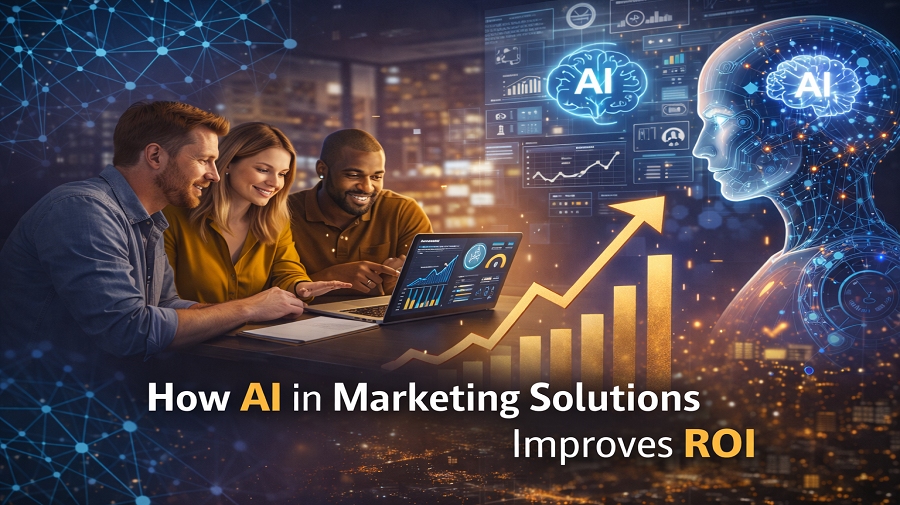
How AI in Marketing Solutions Improves ROI and Marketing Efficiency

The advantage that distinguishes high-performing firms from others is the loss of access to tools and individuals. It is the capacity to make better judgments more quickly and with less ambiguity. Customers allow too little room for mistake, and markets evolve too fast for static tactics. Artificial Intelligence (AI) has enabled marketing systems to learn from every encounter and get better with each result. Prior to allocating resources, they predict what will work rather than responding to performance after it occurs. This move has altered how return on investment is calculated, quantified, and scaled.
In this blog, we’ll talk about how AI in marketing solutions can assist in saving time, cut down on waste, and get a better return on investment throughout the customer’s lifetime.
The Evolution of AI in Marketing Solutions
——————————-
Marketing technology has advanced from basic automation platforms to complex systems that can analyze behavior and make choices on their own within the last ten years.
From Regulation to Intelligence
Static rules governed early marketing automation: send emails at X times, put advertisements in Y channels, and monitor clicks. AI nowadays:
- Learns from patterns instead of following predefined rules
- Adjusts actions based on real-time behavior, not historical assumptions
- Improves over time through continual feedback
Recent Market Shifts Influencing Adoption
Several macro trends have accelerated AI deployment:
Privacy changes
As third-party data recedes, first-party behavioral signals become more valuable. AI systems extract deeper insight from limited data sets.
Digital saturation
Consumers engage across multiple touchpoints. Human teams struggle to coordinate insight at scale. Intelligent systems optimize pathways across channels.
Revenue accountability
Marketing budgets are scrutinized more closely. Decision-makers expect evidence that spending directly adds to measurable value.
In this situation, artificial intelligence serves as the link between data, execution, and results.
Precision Targeting and Personalization
——————————-
AI’s ability to enhance ROI through sophisticated segmentation and customization is among its most significant effects.
Traditional Targeting vs. Predictive Targeting
Historically, audiences were defined by demographics, categories, or industry verticals. These criteria are high-level proxies for intent but weak predictors of purchasing behavior. AI changes this by modeling real-world signals.
AI-Driven Segmentation Uses:
- Engagement signals (scroll depth, time spent, clicks)
- Behavioral clusters derived from interaction patterns
- Contextual signals like buyer readiness and channel affinity
This results in reduced ad waste, higher relevance, and better allocation of resources to high-value prospects.
Dynamic Personalization
Modern systems adapt messaging at scale:
- Landing page content tailored per visitor
- Emails customized based on interaction history
- Offers are adjusted based on the likelihood of purchase
This goes beyond “spray and pray” marketing to intelligent individual engagement.
Automating Execution with Enhanced Performance
——————————-
Efficiency alone does not guarantee ROI growth. The value emerges when automation intersects with performance improvement.
Integrated Automation with Adaptive Learning
AI-driven automation differs from traditional workflow automation:
Decision-level optimization
Instead of adhering to set processes, AI constantly compares the performance of each operation against actual results. It determines which timings, channels, and messages have the biggest effects and automatically ranks those that produce quantifiable lift. It guarantees that resources are constantly directed toward the things that genuinely improve performance.
Feedback loops
Every interaction turns into a learning signal. Instead of depending on out-of-date assumptions, campaign outcomes are fed back into the system, improving future forecasts and enabling tactics to get better with each cycle.
Cross-channel synchronization
A unified experience that adjusts without manual coordination is produced by real-time alignment of activity across online, search, email, and social platforms.
What This Means Practically
- Budget shifts dynamically toward channels performing above target thresholds.
- Messaging adjusts automatically to what resonates best with different segments.
- Lead nurturing adapts based on engagement patterns.
The combined effect? More conversions at lower marginal cost.
Optimization Beyond Surface Metrics
——————————-
ROI is no longer determined by views or clicks alone. Intelligent systems connect marketing activity to value creation in deeper ways.
Modeling Customer Journeys
AI maps multi-stage customer journeys – not as linear funnels, but as evolving graphs of behavior. This allows businesses to:
- Identify drop-off points that reduce conversion probability.
- Detect high-potential signals early in the interaction.
- Forecast which paths drive revenue most efficiently.
Predictive Analytics in Action
Predictive models identify outcomes before they occur:
- Which leads will become customers?
- What content accelerates decision-making?
- When is a prospect most receptive to conversion?
This shifts the strategy from reactive assessment to forward-leaning optimization.
Measuring Impact with Advanced Insights
——————————-
A common pain point in marketing has been delayed or superficial reporting. AI enables real-time visibility and a deeper understanding.
Through AI in reporting & insights, systems detect correlations and anomalies that humans would never spot across thousands of data points.
Real-Time Performance Intelligence
Rather than static dashboards that report yesterday’s data, intelligent systems provide:
- Alerts for performance deviations
- Causal analysis, not just correlation
- Insight into why outcomes varied
This goes beyond metrics to reveal the drivers behind them.
Cross-Functional Alignment
Intelligent insight bridges operational silos:
- Marketing performance becomes visible to finance.
- Customer behavior informs product prioritization.
- Sales conversations integrate with campaign performance.
This alignment ensures that marketing is accountable not only for input metrics but for revenue outcomes.
Market Trends Driving Adoption and ROI Acceleration
——————————-
Understanding ROI requires context about where the market is heading and how AI reshapes competitive dynamics.
Trend: Privacy-First Intelligence
With restrictions on third-party tracking and cookie deprecation, access to external audience data is diminishing. AI compensates by maximizing value from first-party signals and compensating for data gaps through pattern recognition.
Impact: Improved performance assessment and targeting in a privacy-focused environment.
Trend: Real-Time Adaptive Advertising
Nowadays, real-time optimization is embraced by programmatic media, where bids, creativity, and channel selection adapt to real-time performance indications.
Impact: Higher yield from advertising spend by aligning budgets with active market dynamics.
Trend: Generative AI for Creative Production
Developments in generative models enable the quick production of customized content that takes into account the context and preferences of particular audiences.
Impact: Faster iteration cycles and reduced creative costs without compromising relevance.
What Changes When ROI Becomes Predictable?
——————————-
When AI systems govern marketing performance at scale, several strategic shifts occur:
ROI Moves from Estimation to Measurement
Budgets are no longer justified by replacement cost or benchmark comparisons. They are rationalized based on expected contribution to revenue.
Decision Cycles Accelerate
Manual analysis and planning give way to automated insight loops. Teams spend more time thinking strategically rather than interpreting spreadsheets.
Experimentation Becomes Scalable
Testing is no longer limited by manual constraints. Intelligent models evaluate combinations of messaging, timing, and targeting without exhausting resources.
How to Evaluate AI Investments for ROI?
——————————-
Not all AI systems deliver equal value. To assess the potential impact on ROI, consider:
Data connectivity
Is the system unified with key data sources?
Actionability
Does the solution surface insight that directly informs decisions?
Adaptive learning
Can the platform refine performance automatically over time?
Predictive capability
Does it forecast revenue impacts with measurable accuracy?
Investments should be judged not on features alone but on whether they measurably improve performance outcomes.
Conclusion
To put it briefly, the way value is produced, assessed, and sustained has fundamentally changed as a result of AI’s influence on marketing solutions. Intelligent technologies are transforming ROI from an aspirational number to a measurable, continually optimized outcome. As channels multiply and consumer expectations grow, the ability to anticipate demands, adjust engagement, and respond in real time will differentiate revenue-generating systems from those that generate noise. In this context, marketing intelligence is the primary driver of productivity, expansion, and quantifiable return rather than an add-on.
Ready to make every campaign accountable to results? Connect with our experts to build a marketing framework designed for profitable growth.