The Growing Impact of Low-Code and No-Code Tools on App Development


In the current digital landscape, speed is more than just an advantage; it’s a survival mechanism. For business owners and decision-makers, the traditional bottleneck has always been the software development lifecycle. Months of coding, high talent costs, and the “black box” of technical debt often stall great ideas before they hit the market.
However, a shift is occurring. The rise of Low-Code and No-Code Development is democratizing innovation, allowing enterprises to bridge the gap between complex business logic and functional software at a fraction of the traditional cost.
These tools are not just “shortcuts,” they are strategic assets for Application Modernization Services. Let’s explore how this trend is reshaping the enterprise and why your business needs to pay attention.
The Shift: Beyond Manual Coding
—————————-
To the uninitiated, “No-Code” might sound like a compromise. In reality, it is an evolution.
- No-Code platforms allow non-technical stakeholders to build functional apps using visual interfaces and drag-and-drop components.
- Low-Code platforms provide a middle ground, offering a visual foundation that professional developers can extend with custom scripts to handle complex integrations.
For a business owner, this means your “Subject Matter Experts,” the people who actually understand your operations, can participate in the development process. This alignment ensures that the final product actually solves the business problem it was intended to address.
Driving Enterprise Innovation with Low-Code No-Code Development
—————————-
The true power of these platforms lies in Low-Code Development enterprise innovation. Large-scale organizations are no longer using these tools just for simple internal trackers; they are using them to build robust, scalable customer-facing applications.
1. Accelerating Time-to-Market
Traditional development cycles can take six months to a year. With low-code frameworks, a Minimum Viable Product (MVP) can be ready in weeks.
This allows businesses to test market theories, gather user feedback, and pivot without sinking hundreds of thousands of dollars into a rigid codebase.
2. Solving the Talent Gap
There is a global shortage of specialized software engineers. By utilizing enterprise no-code development strategies, companies can empower their existing IT teams to do more with less.
Senior developers can focus on high-level architecture and proprietary AI solutions, while the low-code platform handles the repetitive “plumbing” of the app.
3. Application Modernization Services
Many businesses are held back by “monolithic” legacy systems. These are old software that is too risky to move but too slow to update.
Low-code tools act as a wrapper, allowing you to build modern, mobile-friendly interfaces that pull data from legacy databases, effectively modernizing your stack without a “rip-and-replace” overhaul.
Low-Code and No-Code Platforms
—————————-
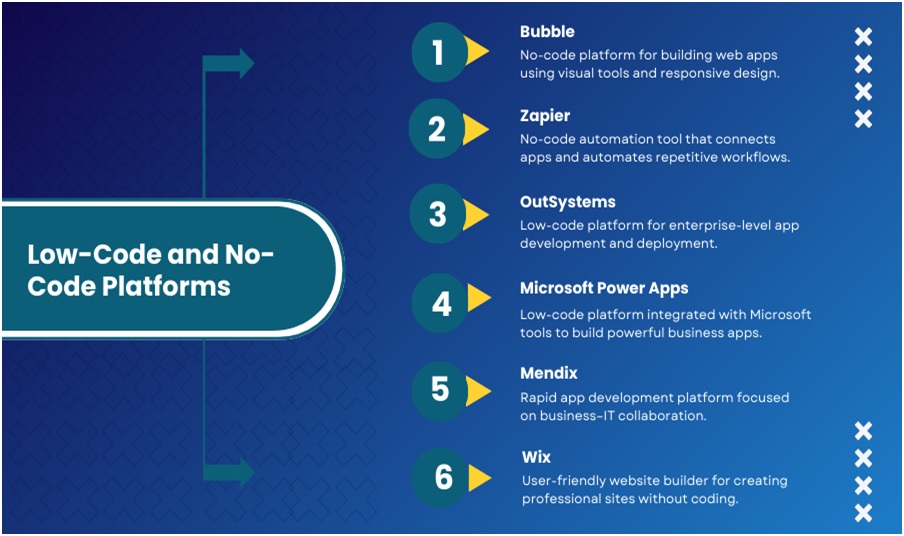 Organizations are spoiled for choices when it comes to low-code and no-code platforms available, each with their own unique features:
- Bubble
It is a no-code platform ideal for building web applications using visual editors that assist with responsive designs and creating seamless workflows.
- Zapier
Another no-code automation platform capable of connecting apps and automating workflows. It is used for its ability to simplify repetitive tasks across industries.
- OutSystems
It is a low-code platform created for enterprise applications, offering powerful tools for app development, deployment, and monitoring.
- Microsoft Power Apps
This low-code, enterprise-ready platform integrates well with Microsoft’s ecosystem, providing tools needed to create powerful applications with advanced functionality.
- Mendix
Rapid app development tools that focus on collaboration between businesses and IT, offering several integration choices.
- Wix
It is a reputed website building tool that offers user-friendly and visual interfaces for professional website creation without coding.
The Intersection of AI and Low-Code
—————————-
As an AI-focused firm, MoogleLabs recognizes that the most potent combination in today’s market is the marriage of Low-Code and Artificial Intelligence.
Modern platforms are now integrating AI solutions directly into the development environment. Whether it’s auto-generating UI components or using machine learning models to predict user behavior, the barrier to entry for high-tech features has vanished.
If you want to integrate a predictive analytics engine into your supply chain app, you no longer need a PhD in data science to build the interface.
Sector Spotlight: Healthcare Software Development
—————————-
Perhaps nowhere is the impact of Low-Code and No-Code Development felt more than in highly regulated industries. Healthcare software development has historically been slow due to the stringent requirements of HIPAA compliance and data security.
Today, we are seeing a surge in:
- Patient Portals: Built quickly to improve patient engagement.
- AI in healthcare: Implementing diagnostic assistance tools and automated patient triaging through low-code interfaces.
- Data Management: Streamlining electronic health records (EHR) through customized dashboards that don’t require a total system rebuild.
By leveraging low-code, healthcare providers can respond to crises (like a pandemic or a sudden regulatory change) in real-time, ensuring that technology serves the patient rather than hindering the provider.
Why “DIY” Isn’t Always the Answer for Businesses
—————————-
While the barrier to entry is lower, the stakes for business owners remain high. A poorly architected low-code app can lead to “Shadow IT,” It is a situation where dozens of disconnected apps are floating around your company without security oversight.
This is where a strategic partner becomes essential. A low-code no-code development company doesn’t just “drag and drop.” They provide the architectural oversight to ensure your Low-Code and No-Code Development projects are:
- Secure: Meeting global standards for data protection.
- Scalable: Ensuring that as your user base grows from 100 to 100,000, the app doesn’t break.
- Integrated: Connecting seamlessly with your existing CRM, ERP, and cloud infrastructure.
When it comes to Low-Code Development and Enterprise Innovation, the goal is to create a sustainable ecosystem where technology accelerates business growth rather than adding to the overhead.
Strategic Advantages for Decision Makers
—————————-
If you are evaluating your budget for the next fiscal year, consider these three pillars of the low-code movement:
| Feature | Business Impact |
| Reduced Cost | Lower initial investment and decreased maintenance fees. |
| Flexibility | Change workflows and UI elements in hours, not days. |
| Consistency | Standardized components ensure a uniform brand experience across all platforms. |
The Road Ahead: AI-Driven Development
—————————-
We are moving toward a future where “natural language” is the new code. Soon, business owners will be able to describe a business process, and AI-powered low-code tools will generate the initial framework.
However, the “human in the loop” remains vital. To truly leverage AI solutions and Application Modernization Services, you need a team that understands the underlying logic. You need engineers who can step in when the low-code tool reaches its limit and write the custom algorithms that give your business its competitive edge.
Final Thoughts: Take the Leap with Low-Code No-Code Development
The growing impact of low-code tools isn’t just a trend in the tech world; it’s a fundamental shift in how business is conducted. It’s about democratizing power and giving the visionaries and business owners, the tools to build.
Are you ready to modernize your legacy systems? Do you have an idea for an AI-powered healthcare app but are worried about the development timeline?
From Low-Code and No-Code Development to high-end AI solutions, hire an AI/ML company that help you build smarter, faster, and more efficiently.