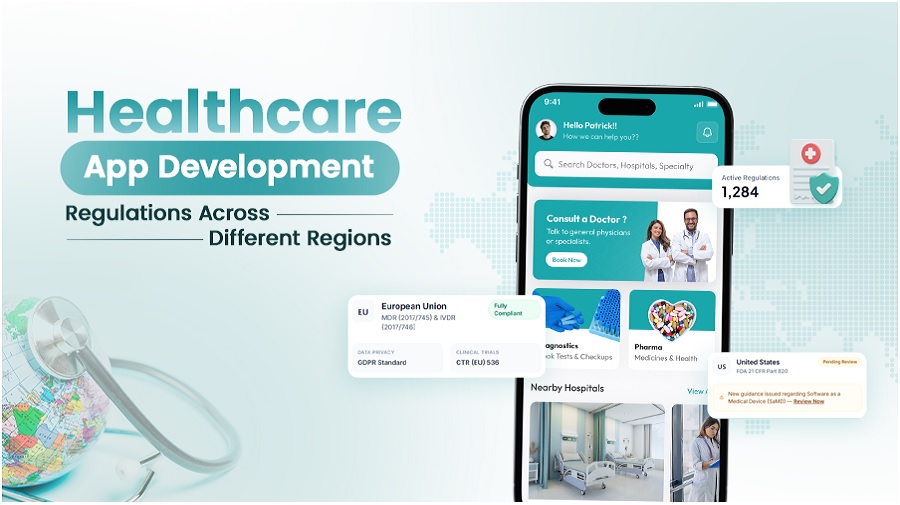
Healthcare App Development Regulations Across Different Regions

Most healthcare applications do not fail because of bad ideas but due to some regulatory surprises. A founder builds an app, early users love it, and hospitals show interest. Then, a regulator asks a simple question: “Where is patient data stored, and who can actually access it?” If the answer is not clear, growth actually stops.
That’s when the healthcare regulations play a significant role here. These regulations are able to shape how apps collect data, store it, and share it. They are not like the legal details that you can fix later on. They influence architecture, security, choice of cloud, and also the timeline of launch from the beginning.
It is like, what actually works in one country may be illegal in another one. An app approved in the US may fail in Europe. A faster launch in India may struggle to scale globally. There are so many such blind spots and challenges when many promising healthcare apps lose momentum.
Let’s break down the healthcare app development regulations across different regions and what you must account for before you write a single line of production code.
1. United States
————————-
The US healthcare system places a strong emphasis on protecting patient data and ensuring a safer clinical usage of digital tools. The regulations are enforced strictly, especially while handling apps like the healthcare one that handles sensitive information and supports medical decisions.
Key Regulations
- HIPAA
- HITECH Act
- FDA Software Regulations
Significance
The healthcare apps must secure patient data at every stage, which includes stronger encryption, well-controlled accessibility, and other detailed activity logs. If an app is able to support the diagnosis, treatment, or clinically informed decisions, it may be reviewed by the FDA. Choosing a compliant service is very important, and without any such compliance system, there can be a big problem in hospital partnerships that leads to limited accessibility.
2. European Union (EU)
————————-
The EU has a stronger emphasis on personal privacy and also on user controls. With the healthcare apps, there must be a following of safety medical standards, and they provide a greater framework for higher standards, patent rights, and also harmonized rules & regulations for medicines, and they aim for a unified and developed healthcare system. As a result, this leads to better safety, quality, and also great accessibility to the innovations. Also, it slows down the digital partnerships, making custom healthcare software solutions quite essential for building a secure and regulation-ready system.
Key Regulations
- GDPR (General Data Protection Regulation)
- MDR (Medical Device Regulation)
Significance
It is a must to have a clear explanation of what and why data is collected. Users should agree and give consent before their health data is processed. And also, the apps must give proper user control, including the ability to view, correct, or delete their data. Only the essential data should be collected and must be aligned with the EU data transfer rules, and also, all of the apps must support the diagnosis process, monitoring, or any treatment. It requires early certification before being released in the market.
3. United Kingdom (UK)
————————-
After the Brexit incident, the UK adheres to its own stringent healthcare regulations that actually help in managing operations that are quite similar to EU standards. And especially, there is a greater focus on the public healthcare systems. The UK’s healthcare regulations ensure great safety and patient protection through some independent bodies. Incorporating health and social care, the UK’s healthcare regulations cover everything from clinical trials to the workforce.
Key Regulations
- UK’s GDPR
- Data Protection Act 2018
- NHS Digital & Clinical Safety Standards
Significance
The healthcare apps must have stronger privacy standards and demonstrate safe usage in clinical settings. Apps working within the NHS must pass all the security reviews, usability testing, and clinical safety assessments. Along with that, clear documentation is required to explain how risks are managed and how the app supports patient safety at all outcomes. There should be proper control for the data, and the systems must be designed more smartly so that there is no such misuse.
4. India
————————-
The healthcare regulations are generally a mix of central & state laws, which include patient care & safety, quality, and standardization through implementation. Regulations are evolving to protect the user data while supporting innovation on a greater scale.
Key Regulations
- Digital Personal Data Protection (DPDP) Act
- Drugs & Cosmetics Act 1940
- National Commission for Allied & Healthcare Professions Act (2021)
- Insurance Regulatory and Development Authority of India (IRDAI)
- National Digital Health Mission (NDHM)
Significance
The healthcare apps must have proper user content before collecting health data and ensure secure storage. There must be protection of sensitive data from any kind of unauthorized accessibility. Apps that are aiming for integration into the hospitals, government platforms, and also insurers consist of secure sharing practices & proper data formats. This is similar to how EMR software enhances patient care in Indian healthcare facilities, which enables secure and interoperable flow.
Compliance tends to be a core requirement for healthcare partnerships and also implies long-term growth.
5. Australia
————————-
In Australia, the healthcare apps are treated like they are in a properly regulated healthcare ecosystem, and this consists of important aspects like transparency, patient safety, and accountability that are aligned to the regulatory approaches. Australian healthcare regulations contain national bodies that are able to manage public health, ensuring safety, quality, and effective practice.
Key Regulations
- Australian Health Practitioner Regulation Agency (Ahpra)
- Privacy Act 1988
- Australian Privacy Principles
- Therapeutic Goods Administration (TGA) Regulations
Significance
The apps must have clear transparency on how data is collected, stored, and also used; that, as a result, makes the users informed about the rights and the data breaches that are prompted. The apps that are helpful in assistance or in diagnosis need approval from the TGA regulations. This applies to many AI-powered health tools and also to remote care solutions.
Why Regional Regulations Matter in Early Development?
————————-
So, the healthcare regulations are not only legal things to check out at the end of the development process. It is meant for how you shape or design a healthcare app and how it can scale from the beginning. There are regional laws and regulations that tend to impact the stored patient data, the way it is protected, and also the accessibility.
On the other hand, with these strict regulations, there are certain aspects like onboarding, data consent flows, feature availability, and also the third-party integrations that make seamless functionality without any issues. While considering the regulations from the initial day, your development teams can build flexible systems that actually support multiple regions across networks. Also, with this, there is a reduction of risks, saving costs, and also easier expansion into the marketplace with much confidence.
For healthcare apps, the early regulatory alignment is not a slowdown but a foundation for stability, trust, and longer-term growth.
Conclusion
The healthcare app development goes beyond building just innovative features. It requires an understanding of how regional regulations can prevent patient data from breaches or issues and ensure proper safety standards, and it also defines digital health standards. The founders and product teams that plan for compliance on an early basis can easily launch faster and avoid higher expenses, and also establish a stronger relationship with the healthcare providers and regulators.
Working with an experienced healthcare app development company can help you bridge the gap between innovation and standard compliance. And with the regulatory insight and technical expertise, your healthcare apps can scale across regions while staying secure and reliable and also be made future-ready for greater productivity.