AI Audit and AI Testing: How They Differ and When You Need Each

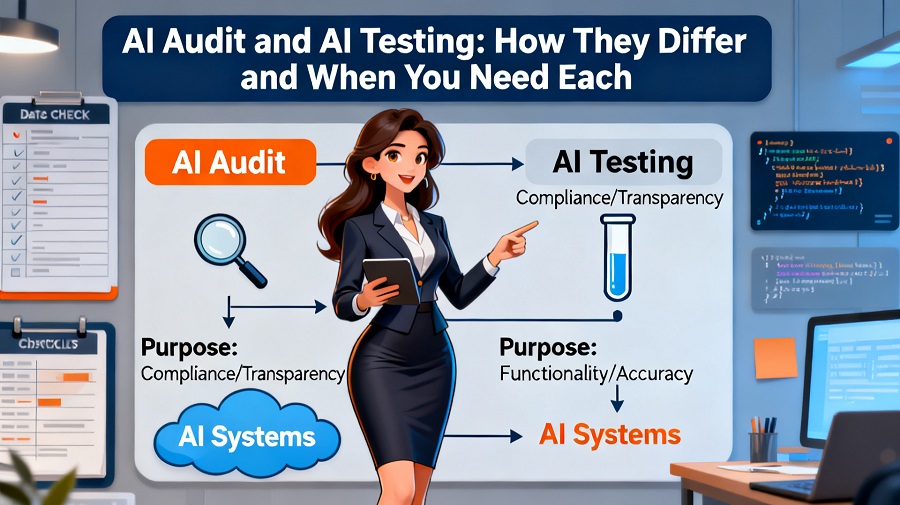
AI powered software can feel kinda unpredictable even if the core thing, mostly, works the way you expect. An ai audit service kinda helps orgs look at the wider technical landscape around an AI system, while AI testing leans more toward whether the specific features models do their job correctly under certain, defined situations.
These two practices sorta overlap, but they end up solving different headaches. Testing is often continuous, and more product focused. Auditing tends to take a more zoomed out perspective on architecture, data practices, security controls , monitoring, and even internal processes.
If you get the difference, teams can pick the right method at the right stage in an AI project, not too early or late, you know.
What is AI testing?
———————–
AI testing is mainly about checking whether an AI driven system acts properly and matches the stated technical or product requirements, you know. With traditional software, the behavior is typically more straightforward and predictable so it can be verified with usual test cases.
But AI systems can be way harder to judge, because what they produce is tied to training data, the model setup, the given context and also whatever new info comes in.
Like, take an example of a SaaS platform that applies AI to classify customer requests. In that situation, developers should confirm that the capability actually takes the right kind of input, and then returns the expected category.
They should not stop there though, they also need to look at the classification accuracy, and check how the system behaves when the request is incomplete , or even when it’s unusual in some subtle way.
What is an AI audit?
———————–
An AI audit is sort of a broad review of an AI system plus the processes that live around it. Instead of only checking single features , an audit can also look at models and datasets, the software architecture, the access controls, and the documentation.
It can include monitoring practices too, and basically how teams handle AI related risks. This wider lens can surface issues that usual test cases might skip. A model might still sail through functional tests, but the rest of the setup , can be quietly weak, like poor monitoring or not enough safeguards around sensitive data.
AI audit vs. AI testing: key differences
The main thing is scope, sorta—well, it is. AI testing looks at specific system behaviors, and kinda checks them. While an AI audit digs into the whole environment where those behaviors show up, even the surrounding context.
For example, take an AI recommendation engine on an online marketplace. Testing can check that suggestions show up the right way, still feel pertinent, and that everything loads fast enough like it should, of course.
But an audit could go beyond that and look at what data influences those recommendations, who can access that data, how teams detect changes in model behavior, and if the responsibilities for maintaining the system are clear and assigned right.
Testing is usually narrower and happens more often. Auditing is broader , and it often mixes a technical assessment with a review of processes, safeguards controls, and similar kinds of governance.
What does AI testing cover?
———————–
Functional behavior
Functional testing is basically about seeing if the AI features actually do the job inside the application . Like, for instance, when a system pulls data from uploaded invoices, the engineers can check if the supported files get in properly, if the AI processes them the right way, and if the extracted info ends up in the right workflow, not somewhere else.
Model performance
Teams also need measurable criteria for how good the model really is, like not just vibes. A classification model might need things such as precision and recall numbers, but another AI use case can lean on different metrics entirely, sometimes odd ones you would not expect. In the end the key part is to lock down what “acceptable performance” means , before any testing even starts.
Edge cases
Real users will sometimes give, incomplete input, or something unexpected, maybe even a bit unusual. By testing these kinds of scenarios, teams can find where an AI system turns flaky. They can also see how the app behaves when the model gives a mediocre output or a weak result.
Application performance
AI functionality also kind of pushes on the whole product. Load testing and integration testing can help you see if the system stays responsive, like as usage climbs, or when the AI parts are chatting and interacting with other services.
What does an AI audit cover?
———————–
Data practices
Auditors might look into where relevant data is coming from, how the various teams manage it, and if the access controls actually line up with what the system is meant to do.
Poor data quality, or just vague way of handling procedures, can really mess with AI performance even though the model part is working correctly.
Architecture and security
An audit might look at how an AI component plugs into the rest of the software setting. And yeah, this can cover the underlying infrastructure, authentication methods, integrations, access permissions, and even the way sensitive data moves between the system components.
Sometimes it’s less about “the model” and more about how everything interacts around it, in practice it can be pretty tricky.
Monitoring
After it ships, the AI behavior can drift a bit, because day to day usage in the world is kinda different than what we had in development, so the “rules” don’t always match.
An audit can look into whether the teams have real mechanisms in place, like detecting performance slowdown, odd or unexpected outputs, or other shifts that actually need a closer examination, not just a quick shrug.
Documentation and ownership
Organizations should know who, exactly , is responsible for keeping an AI system running and how critical choices are recorded or written down.
An audit might look at inner routines, the model documentation, the sign off workflow, and who does the upkeep.
When do you need AI testing?
———————–
Testing of AI needs to be part of the regular development lifecycle.
You require testing in the following circumstances:
- Developing a new AI-powered feature
- Incorporating an external model into your software
- Updating the existing model
- Modification in key data sets
- Application Logic modification involving AI
- Preparation for releasing a new product
Testing even needs to continue after the product has been launched due to model updates and modifications in input data.
Select Testing where the most important aspect is the correct functioning of the feature.
When do you need an AI audit?
———————–
An audit makes more sense when your worries stretch beyond just one feature, or some small part of it.
Like, an organization might have added several AI capabilities over time but never really checked how they interplay with the overall architecture, the data practices , the security controls, and the monitoring processes, together.
Also, an audit can come in handy before you start pushing AI into more important workflows or when you want it to touch more sensitive information.
Another very typical trigger is uncertainty. If the team can not describe, in a straight forward way, how an AI system is being monitored, what kinds of risks it brings in, or who is accountable for specific controls , then an audit will often help surface where the holes are.
Do you need both?
———————–
Yeah , in lots of cases, it works like that. AI testing and AI auditing they really seem to team up, not because they do the same job but because they ask different questions, sort of.
With testing you can show the model meets the defined performance requirements. But an audit might still uncover weak access controls, or say there is insufficient monitoring , even if the scores look good on paper.
And sometimes the reverse happens too. A company can have solid documentation and neat processes, while a new model version, when it gets dropped into real scenarios , performs poorly. In that situation testing is the better fit for spotting the trouble early.
If you use both you basically get two layers of assurance. Testing focuses on the technical behavior, while auditing takes the wider AI environment into account, more like governance and surrounding conditions.
How to choose where to start
———————–
Start with the problem you are trying to solve, like really clarify it first. If your team is developing or changing an AI feature, then begin with testing. Not just “run it once” but set expectations, define how it should behave, pick measurable criteria and then evaluate the system under realistic conditions, because yeah those edge cases tend to show up anyway.
If you need a broader understanding of an existing AI environment, start with an audit. Look at architecture, how the data is handled, what kind of monitoring is in place, the security controls, and who owns what, all together not scattered.
Also pay attention to product maturity. Early-stage AI projects kind of require frequent testing because everything shifts quickly. Mature systems often benefit from wider audits too, since their architecture and operational impact become more complex over time, and then the simple checks stop being enough.
Final thoughts
AI testing and AI auditing do sort of different jobs, kind of you know. Testing is more about checking whether a particular AI capability is working as it should, under certain set conditions, with defined inputs and expected output. Auditing is more like looking around the whole landscape, not just the one piece, it covers the larger environment , including system architecture, how the data is handled, security measures, monitoring in production, and even internal processes.
Also the decision isn’t usually stuck forever. Most teams can do regular testing during development and then use broader audits later, when they actually need to understand how the whole AI system is being managed and governed.
If orgs grasp this difference, they can pick the right approach for the issue in front of them , and improve their AI systems in a more systematic way, instead of guessing.