How AI Is Transforming Healthcare Software Development?

Healthcare has relied on technology for many years. Whether it’s through electronic medical records or the ability to schedule an appointment online, software has transformed the way that physicians and patients communicate. Now, AI is transforming the way healthcare software is developed.
AI is assisting developers with developing smarter systems capable of managing vast quantities of health-related data, enhancing precision, and making health-care services more accessible. It is also altering the manner in which medical software is developed, tested, and utilized.
The aim is not to take over from healthcare professionals. Rather, AI provides a platform for developing applications that will help doctors, enhance the experience of patients, and streamline administrative procedures in healthcare settings.
Smarter Healthcare Applications With AI
—————————-
Traditional healthcare software has set guidelines for what it can do. This software is able to keep track of patient data, schedule appointments, and perform simple operations. AI-based software can be used for far more than this.
Healthcare applications that use artificial intelligence (AI) can use what they have learned from previous patient interactions to enhance how well they work as time goes on. AI-based systems can recognize patterns in data, predict future outcomes based upon past trends, and provide helpful advice.
An AI-powered health care system analyzes patient records and identifies critical changes to a person’s health. This allows physicians to make faster decisions about providing quality care.
In order to create better healthcare software, developers have been shifting their focus toward developing more adaptable, smart, and easily accessible systems.
Improving Medical Data Management
—————————-
Every day healthcare organizations process large volumes of data. Patient records, laboratory results, radiological images, and treatment history are just some examples of data that requires effective organization and storage.
This data management process takes longer when completed manually and has a greater possibility of errors. AI enables efficient processing and organization of healthcare data.
AI-powered software can:
- Sort medical records
- Find important information quickly
- Reduce paperwork
- Identify missing details
- Improve data accuracy
The better the data is managed, the more time healthcare workers have to focus on patient care instead of spending hours looking up the answers to their questions.
AI Helps Developers Build Better Healthcare Software
AI is not just about changing how healthcare is delivered. AI is also changing how developers build those solutions.
AI can help developers build custom healthcare applications faster and maintain high quality by assisting with software development tasks such as code recommendations, error detection, and testing.
For instance, artificial intelligence (AI) can assist with identifying potential code problems prior to the release of a product. In addition, AI can be used to evaluate various feature options and enhance overall system efficiency.
By being able to create more reliable health care solutions faster than before, development teams can use this tool.
Enhancing Patient Care Through AI Software
—————————-
More and more patients are using patient-centric health care software. Mobile health apps, virtual assistants, and remote patient monitoring software allow patients to better control their health.
AI helps these systems provide more personalized experiences.
For example, healthcare apps can use AI to:
- Track patient progress
- Send medication reminders
- Answer common health questions
- Monitor health changes
- Provide personalized suggestions
These tools enable patients to maintain contact with healthcare professionals and take care of their own health when not in the hospital environment.
AI in Medical Diagnosis and Decision Support
—————————-
One of the biggest changes AI brings to healthcare software is decision support.
Before doctors make a decision, they have a lot of information to review. AI software can examine the medical data and indicate potential issues.
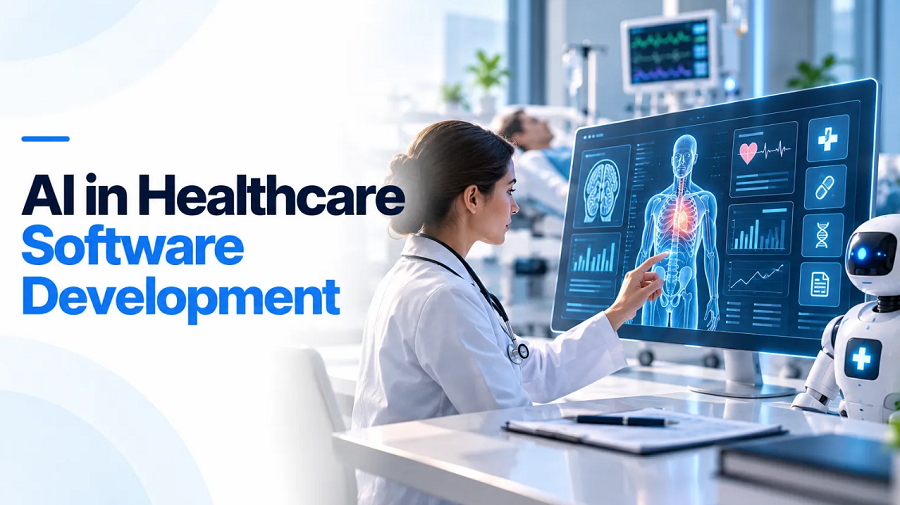
AI systems are able to look at pictures of patients (medical images), as well as a patient’s past illnesses and/or medical conditions (patient history) and the results from laboratory testing (test results) to provide information that may assist doctors in identifying potential health problems.
These systems don’t replace doctors. They just offer additional information to help you make better choices.
Faster Healthcare Software Testing
The software used for health care has to be held to a high standard, since the software contains personal and private patient data. Therefore, testing of this software is a critical component of the development process.
AI has the potential to enhance speed and efficacy of testing. Through automation, AI can evaluate software performance, detect anomalies, and uncover vulnerabilities.
This helps developers create safer healthcare applications.
AI based testing will also decrease the amount of work required of humans to perform repetitive tests. Developers can then spend their time working towards increasing product functionality and improving the experience of users.
Improving Healthcare Security
Healthcare systems are where patients’ private information is stored. This makes security a significant issue.
Artificial intelligence is helping programmers develop more effective safety measures for computers. AI will be able to watch computer networks, find irregular behavior, and determine whether there may be potential cyber attacks.
AI can recognize unusual logging in and/or unexpected patterns of data access. This enables healthcare organizations to take action on potential security threats rapidly.
As healthcare software continues to be more connected, it is increasingly important that we have robust security controls in place.
The Growth of Telehealth Software
People are increasingly turning to telehealth platforms to make it easier for them to receive the healthcare services they need. AI has been able to help make those platforms better.
Telehealth software using artificial intelligence (AI) has the capability to provide virtual doctor visits, monitor patients remotely, and automate patient-provider communications.
An AI chat assistant can provide initial answers to general medical questions prior to a person being able to discuss their concerns with a doctor. Similarly, remote patient monitoring devices can gather health data and transmit it to a physician.
In addition to helping patients receive their care, it also eliminates the need to continually go into a hospital/clinic.
Challenges of Using AI in Healthcare Software
The advantages of using AI in healthcare software development are accompanied by the disadvantages that developers must contend with.
Data privacy has become a major concern for most people. Healthcare organizations have an obligation to safeguard patient data, as well as comply with federal and state laws that govern how patient data may be used.
Another difficulty with using AI is accuracy. For AI to produce accurate results, it must use high-quality information. Inadequate or incomplete information will lead to less-than-optimal performance.
Organizations in healthcare are also in need of individuals with training that understand both technology and medical requirements.
A successful building of AI healthcare software requires a delicate balance of creating new ideas (innovation), providing safe care (safety) and building the confidence of patients in the technology (patient trust).
The Future of AI in Healthcare Software Development
—————————-
Artificial Intelligence will continue to shape how software is developed for the healthcare industry over the next few years. In addition, software developers will develop more sophisticated tools to assist both healthcare professionals and patients.
Future healthcare software will provide additional support for personalized treatments, enhanced patient monitoring devices, and better ways to communicate with doctors.
Healthcare is a people-driven industry that cannot be automated. However, AI can assist healthcare workers to perform their jobs more effectively and ultimately improve patient care.
The goal of the development of the next generation of healthcare software will be to create software products that are much faster, safer, and better suited to help people in their everyday lives. AI will become a major component of this process, enabling the creation of a healthcare system that is significantly more connected and focused on the needs of patients.
FAQs About How AI Is Transforming Healthcare Software Development
—————————-
Q1) How is AI changing healthcare software development?
Healthcare software is being created with artificial intelligence (AI) by developers so they may develop a higher level of “smartness” for their products. This includes the ability to process and analyze large amounts of data, automate processes, make fewer errors, and provide a more useful experience for both physicians and patients. With the use of AI, developers are able to create faster, safer, and more personalized solutions to help improve healthcare.
Q2) Can AI improve the accuracy of healthcare software?
Yes, AI may enhance accuracy through identification of trends within medical data, error detection and facilitating the processing of information for healthcare systems. Human evaluation remains a vital component of medical decision making.
Q3) How does AI help doctors and healthcare professionals?
AI-based health-care software organizes patients’ data, analyzes their medical records, aids in the identification of illness, and reduces the amount of time spent performing routine duties. These benefits allow professionals to spend more time caring for patients.
Q4) Is AI healthcare software safe for patient data?
Artificial intelligence-based healthcare software has the potential to enhance security measures within healthcare organizations through the identification of anomalies and protection of sensitive data. In addition to using artificial intelligence-based healthcare software, healthcare organizations should also utilize robust security protocols and adhere to privacy rules in order to protect patient data.
Q5) What is the future of AI in healthcare software development?
AI will continue to assist healthcare professionals and enhance the use of digital healthcare services. As such, the future of AI in healthcare software is expected to include: more personalized care tools; improved remote monitoring; more intelligent health-related applications; and improved communication among patients and healthcare providers.