
How Generative AI Is Transforming Enterprise Software Development

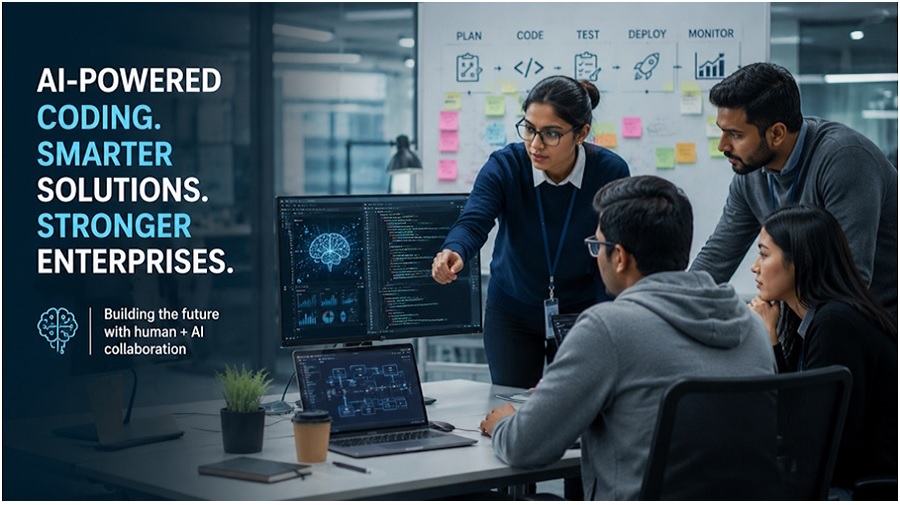
Enterprise software development has always been a careful balance between speed, quality, cost, and business fit. Teams are expected to build secure applications, support legacy systems, release new features, and respond to changing customer needs without slowing down the business. That pressure is one reason generative AI has moved so quickly from experiment to everyday engineering support.
Generative AI is not replacing software teams. It is changing how they work. It helps teams write code faster, review existing systems, create test cases, document features, analyze requirements, and improve support workflows. For enterprises, the real value is not only faster coding. The bigger shift is how AI helps turn complex business needs into working software with less friction.
Many companies are already exploring AI across healthcare, finance, education, retail, logistics, and internal operations. ZeeClick has covered similar technology adoption trends in areas such as AI-driven healthcare software development and software development services for digital change. Generative AI now adds a new layer to that software journey.
Faster requirement analysis
—————————
Enterprise software projects often begin with long requirement documents, stakeholder meetings, workflow notes, and scattered user feedback. Before a single feature is built, business analysts and product managers spend time turning that information into user stories, process maps, and technical notes.
Generative AI can support this early phase by summarizing documents, finding gaps, grouping similar requirements, and creating first-draft user stories. It can also compare business rules across teams and flag unclear instructions before they create delays later.
This does not remove the need for human review. Enterprise requirements are rarely simple. A finance workflow, healthcare platform, or logistics system may involve compliance rules, approvals, exception handling, and role-based access. AI can speed up the first pass, but product owners and engineers still need to check whether the output matches real business needs.
The benefit is that teams spend less time sorting raw information and more time asking better questions.
AI-assisted coding becomes part of daily engineering
—————————
Code generation is the most visible use of generative AI in software development. Developers can use AI tools to create boilerplate code, suggest functions, explain unfamiliar code, convert logic from one language to another, and draft API calls.
For enterprise teams, this is useful because large systems often include repeated patterns. Authentication flows, data validation, reporting screens, admin panels, and CRUD operations can take a lot of time when built manually from scratch. AI can help produce a first version, while developers focus on architecture, business rules, security, and performance.
The best results come when teams treat AI-generated code as a draft, not a final answer. Developers still need to review logic, test edge cases, check dependencies, and confirm that the code fits internal standards. In enterprise settings, code must be maintainable for years, not just work once during a demo.
This is where experienced engineering judgment matters. A useful AI suggestion can save time, but a poor suggestion copied without review can create future technical debt.
Better modernization of legacy systems
—————————
Many enterprises still run older applications that support core operations. These systems may work well, but they can be hard to change because documentation is missing, codebases are large, and original developers may no longer be available.
Generative AI can help teams understand legacy code faster. It can explain old functions, map dependencies, suggest refactoring paths, and help create missing documentation. This makes modernization less risky.
For example, a team working on an old inventory system can use AI to understand business logic hidden inside stored procedures or outdated application code. Once the logic is clearer, engineers can plan safer migration steps, API layers, or module-by-module upgrades.
This is especially useful for businesses working with custom software development services, where the goal is not to force a generic tool into the company but to build around existing workflows, data, and long-term needs.
Testing gets broader and faster
Testing is another area where generative AI is making a strong impact. Enterprise applications need unit tests, regression tests, usability checks, API tests, security checks, and user acceptance testing. Creating and maintaining these tests can consume a large part of the development cycle.
Generative AI can help create test scenarios from requirements, generate unit test drafts, suggest edge cases, and turn bug reports into repeatable test steps. It can also help QA teams create test data for different user roles, regions, pricing rules, and exception cases.
This does not mean teams should trust every AI-generated test. The quality of a test depends on how well it reflects real business behavior. AI may miss rare but important scenarios unless the team gives it strong context.
The practical gain is coverage. Teams can move beyond obvious happy-path testing and explore more negative cases, boundary cases, and workflow variations. That leads to more stable enterprise software.
Documentation becomes less painful
Documentation is often treated as a task to finish at the end of a project. By then, teams are busy with release work, and documentation may become incomplete or outdated.
Generative AI helps by turning code comments, release notes, user stories, and technical decisions into readable documentation drafts. It can create API guides, onboarding notes, admin manuals, and support articles.
This is valuable for large companies because enterprise software is used by many groups: developers, business users, support teams, compliance teams, and new employees. Clear documentation helps each group understand the system without asking engineers the same questions again and again.
AI can also help keep documentation updated when features change. A developer can provide a code change or release note and ask AI to update the related user guide. Human review is still needed, but the starting point is much better than a blank page.
Product teams can prototype faster
—————————
Before investing in full development, product teams often need prototypes to test ideas with users. Generative AI can help create wireframes, sample content, workflows, user journeys, and feature descriptions.
This makes early discovery faster. Instead of discussing abstract ideas for weeks, teams can review clickable concepts, sample screens, or workflow drafts much earlier. Business users can react to something visible, which often leads to clearer feedback.
Fast prototyping also reduces waste. If users dislike a workflow during the prototype stage, the team can revise it before heavy development begins. That protects budget and avoids building features that people do not use.
ZeeClick has also discussed how businesses evaluate partners when building scalable products, including points covered in its article on software development companies helping startups build scalable products. The same lesson applies to enterprise AI projects: speed matters, but the software still needs a sound product direction.
Security and governance need more attention
—————————
Generative AI brings clear benefits, but it also creates new risks. Enterprise teams must think carefully about data privacy, intellectual property, source code exposure, model accuracy, access controls, and audit trails.
A common mistake is allowing teams to paste sensitive code, customer records, or business documents into public AI tools without policy checks. That can create serious data issues. Enterprises need clear rules about which tools are approved, what data can be used, and how AI outputs should be reviewed.
Governance also matters for AI-generated code. Teams should track whether code was generated, who reviewed it, and whether it passed the same checks as human-written code. AI should fit into the existing development process, not sit outside it.
Security teams may also use AI for code scanning, threat modeling, and policy checks, but final accountability still belongs to the organization.
Enterprise developers will need new habits
Generative AI changes the developer role. Developers still need strong programming skills, but they also need to become better reviewers, prompt writers, system thinkers, and risk assessors.
A developer using AI well does not simply ask for code and paste it into a project. They provide context, check assumptions, compare options, test the output, and improve it. They understand when AI is useful and when it may be risky.
This creates a new skill mix. Developers who understand architecture, domain logic, testing, and security will get more value from AI than those who only use it for quick snippets.
For enterprises, training matters. Teams need shared standards for AI use, prompt quality, code review, documentation, and security checks. Without standards, AI use becomes inconsistent across departments.
AI will not fix broken software processes
—————————
Generative AI can speed up many parts of development, but it cannot fix weak planning, unclear ownership, poor architecture, or missing user feedback. In some cases, AI may even make problems worse by helping teams produce more code before they have solved the right problem.
Enterprise leaders should avoid treating generative AI as a shortcut around good software discipline. The strongest results come when AI supports a mature process: clear goals, strong architecture, secure coding, QA discipline, and active business involvement.
AI works best as a multiplier for good teams. It helps them move faster, explore more options, and reduce repetitive work. It does not replace the need for experienced judgment.
What comes next for enterprise software teams
Generative AI is becoming a normal part of software development. In the near future, enterprise teams will likely use AI assistants across planning, coding, testing, documentation, DevOps, support, and analytics.
The winning teams will not be the ones that use AI everywhere without control. They will be the ones that use AI carefully where it improves real work. They will protect sensitive data, review outputs, train teams, and connect AI tools to measurable business goals.
Enterprise software development is moving from manual-heavy delivery to AI-assisted delivery. The change is already visible. The next step is learning how to use it with enough discipline to build software that is faster to deliver, easier to maintain, and better matched to business needs.