Why Machine Learning Projects Fail After the Proof-of-Concept Stage?

A machine learning proof of concept can be surprisingly persuasive. A small team prepares a dataset, trains a model, and demonstrates that it can predict demand, classify customer requests, detect unusual transactions, or recommend products.
The early results look promising. Business leaders see a working demo. The project receives positive feedback, and the team starts discussing a broader rollout.
Then progress slows.
The model does not connect cleanly with existing applications. Data quality changes outside the test environment. Predictions take too long to reach the people who need them. Security teams raise questions that were not considered during the experiment. The business cannot agree on who will maintain the system after launch.
Months later, the proof of concept remains a presentation rather than a working business tool.
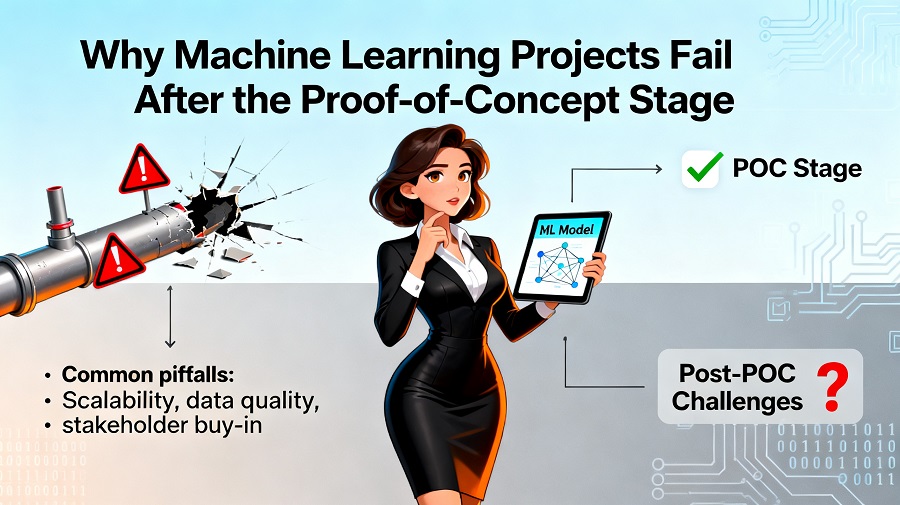
This pattern is common because proving that a model can produce a useful result is not the same as building a dependable machine learning product. The first task is mainly analytical. The second involves software engineering, data management, operations, security, governance, and business ownership.
Understanding that gap helps companies avoid spending months on experiments that never reach daily use.
A Proof of Concept Answers Only One Question
—————————–
A proof of concept usually asks whether a machine learning approach is technically possible.
For example, a retailer may want to predict which customers are likely to stop purchasing. The data team collects historical records, selects a model, and tests its ability to identify customers who later became inactive.
If the model performs better than a simple baseline, the experiment may be considered successful.
That result is useful, but it answers only one question: can patterns in the available data support a reasonable prediction?
Even tools such as no-code machine learning platforms can simplify early experimentation, but they do not remove the need for dependable data, software connections, monitoring, and ownership.
A production system must answer many more questions:
- Can the model work with current data rather than a prepared historical file?
- Can predictions reach business users at the right time?
- Can the system handle missing, delayed, or incorrect records?
- Can teams explain how predictions are used?
- Can the model be monitored after release?
- Can someone update or replace it when its performance changes?
- Does the business process actually improve because of the prediction?
Many projects fail because leaders treat the first technical result as evidence that the remaining work will be simple. In reality, the proof of concept may represent only a small part of the total effort.
The Test Data Is Cleaner Than Real Business Data
—————————–
Data used during an experiment is often prepared specifically for the model. Duplicate records are removed, missing values are handled, labels are checked, and unusual cases may be excluded.
Real business data is rarely as controlled.
Customer records may be stored differently across departments. Product names can change. Teams may stop entering certain fields. A software update can alter the format of an important value. Historical data may contain patterns that no longer represent current customer behavior.
A model trained on a carefully prepared dataset can struggle as soon as it receives live information.
The problem is not always the model itself. The surrounding data process may be unreliable.
Before moving beyond the proof of concept, teams need to document where each data field comes from, how often it changes, who owns it, and what should happen when it is incomplete. They also need automated checks that identify unexpected values before those values affect predictions.
Without this foundation, the model becomes dependent on manual cleanup. That may be acceptable during an experiment, but it cannot support routine business use.
The Model Is Not Connected to a Business Decision
—————————–
A model can be accurate and still have little practical value.
Consider a system that predicts which sales leads are most likely to convert. The prediction matters only if sales representatives receive it before deciding whom to contact. It also needs to be presented in a form they understand and trust.
If the result sits in a separate dashboard that nobody checks, the model has not improved the sales process.
Every machine learning project needs a clear path from prediction to action. Teams should know:
- Who receives the prediction?
- When do they receive it?
- What decision should it support?
- What options does the user have?
- How will the team record the action taken?
- How will the business measure the outcome?
These questions should be answered before the model is prepared for wider use.
A project framed as “build a churn model” is incomplete. A stronger definition would be “help the retention team identify high-risk customers each week and select a suitable response before those customers disengage.”
The second version connects the technical work to a person, a schedule, and an expected business result.
The Existing Software Cannot Support the Model
—————————–
A notebook-based experiment may produce predictions correctly, but business applications need much more than a model file.
The system may need an application programming interface, access controls, data pipelines, error handling, logging, user screens, alerts, and connections with customer relationship management or resource planning software.
These parts often require more work than the model itself. This is also why broader software development services support digital transformation: new technology must work with actual business processes, data, and existing systems rather than remain an isolated tool.
A company may also discover that its existing applications were not designed to use real-time predictions. Important data might be trapped in older systems. Some processes may still depend on spreadsheets and manual approvals.
The move from proof of concept to production calls for close cooperation between data scientists, software engineers, cloud specialists, security professionals, and the people who own the affected process.
Businesses that lack these skills internally may work with a software development company in Germany to connect the model with existing applications, prepare supporting services, and make the system suitable for regular use.
The goal is not merely to place a model on a server. The goal is to create a working product around it.
Nobody Owns the Project After the Demo
Proof-of-concept work is often led by a small technical group. Once the demo is complete, ownership becomes unclear.
The data science team may expect the information technology department to run the system. The IT team may view the model as a data science responsibility. The business department may expect both groups to manage it without assigning a product owner.
This confusion leads to delayed decisions and unresolved problems.
A production machine learning system needs named owners for several areas:
- Business outcome
- Data quality
- Model performance
- Application support
- Security and access
- User training
- Budget and vendor management
One person does not need to handle every task, but each responsibility must belong to someone.
A business owner is especially important. This person should decide whether the system continues to solve a useful problem and whether users are acting on its output.
Without business ownership, the project can become technically interesting but commercially irrelevant.
Performance Changes After Release
A machine learning model is built from past examples. Its performance can decline when customer behavior, market conditions, product ranges, internal policies, or data collection methods change.
A fraud model may become less useful when criminals adopt new tactics. A demand forecast may struggle after a major pricing change. A customer support classifier may misroute requests when the company launches a new service.
This change is sometimes called model drift, but the practical issue is simple: a model that worked during testing may not keep working in the same way.
Teams need a monitoring plan before release.
That plan should identify:
- Which prediction measures will be tracked
- How often results will be reviewed
- What level of decline requires action
- Who can approve retraining
- Which data will be used for updates
- How an older model can be restored if a new version performs poorly
Monitoring should also include the wider business process.
A model may maintain its technical score while producing less value because employees stop using it, customers respond differently, or the recommended action becomes too costly.
The Success Metric Is Too Narrow
Machine learning teams often focus on measures such as accuracy, precision, recall, or mean error. These measures help compare models, but they do not fully describe business impact.
A customer churn model may identify high-risk accounts accurately, yet the retention offers could cost more than the revenue they preserve.
A recommendation system may increase clicks while reducing average order value.
An automated document classifier may save time for one department while creating extra correction work for another.
A production decision should consider technical and business measures together.
Useful business measures might include:
- Revenue protected or gained
- Time saved per case
- Reduction in manual review
- Cost per prediction
- Customer response rate
- Error correction workload
- Adoption by intended users
Teams should agree on these measures before starting the proof of concept. Otherwise, a technically successful demo may be promoted without evidence that it solves a valuable problem.
Users Do Not Trust the Output
A prediction only matters when someone is willing to use it.
Employees may reject a machine learning system when its recommendations appear without explanation, conflict with their experience, or create extra work. They may also worry that the system is intended to monitor or replace them.
These concerns cannot be solved through technical training alone.
Teams should involve users early and ask how decisions are currently made. The model’s output should fit that process rather than forcing people into a separate tool without a clear reason.
It can also help to show the factors behind a recommendation when the use case permits it. A sales representative may trust a lead score more when the system identifies recent product interest, company size, and past engagement as contributing factors.
User feedback should continue after launch. Frontline employees often notice changing patterns before they appear in formal performance reports.
Security and Compliance Arrive Too Late
An experiment may use a limited dataset in a controlled workspace. A production system may process personal, financial, operational, or commercially sensitive information across several services.
That change can introduce new risks.
Teams need to consider who can access the data, where it is stored, how long it is retained, and whether prediction records must be auditable. They may need approval before using certain customer attributes or sending data to an external service.
Security and legal reviews should begin during project planning, not after the model has been completed.
Late reviews can force major changes to the system design. In some cases, they can stop the project entirely because the planned use of data does not meet company policy or regulatory requirements.
The Project Tries to Scale Too Quickly
A successful experiment can create pressure for a company-wide launch.
That is often a mistake.
A controlled pilot with one department, region, or customer group provides a safer way to test the full system. It reveals whether data arrives correctly, users understand the output, support teams can resolve problems, and the predicted value appears in real work.
The pilot should include clear entry and exit criteria.
For example, the company may require the system to meet a minimum prediction standard, achieve a defined user adoption rate, and reduce processing time without increasing customer complaints.
If the pilot succeeds, the company can expand gradually. If it fails, the team can correct the process without disrupting the entire business.
A Better Path From Experiment to Production
—————————–
Companies can improve their chances of success by treating machine learning as a product rather than a one-time technical project.
A practical path includes these steps:
Define the business decision
Describe who will use the model, what decision it supports, and what measurable result should change.
Check data readiness
Review data quality, ownership, access, update frequency, and known gaps before training the model.
Design the full system early
Plan how data enters the system, where predictions go, how users respond, and how errors are handled.
Involve users during the experiment
Ask intended users to review early output and explain what would make the prediction useful in their daily work.
Run a limited pilot
Test the model, application, workflow, and support process with a controlled group.
Prepare monitoring and ownership
Assign responsibility for business results, data health, model performance, software support, and future updates.
Scale based on evidence
Expand only after the system produces a stable technical result and a measurable business benefit.
From a Promising Demo to a Working Product
Machine learning projects rarely fail because the first model cannot produce an interesting prediction. They fail because the company underestimates everything required around that model.
Clean live data, dependable software, clear ownership, user trust, security controls, and meaningful business measures determine whether an experiment becomes a useful product.
The proof of concept should not be treated as the finish line. It is evidence that an idea deserves a more demanding test.
Companies that plan for production from the beginning can make better decisions about which experiments to fund, which ones to stop, and which ones are ready to become part of daily work.