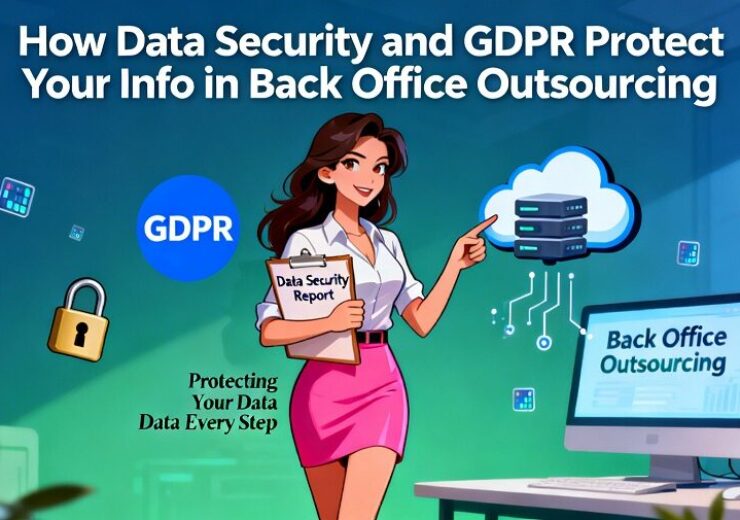
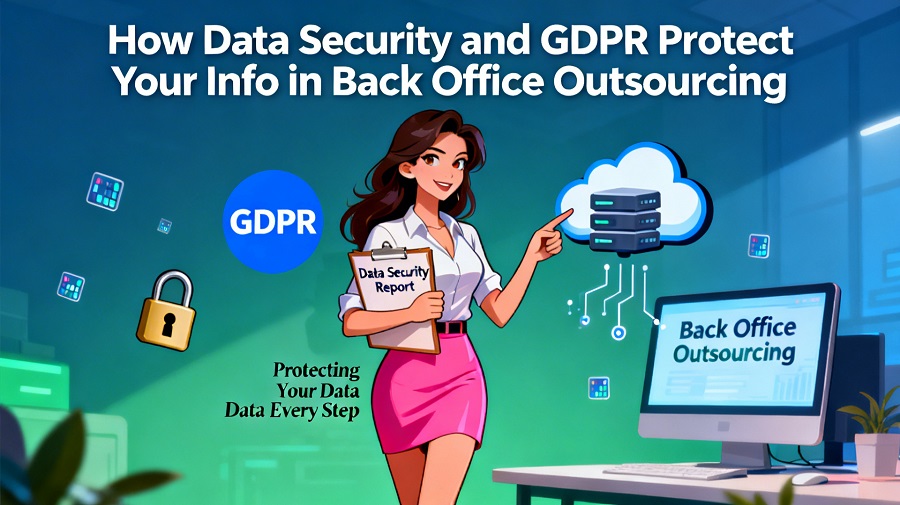
How Data Security and GDPR Protect Your Info in Back Office Outsourcing

Have you ever seen any entrepreneur addressing your queries? Whether you want to sign up for a new account on Outlook, enter your attendance in the HRMS, or even fill out survey forms. Your information begins a journey. Sometimes, it takes your data to a specialized team in a completely different part of the world. This professional support from a specialized expert is called a Back-office outsourcing service.
The back office is like a high-tech engine room that pulls every major company to success. Think of a famous brand like Nike or Apple. These are some highly recognized brands engaged in shoe- and phone-making activities, respectively. So, they are excellent at what they originally do, but they might hire an external company for a back-office service like promoting their products, managing the data of their products worldwide, etc. So, delegating some non-core activities to an expert to handle that boring but vital stuff like a professional is defined as “business process outsourcing.”
Here, a big question arises: If a company in the USA or any part of the world sends its private data or records to a BPO company in India. Is it not afraid of its sensitive records being stolen? Or how does an external partner ensure privacy? Well, these concerns end when that partner follows strict international laws like CCPA, GDPR, HIPAA, or SOC 2 along with ISO security rules.
What Exactly is Back-Office Outsourcing?
———————————-
Before diving deep into security, let’s invest a few seconds in understanding what back-office outsourcing is. Let’s say your front office handles customers and sales at a restaurant. And the team in the backend, like the chef and catering professionals, talks to the owner who takes care of revenues every day. The back-office team, like chefs and others, handles supplies, utility bills, and the orders there.
This example clarifies that back office BPO services do the heavy lifting behind the scenes for businesses. They manage multiple tasks like data entry, market research, HR support, accounting, managed IT support, and compliance management. So, these outsourcing partners handle so many personal records like names, addresses, and credit card numbers that they must be more secure than a bank.
The Superhero of Privacy: What is GDPR?
———————————-
As niche-based and hygienic data is the new gold, the GDPR is the world’s most elite security cover for it. GDPR, or General Data Protection Regulation, is a law that the European Union (EU) drafted in 2018 for the first time, and then it continued to update it while changing the internet forever.
Even if you don’t live in Europe, GDPR still protects your sensitive information. It is simply because the service providers must protect the sensitivity of records for businesses located in Europe. Likewise, companies in the USA get data protection under SOC 2, CCPA, and HIPAA. So, the rules are everywhere in the world to govern data privacy. These are like privacy shields that cover data wherever it goes.
The “Big Fine” Fact
GDPR is not just a rule; it imposes restrictions and penalties if a company is careless with your data. For instance, British Airways (2020) was fined €22 million for breaching the confidentiality of customers’ data (source).
It’s a lesson for those who leave a password on a sticky note or hack data because they use offbeat software. These are some green signals to hackers to infringe privacy rules. Instances like these can become some strong reasons to fine them a staggering amount of money. For example, 4% of Google or Amazon’s profit is massive. It can be the penalty imposed for misusing or mistreating data while compromising its privacy.
To avoid these consequences, a back-office outsourcing services provider takes your privacy very seriously.
The Triple-Lock System of Data Security
———————————-
Delegating back-office services to an experienced company ensures a triple-lock system to keep the bad guys out of it.
Lock 1: The Digital Handcuffs (Encryption)
How panicking the consequences are when a secret is out! And think of its opposite scenario
where only you know its secret code to understand. It is called encryption.
Likewise, outsourcing companies follow encryption, which is also necessary under ISO 27001 for the privacy of data. This method scrambles data into a mess of random symbols before sending across the ocean. So even if any hacker tries to intercept beforehand, he or she gets gibberish data like this—*&^%$#@. Without its key, its decryption is impossible.
Lock 2: The “Eyes Only” Policy (Access Control)
BPOs are highly secure companies because they comply with ISO standards and global &
localized laws for data privacy. It is possible by assigning authority to responsible personnel. This system is based on “role-based access control”, which means that the computer allows access to a specific set of data to authorized employees only. Once they are done, the door locks behind them.
Lock 3: The Human Firewall (Training)
The biggest threat to data is a mistake that a person does. A hacker can attempt vulnerability, but it becomes successful when the data management has loopholes. A popular study reveals that 88% of all data breaches are an outcome of human errors, like clicking phishing emails.
IT professional companies providing back-office outsourcing services strictly host training sessions about how to spot fake emails, why to avoid a public Wi-Fi for work, and why to use multi-factor authentication in your phone and email log-ins.
Why Compliance is a “Must-Have” for BPOs
———————————-
Compliance sounds extremely common these days. An outsourcing company often complies with regulatory frameworks like GDPR, SOC 2, the DPA, etc. It mandates passing a test to prove that these companies are safe to share data with. Majorly, BPOs strictly adhere to these: ISO 27001: This compliance is associated with data security, which audits every digital asset’s data privacy, like cameras, computers, firewalls, networks, etc.
SOC 2: This is an audit pervasive in the USA, which looks at how companies handle your privacy while keeping their systems online.
Most reputed companies do not delegate their data processing with companies that are not certified with the ISO community. These certifications signify the trust and reputation of companies that are compliant with regulatory frameworks.
Your Rights as a Data Owner
———————————-
GDPR and modern data laws empower companies to seek privacy and confidentiality. Before these laws, it was tough to ensure that your data was safe.
GDPR empowers companies with the “right to be forgotten”. It means that you don’t want a company to keep your data anymore; the BPO must delete it. So, this law acts as a giant “undo” button proactively controlling your digital footprints. There is another act, empowering you with the “right to access”. It implies that a company can ask anytime, “What do you know about me?” And the business process outsourcing company would share every detail it has on record.
The Future: AI and Cyber-Guards
———————————-
As we move further, security-based technology is getting even smarter. Many back -office BPO
service providers deploy artificial intelligence (AI) to guard data. These AIs act like sniffer dogs, watching the network 24/7. On seeing any malicious attempt to log in from a weird link or country at 3:00 AM or a massive volume of data movement at once, it makes noise alarming the IT team and shuts the system down instantly. It happens much faster than a human could ever react.
Conclusion
Being more closely connected than ever, the digital world is threatening. Using an app or buying a product online means sharing sensitive information and your data might travel to five or more different countries. Back-office outsourcing service providers make it work globally. They show no leniency in following the strict rules of GDPR and also aligning advanced security related technologies. This practice helps in protecting digital property of the company.