The Rise of Vibe Coding: How AI is Changing the Software Development Lifecycle

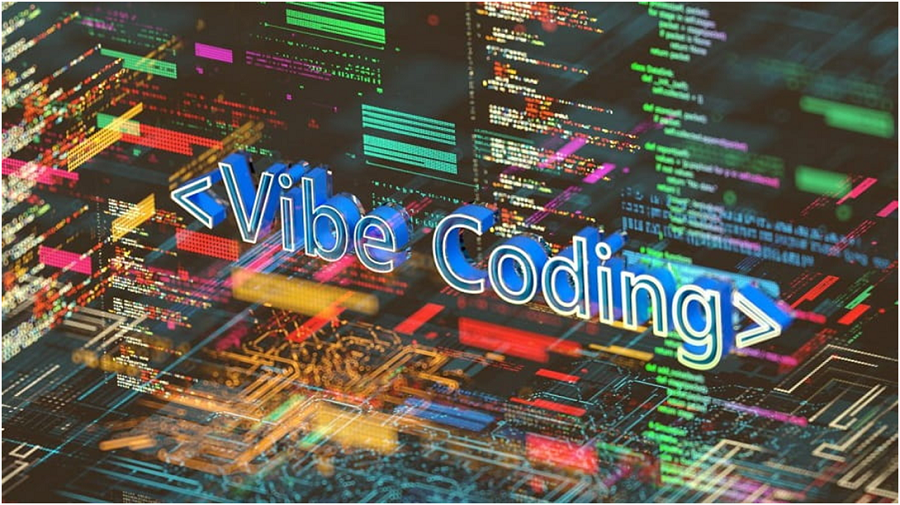
Vibe coding is a term that’s floating around that’s been performing the rounds in the engineering world and would have sounded like a joke 5 years in the past. It’s a method of creating software in which a developer types out a description of what they need, then observes an AI model write the code, executes it and guides the results towards something that actually works, mostly by trial and error and experimentation rather than manually coding each and every line.
AI researcher Andrej Karpathy popularized the term, to reflect an actual change in the way many programmers work these days: less code typing and more talking to a model and listening to it. It began as a jest about coding style and now it’s a turning point in the making of software. It’s important to realize why this is so when you consider what software development was like before. For many years the task was to write down a problem in the form of a set of unambiguous and exact instructions that a machine could follow.
Watched tutorials on how to program in languages, learnt the syntax, studied design patterns, and had to spend a tremendous amount of time on the mechanical aspects of the job: knowing which boilerplate to use, memorizing the syntax of repetitive functions, finding the missing semicolon, re-reading the documentation to remember the exact name of a function in a library call. Some of the criteria for determining skill were the ability to write correct and idiomatic code from scratch. In the case of Vibe coding, it’s the opposite. The developer is no longer an author but an editor: one who generates syntax is no longer the one directing intent, assessing results.
How We Got Here
———————
This change wasn’t made in a day. It has been developed over several years of continuous advancement of LLM technology, eventually resulting in tools that can remember the context of a large codebase, learn a project’s conventions and make changes across multiple files based on a single prompt.
The first AI coding assistants provided code autocomplete or completion of a line or a function, depending on pattern matching. This was helpful but doesn’t go far enough. Models that can reason about a job over a more comprehensive range and agentic tools that can read a repository, plan a series of changes, write them, run tests then repeat if something fails would change the game. As AI was able to do more of this, the role shifted from coding to specifying desired results and monitoring the process leading to the results.
Rethinking Planning and Design
It has had an impact on software development lifecycle at almost every stage. Planning and designing can involve ideas that were previously days to prototype and now it can be sketched out in an afternoon. A product manager or designer with a ballpark idea might be able to explain a feature and view a working prototype of it before the meeting that it would normally be discussed on a whiteboard. This is because it reduces the back-and-forth from concept to something tangible and alters the way teams validate concepts. They can go so far as to build the thing and see how it feels rather than debating hypothetically.
Vibe Coding Market
In looking into the direction of this tendency, I came across one very striking projection that provides a sense of the size of this change from perspective. According to a report by Roots Analysis the global vibe-coding market is expected to increase from USD 2.96 billion in 2025 to USD 325 billion by 2040, at a compound annual growth rate (CAGR) of 36.79% for the forecast period of 2025-2040.
That’s a growth curve that goes beyond being merely interested in a new development style. It feels that this conversational coding process will be more common in the future than it is today, and will be adopted by companies, not just by coding enthusiasts or early adopters. It’s a clear example that marketers and tech people should engage with the vibe-coding norm and best practices before they solidify to avoid the possibility of it becoming a forgettable flash in the pan.
Implementation: Speed With a Catch
When it comes to implementation, the most significant difference is the speed but not just that. The entire categories of such “dull” work that used to require a lot of time like writing test scaffolding, converting data formats, writing repetitive CRUD actions, or migrating the code between different frameworks can be performed in a few seconds by using a good prompt and a review pass. It is important to note that this isn’t an indictment of deep understanding of the technical aspects.
The most useful of these tools might be the ones that the developers who already know how to work with systems know enough to know when the code they are generating is slightly off, inefficient or not the best architectural choice. The problem with coding in VIBE with no underlying knowledge is that it will work until it doesn’t, and no one involved will know why.
Testing and Quality Assurance in the AI Era
Testing and quality assurance are not only being transformed but are also being overhauled. AI tools are now capable of creating test cases, simulating edge cases and even creating tests which simulate expected behavior from a description of it. Some teams are using AI to review AI, e.g., one team writes some code, another team reviews it and comments on it, and a human doesn’t look at the pull request until later.
This has made it much quicker for products to be released, but it’s also added to another level of risk. “Plausible” code and code that passes superficial tests can be bugs that no one on the team really grasps, since no one wrote it in the “traditional” sense. This has resulted in a renewed focus on code review discipline because, as the old saying goes, “if a man wrote it, he knows it. This has brought back the focus on code review discipline as the old truism “if a man wrote it, he knows it” no longer holds true.
The Maintenance Problem
Perhaps the most interesting open question is with regard to maintenance and long-term ownership. Easily generated software isn’t necessarily easily maintained. AI-powered code can be quickly generated with an iterative process, and this may result in substandard coding patterns, redundancies, or even decisions being made for the architecture without being intentional or deliberate.
The role of curator is becoming more prevalent and is being assumed by experienced engineers who are getting involved in the process of structuring and imposing standards on output produced by AI, ensuring it remains coherent as it develops. This has led to new practices, such as creating detailed specification documents before writing any code; having very strict style guides that AI tools are told to follow; and always having to pass a human a tweet, architecture and security review, as well as a set of typos.
What This Means for Developers
None of these are indications that traditional programming skills are not needed anymore. But I think the ones benefiting the most from AI to create something are the ones who can still fluently read code, think about system design and understand when a pretty design is actually a real problem.
The only change that has occurred is that people’s focus has shifted. Less is invested in the mechanical process of creating syntax and more invested in judgment; in deciding what to construct and in verifying that what is constructed is correct, and in shaping the structure of a system over time. Vibe coding, in this respect, isn’t actually concerning the replacement of developers. It’s about redefining developer’s role and this redefinition is still ongoing.